Key takeaways
- Radiation therapy starts damaging cancer cells during treatment, but most cells do not die immediately.
- Radiation works mainly by damaging cancer-cell DNA, making it difficult or impossible for the cells to continue dividing.
- Cancer cells can continue dying for weeks or months after radiation therapy ends, particularly when damaged cells later attempt to divide.
- Tumors do not always shrink right away. Treatment-related inflammation, swelling, and tissue changes can temporarily affect how a tumor looks on scans.
- An early scan showing little shrinkage does not necessarily mean radiation therapy has failed. Response to radiation often needs to be evaluated over time.
Radiation therapy is one of the most widely used treatments for cancer, but its effects are often misunderstood. Unlike surgery, where a tumor may be physically removed during a procedure, radiation therapy works at the cellular level. The radiation is delivered within minutes, but the biological response develops over time.
So, when does radiation therapy start working, and how does it actually kill cancer cells? Radiation primarily works by damaging DNA and disrupting a cancer cell’s ability to continue dividing. Some cells die relatively soon after treatment, while others remain present for days or weeks before they eventually lose their ability to reproduce. This is why a tumor may continue shrinking long after a course of radiation therapy has finished.
Understanding this timeline can also help explain why doctors do not always expect an immediate change on a scan and why an early scan does not necessarily show the full effect of treatment.
Does Radiation Therapy Kill Cancer Cells Right Away?
Radiation therapy starts affecting cancer cells when radiation is delivered, but it does not usually kill every targeted cancer cell immediately. Instead, radiation causes biological damage that can determine what happens to a cancer cell the next time it attempts to grow and divide.
One of the main targets is DNA. Radiation can damage DNA directly or indirectly through the production of reactive oxygen species, which are highly reactive molecules formed when radiation interacts with water and other molecules within cells. If enough damage accumulates, the cancer cell may no longer be able to reproduce successfully.
This means there is an important difference between radiation being delivered and a cancer cell actually dying. Some cells may die during treatment, while others survive temporarily but have lost their ability to produce viable daughter cells. They may die later when they attempt to divide. As a result, tumor cell death can continue for days, weeks, and in some circumstances months after radiation therapy has ended.
How quickly this happens varies according to the type of cancer, radiation dose and fractionation, tumor biology, oxygenation, and the ability of individual cancer cells to repair radiation-induced DNA damage (Baskar et al., 2012; Chen et al., 2022; Wu et al., 2023).
How Does Radiation Therapy Kill Cancer Cells?
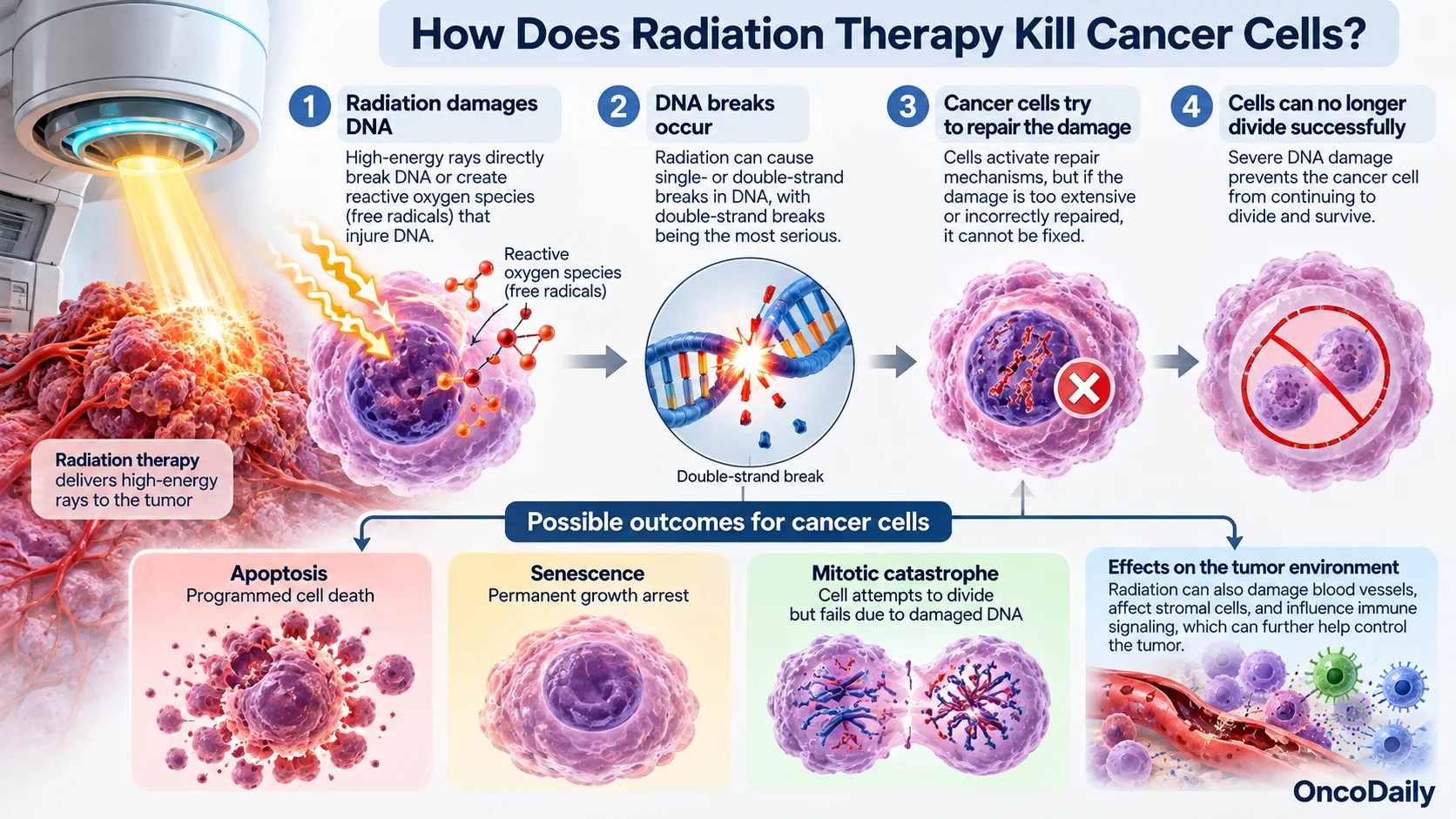
Radiation therapy works primarily by causing DNA damage that interferes with a cancer cell’s ability to reproduce. One particularly important form of injury is a DNA double-strand break, in which both strands of the DNA molecule are broken. Double-strand breaks are among the most biologically important forms of radiation-induced DNA damage because they can be difficult for a cell to repair correctly.
Cells have sophisticated systems for detecting and repairing DNA damage, so radiation exposure does not automatically mean that a cell will die. Cancer cells may successfully repair some injuries. However, when the damage is too extensive, incorrectly repaired, or overwhelms these repair mechanisms, the cell may lose its ability to continue dividing.
Several outcomes are possible. Some cancer cells undergo apoptosis, a regulated form of cell death. Others enter senescence, a state in which they remain metabolically active but permanently lose their ability to divide. Another important response is mitotic catastrophe. In this situation, a severely damaged cell attempts to divide but cannot correctly complete the process because of extensive chromosomal damage.
Radiation can also affect other parts of the tumor environment, including blood vessels, stromal cells, and immune signaling. The contribution of these effects varies between tumors and treatment approaches, but radiation-induced DNA damage and the resulting loss of a cancer cell’s reproductive capacity remain central to how radiotherapy achieves tumor control (Huang and Zhou, 2020; Chen et al., 2022; Jiao et al., 2022; Wu et al., 2023).
Why Do Cancer Cells Keep Dying After Radiation Therapy Ends?
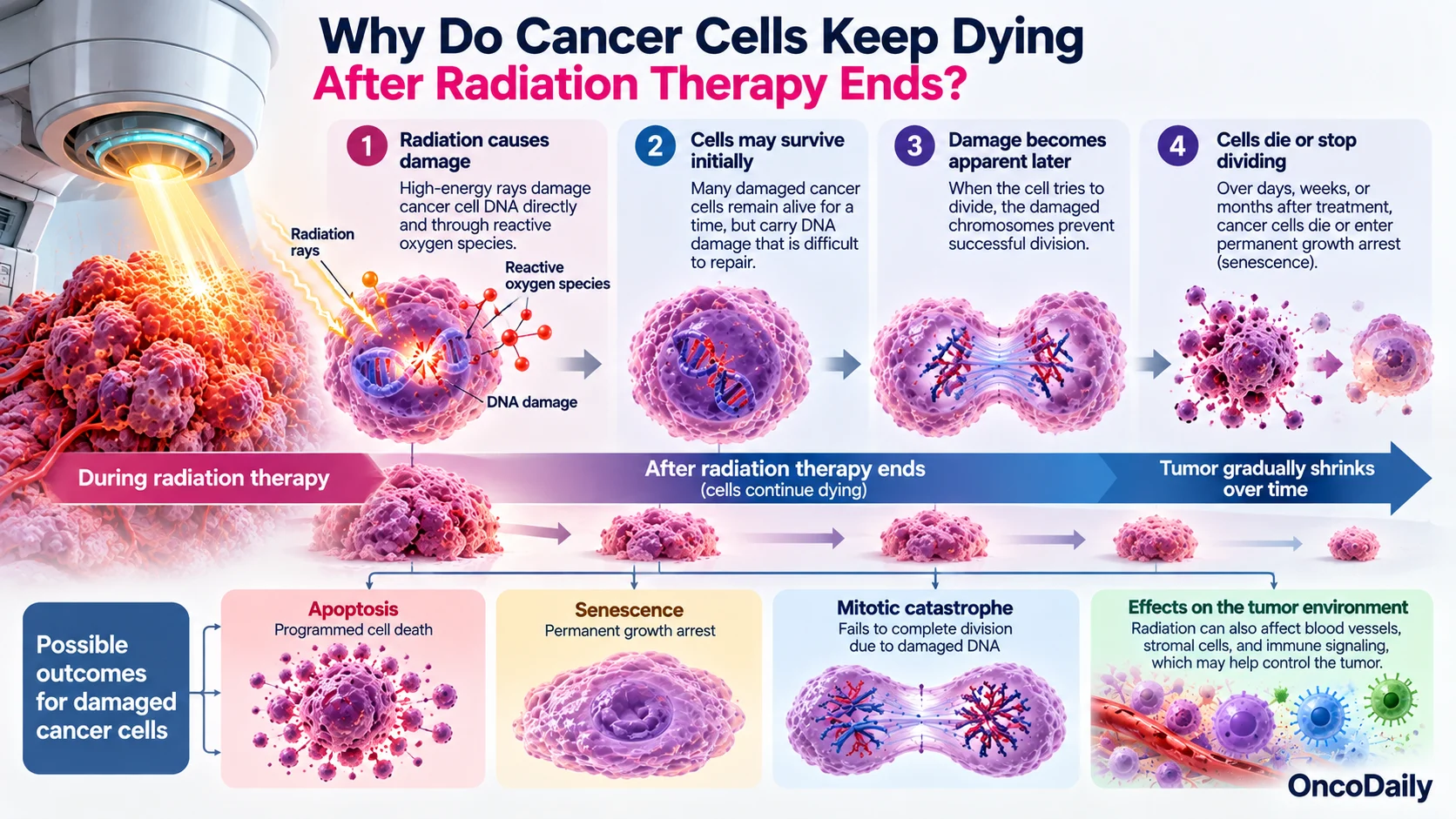
For most forms of external beam radiation therapy, the radiation does not remain in the patient’s body after a treatment session. However, the biological damage produced by that radiation remains.
A cancer cell with radiation-damaged DNA may initially survive and continue functioning. The consequences of that damage can become apparent only later, particularly when the cell attempts to reproduce. If its chromosomes have been damaged beyond successful repair, cell division may fail. This delayed loss of reproductive ability is one reason the antitumor effects of radiation can continue even though no additional radiation is being delivered.
Not every cancer cell responds in exactly the same way. Some undergo apoptosis, some lose their ability to survive following unsuccessful cell division, and others enter long-term senescence. The balance between these responses depends on factors such as the type of cancer, radiation dose, cell-cycle characteristics, and molecular pathways involved in DNA damage and repair.
This delayed biological response helps explain why a tumor may continue to change or shrink after radiation therapy has finished. Radiation can also alter the tumor microenvironment and influence immune signaling, although the importance of these effects varies between tumor types and remains an active area of research (Chen et al., 2022; Jiao et al., 2022).
How Long Does It Take for a Tumor to Shrink After Radiation Therapy?
There is no single timeline for tumor shrinkage after radiation therapy. Some tumors respond relatively quickly, while others change gradually over several months. Importantly, successful radiation treatment does not always result in immediate or dramatic shrinkage.
The timing depends on several factors, including the type of cancer, how rapidly its cells divide, the size and location of the tumor, the radiation dose and treatment schedule, and whether radiation is being combined with other treatments.
What appears on a scan can also be more complicated than simply “smaller means treatment worked.” Radiation affects both the tumor and the surrounding normal tissues. Inflammation, swelling, and tissue repair can temporarily make a treated area look unchanged or even larger. Later, fibrosis and other post-radiation changes can further alter its appearance.
These changes can be particularly important after highly focused treatments such as stereotactic body radiation therapy (SBRT) and stereotactic radiosurgery (SRS). For example, after liver SBRT, changes in tumor size or enhancement may take months to appear, while radiation-related changes in the surrounding liver can complicate interpretation. Similar challenges occur when evaluating the central nervous system after radiation therapy.
For this reason, doctors usually evaluate the pattern of change over time rather than interpreting one early scan in isolation. A tumor that remains stable may also represent a successful treatment response if it has stopped growing. Depending on the cancer, changes in metabolic activity or other characteristics may also provide information before substantial tumor shrinkage becomes visible (Katsura et al., 2021; Navin et al., 2022; Alcantara et al., 2020).
How Do Doctors Know if Radiation Therapy Is Working?
Doctors do not rely on a single test to determine whether radiation therapy is working. Instead, they combine information from imaging, physical examinations, symptoms, and, when appropriate, laboratory tests and tumor markers.
CT and MRI are commonly used to evaluate changes in the treated tumor and surrounding tissues. PET-CT can provide additional information in selected cancers by showing metabolic activity rather than tumor size alone. However, PET findings also need to be interpreted carefully because inflammation caused by radiation can temporarily produce increased metabolic activity.
The timing of follow-up imaging therefore matters. Scanning too early can capture inflammation, swelling, and other treatment-related effects rather than the tumor’s eventual response. There is no universal waiting period that applies to every cancer. The appropriate timing depends on the tumor type, location, treatment technique, radiation dose, and clinical situation.
For some cancers, blood tests can provide additional information. PSA, for example, is routinely followed after radiation therapy for prostate cancer, while other tumor markers may be useful in specific diseases. These measurements are interpreted alongside imaging findings and the patient’s overall clinical course rather than being used alone to determine whether treatment has worked.
The definition of a successful response also depends on the purpose of treatment. When radiation is given with curative or definitive intent, doctors may look for disappearance, shrinkage, or long-term control of the treated tumor. When radiation is given with palliative intent, improvement in symptoms such as pain, bleeding, obstruction, or pressure may itself represent an important treatment response.
Ultimately, response to radiation therapy is a process rather than a single moment. The radiation dose is delivered during treatment, but its biological consequences continue afterward. This is why a tumor that has not disappeared or substantially shrunk on an early scan should not automatically be considered resistant to treatment. Response must be assessed over time and in the context of the specific cancer and radiation treatment received (Alcantara et al., 2020; Katsura et al., 2021; Navin et al., 2022).
FAQ
How quickly does radiation therapy start working?
Radiation begins damaging cancer-cell DNA during treatment, but the full effect takes time. Many damaged cancer cells die later when they attempt to divide, so the tumor may continue responding for weeks or months.
Does a tumor shrink during radiation therapy?
Some tumors may begin shrinking during treatment, while others show little immediate change. The timing depends on the cancer type, tumor biology, radiation dose, and treatment approach.
Does radiation keep working after the last treatment?
Yes. Although external beam radiation does not remain in the body, the DNA damage it causes can continue preventing cancer cells from successfully dividing after treatment has ended.
Does no tumor shrinkage mean radiation therapy did not work?
Not necessarily. A tumor may remain stable, shrink slowly, or temporarily appear larger because of inflammation and other treatment-related changes. Doctors usually evaluate response over time rather than relying on one early scan.
How do doctors know if radiation therapy has worked?
Doctors may use CT, MRI, or PET-CT scans, along with physical examinations, changes in symptoms, and certain tumor markers when appropriate. The best method and timing depend on the type of cancer and the purpose of radiation therapy.