Key takeaways
- Proton and photon therapy can both effectively treat cancer.
- Proton therapy may reduce radiation exposure to nearby healthy tissues.
- The potential benefit is greatest near sensitive organs and in younger patients.
- Proton therapy does not always cause fewer side effects or improve cancer control.
- The best treatment depends on the cancer type, tumor location, and individual radiation plan.
Proton therapy and photon therapy are both forms of radiation treatment used to destroy cancer cells, but they deliver radiation through the body in different ways. Photon therapy remains the most widely used form of external-beam radiation, while proton therapy offers a different physical dose distribution that can reduce radiation exposure to some surrounding healthy tissues.
For certain patients, particularly when a tumor is close to sensitive organs or long-term radiation exposure is an important concern, this difference may influence treatment planning. However, proton therapy is not automatically more effective or appropriate for every cancer. The best approach depends on the tumor location, treatment goals, surrounding organs, and the individual radiation plan.
What Is Proton Therapy?
Proton therapy, also known as proton beam therapy, is a type of external-beam radiation therapy that uses positively charged particles called protons to treat cancer. Like other forms of radiation therapy, it works primarily by damaging the DNA of cancer cells, reducing their ability to continue growing and dividing.
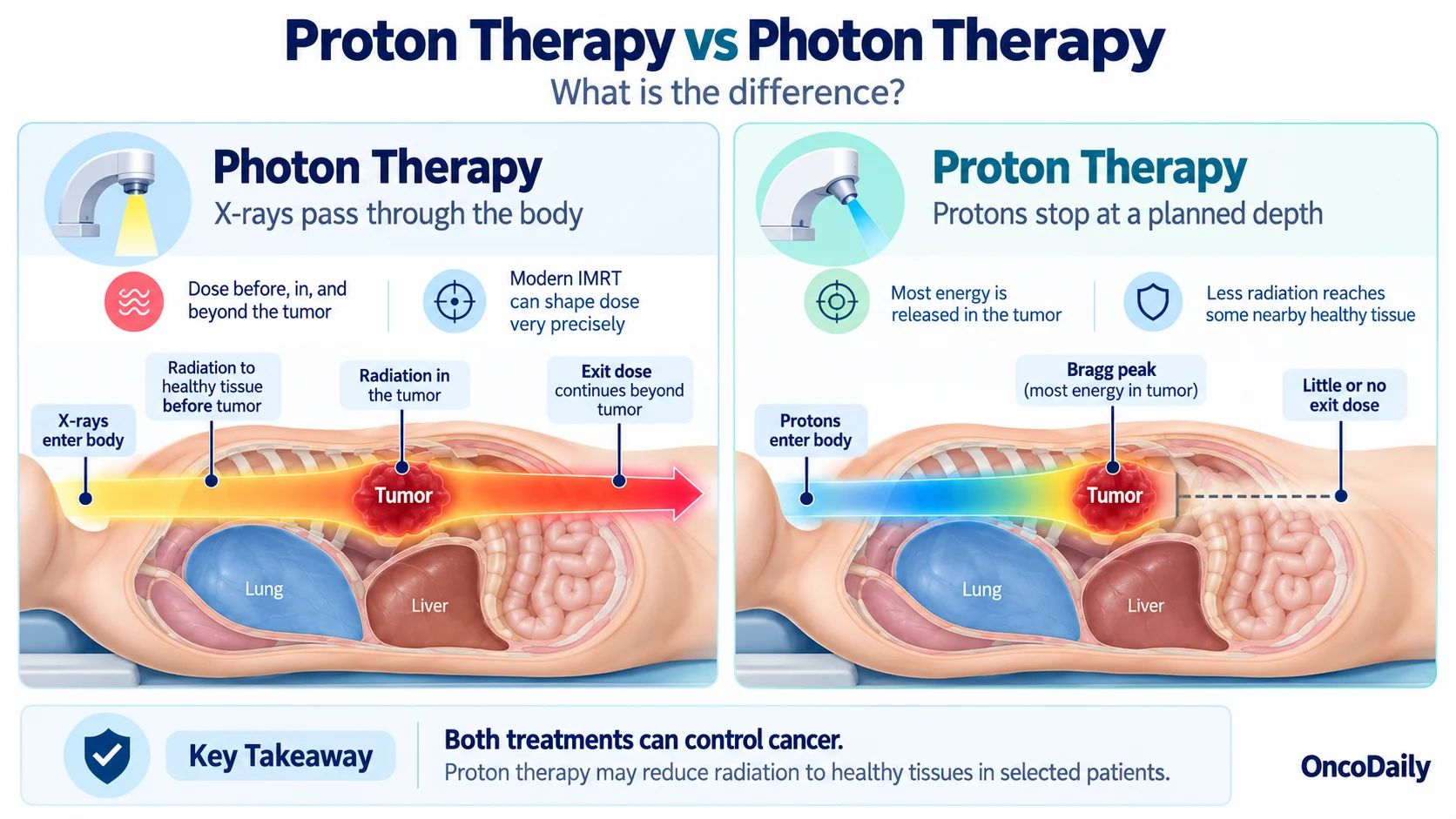
What makes proton therapy different is the way protons release their energy inside the body. Protons deposit relatively little radiation as they enter the body and release most of their energy near a specific depth known as the Bragg peak. Beyond this point, the radiation dose falls rapidly. This allows radiation oncologists to reduce the amount of radiation delivered beyond the tumor compared with conventional photon treatment (Mohan and Grosshans, 2017; Durante et al., 2017).
This physical property can be particularly useful when a tumor is close to sensitive organs or when limiting radiation to normal tissues is an important part of the treatment plan. However, the clinical advantage varies depending on the individual cancer and treatment situation.
What Is Photon Therapy?
Photon therapy uses high-energy X-rays, or photons, to damage cancer-cell DNA. It is the most commonly used form of external-beam radiation therapy and has been studied extensively across almost every major cancer type.
Unlike protons, photons do not stop at a specific depth. They deposit radiation as they enter the body, deliver dose to the tumor, and continue to deposit some radiation as they pass beyond it. Modern treatment techniques, particularly intensity-modulated radiation therapy (IMRT), can shape and adjust photon beams very precisely to concentrate radiation within the tumor while limiting exposure to surrounding tissues.
Photon therapy therefore remains a highly effective standard treatment for many cancers. Its widespread availability, extensive clinical evidence, and increasingly precise treatment-planning techniques mean that it may provide excellent tumor control with acceptable side effects for many patients (Mohan and Grosshans, 2017; Durante et al., 2017).
Proton Therapy vs Photon Therapy: What Is the Difference?
The main difference between proton and photon therapy is how the radiation dose travels through the body.
Photon beams continue beyond the tumor, so some radiation is delivered to tissues in front of and behind the treatment target. Modern techniques such as IMRT can minimize this exposure considerably, but they cannot completely eliminate it.
Proton beams have a finite range. Their energy can be selected so that most of the radiation dose is deposited within the treatment target before the dose falls rapidly. This can reduce the total amount of radiation received by certain healthy tissues and organs (Mohan and Grosshans, 2017; Ma et al., 2026).
However, this does not mean that proton therapy is inherently better at killing cancer. When an appropriate radiation dose is delivered, both approaches can provide effective tumor control. For many cancers, the potential advantage of proton therapy is mainly reducing normal-tissue exposure and treatment-related toxicity, rather than increasing the ability to destroy the tumor itself.
Comparative clinical evidence remains limited for many cancer types, so the choice between proton and photon therapy should be based on the expected benefit for the individual patient rather than on one technique being universally superior (Ma et al., 2026).
Which Cancers Can Be Treated With Proton Therapy?
Proton therapy can be used for a variety of solid tumors, although its role is better established in some situations than others.
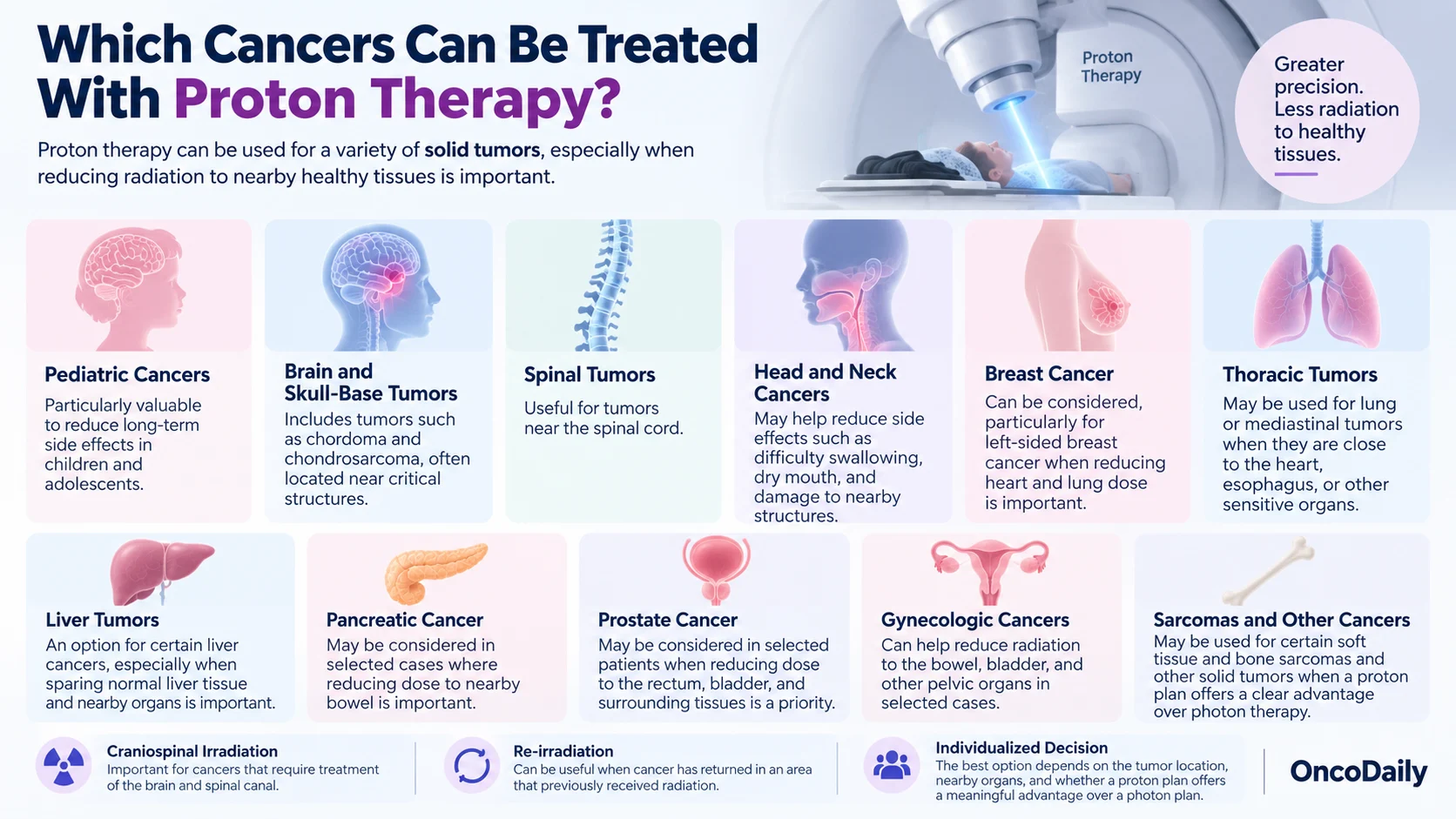
Important uses include pediatric cancers, certain skull-base tumors such as chordoma and chondrosarcoma, selected brain and spinal tumors, and cancers requiring treatment close to sensitive structures. Proton therapy is also frequently considered when craniospinal irradiation is needed because reducing unnecessary radiation exposure outside the brain and spinal canal can be particularly valuable (ACR-ARS Practice Parameter, 2024; Conde-Moreno et al., 2026).
It may also be considered for selected head and neck cancers, uveal melanoma, breast cancer, thoracic tumors, prostate cancer, liver tumors, sarcomas, and other cancers when treatment planning shows a meaningful advantage over photon therapy.
Another important use is re-irradiation, when cancer has returned in an area that previously received radiation. In these situations, reducing additional radiation to normal tissues that have already been exposed can be especially important (Conde-Moreno et al., 2026).
The fact that proton therapy can be used for a particular cancer does not necessarily mean it is the preferred treatment. Radiation oncologists consider whether a proton plan meaningfully improves the distribution of radiation compared with a high-quality photon plan.
Does Proton Therapy Cause Fewer Side Effects Than Photon Therapy?
Proton therapy can reduce some side effects because it may expose less healthy tissue to radiation. The potential advantage is greatest when important organs are located close to the tumor or when the long-term consequences of radiation exposure are an important concern.
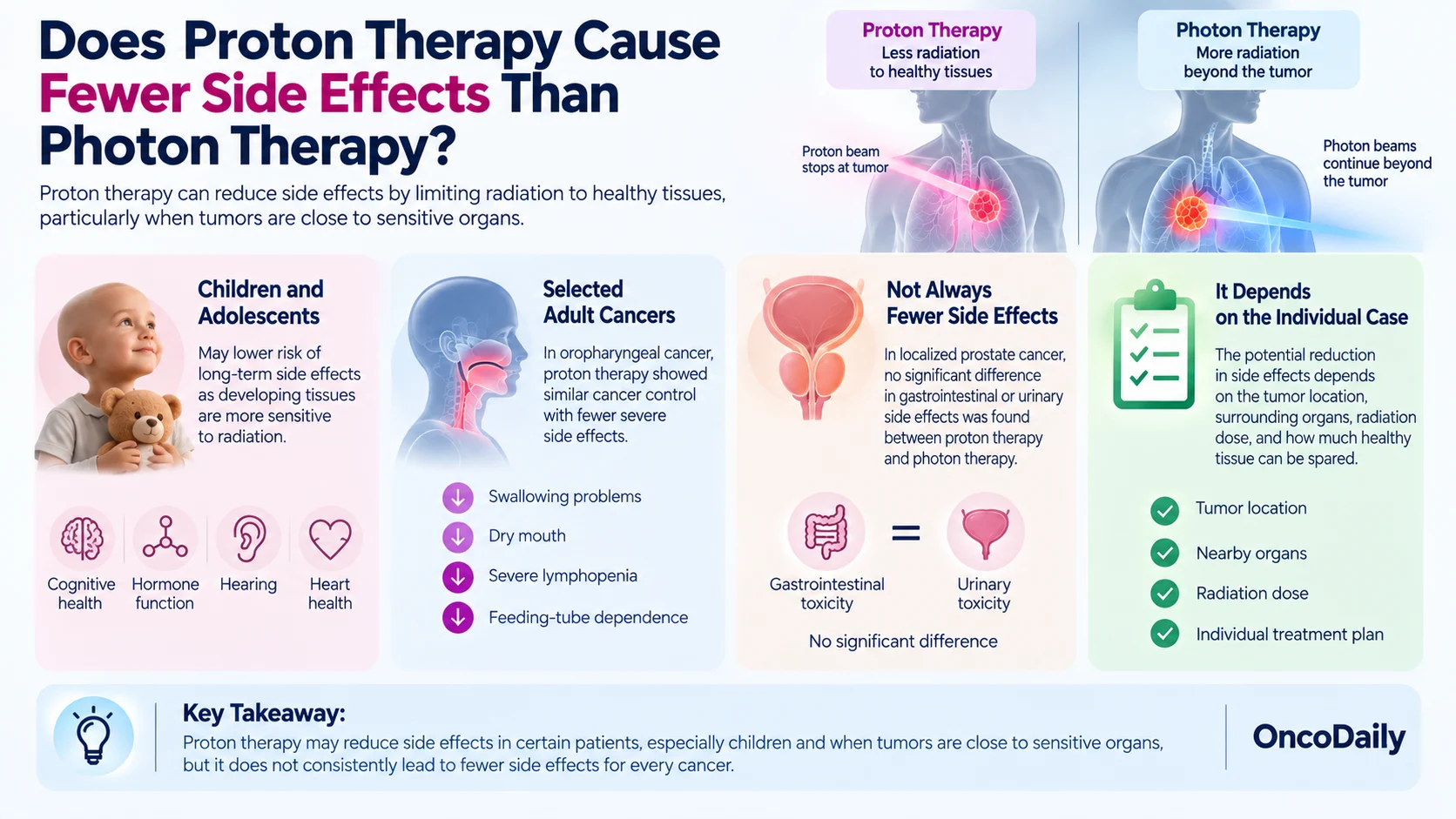
This is particularly relevant in children and adolescents, whose developing tissues may be more sensitive to radiation and who may live for many decades after treatment. Reducing unnecessary radiation may help lower the risk of some late effects involving cognition, hormone function, hearing, cardiovascular health, and second cancers, although proton therapy itself can still cause both short- and long-term side effects (Indelicato et al., 2016; Zając-Grabiec et al., 2025).
Evidence is also becoming stronger in selected adult cancers. A randomized phase III trial in patients with oropharyngeal cancer found that intensity-modulated proton therapy achieved similar disease control to photon IMRT while reducing several high-grade treatment-related toxicities, including swallowing problems, dry mouth, severe lymphopenia, and feeding-tube dependence (Frank et al., 2026).
However, fewer side effects are not seen consistently in every cancer. In localized prostate cancer, for example, comparative research has not shown a significant difference in gastrointestinal or urinary toxicity between proton therapy and modern photon IMRT (Yu et al., 2024).
The potential reduction in side effects therefore depends on the tumor location, surrounding organs, radiation dose, and how much healthy tissue can actually be spared in an individual treatment plan.
Who May Benefit Most From Proton Therapy?
Proton therapy may provide the greatest benefit when reducing radiation to healthy tissue could make a meaningful difference to treatment safety or long-term quality of life.
Children and adolescents are an important group because limiting radiation to developing tissues may reduce the risk of long-term complications. Patients with tumors directly beside sensitive structures such as the brainstem, spinal cord, optic structures, heart, or other critical organs may also benefit when a proton plan can substantially reduce the radiation these tissues receive (Indelicato et al., 2016; ACR-ARS Practice Parameter, 2024).
Patients requiring craniospinal irradiation or re-irradiation may also be good candidates. In these situations, the ability to reduce radiation outside the intended target or limit additional exposure to previously treated tissues can be particularly useful (Conde-Moreno et al., 2026).
For many adult cancers, patient selection depends on comparing the actual proton and photon treatment plans. If both approaches provide similar protection to healthy tissue, proton therapy may offer little additional clinical benefit. If the proton plan substantially lowers radiation to an important organ, however, that difference may support its use.
proton therapy
What Are the Limitations of Proton Therapy?
Proton therapy has important advantages, but it also has limitations. One of the main practical challenges is availability and cost. Proton therapy requires highly specialized equipment and infrastructure, so treatment centers are considerably less common than conventional photon radiation facilities.
There are also technical challenges. Because protons stop at a planned depth, treatment can be more sensitive to changes in the patient’s position and internal anatomy. Weight loss, changes in tumor size, differences in organ filling, and breathing motion can affect how protons travel through the body. Tumors that move with breathing, such as those in the lung or liver, may therefore require specialized motion-management techniques, robust treatment planning, and sometimes adaptation during the course of treatment (Liang et al., 2026).
Another limitation is the strength of the clinical evidence. Proton therapy often provides a better dosimetric result, meaning less radiation reaches selected healthy tissues. However, this does not automatically translate into better tumor control, longer survival, or fewer side effects for every cancer.
Recent evidence reviews have found that comparative evidence remains low or very low certainty for many adult cancer indications, with relatively few high-quality randomized trials directly comparing proton and modern photon therapy (Moltó-Puigmartí et al., 2026; Ma et al., 2026).
For this reason, proton therapy is generally most valuable when the treatment plan shows a clear and clinically meaningful advantage over modern photon therapy. The decision should be individualized rather than based simply on proton therapy being a newer technology.
FAQ
Is proton therapy better than photon therapy?
Not always. Proton therapy may reduce radiation to nearby healthy tissues, but both treatments can be effective. The best option depends on the cancer type, tumor location, and individual treatment plan.
Does proton therapy cause fewer side effects?
It can in some patients, especially when the tumor is close to sensitive organs or in children. However, fewer side effects are not guaranteed for every cancer.
Which cancers are most commonly treated with proton therapy?
Proton therapy is often considered for pediatric cancers, skull-base and spinal tumors, some brain and head and neck cancers, selected breast and thoracic cancers, and certain re-irradiation cases.
Is proton therapy more effective at killing cancer than photon therapy?
Usually not simply because it uses protons. For many cancers, both can provide similar tumor control. The main advantage of proton therapy is often better normal-tissue sparing.
How do doctors decide between proton and photon therapy?
Radiation oncologists compare treatment plans and consider the tumor location, nearby organs, expected side effects, treatment goals, and whether proton therapy offers a meaningful advantage.