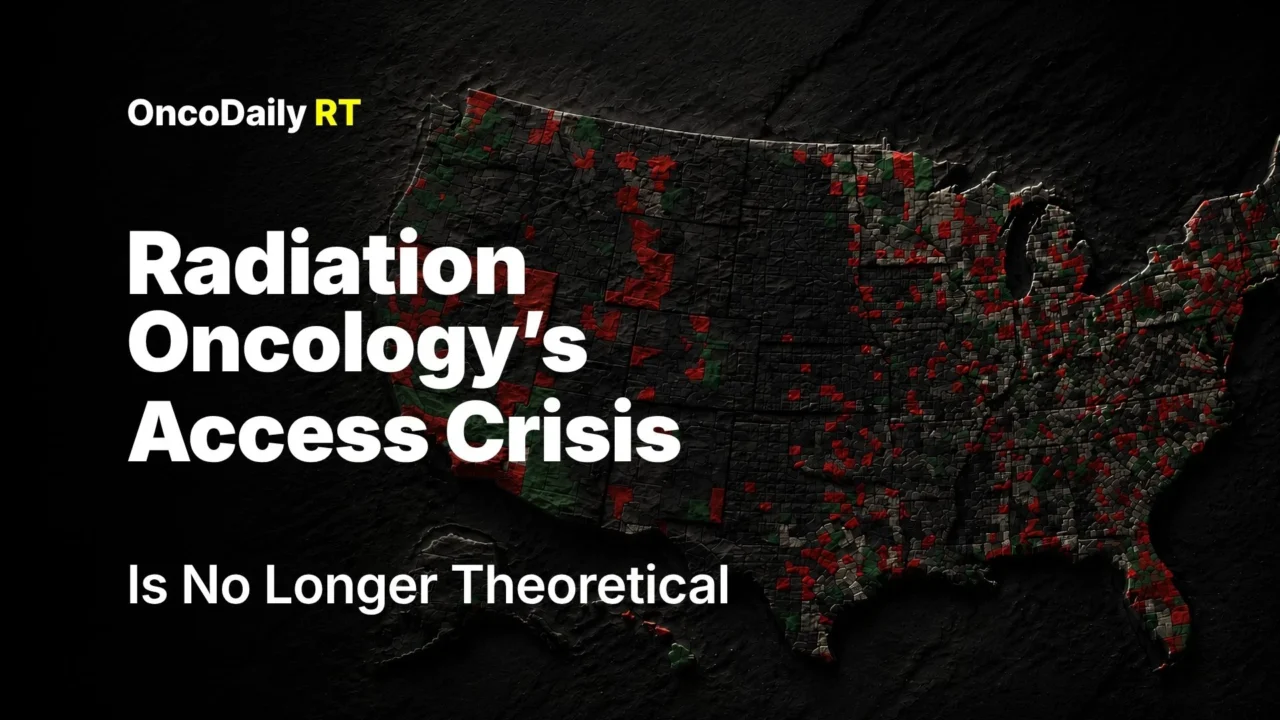
For years, warnings about the fragility of the radiation oncology infrastructure in the United States were often treated as projections of what might happen in the future. A national study by Catherine Yu and colleagues now makes one conclusion increasingly difficult to ignore: the crisis is already unfolding.
Published in the International Journal of Radiation Oncology, Biology, Physics, the study examined radiation oncology practice sites across the United States between 2018 and 2025. Its findings reveal a delivery system that may appear stable at the national level but is experiencing substantial geographic and organizational instability beneath the surface.
Stability on Paper, Disappearance on the Ground
At first glance, national radiation oncology practice-site numbers appear relatively stable. Between 2018 and 2025, the total number of sites fluctuated within a narrow range, creating the impression that treatment capacity had been largely preserved.
That apparent stability, however, masks relentless turnover.
The study found that freestanding radiation oncology sites had 56% higher odds of disappearance than hospital-affiliated facilities. Sites located in rural counties faced 44% higher odds of disappearance than those in urban areas.
These closures were not random. They were systematic, predictable, and concentrated among practices with fewer structural protections and communities with fewer alternatives.
The findings indicate that national site counts alone are an inadequate measure of access. A newly opened center in a well-served metropolitan market does not compensate for the disappearance of the only radiation oncology facility available to patients in a rural region.
When One Closure Means the Loss of an Entire Service
The consequences of a practice-site closure differ dramatically depending on where it occurs.
Urban counties that experienced a net loss of radiation oncology sites retained an average of 3.66 operating centers by 2025. Rural-adjacent counties retained only 0.43 sites, while rural-nonadjacent counties retained an average of just 0.28 sites.
In urban communities, the disappearance of one location may still leave patients with several treatment alternatives. In rural areas, the same event can eliminate local radiation therapy access entirely.
This distinction is critical because radiation therapy cannot easily be transferred to a virtual or remote model. Treatment often requires patients to travel to a facility every weekday for several weeks. Each visit depends on specialized equipment and the physical presence of radiation oncologists, medical physicists, radiation therapists, nurses, and other trained professionals.
When a local site disappears, patients may face hours of additional travel for every treatment session. For older adults, individuals with limited financial resources, patients unable to take extended time away from work, and those without reliable transportation, that burden may become impossible to overcome.
The result may be delayed treatment, missed appointments, treatment interruptions, or the selection of a different therapeutic approach based not on clinical appropriateness, but on geographic accessibility.
More Than 50 Million Americans Without Local Access
By 2025, 68.5% of all U.S. counties—2,154 of 3,144 counties—had no radiation oncology practice site.
Together, these counties were home to approximately 50.8 million people.
The study also found that counties without a radiation oncology site were systematically more socioeconomically disadvantaged than counties with at least one facility. They had higher poverty rates, higher rates of uninsurance among adults younger than 65 years, lower median household incomes, and fewer primary care physicians per 10,000 residents.
These findings demonstrate that the radiation oncology access crisis is not occurring in isolation. The communities losing access are frequently the same communities already experiencing broader shortages in healthcare resources.
Patients in these areas are therefore not simply being asked to travel farther for radiation therapy. They may also have fewer primary care providers, fewer specialists, lower insurance coverage, and less financial flexibility to absorb transportation, accommodation, childcare, or employment-related costs.
The disappearance of radiation oncology infrastructure risks deepening inequalities that are already embedded throughout the cancer care system.
A Crisis Concentrated Where Alternatives Are Scarce
The study found that 427 counties experienced a net loss of at least one radiation oncology practice site during the study period, while only 232 counties experienced net growth.
More than 70% of counties with net losses were located in the South and Midwest, regions that include a substantial number of rural communities.
Nearly seven million people lived in rural counties that experienced a reduction in local radiation oncology capacity. The geographic density of remaining treatment options was also dramatically lower in these communities.
Urban counties experiencing site loss retained an average of 10.20 radiation oncology sites per 1,000 square miles. Rural-adjacent counties retained only 0.64, while rural-nonadjacent counties retained 0.46 sites per 1,000 square miles.
These figures illustrate the practical consequences of site disappearance. A facility may technically remain within the same county or neighboring region, yet still require a patient to undertake a lengthy journey for every fraction of treatment.
For patients receiving daily radiation therapy, distance is not a minor inconvenience. It can become a decisive factor in whether treatment is initiated, completed, or declined.
The Most Disturbing Finding May Be the Timing
Perhaps the most concerning aspect of the study is that its data largely precede the major Medicare coding and reimbursement disruptions introduced on January 1, 2026.
The structural vulnerability identified by Yu and colleagues developed between 2018 and 2025—before the full impact of the latest reimbursement changes could be observed.
The 2026 changes restructured radiation treatment delivery and image-guidance codes, consolidated several established billing pathways, and altered the valuation of practice expenses under the Medicare Physician Fee Schedule.
Radiation oncology organizations have subsequently raised concerns that these changes may threaten the financial sustainability of freestanding and community-based practices.
If rural and freestanding sites were already significantly more likely to disappear before the latest payment disruption, the central question is no longer whether additional closures are possible. It is how rapidly existing pressures may accelerate the contraction of access.
Reimbursement Is Now an Access Issue
ebates over radiation oncology reimbursement are often framed as disputes over billing, practice economics, or payment methodology. The findings of this study demonstrate that the consequences extend far beyond institutional finances.
When reimbursement becomes insufficient to sustain a freestanding or rural treatment center, the result may be the loss of an essential cancer service for an entire community.
Radiation oncology facilities require substantial fixed investment. Linear accelerators are expensive to purchase, operate, and maintain. Practices must also support highly specialized multidisciplinary teams, regulatory compliance, quality assurance, treatment planning systems, and safety infrastructure.
Smaller facilities and rural practices may have limited ability to absorb reimbursement reductions, administrative costs, staffing shortages, or fluctuations in patient volume. Unlike large hospital systems, they may not have access to broad financial reserves or multiple service lines capable of offsetting losses.
Protecting the viability of these centers is therefore not simply a matter of preserving individual businesses. It is a matter of maintaining access to one of the fundamental pillars of cancer treatment.
National Numbers Can No Longer Be Used as Reassurance
The study exposes the danger of relying on aggregate national statistics.
A stable total number of radiation oncology sites does not mean that access is stable. National counts can remain unchanged while treatment capacity moves away from vulnerable communities and becomes increasingly concentrated in metropolitan and hospital-affiliated systems.
The disappearance of one rural center and the opening of one additional urban location may appear neutral in a national dataset. For patients, however, the consequences are profoundly unequal.
One community gains another option. Another loses its only one.
Meaningful assessment of the radiation oncology delivery system must therefore account for geography, remaining local capacity, travel distance, socioeconomic vulnerability, and the availability of realistic alternatives.
A Wake-Up Call for Policymakers and Oncology Leaders
This study should serve as a wake-up call for policymakers, professional organizations, healthcare systems, payers, and every stakeholder involved in cancer care.
Policies designed to preserve radiation oncology access must recognize that rural and freestanding practices face distinct structural risks. Uniform reimbursement approaches may unintentionally destabilize the facilities that are most difficult to replace.
Payment models should account for clinical complexity, lower-volume service areas, geographic isolation, staffing requirements, and the essential role played by community-based centers.
Broader solutions may also require regional treatment networks, shared technical support, innovative staffing arrangements, partnerships between larger systems and rural facilities, transportation assistance, and temporary accommodation for patients who must travel.
Telehealth can support consultations, follow-up care, and multidisciplinary coordination, but it cannot replace the physical infrastructure required to deliver radiation therapy. Once a treatment site closes, rebuilding that capacity requires substantial capital, regulatory approval, specialized personnel, and time.
Prevention is therefore far more realistic than reconstruction.
The Window for Action Is Closing
The issue is no longer simply reimbursement or practice economics. It is whether the United States is willing to tolerate the gradual dismantling of equitable access to life-saving cancer care.
More than 50 million Americans already live in counties without a radiation oncology practice site. Rural communities that lose a facility are frequently left with little or no remaining local capacity. Freestanding centers—the very facilities that often provide community-level access—are disappearing at significantly higher rates than hospital-affiliated sites.
These are not theoretical warning signs. They are measurable indicators of a delivery system under strain.
Without meaningful policy intervention, today’s structural vulnerabilities may become tomorrow’s collapse.
Future generations may look back on this moment not as the beginning of the radiation oncology access crisis, but as the moment when the evidence became undeniable—and the opportunity to stop it was allowed to pass.
Written by Nare Hovhannisyan, MD
Stay informed with more articles like this on OncoDaily