
A 2026 systematic review and meta-analysis published in JAMA Oncology by Miszczyk et al. evaluated outcomes of local salvage therapies alone for patients with locally recurrent prostate cancer after definitive radiotherapy.
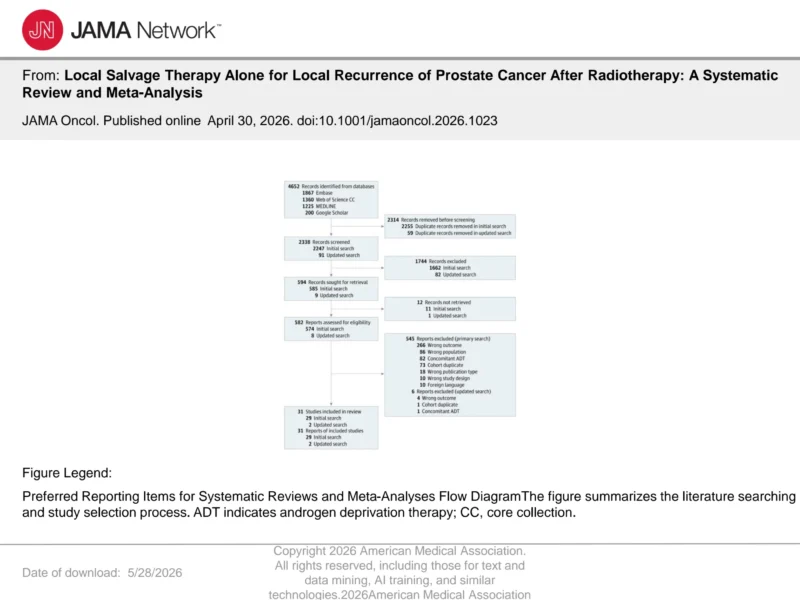
The analysis included 31 studies and 4,525 patients, assessing salvage high-dose-rate brachytherapy, low-dose-rate brachytherapy, SBRT, salvage radical prostatectomy, cryotherapy, HIFU, and mixed local treatment approaches. The study focused on whether local therapy alone could help patients avoid or delay androgen deprivation therapy while maintaining disease control.
Title: Local Salvage Therapy Alone for Local Recurrence of Prostate Cancer After Radiotherapy; A Systematic Review and Meta-Analysis
Year: 2026
Authors: Marcin Miszczyk, Federico Mastroleo, Anna Kujawska, Adam Gurwin, Giulia Marvaso, Tamás Kói, Giorgio Calleris, Marnix Rasing, Joseph Chin, Donald Fuller, Arjun Nathan, Max Peters, Jochem van der Voort van Zyp, Pocharapong Jenjitranant, George Hruby, Timo F. W. Soeterik, Giulio Francolini, Leonie Exterkate, Christiaan G. Overduin, Giancarlo Marra, Paolo Gontero, Ahmed R. Alfarhan, Paweł Rajwa, Amar U. Kishan, Barbara Alicja Jereczek-Fossa, Shahrokh F. Shariat
Study Design and Risk of Bias
The evidence base included both prospective and retrospective studies, reflecting the real-world nature of this clinical question. Sixteen studies, including 1,639 patients, were assessed as having a low risk of bias. The remaining 15 studies, including 2,886 patients, were considered to have a high risk of bias.
The main risk-of-bias concerns were related to patient selection. This is an important point because patients offered local salvage therapy are often selected carefully, usually based on disease extent, imaging findings, PSA kinetics, comorbidity profile, prior treatment, and expected life expectancy. As a result, comparisons between treatment methods should be interpreted cautiously. The study does not establish one local salvage approach as clearly superior to another, but it provides useful pooled estimates for clinicians discussing treatment options with patients.
ADT-Free Survival
Data on androgen deprivation therapy–free survival were available from 22 studies including 2,887 patients. Across all local salvage treatment methods, the pooled median ADT-free survival was 71.8 months. The pooled ADT-free survival rate was 76.8% at 2 years and 55.2% at 5 years.
These findings suggest that more than three-quarters of patients remained free from ADT at 2 years after local salvage therapy alone, and more than half remained ADT-free at 5 years. This is clinically meaningful for patients hoping to postpone systemic therapy and its associated adverse effects.
When outcomes were examined by treatment method, the 2-year ADT-free survival estimate was numerically highest with high-dose-rate brachytherapy at 84.6%, followed by low-dose-rate brachytherapy at 83.5%, cryotherapy at 79.0%, stereotactic body radiotherapy at 78.1%, high-intensity focused ultrasound at 71.9%, and salvage radical prostatectomy at 63.2%.
At 5 years, the highest numerical ADT-free survival estimate was observed with low-dose-rate brachytherapy at 67.8%. Other 5-year estimates were 60.9% with cryotherapy, 56.4% with high-dose-rate brachytherapy, 52.6% with stereotactic body radiotherapy, 48.0% with high-intensity focused ultrasound, and 39.7% with salvage radical prostatectomy.
Although these differences are notable, they should not be read as a ranking of treatments. The patient populations, study designs, follow-up durations, recurrence characteristics, imaging methods, and criteria for starting ADT differed across studies. Still, the data show that several local salvage approaches can keep a substantial proportion of patients off ADT for years.
Metastasis-Free Survival
Metastasis-free survival data were available from 24 studies including 3,425 patients. The pooled median metastasis-free survival was not reached, suggesting that many patients remained free from distant progression during follow-up.
The pooled metastasis-free survival rate was 90.4% at 2 years and 75.2% at 5 years. These results indicate that early metastatic progression was uncommon after local salvage therapy alone, with approximately nine in ten patients remaining metastasis-free at 2 years and about three in four remaining metastasis-free at 5 years.
At 2 years, metastasis-free survival was broadly similar across treatment methods. The estimate was numerically highest with high-intensity focused ultrasound at 92.7%, followed by low-dose-rate brachytherapy at 91.2%, high-dose-rate brachytherapy at 89.5%, stereotactic body radiotherapy at 89.1%, salvage radical prostatectomy at 88.7%, and cryotherapy at 86.8%.
At 5 years, metastasis-free survival was 84.5% with low-dose-rate brachytherapy, 78.9% with salvage radical prostatectomy, 78.6% with high-intensity focused ultrasound, 69.3% with cryotherapy, 69.2% with stereotactic body radiotherapy, and 68.6% with high-dose-rate brachytherapy.
The relatively preserved metastasis-free survival across modalities supports the idea that local salvage therapy can be an appropriate strategy for selected patients with localized recurrence. However, the analysis also reinforces the need for careful staging and risk assessment before choosing a local-only approach.
Clinical Interpretation
This study adds important evidence to a difficult area of prostate cancer management. After definitive radiotherapy, local recurrence can be challenging to treat. Systemic therapy is commonly used, but not every patient with radiorecurrent disease has aggressive systemic biology. Some patients may have disease that remains confined to the prostate or prostate bed for a prolonged period, making them potential candidates for local salvage treatment.
The results suggest that local salvage therapy alone can provide durable control in selected patients. The fact that 76.8% of patients remained ADT-free at 2 years and 55.2% remained ADT-free at 5 years is especially relevant for patient-centered decision-making. Avoiding or delaying ADT may matter greatly for patients who are concerned about quality of life, sexual function, energy levels, metabolic health, or long-term treatment burden.
The metastasis-free survival findings are also reassuring. With a pooled 2-year metastasis-free survival rate of 90.4%, the study suggests that early distant progression after local salvage therapy alone is not frequent in properly selected cohorts. At 5 years, the pooled metastasis-free survival rate of 75.2% shows that many patients can maintain disease control without immediate systemic therapy.
Why Patient Selection Matters
The findings should be interpreted in the context of careful patient selection. Local salvage therapy alone is not appropriate for every patient with recurrence after radiotherapy. Patients with rapidly rising PSA, short PSA doubling time, high-grade disease, early recurrence, suspicious nodal or distant disease, or substantial comorbidity may require a different approach.
Modern imaging, especially prostate-specific membrane antigen PET, may further refine selection by helping identify patients with truly localized recurrence. Biopsy confirmation, PSA kinetics, interval from prior radiotherapy, baseline urinary and bowel function, and patient preferences all remain important in treatment planning.
The study also highlights the limitations of the current evidence. There were no randomized clinical trials included, and many studies were retrospective. Treatment techniques, toxicity reporting, imaging methods, and criteria for starting ADT varied across studies. These factors limit direct comparisons between local salvage modalities and make it difficult to determine whether one approach is definitively better than another.
Takeaway
Miszczyk et al. provide evidence that local salvage therapy alone may be a reasonable option for carefully selected patients with locally recurrent prostate cancer after definitive radiotherapy. Across 31 studies and more than 4,500 patients, local salvage approaches were associated with meaningful ADT-free survival and metastasis-free survival.
The main message is not that every patient with radiorecurrent prostate cancer should avoid systemic therapy. Rather, the study supports a more individualized approach. For patients with localized recurrence, favorable disease features, and a strong preference to delay ADT, local salvage therapy alone may offer a clinically meaningful window of disease control without immediate systemic treatment.
Further prospective studies and randomized trials are still needed, but these results provide useful data for shared decision-making between clinicians and patients facing recurrence after prostate radiotherapy.
Read Full article here.