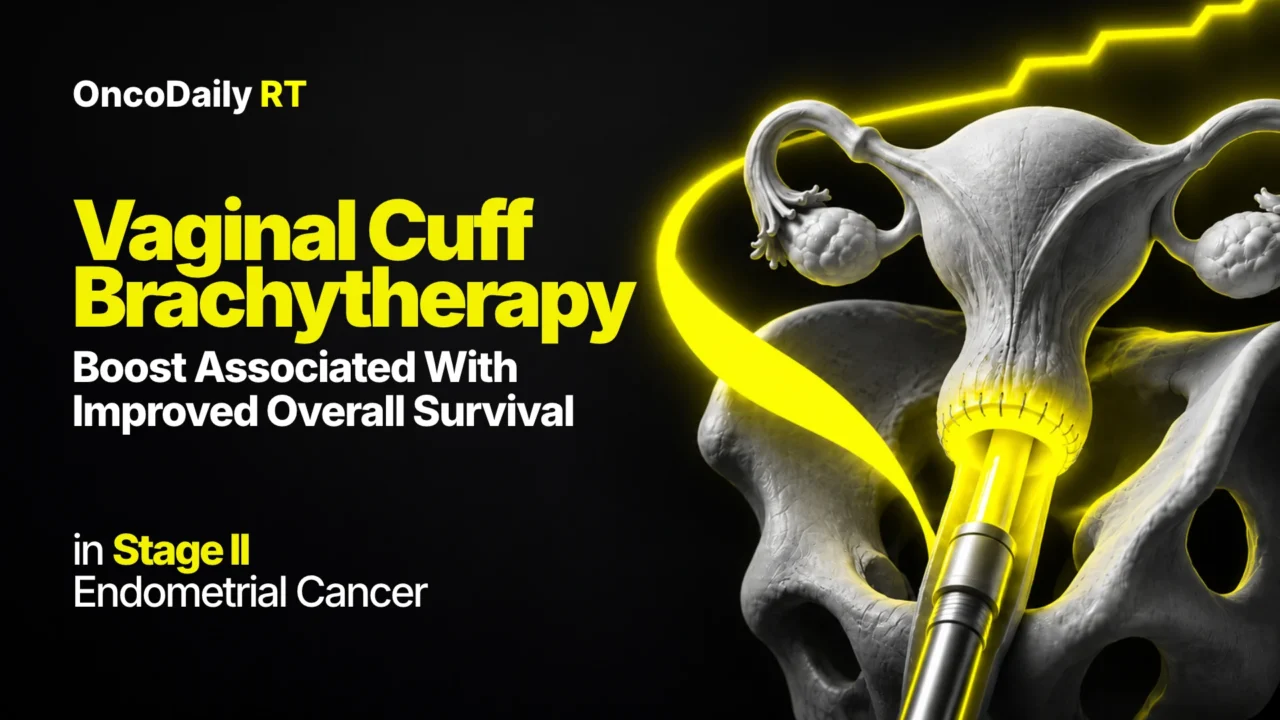
A new retrospective study published in Advances in Radiation Oncology in November 2026 has found that adding a vaginal cuff brachytherapy (VCB) boost to whole-pelvic radiotherapy is associated with significantly improved overall survival in patients with stage II endometrial cancer.
The study, titled “Improved Overall Survival Associated With Vaginal Cuff Brachytherapy Boost for Stage II Endometrioid Endometrial Cancer,” was conducted by Mariam Atobiloye, Jackson Howell, and colleagues from the University of Utah Huntsman Cancer Institute and collaborating institutions.
Analyzing data from 1,782 patients, the investigators found that combining whole-pelvic radiotherapy with vaginal cuff brachytherapy was associated with a lower risk of death than pelvic radiotherapy alone. This association remained statistically significant following multivariable adjustment and propensity score matching.
The findings raise an important question about postoperative management: could additional radiation directed to the vaginal cuff improve outcomes in patients with cervical stromal involvement?
Study Design and Patient Population
The researchers conducted a retrospective analysis using the National Cancer Database (NCDB), identifying patients diagnosed between 2010 and 2022 with FIGO 2009 stage II endometrioid endometrial cancer.
Eligible patients had undergone hysterectomy with surgical staging and had cervical stromal involvement without documented nodal or distant metastatic disease.
A total of 1,782 patients met the study’s eligibility criteria and were divided into two treatment groups:
- Whole-pelvic radiotherapy (WPRT) alone: 670 patients.
- WPRT plus vaginal cuff brachytherapy boost (WPRT + VCB): 1,112 patients.
Patients receiving chemotherapy, those with positive surgical margins, and those with incomplete pathological risk-factor information were excluded.
The median follow-up was 6.5 years.
The primary objective was to compare overall survival between treatment approaches. Investigators also evaluated patterns of care and factors associated with selection of brachytherapy.
To account for potential differences between treatment groups, the study incorporated multivariable Cox regression, propensity score matching, and a three-year landmark analysis.
Adding Vaginal Cuff Brachytherapy Is Associated With Improved Overall Survival
The study demonstrated a statistically significant association between the addition of vaginal cuff brachytherapy and improved overall survival.
In the full cohort, multivariable analysis showed that patients receiving WPRT + VCB had a 32% lower hazard of death compared with those treated with WPRT alone.
The adjusted hazard ratio was 0.68 (95% CI, 0.55–0.83; P<0.001).
The estimated three-year overall survival rates were:
- 91.7% with WPRT + VCB.
- 88.8% with WPRT alone.
This represented an absolute difference of 2.9 percentage points in favor of the combined approach.
The survival curves continued to separate during subsequent follow-up. Importantly, the association remained significant in a three-year landmark analysis, which was performed to reduce potential immortal time bias.
Among patients alive at the landmark, WPRT + VCB was associated with better subsequent survival (HR 0.70; 95% CI, 0.55–0.89; P=0.004). These findings suggest that the observed survival difference was not explained solely by early mortality or treatment-timing effects.
Survival Association Persists After Propensity Score Matching
To further address differences in baseline patient characteristics, the researchers performed a propensity score-matched analysis.
Patients were matched using demographic and pathological characteristics, including age, race, comorbidity burden, lymphovascular space invasion (LVSI), tumor grade, and peritoneal cytology.
Following matching, the survival association remained statistically significant.
The addition of vaginal cuff brachytherapy was associated with a 39% lower hazard of death compared with pelvic radiotherapy alone.
The adjusted hazard ratio was 0.61 (95% CI, 0.47–0.79; P<0.001).
A three-year landmark analysis within the matched population demonstrated a similar association (HR 0.59; 95% CI, 0.43–0.82; P=0.001).
The persistence of the association across different analytical methods strengthens the observational findings.
Nevertheless, propensity score matching can only adjust for measured variables and cannot eliminate the possibility of residual confounding.
Consequently, these results should not be interpreted as definitive proof that the brachytherapy boost itself caused the survival improvement.
How Might Vaginal Cuff Brachytherapy Improve Outcomes?
For patients with stage II endometrial cancer, cervical stromal invasion is an important risk factor for locoregional recurrence.
Whole-pelvic radiotherapy treats potential microscopic disease within the pelvis, while vaginal cuff brachytherapy delivers a concentrated additional radiation dose to the vaginal apex and adjacent tissues considered at risk for recurrence.
The investigators proposed that improved local control may explain the observed survival association.
By intensifying radiation to the vaginal cuff, brachytherapy may reduce the risk of local recurrence in selected patients whose disease is more likely to fail within the pelvis rather than at distant sites.
This hypothesis is particularly relevant to endometrioid histology, in which local control may play an important role in long-term disease outcomes.
However, the NCDB does not contain information on locoregional recurrence, distant progression, or progression-free survival.
Therefore, the study could not determine whether the survival association resulted from improved vaginal or pelvic control.
The investigators emphasized that prospective research incorporating recurrence patterns is necessary to establish the underlying mechanism.
Lymphovascular Invasion and Other Prognostic Factors
The study also evaluated clinicopathological characteristics associated with overall survival.
Approximately one-third of patients in both treatment groups had positive lymphovascular space invasion.
Multivariable analysis identified LVSI as a significant adverse prognostic factor, associated with a higher hazard of death.
The hazard ratio for LVSI-positive disease was 1.47 (95% CI, 1.20–1.81; P<0.001).
Increasing age and greater comorbidity burden were also associated with worse survival outcomes.
These findings reinforce the importance of pathological risk assessment when selecting postoperative treatment.
However, the database recorded LVSI only as present or absent, without distinguishing focal from substantial involvement.
Similarly, the extent of cervical stromal invasion was not available.
These missing details limit the ability to identify which patients might benefit most from additional vaginal cuff irradiation.
Vaginal Cuff Brachytherapy Boost Is Becoming More Common
The researchers also examined how postoperative radiation practices changed over time.
The use of WPRT combined with a vaginal cuff brachytherapy boost increased during the study period, particularly after 2016.
By 2022, 66.3% of patients in the analyzed cohort received combined WPRT + VCB, making it the more frequently used radiation approach.
The investigators observed variations according to geographic region and treatment setting.
Patients treated at academic institutions or in certain US regions were more likely to receive WPRT alone.
However, relatively few demographic or pathological characteristics consistently predicted the selection of a brachytherapy boost.
This suggests that institutional preferences and regional practice patterns may contribute to treatment variation.
What Do These Findings Mean for Clinical Practice?
Current postoperative treatment strategies for stage II endometrial cancer incorporate pelvic external-beam radiotherapy, with vaginal cuff brachytherapy considered according to pathological risk factors.
The present study provides additional observational evidence supporting the potential value of combining these approaches.
Its major strengths include the large national cohort, relatively long follow-up, detailed adjustment for documented pathological characteristics, and consistent survival associations across multiple statistical analyses.
Nevertheless, several important limitations remain.
The retrospective design introduces potential selection bias and unmeasured confounding. In addition, a substantial proportion of otherwise eligible patients were excluded because of missing pathological information.
The database also lacked molecular classification, including POLE mutation status, mismatch-repair deficiency, and p53 abnormalities.
These biomarkers are increasingly important in modern endometrial cancer management and may influence the balance between locoregional treatment intensification and systemic therapy.
Furthermore, the study did not report recurrence outcomes, treatment-related toxicity, or patient-reported quality of life.
As a result, it could not assess whether any survival advantage was accompanied by increased vaginal, urinary, gastrointestinal, or sexual toxicity.
The study population was also defined according to the FIGO 2009 staging system, whereas contemporary staging incorporates additional pathological and molecular considerations.
Toward More Individualized Adjuvant Radiotherapy in Endometrial Cancer
The study suggests that adding vaginal cuff brachytherapy to whole-pelvic radiotherapy may be associated with improved survival among patients with surgically treated FIGO 2009 stage II endometrioid endometrial cancer.
In the full cohort, combined treatment was associated with a 32% lower adjusted hazard of death, with an even stronger association observed following propensity score matching.
These findings support further investigation of vaginal cuff brachytherapy boost as a strategy for postoperative treatment intensification in selected patients with stage II endometrial cancer.
However, because the results are observational, they should be considered hypothesis-generating rather than definitive evidence that every patient with stage II disease requires a brachytherapy boost.
Future prospective studies incorporating molecular classification, detailed recurrence patterns, toxicity outcomes, and patient-reported quality of life will be essential for determining which patients derive meaningful benefit from additional local radiation.