PROTEUS trial, was presented during the ASCO 2026 Plenary Session by Mary-Ellen Taplin, MD, FASCO. The study evaluated one year of perioperative apalutamide plus androgen deprivation therapy in patients with high-risk localized or locally advanced prostate cancer undergoing radical prostatectomy.
The trial was designed to determine whether the addition of neoadjuvant and adjuvant apalutamide plus ADT, compared with placebo plus ADT, could improve pathological response and long-term outcomes in this high-risk population.
Background
The presentation highlighted the unmet need in high-risk localized prostate cancer. Despite refinements in radical prostatectomy as a curative-intent therapy, more than half of patients with high-risk disease may relapse and require subsequent therapy. The development of metastases was described as being associated with poor prognosis, with a median time from metastasis development to death of approximately 3 to 5 years.
Apalutamide, an androgen receptor pathway inhibitor, has shown efficacy in metastatic castration-sensitive prostate cancer and nonmetastatic castration-resistant prostate cancer. It has also shown favorable activity in the neoadjuvant setting in phase 2 studies. PROTEUS was conducted to assess whether adding one year of perioperative apalutamide plus ADT to radical prostatectomy could improve pathological and long-term clinical outcomes.
Study Design
PROTEUS enrolled 2,109 patients with high-risk localized or locally advanced prostate cancer. Patients were randomized 1:1 to receive either apalutamide 240 mg once daily plus ADT or placebo plus ADT.
Treatment was given around radical prostatectomy. Patients received six cycles of neoadjuvant therapy before surgery, followed by radical prostatectomy, then six cycles of adjuvant therapy after surgery. Apalutamide or placebo was stopped two weeks before planned radical prostatectomy and resumed four weeks after surgery.
Adjuvant or salvage radiotherapy after radical prostatectomy was allowed at the investigator’s discretion. Stratification factors included clinical nodal status` cN0 vs N1, Gleason score` 7 vs 8-10, and geographic region` North America, Europe, ROW.
Post-treatment follow-up included PSMA-PET imaging three months after the end of treatment, PSA testing every three months, and conventional plus PSMA-PET imaging after biochemical failure, defined as PSA ≥0.2 ng/mL, with imaging every six months thereafter.
The trial had dual primary endpoints assessed by blinded independent central review. These were pathologic complete response/minimal residual disease, defined as ypT0 or ypT2 disease with ≤5 mm residual tumor, and metastasis-free survival, defined as metastasis by conventional or PSMA-PET imaging, histopathology, or death.
Key secondary endpoints included event-free survival, time to first subsequent therapy, time to distant metastasis by conventional or PSMA-PET imaging, no evidence of disease at four years, metastasis-free survival by conventional imaging, and time to PSA-free survival with testosterone recovery.
Baseline characteristics were well balanced between treatment arms. The median age was 66 years in both groups. Patients aged 75 years or older represented 10.0% of the apalutamide plus ADT arm and 8.9% of the placebo plus ADT arm.
Most patients had high-grade disease. Gleason score ≥8 was reported in 95.7% of patients in the apalutamide plus ADT arm and 95.8% in the placebo plus ADT arm. Median baseline PSA was 14.4 ng/mL and 15.1 ng/mL, respectively. Tumor stage ≥T3 was present in 35.1% and 35.8%, while regional lymph node involvement was reported in 12.2% and 12.4%.
At the clinical cutoff of February 2, 2026, the median follow-up was 61.7 months. At that time, 85.1% of patients in the apalutamide plus ADT arm and 87.6% in the placebo plus ADT arm remained on study.
Results
PROTEUS met the primary endpoint of pCR/MRD. The pCR/MRD rate was 8.9% with apalutamide plus ADT compared with 1.0% with placebo plus ADT. This corresponded to an odds ratio of 10.17, with a 95% confidence interval of 5.27–19.64 and p<0.0001.
The slide described this as a nine-fold improvement in pCR/MRD at radical prostatectomy after six cycles of neoadjuvant apalutamide plus ADT compared with placebo plus ADT. The ypT0 rate was 5.1% in the apalutamide plus ADT arm and 0.4% in the placebo plus ADT arm.
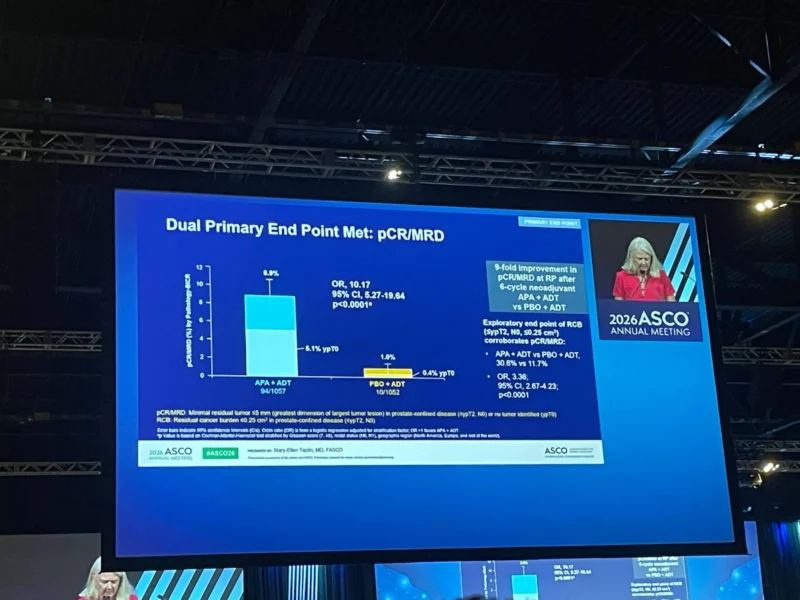
The exploratory residual cancer burden endpoint was also supportive. Residual cancer burden response was reported in 30.6% of patients treated with apalutamide plus ADT compared with 11.7% of those treated with placebo plus ADT, with an odds ratio of 3.36, 95% CI 2.67–4.23, and p<0.0001.
PROTEUS also met the primary endpoint of metastasis-free survival by conventional or PSMA-PET imaging. Apalutamide plus ADT reduced the risk of metastasis or death by 20% compared with placebo plus ADT, with a hazard ratio of 0.80, 95% CI 0.67–0.96, and p=0.02.
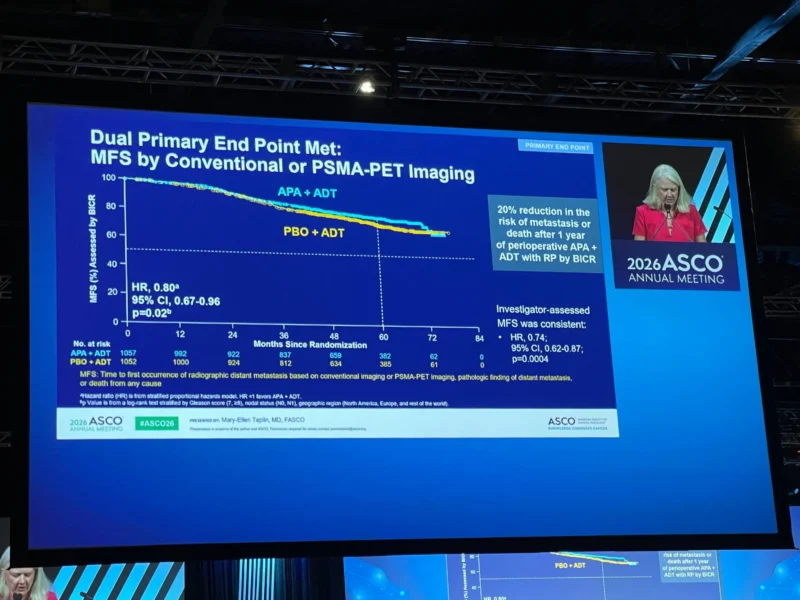
Investigator-assessed metastasis-free survival was consistent with the primary analysis, with a hazard ratio of 0.74, 95% CI 0.62–0.87, and p=0.0004.
Secondary Outcomes
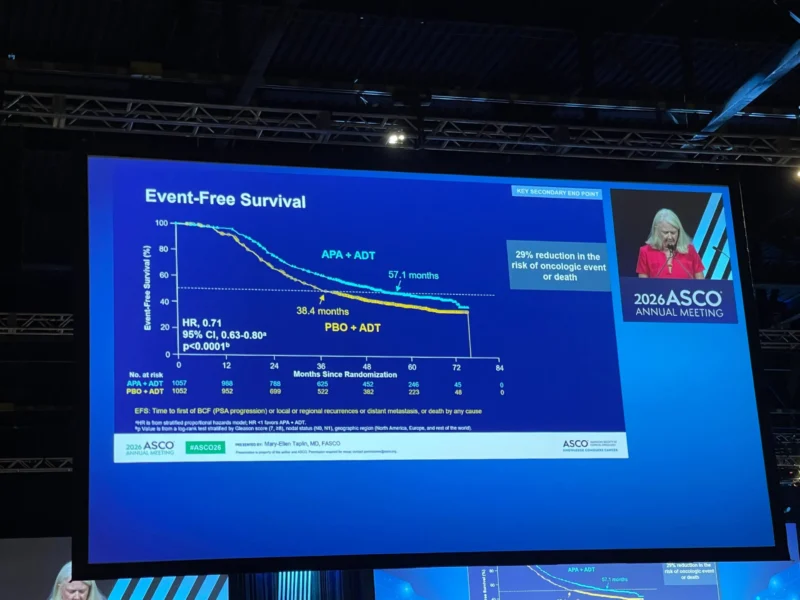
Event-free survival also favored apalutamide plus ADT. The presentation reported a 29% reduction in risk, with a hazard ratio of 0.71, and described a 19-month difference in favor of apalutamide plus ADT.
Time to first subsequent therapy was significantly delayed. Median time to first subsequent local, regional, or systemic therapy was 74.2 months with apalutamide plus ADT compared with 41.5 months with placebo plus ADT. This corresponded to a hazard ratio of 0.65, 95% CI 0.57–0.73, and p<0.0001. The slide described this as nearly three years of added treatment-free interval.
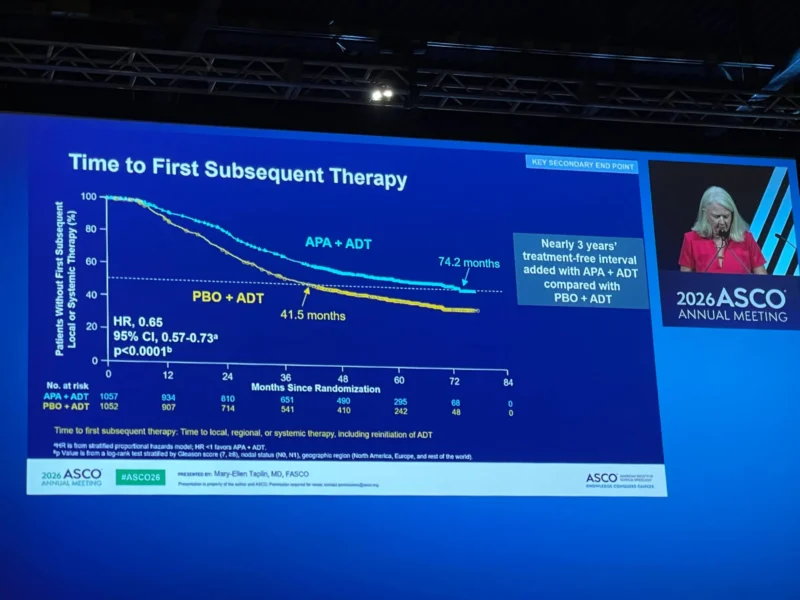
Fewer patients in the apalutamide plus ADT arm required subsequent therapy: 42.4% versus 56.7%. Subsequent systemic therapy was used in 26.7% versus 36.4%, postoperative radiotherapy in 13.0% versus 18.4%, other radiotherapy in 1.9% versus 1.2%, and subsequent surgery in 0.9% versus 0.7%.
Time to distant metastasis by conventional or PSMA-PET imaging also favored apalutamide plus ADT. The hazard ratio was 0.68, 95% CI 0.55–0.83, with p=0.0002. At five years, 82.8% of patients in the apalutamide plus ADT arm were without distant metastasis compared with 76.2% in the placebo plus ADT arm.
Metastasis-free survival by conventional imaging alone was not statistically significant, with a hazard ratio of 0.84, 95% CI 0.67–1.07, and p=0.15. The presentation noted that use of PSMA-PET, with potential early detection of metastasis and subsequent therapy, may affect metastasis-free survival assessed by conventional imaging.
Testosterone Recovery
Testosterone recovery was similar between treatment arms. Among patients with testosterone recovery to ≥200 ng/dL, the median testosterone value was 270 ng/dL with apalutamide plus ADT and 290 ng/dL with placebo plus ADT.
The median time from end of treatment to testosterone recovery was 8.1 months with apalutamide plus ADT and 6.6 months with placebo plus ADT. Testosterone recovery to ≥200 ng/dL occurred in 81.6% of patients receiving apalutamide plus ADT and 83.0% receiving placebo plus ADT.
Safet
Treatment-related adverse events were common in both groups. All-grade treatment-related adverse events occurred in 95.2% of patients receiving apalutamide plus ADT and 93.8% receiving placebo plus ADT.
Grade 3/4 treatment-related adverse events were more frequent with apalutamide plus ADT, occurring in 27.5% versus 18.9%. Grade 3/4 treatment-related adverse events leading to dose reduction occurred in 11.2% versus 2.3%, and those leading to dose interruption occurred in 12.0% versus 4.4%. Treatment-related adverse events leading to death were reported in 0.7% and 0.1%, respectively.
Treatment-emergent adverse events of special interest were also more frequent with apalutamide plus ADT. At least one event of special interest occurred in 37.9% of patients in the apalutamide plus ADT arm compared with 20.4% in the placebo plus ADT arm. Skin rash occurred in 33.0% versus 15.3%, with grade ≥3 rash in 5.9% versus 0.3%. Fatigue was similar between groups, occurring in 27.7% versus 26.8%.
Key Takeaway
In high-risk localized or locally advanced prostate cancer, PROTEUS was the first trial shown in the presentation to demonstrate that one year of perioperative apalutamide plus ADT significantly improved metastasis-free survival, major pathological response at prostatectomy, event-free survival, and time to subsequent therapy.
The results support perioperative apalutamide plus ADT as a treatment-intensification strategy in patients with high-risk localized or locally advanced prostate cancer undergoing radical prostatectomy.