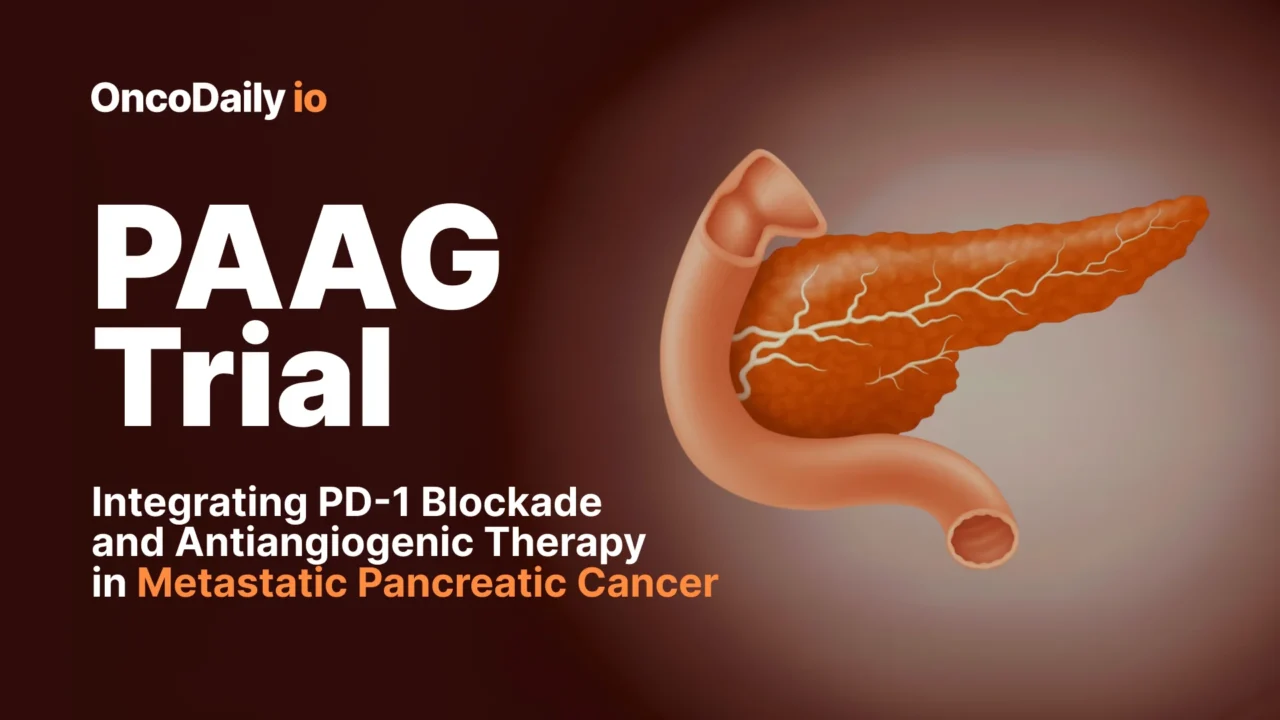
Pancreatic ductal adenocarcinoma (PDAC) has long been regarded as one of the most immunotherapy-refractory solid tumors, shaped by a profoundly immunosuppressive microenvironment, dense stromal architecture, and limited T-cell infiltration. Despite multiple attempts to introduce immune checkpoint inhibition into pancreatic cancer treatment, single-agent and dual-agent immunotherapy strategies have consistently failed to demonstrate meaningful clinical benefit. Against this background, the phase II PAAG study presented at the 2026 ASCO Gastrointestinal Cancers Symposiumoffers an important signal that rational immune–angiogenic–chemotherapy integration may partially overcome these barriers in the first-line metastatic setting.
Trial Concept and Biological Rationale
The PAAG regimen combines four mechanistically complementary components:
- penpulimab (anti–PD-1),
- anlotinib (multi-target antiangiogenic TKI),
- standard nab-paclitaxel plus gemcitabine chemotherapy.
This strategy is grounded in the hypothesis that immunotherapy resistance in PDAC is not simply due to lack of antigenicity, but rather to ineffective immune cell trafficking, abnormal tumor vasculature, and myeloid-driven immune exclusion.
Antiangiogenic therapy may normalize tumor vasculature, reduce hypoxia, and improve immune infiltration, while chemotherapy can promote antigen release and immunogenic cell death. PD-1 blockade is then positioned to sustain and amplify nascent antitumor immune responses once the tumor microenvironment has been rendered more permissive.
Efficacy: A Meaningful PFS and Response Signal
In this open-label, randomized phase II trial, 159 patients with previously untreated metastatic pancreatic cancer were randomized 2:1 to receive PAAG versus chemotherapy alone. The integrated regimen produced a statistically and clinically significant improvement in progression-free survival, with a median PFS of 7.8 months versus 4.5 monthsfor standard chemotherapy (P < .001). This degree of separation exceeds what would be expected from chemotherapy intensification alone and suggests a true contribution from immune and vascular modulation.
Tumor response rates further support this interpretation. The objective response rate nearly doubled with PAAG (49.5% vs 25.9%), and complete responses—exceptionally rare in metastatic PDAC—were observed exclusively in the experimental arm. Disease control exceeded 90%, indicating broad tumor growth suppression rather than isolated deep responses in a small subset.
Overall survival data were immature at the time of analysis but showed a numerical trend favoring PAAG (13.9 vs 10.5 months). While not statistically significant, this trend aligns directionally with the observed PFS and response improvements and warrants longer follow-up.
Safety: Intensification Without Prohibitive Toxicity
Importantly, the clinical gains achieved with PAAG were not offset by prohibitive toxicity. The overall safety profile was largely comparable to chemotherapy alone, with hematologic adverse events remaining within expected ranges. Non-hematologic toxicities were similarly manageable, and immune-related events—while present—did not result in excess severe complications.
Rash occurred more frequently in the PAAG arm, consistent with immune activation, but grade ≥3 events were uncommon. Notably, no treatment-related deaths were reported, supporting the feasibility of this quadruplet approach in a real-world metastatic population.
Interpreting the Signal: Why This Matters in PDAC
What distinguishes PAAG from prior negative immunotherapy studies in pancreatic cancer is not the addition of PD-1 blockade per se, but the context in which immunotherapy is deployed. Rather than attempting to activate immunity in a hostile, non-inflamed tumor microenvironment, this regimen appears to reshape that environment first—through chemotherapy-mediated tumor debulking and angiogenesis inhibition—before engaging adaptive immunity.
This aligns with emerging evidence across solid tumors that immunotherapy efficacy is conditional, not universal, and depends heavily on stromal biology, vascular integrity, and immune cell access. In this sense, PAAG represents a shift from “adding immunotherapy” to engineering immune permissiveness.
Limitations and Next Steps
As a phase II study, PAAG remains hypothesis-generating. Biomarker analyses were not yet reported, and it remains unclear whether benefit is uniform or enriched in specific biological subsets. Additionally, OS maturity and external validation are essential before clinical practice change can be justified.
Nonetheless, the magnitude of PFS improvement and response enhancement observed here positions PAAG as one of the most promising immunotherapy-containing strategies tested to date in metastatic pancreatic cancer. Future work should focus on biomarker refinement, immune correlates, and confirmation in phase III trials.
You Can Watch More on OncoDaily Youtube TV