
Immune checkpoint inhibitors combined with chemotherapy have become a standard first-line treatment for many patients with metastatic non–small cell lung cancer (NSCLC). Despite these advances, only a subset of patients achieves durable clinical benefit, while others experience early disease progression.
Although PD-L1 expression remains the most widely used biomarker in clinical practice, its predictive accuracy is far from perfect. Many patients with high PD-L1 expression fail to respond, whereas some patients with low expression derive substantial benefit. As a result, investigators continue to search for additional biomarkers capable of identifying patients most likely to benefit from immunotherapy.
In a prospective study published in iScience, Amanda B. Figueiredo and colleagues explored whether circulating immune cells present in peripheral blood before treatment initiation could predict response to pembrolizumab plus chemotherapy in patients with treatment-naïve stage IV NSCLC. Their findings suggest that systemic immune profiling may provide important insights into both treatment response and mechanisms of resistance.

Non-Small Cell Lung Cancer: Causes, Symptoms, Diagnosis, Treatment Options
Study Design
The study prospectively enrolled 33 patients with treatment-naïve stage IV NSCLC receiving first-line pembrolizumab combined with chemotherapy. Investigators performed extensive immune profiling using flow cytometry, single-cell RNA sequencing, metabolomic analysis, and machine-learning approaches.
Patients were evaluated for response at 9 weeks and again at 6 months to distinguish both early and durable clinical benefit. Importantly, blood samples were obtained before therapy began, allowing researchers to investigate whether baseline immune characteristics could predict future outcomes.
Key Clinical Outcomes
- Objective response rate: 42.5%
- Median overall survival: 14.3 months in responders versus 7.8 months in non-responders
- Hazard ratio for death: 2.21 for non-responders compared with responders
These findings highlight the substantial clinical differences between patients who benefit from immunotherapy and those who do not.
Activated CD4 T Cells Emerged as a Strong Predictor of Response
One of the most important observations from the study was the association between activated CD4-positive T cells and favorable treatment outcomes.
Patients who ultimately responded to therapy demonstrated higher frequencies of circulating CD4-positive T cells expressing CD69, a marker of recent immune activation. In contrast, non-responders showed higher frequencies of total CD4-positive T cells but fewer activated CD69-positive cells.
This distinction suggests that the functional state of T cells may be more important than their absolute number. Simply having more T cells was not associated with benefit. Rather, patients with evidence of active immune engagement before treatment appeared more likely to respond to checkpoint blockade.
Machine-learning analyses further demonstrated that these immune-cell populations could accurately distinguish responders from non-responders, supporting their potential role as clinically useful biomarkers.
Predictive Performance
- CD4+CD69+ T cells predicted response at 9 weeks
- Combined CD4 and CD4+CD69+ model achieved an AUC of 0.87
- Positive predictive value: 77.8%
- Negative predictive value: 70%
These results suggest that a simple blood test assessing T-cell activation could potentially contribute to future treatment selection strategies.
Progression-Free Survival Was Closely Linked to Immune Activation
The investigators next evaluated whether these immune biomarkers were associated with progression-free survival.
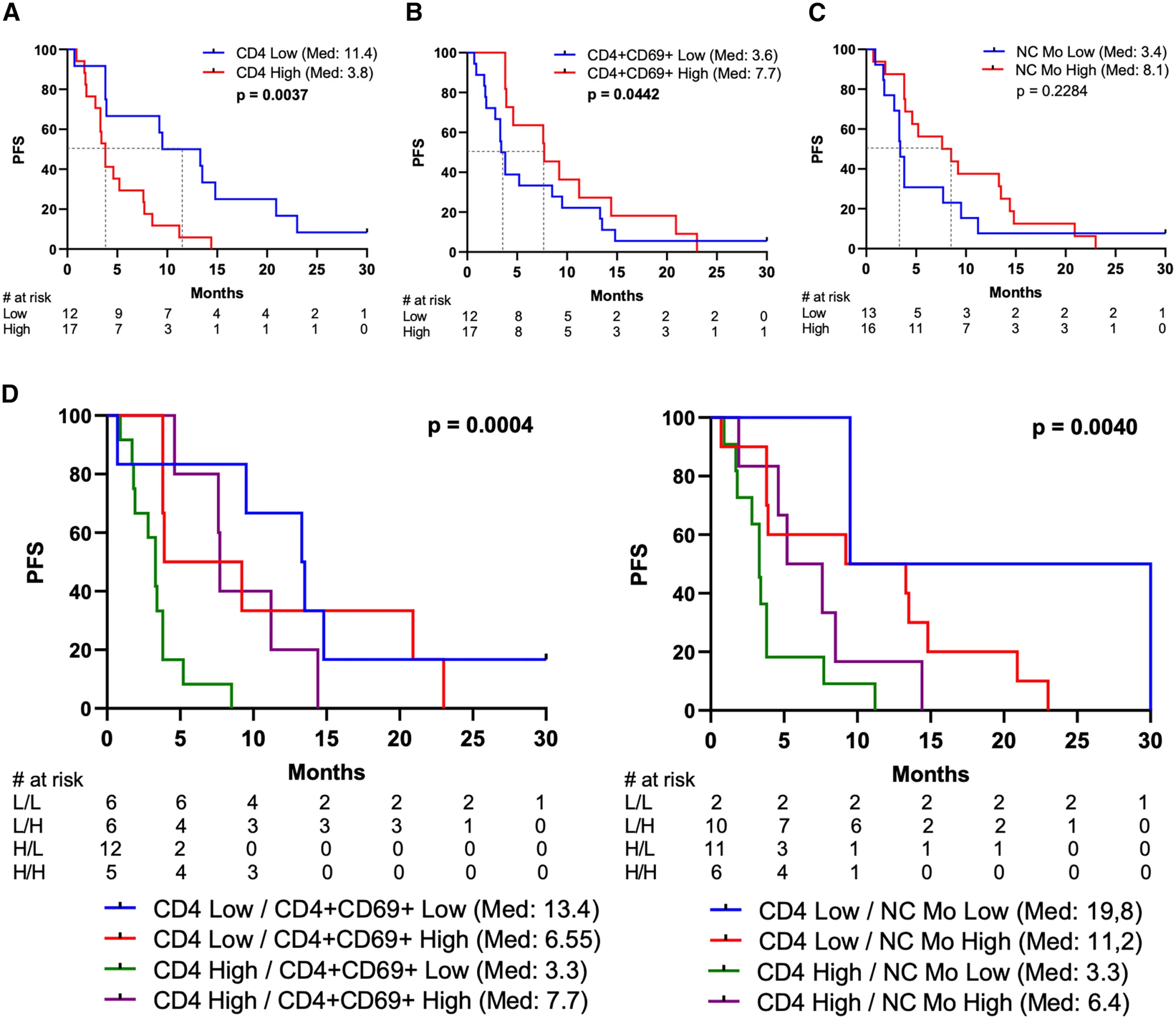
Patients with higher frequencies of activated CD4+CD69+ T cells experienced significantly longer progression-free survival compared with those lacking these activated populations. Conversely, patients with high levels of total CD4 T cells but low activation markers had substantially poorer outcomes.
This finding reinforces the concept that immune competence before treatment initiation may influence subsequent response to checkpoint inhibition.
Progression-Free Survival Findings
- Median PFS: 7.7 months in patients with high CD4+CD69+ frequencies
- Median PFS: 3.6 months in patients with low CD4+CD69+ frequencies
- Median PFS: 11.4 months in patients with low total CD4 frequencies
- Median PFS: 3.8 months in patients with high total CD4 frequencies
These differences suggest that activated immune-cell populations may serve as both predictive and prognostic biomarkers.
CTLA-4 Emerged as a Potential Driver of Resistance
While responders displayed activated immune signatures, non-responders exhibited a distinctly different immune profile.
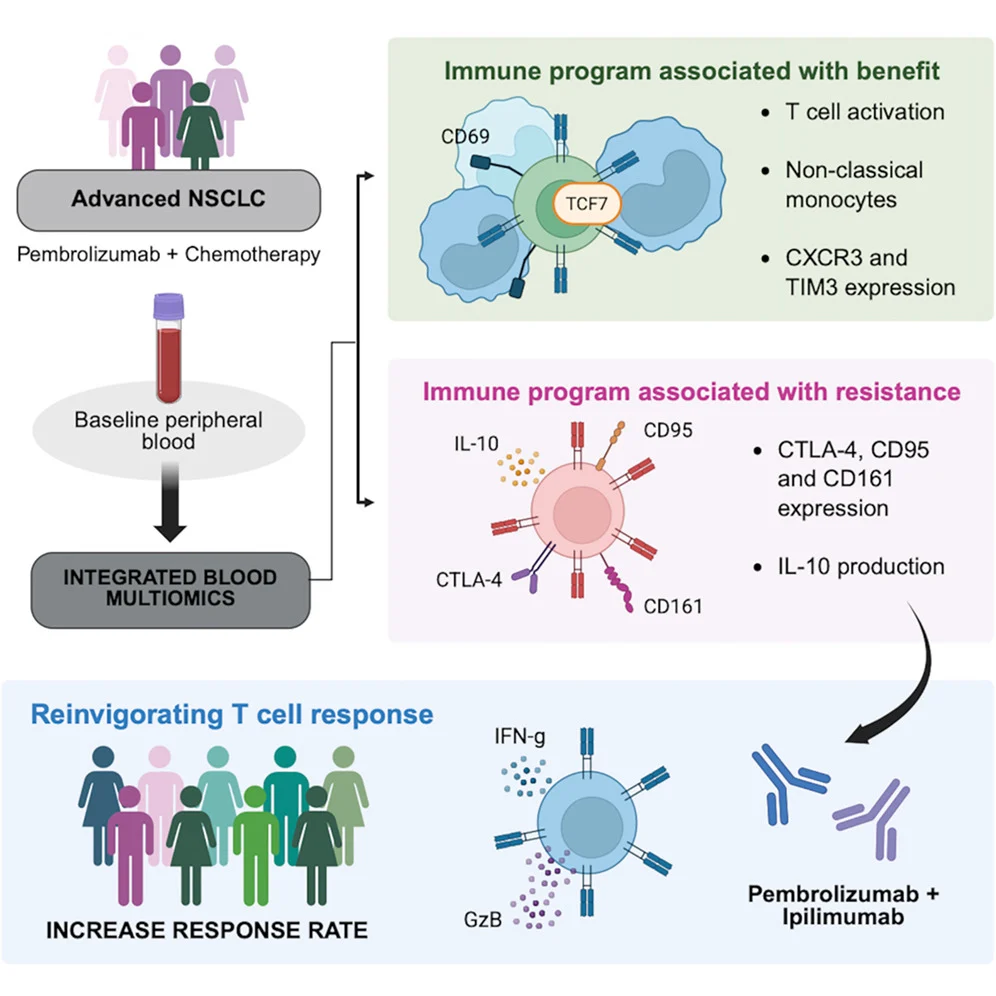
Patients who failed therapy demonstrated increased frequencies of T cells expressing CTLA-4, CD161, CD95, and IL-10. These molecules are commonly associated with immune suppression, T-cell dysfunction, or exhaustion.
The findings suggest that resistance to PD-1 blockade may not simply reflect a lack of immune activation but rather the presence of active suppressive pathways that prevent effective antitumor immunity.
Among these pathways, CTLA-4 emerged as one of the strongest signals associated with treatment failure. Investigators repeatedly identified CTLA-4-positive T-cell populations in non-responders across multiple analytical platforms.
TCF-1 Identified a Favorable Immune State
Another important discovery involved TCF-1, a transcription factor increasingly recognized as a marker of stem-like and durable antitumor T-cell responses.
Responders consistently demonstrated higher frequencies of TCF-1-positive CD4 and CD8 T cells. These cells are thought to preserve long-term immune function and maintain responsiveness to checkpoint inhibition. In contrast, non-responders exhibited higher IL-10 expression and reduced TCF-1 levels, suggesting a shift toward a more suppressive immune environment.
Together, these findings indicate that successful immunotherapy may depend on maintaining a balance between activation signals and inhibitory pathways within the immune system.
Blood Findings Were Confirmed Within the Tumor Microenvironment
A particularly important aspect of the study was the validation of blood-based observations using independent tumor datasets.
Analysis of single-cell RNA sequencing data from tumor samples revealed patterns remarkably similar to those observed in peripheral blood. Responders demonstrated higher expression of CD69, CXCR3, and TCF-1-related signatures, whereas non-responders showed increased CTLA4, FAS, and KLRB1 expression.
These results suggest that peripheral blood may serve as a non-invasive window into the biology of the tumor microenvironment. Rather than requiring repeated biopsies, circulating immune cells may provide clinically meaningful information regarding ongoing antitumor immune responses.
Can CTLA-4 Blockade Reverse Resistance?
To explore whether CTLA-4 contributes directly to treatment resistance, investigators performed laboratory experiments using immune cells from non-responding patients.
When CTLA-4 blockade with ipilimumab was added to PD-1 inhibition, T-cell function improved significantly. Dual checkpoint inhibition increased production of interferon-gamma and granzyme B, two key mediators of antitumor immunity.
These findings provide a biological rationale for combining CTLA-4 and PD-1 blockade in selected patients whose tumors exhibit strong CTLA-4–associated resistance signatures.
Clinical Implications
The study highlights the growing importance of blood-based immune monitoring in immuno-oncology. Rather than relying exclusively on tumor PD-L1 expression, future treatment strategies may incorporate circulating immune-cell profiles to identify patients most likely to benefit from specific immunotherapy approaches.
Activated CD69-positive T cells and TCF-1-positive immune populations emerged as markers of favorable outcomes, whereas CTLA-4-positive and IL-10-producing T cells were strongly associated with resistance.
Importantly, these biomarkers were detectable before treatment began, raising the possibility of using peripheral blood tests to guide therapeutic decisions and personalize immunotherapy selection.
Conclusion
Figueiredo and colleagues provide compelling evidence that circulating immune-cell populations can predict response to pembrolizumab plus chemotherapy in metastatic NSCLC. Patients with activated CD69-positive and TCF-1-positive T-cell populations experienced superior outcomes, while CTLA-4-driven suppressive immune states were associated with resistance.
Beyond identifying potential biomarkers, the study offers important biological insights into why some patients respond to immunotherapy and others do not. As blood-based immune profiling continues to evolve, these findings may contribute to more precise patient selection and support future strategies incorporating CTLA-4 blockade to overcome resistance in advanced NSCLC.
Read Full Article Here