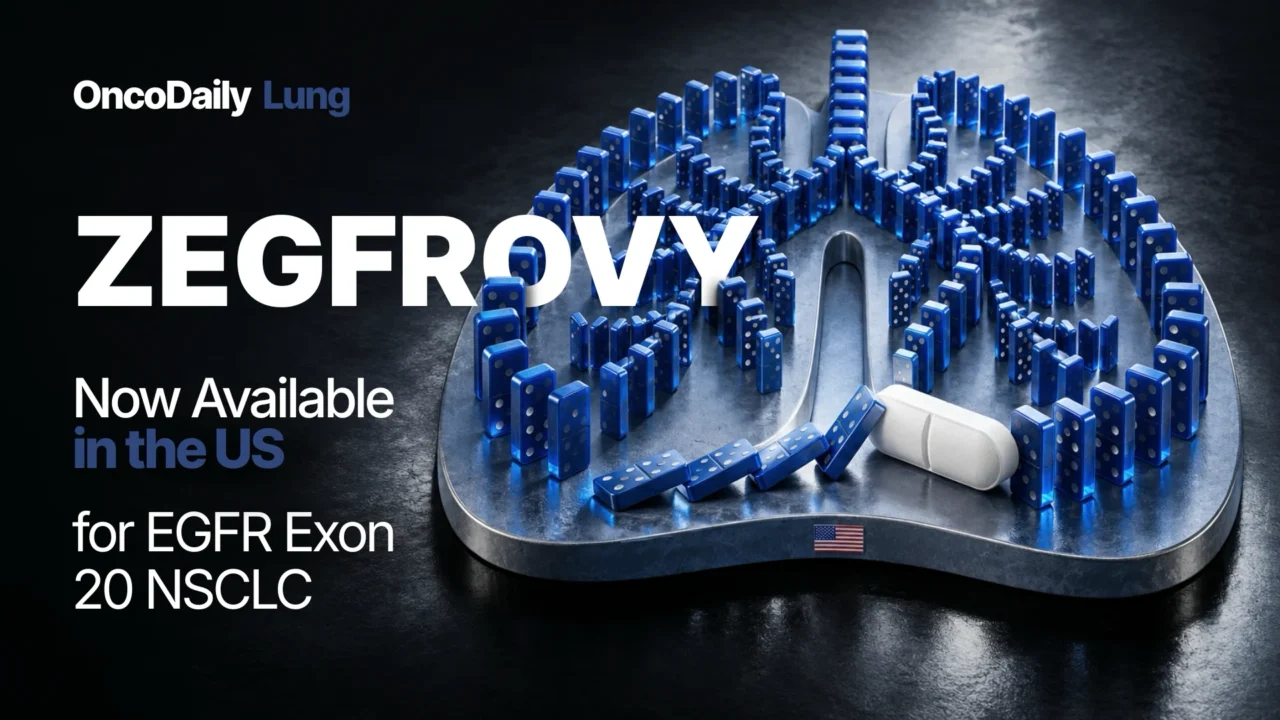
Patients in the United States with previously treated EGFR exon 20 insertion-mutated non-small-cell lung cancer now have access to another mutation-specific oral treatment option.
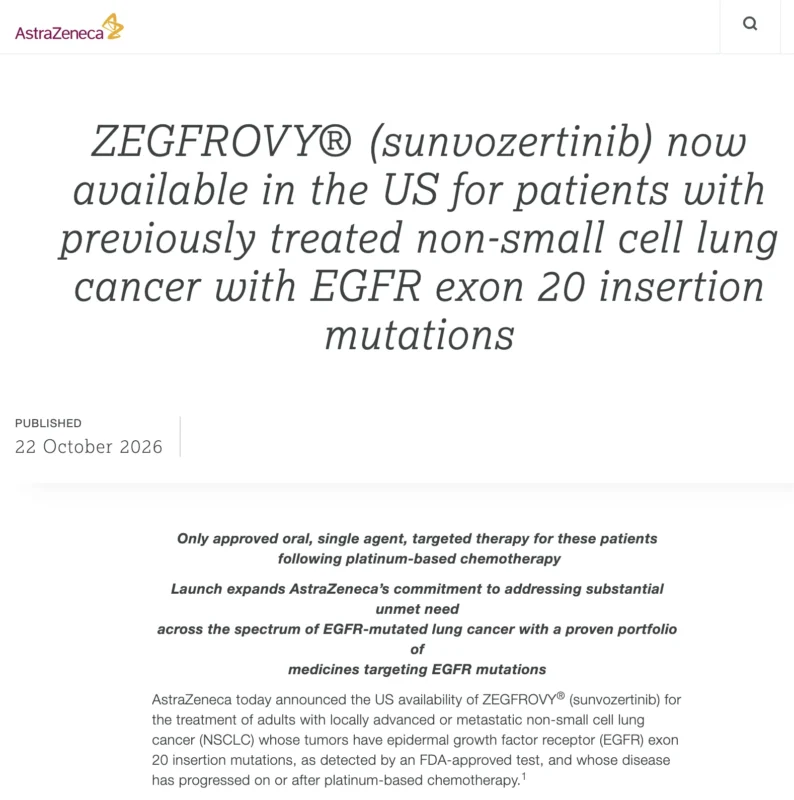
On October 22, 2026, AstraZeneca announced the US commercial availability of ZEGFROVY® (sunvozertinib) for adults with locally advanced or metastatic NSCLC harboring EGFR exon 20 insertion mutations whose disease has progressed on or after platinum-based chemotherapy.
Sunvozertinib previously received FDA accelerated approval based on response and durability data from the WU-KONG1B study. The current announcement therefore represents the US launch and availability of the drug, rather than a new FDA approval.
The development is particularly relevant because EGFR exon 20 insertion mutations represent a biologically distinct subgroup of EGFR-mutated NSCLC that has historically been difficult to treat with earlier-generation EGFR tyrosine kinase inhibitors.
EGFR Exon 20 Insertions Remain a Distinct Therapeutic Challenge
EGFR exon 20 insertions account for an estimated 10% of EGFR-mutated NSCLC. Unlike classical EGFR exon 19 deletions and L858R mutations, exon 20 insertion alterations frequently confer primary resistance to earlier-generation EGFR TKIs.
As a result, patients have historically had fewer effective targeted options and relatively poor outcomes. The AstraZeneca announcement cites real-world evidence suggesting that five-year overall survival in this population may be as low as 8%.
Sunvozertinib was specifically developed to address this molecular subgroup.
What Is Sunvozertinib?
Sunvozertinib is an oral, irreversible EGFR inhibitor designed to target a broad range of EGFR mutations while maintaining selectivity over wild-type EGFR. In the United States, the approved indication is for adults with locally advanced or metastatic NSCLC, with EGFR exon 20 insertion mutations confirmed by an FDA-approved test whose disease has progressed on or after platinum-based chemotherapy.
The recommended dose is 200 mg orally once daily with food. The approval was granted under the FDA’s accelerated approval pathway, meaning continued approval may depend on verification of clinical benefit in a confirmatory trial.
WU-KONG1B Supported Accelerated Approval
The FDA accelerated approval was based on results from WU-KONG1B, a multinational, open-label dose-randomization study in previously treated patients with locally advanced or metastatic EGFR exon 20 insertion-mutated NSCLC.
The efficacy population included 85 patients treated with sunvozertinib 200 mg once daily. The confirmed objective response rate was:
- 46%
- 95% CI 35%–57%
Among the 39 patients who responded, median duration of response was:
- 11.1 months
- 95% CI 8.2–not estimable
Importantly:
- 72% of responders
- maintained their response for at least six months
These results provided the basis for accelerated approval and demonstrate that a clinically meaningful proportion of previously treated patients can achieve durable tumor responses with oral EGFR-directed therapy.
An Oral Targeted Option After Platinum Chemotherapy
One of the practical advantages of sunvozertinib is its oral administration. The company describes ZEGFROVY as the only approved oral, single-agent targeted therapy in the United States for this patient population following platinum-based chemotherapy.
The drug is also listed in the NCCN Clinical Practice Guidelines in Oncology for NSCLC as a Category 2A recommended subsequent-therapy option for advanced or metastatic EGFR exon 20 insertion-positive disease.
The availability of an oral targeted agent may be particularly relevant for patients seeking an alternative to additional intravenous systemic therapy after progression on platinum chemotherapy.
Safety: Diarrhea and Dermatologic Toxicity Are Common
The efficacy signal needs to be balanced against the toxicity profile. Among the 121 patients included in the safety population, diarrhea occurred in 73%. Grade 3 diarrhea occurred in 2.5%. Diarrhea led to dose interruption or reduction in approximately 5% of patients and permanent discontinuation in 0.8%.
Nausea and vomiting occurred in 43%, including grade 3 events in 3.3%. The prescribing information recommends administering sunvozertinib with food and using supportive measures such as antidiarrheal therapy, antiemetics and fluid replacement when clinically indicated.
Rash Is Another Important Treatment-Related Concern
Dermatologic adverse events occurred in:
- 68% of patients
These included rash, acneiform dermatitis and pruritus. Grade 3 rash occurred in approximately 7%.
Patients are advised to use non-irritating emollients during treatment and avoid skin products containing substances such as retinol, retinoic acid or benzoyl peroxide. Dose interruption, reduction or discontinuation may be required according to severity.
ILD/Pneumonitis Requires Close Monitoring
Interstitial lung disease and pneumonitis remain clinically important risks with EGFR-directed therapy. In the sunvozertinib safety population ILD/pneumonitis occurred in 1.7%. Treatment was permanently discontinued because of ILD/pneumonitis in 0.8%.
Patients developing new or worsening respiratory symptoms such as dyspnea, cough or fever should be promptly evaluated. Sunvozertinib should be withheld when ILD/pneumonitis is suspected and permanently discontinued if the diagnosis is confirmed.
Ocular Toxicity Is Uncommon but Clinically Relevant
Ocular adverse events occurred in approximately 13% of patients. Reported events included dry eye, blurred vision, visual impairment and keratitis. Keratitis itself occurred in 0.8%. Patients developing new or worsening ocular symptoms should undergo ophthalmologic evaluation, and contact lenses should be discontinued until symptoms have been assessed.
Other Common Adverse Events
The most common adverse reactions occurring in at least 20% of patients included: diarrhea, rash, decreased appetite, stomatitis, fatigue, nausea, paronychia, vomiting, constipation, musculoskeletal pain, pruritus, dry skin, urinary tract infection, abdominal pain and weight loss.
Laboratory abnormalities included reductions in lymphocytes, hemoglobin, neutrophils, potassium and sodium, together with increases in lipase, amylase, creatine kinase, AST, ALT, magnesium and alkaline phosphatase.
These toxicities reinforce the importance of proactive supportive care and laboratory monitoring during treatment.
First-Line Development Is Already Moving Forward
The next major question is whether sunvozertinib can move from post-platinum treatment into the first-line setting. A supplemental New Drug Application has been submitted to the FDA based on results from the phase III WU-KONG28 trial.
According to AstraZeneca, the first-line application has also been submitted to China’s Center for Drug Evaluation. Both the FDA and China’s CDE have granted Breakthrough Therapy Designation to sunvozertinib in this first-line setting.
The announcement states that WU-KONG28 results were presented at the most recent ASCO meeting. This creates a potentially important transition for sunvozertinib.
Its current US indication is specifically for patients who have already progressed on or after platinum chemotherapy.
If first-line approval is ultimately granted, treatment sequencing for EGFR exon 20 insertion-mutated NSCLC could change substantially.
From a Post-Platinum Option Toward an Earlier Targeted Strategy
The therapeutic landscape for EGFR exon 20 insertion NSCLC has evolved significantly in recent years. Historically, these tumors sat in an uncomfortable position between conventional EGFR-mutated disease and driver-negative NSCLC.
They carried an actionable EGFR alteration, but the structural characteristics of exon 20 insertions limited the activity of many conventional EGFR TKIs.
The development of mutation-specific therapies has increasingly separated exon 20 insertion disease into its own targeted-treatment category. Sunvozertinib’s US availability now expands access to an oral option after platinum chemotherapy.
The next question is whether its activity is strong enough to justify moving targeted therapy ahead of platinum-based treatment entirely.
That question will depend on the regulatory assessment of the WU-KONG28 phase III data.
OncoDaily Takeaway
The US launch of ZEGFROVY (sunvozertinib) expands targeted treatment options for patients with EGFR exon 20 insertion-mutated locally advanced or metastatic NSCLC whose disease has progressed on or after platinum-based chemotherapy.
In WU-KONG1B, sunvozertinib produced a 46% confirmed response rate, with median duration of response of 11.1 months and 72% of responders maintaining response for at least six months.
The oral once-daily regimen offers a mutation-specific treatment option in a subgroup historically characterized by limited sensitivity to conventional EGFR TKIs.
The toxicity profile requires active management, particularly for diarrhea, dermatologic adverse events and the less common but clinically important risk of ILD/pneumonitis.
Importantly, October 22 marks the US commercial availability of an already accelerated-approved therapy, not a new FDA approval. The larger story may now be what comes next.
With a supplemental first-line application submitted based on the phase III WU-KONG28 programme, sunvozertinib could potentially move from a post-platinum targeted option toward an earlier treatment strategy for EGFR exon 20 insertion NSCLC.
Source
- AstraZeneca. ZEGFROVY® (sunvozertinib) now available in the US for patients with previously treated non-small cell lung cancer with EGFR exon 20 insertion mutations. Published October 22, 2026.