In advanced non-small cell lung cancer, molecular testing is no longer simply a diagnostic exercise. It determines whether patients receive targeted therapy, and increasingly, whether they receive it at the right time.
A large US real-world analysis published in JCO Precision Oncology evaluated more than 13,000 patients with advanced NSCLC and found that patients whose next-generation sequencing results were available before initiation of first-line therapy were more likely to receive targeted treatment and had longer overall survival than patients tested with non-NGS methods up front or those whose NGS results became available only after systemic therapy had already started (Scott et al., 2026).
The study does not prove that NGS itself directly prolongs survival. Rather, its multivariable analyses suggest that the benefit is largely mediated through what NGS enables: earlier identification of actionable drivers and earlier delivery of matched therapy. That distinction is central to the clinical interpretation.
A Large Real-World Cohort Across US Oncology Practice
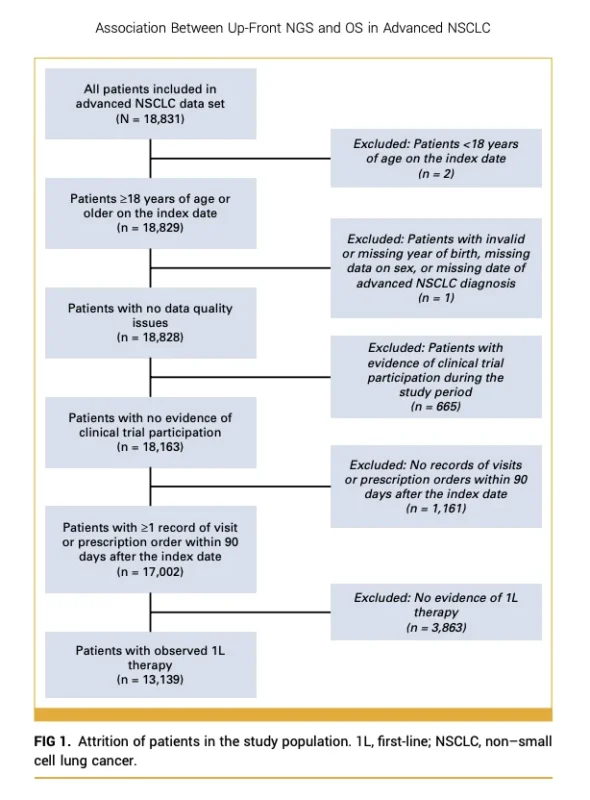
Scott et al. analyzed the Flatiron Health advanced NSCLC database, drawing on electronic health record data from approximately 280 US cancer clinics and roughly 800 sites of care. Patients were newly diagnosed with stage IIIB, IIIC, IVA, or IVB NSCLC between April 2019 and December 2021 and had to have received first-line systemic therapy (Scott et al., 2026).
A total of 13,139 patients were included. They were divided into three testing strategies:
- Up-front NGS: NGS results available before or at initiation of first-line therapy.
- Up-front non-NGS testing: non-NGS molecular testing results available before first-line treatment.
NGS after first-line initiation: NGS results became available only after systemic therapy had already begun. The analysis therefore addressed not only which test was used, but also when the result became clinically actionable.
Up-Front NGS Was Still Missing in More Than Half of Treated Patients
Among all 13,139 patients, genomic testing results of any type were available before first-line treatment in 67.8%. However, only 47.3%-6,210 patients, had up-front NGS results. Another 2,697 patients, or 20.5%, had only non-NGS testing results available before starting therapy, while 2,824 underwent NGS only after treatment had already begun (Scott et al., 2026).
This is an important implementation gap. Even within a contemporary US oncology dataset, a substantial proportion of patients began treatment without the broad molecular information that could determine whether a genotype-directed first-line therapy was available.
NGS Uptake Improved Rapidly Over Time
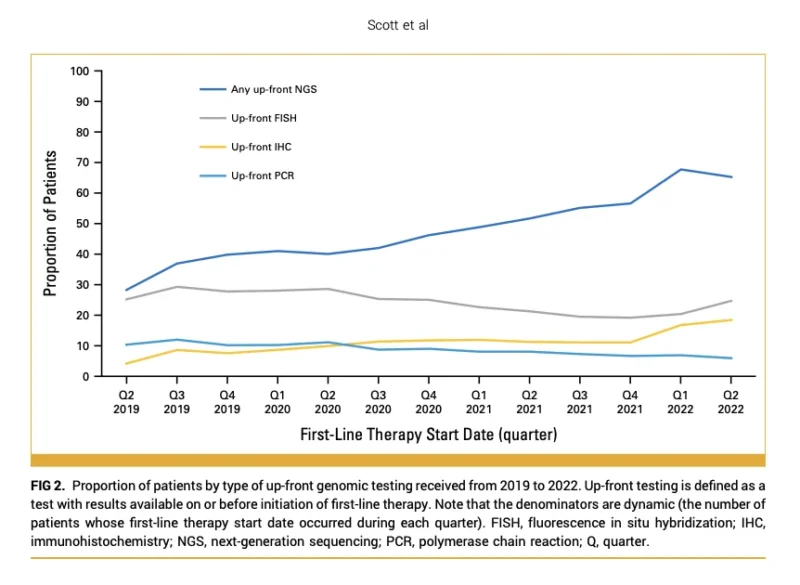
The trend over time was encouraging. Up-front NGS use increased from 28.7% in 2019 to 65.6% in 2022, while use of FISH and PCR gradually declined. The chart on page 6 makes this shift particularly clear: the NGS curve rises steadily across the study period, while traditional single- or limited-gene methods remain flat or decline.
This reflects the broader evolution of advanced NSCLC from a disease defined primarily by histology into one in which increasingly many molecular alterations can determine first-line treatment. But the authors also emphasize that implementation remained incomplete. Approximately one-third of patients were still initiating systemic therapy without NGS results available beforehand.
Up-Front NGS Was Associated With More Targeted Therapy
The clearest clinical difference between the testing groups was access to targeted therapy. Targeted therapy was received by:
- 22.6% of patients with up-front NGS
- 19.5% with up-front non-NGS testing
- 14.8% with NGS performed after first-line treatment began
Timing mattered even more than the overall proportion. Among patients who eventually received targeted therapy, 83.5% of those with up-front NGS started it in the first-line setting, compared with only 41.6% among patients whose NGS results became available after first-line therapy had started. The implications are straightforward.
When NGS results are delayed until after treatment initiation, some patients who could potentially have received a molecularly matched first-line treatment instead begin chemotherapy, immunotherapy, or another nonspecific regimen. The opportunity is not necessarily lost completely, but it may be delayed until a later line, when the patient may have accumulated greater disease burden, treatment toxicity, or clinical deterioration.
Overall Survival Was Longest With Up-Front NGS
The survival findings were clinically meaningful. Median overall survival from advanced NSCLC diagnosis was:
- 20.9 months with up-front NGS
- 17.5 months with up-front non-NGS testing
- 18.2 months when NGS was performed after first-line therapy had already started
The differences were statistically significant. After adjustment for baseline demographic and clinical characteristics, up-front NGS was associated with a 7.6% lower risk of death compared with up-front non-NGS testing:
- HR 0.92; P=0.0144.
When treatment variables, including immune checkpoint inhibitor use and line of targeted therapy—were added to the model, the HR moved toward 1:
- HR 0.94; P=0.0476
This change is one of the most important findings in the paper. It suggests that the survival association with up-front NGS was largely explained by the treatments patients subsequently received. In other words, the value of molecular testing lies in changing clinical management.
Earlier Targeted Therapy Was Associated With the Largest Survival Advantage
The multivariable model further reinforces the importance of treatment timing. Compared with patients who never received targeted therapy, the risk of death was lower when targeted therapy was initiated in:
- First line: HR 0.39
- Second line: HR 0.49
- Third line or later: HR 0.54
The strongest association with improved survival was therefore observed when targeted therapy was used in the first-line setting. These results should not be interpreted as randomized evidence that treatment line alone causes the difference; patients who survive long enough to reach later lines and those selected for different treatments may differ substantially.
Nevertheless, the direction of the finding is consistent with a central principle of precision oncology: when an actionable oncogenic driver is present, identifying it before starting treatment creates the opportunity to use the most appropriate therapy from the beginning.
Waiting for NGS Results Did Not Appear to Harm Survival
One of the most clinically interesting findings concerns time to treatment. Median time to first-line therapy was:
- 41 days with up-front NGS
compared with
- 33 days with up-front non-NGS testing
and
- 24 days when NGS was obtained after first-line therapy had already begun
Despite this longer interval, patients with up-front NGS had the longest median overall survival. This provides real-world support for a frequently encountered clinical dilemma.
There can be pressure to start systemic therapy quickly, particularly when molecular testing requires additional tissue acquisition, sequencing, or turnaround time. Yet beginning treatment before biomarker results are available may lead to a treatment choice that is less appropriate for the tumor’s biology.
The study does not imply that treatment should be delayed in clinically unstable patients. But in a patient who can safely wait for comprehensive molecular results, the findings support prioritizing an informed first-line decision rather than starting empiric therapy simply because it can begin sooner.
The Study Reflects an Increasingly Actionable NSCLC Landscape
The clinical value of broad sequencing has changed over time. Earlier real-world analyses produced inconsistent conclusions regarding whether broad molecular testing was associated with better survival. Scott and colleagues argue that this may partly reflect the smaller number of actionable alterations and available targeted therapies during earlier treatment eras That context is critical.
As more actionable alterations become clinically relevant, the probability that comprehensive molecular testing will directly alter treatment increases. In this study, the most commonly identified oncogenic alterations were KRAS, EGFR, and BRAF, found in 18.1%, 12.1%, and 4.3% of patients, respectively.
The dataset also captured alterations in ALK, ROS1, MET, RET, and NTRK. A limited sequential-testing strategy therefore carries increasing risk of missing a clinically relevant alteration or delivering results too late to influence the first treatment decision.
This Is Primarily a Treatment-Selection Story
The survival data could easily be summarized as “NGS improves survival,” but that framing would overstate what a retrospective study can establish. A more accurate interpretation is that up-front comprehensive molecular testing is associated with a treatment pathway that produces better outcomes. Patients with up-front NGS were more likely to receive a targeted therapy.
They were much more likely to receive that therapy in the first-line setting. And when treatment variables were incorporated into the survival model, part of the observed NGS-associated survival advantage diminished. That is biologically and clinically coherent. NGS is not therapeutic in itself. Its value is in identifying information that changes therapy.
The Data Also Reveal Persistent Implementation Inequities
The testing cohorts were broadly similar, but several differences deserve attention. A higher proportion of Black patients were represented in the up-front non-NGS group compared with the up-front NGS group:
- 11.4% versus 8.6%.
Patients receiving NGS only after treatment initiation were also more likely to be treated in community practice:
- 93.8% versus 86.9% in the up-front NGS cohort
These findings are descriptive and cannot establish the reasons for the differences. However, they highlight a broader implementation challenge. Precision oncology only improves outcomes when patients have timely access to testing, adequate tissue acquisition, reimbursement, sequencing infrastructure, and clinicians able to act on the results.
The next phase of molecular oncology therefore involves not only discovering additional biomarkers but ensuring that existing testing standards are consistently implemented.
Important Limitations of the Real-World Analysis
The authors appropriately emphasize that this was a retrospective observational study based on routine electronic health record data. Several limitations affect causal interpretation. The database did not capture all potentially important clinical details, including sites of metastasis and complete regimen-level information. Testing performed outside the captured health system may have been missed.
The investigators also did not have detailed information about exactly which genes were included in every NGS or non-NGS assay. Consequently, the comparison should not be interpreted as a simple contrast between “comprehensive testing” and “single-gene testing” (Scott et al., 2026).
Clinical urgency may also have influenced both testing and outcomes. Patients with highly symptomatic disease may have needed immediate treatment before molecular results were available. Conversely, younger patients and never-smokers, groups in whom actionable drivers are more common, may have been more likely to undergo broad molecular testing. Importantly, smoking status was not included in the Cox regression model, which the authors identify as a limitation. These potential confounders mean the study demonstrates association rather than causation.
The Bottom Line
Scott et al. provide compelling real-world evidence that when molecular testing occurs matters in advanced NSCLC. Among more than 13,000 patients:
- Median OS with up-front NGS: 20.9 months
- Up-front non-NGS testing: 17.5 months
- NGS after first-line treatment initiation: 18.2 months
Up-front NGS was also associated with a higher probability of receiving targeted therapy:
- 22.6% versus 14.8% when NGS became available only after first-line treatment had begun.
And when targeted therapy was used after up-front NGS, it was far more likely to be used in the first-line setting. The central clinical lesson is therefore not simply “order NGS.” It is obtain comprehensive molecular results early enough for them to influence the first treatment decision. In a disease where the number of actionable alterations continues to expand, molecular testing performed after systemic therapy has already begun may be biologically informative, but clinically late.
Reference
- Scott, S. C., Nguyen, D., Cai, B., Gorritz, M., Caro, N., Yasuda, M., Gu, Y., Chen, C.-C., Pretre, V., Saliba, T. R., & Levy, B. P. (2026). Real-world association between up-front next-generation sequencing and overall survival in advanced non–small cell lung cancer in the United States. JCO Precision Oncology, 10, e2600108. https://doi.org/10.1200/PO-26-00108.