
An artificial intelligence-assisted analysis of tumor pathology has identified a potential predictive biomarker for datopotamab deruxtecan in advanced non-small-cell lung cancer. Published in Nature Medicine, the study demonstrates that the intracellular distribution of TROP2, rather than conventional protein-expression intensity, is associated with treatment outcomes, opening a new direction for biomarker-guided antibody–drug conjugate development.
The emergence of antibody–drug conjugates (ADCs) has created new therapeutic opportunities in non-small-cell lung cancer (NSCLC), but identifying which patients are most likely to benefit remains a central challenge.
Unlike established molecularly targeted therapies, for which specific genomic alterations can predict treatment response, many ADCs have entered clinical development without validated biomarkers capable of reliably identifying responsive tumors.
Trophoblast cell surface antigen 2 (TROP2) represents a particularly important example. Although TROP2 is expressed in approximately 90% of NSCLC samples, conventional immunohistochemical assessment has not consistently predicted clinical benefit from TROP2-directed ADCs.
A new study published online on November 11, 2026, in Nature Medicine suggests that this limitation may reflect an incomplete understanding of what constitutes biologically meaningful target expression.
In Normalized Membrane Ratio of TROP2 as a Predictor of Clinical Outcomes With Datopotamab Deruxtecan in Non-Small-Cell Lung Cancer, Marina C. Garassino, Myung-Ju Ahn, Markus Schick, Ansh Kapil, and colleagues describe an AI-assisted computational pathology approach capable of quantifying TROP2 distribution across individual tumor cells.
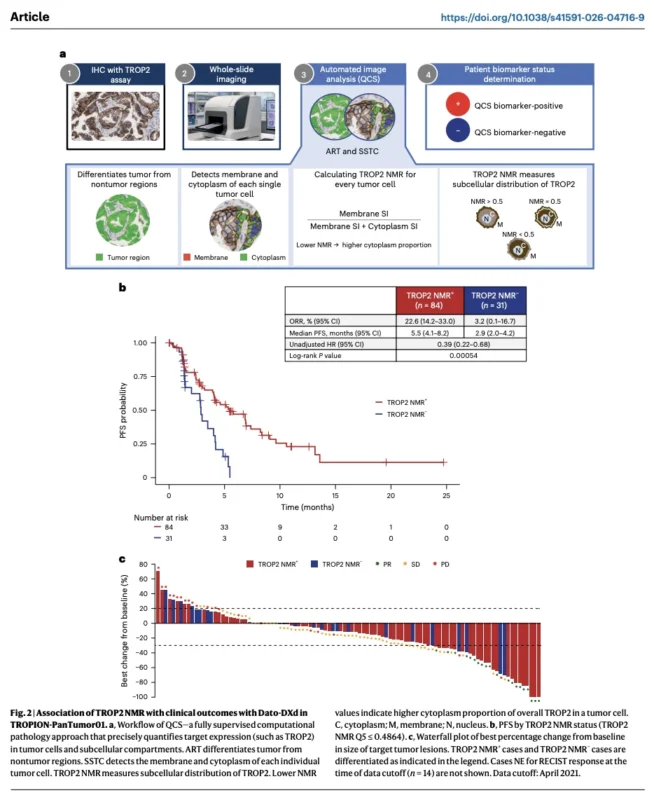
The researchers developed a metric called the TROP2 normalized membrane ratio (NMR), which measures the relative distribution of TROP2 between the cell membrane and cytoplasm. In retrospective analyses of TROPION-PanTumor01 and TROPION-Lung01, this biomarker was associated with substantially different outcomes following treatment with datopotamab deruxtecan (Dato-DXd).
The findings suggest that understanding the intracellular localization of an ADC target may provide more clinically relevant information than measuring its abundance alone.
Why Conventional TROP2 Testing Has Failed to Predict ADC Response
TROP2 is a transmembrane glycoprotein involved in cellular signaling and tumor biology. Its expression has been identified across multiple solid malignancies, including breast, lung, and gastrointestinal cancers. Because TROP2 is broadly expressed, it has become an attractive target for ADC development.
Datopotamab deruxtecan combines a humanized anti-TROP2 antibody with a topoisomerase I inhibitor payload through a cleavable linker. Following binding to TROP2-expressing tumor cells, antibody internalization and intracellular trafficking are believed to contribute to payload delivery and antitumor activity.
However, clinical evidence has demonstrated that simply identifying TROP2 expression does not reliably distinguish patients who respond from those who do not. Conventional immunohistochemistry (IHC) relies on pathologists visually assessing staining intensity and the proportion of positive tumor cells.
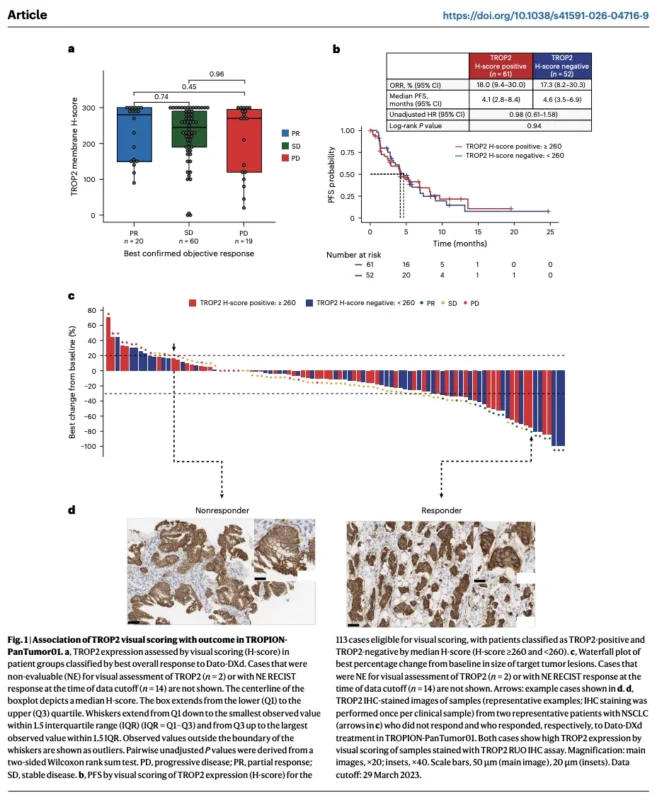
These results may be summarized using an H-score. In the TROPION-PanTumor01 study, investigators found no meaningful relationship between visually assessed TROP2 expression and objective response to Dato-DXd. Patients classified as TROP2 H-score-positive and H-score-negative had similar objective response rates of 18.0% and 17.3%.
Median progression-free survival (PFS) was likewise comparable at 4.1 and 4.6 months. These findings indicated that high TROP2 expression alone was insufficient to predict benefit.
The new research therefore addressed a different biological question: rather than measuring only how much TROP2 a tumor expresses, could evaluating where the protein is located within individual cells provide better predictive information?
From Protein Expression to Subcellular Localization
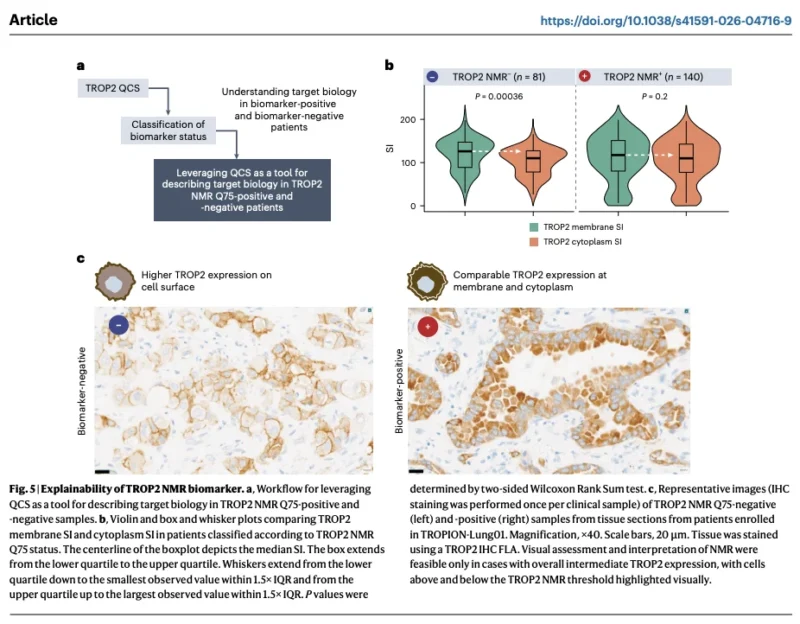
To investigate this question, the researchers employed a computational pathology platform known as quantitative continuous scoring (QCS). This approach combines digitized IHC slides, pathologist-supervised deep learning, and quantitative image analysis.
The system first identifies tumor regions while excluding surrounding nontumor tissue. It then segments individual tumor cells into subcellular compartments, including the membrane, cytoplasm, and nucleus. TROP2 staining intensity is subsequently quantified across these compartments.
This allows researchers to evaluate biological features that are difficult to identify or measure consistently through conventional microscopic examination. Among several candidate features, the investigators identified the normalized membrane ratio as the most promising.
TROP2 NMR is calculated as the relative amount of membrane-associated TROP2 compared with the combined membrane and cytoplasmic signal. A lower NMR indicates a greater proportion of cytoplasmic TROP2 relative to membrane-associated expression.
The authors hypothesized that this intracellular distribution might reflect more active receptor trafficking and internalization, processes potentially relevant to ADC delivery. Unlike conventional H-score assessment, NMR therefore provides information about the spatial distribution of the therapeutic target.
TROPION-PanTumor01: Identifying the Biomarker
The initial discovery analysis used tumor specimens from TROPION-PanTumor01, a phase I study evaluating Dato-DXd in patients with advanced solid tumors. Among 180 patients with NSCLC enrolled in the study, 115 had suitable tumor samples for quantitative analysis.
The researchers evaluated several computational pathology features, including membrane staining intensity, cytoplasmic staining intensity, the proportion of positive cells, and spatial characteristics. TROP2 NMR demonstrated the strongest association with PFS.
Among the biomarker-evaluable population, 84 patients, representing approximately 73%, were classified as TROP2 NMR-positive using the discovery-stage definition. Median PFS was 5.5 months among NMR-positive patients compared with 2.9 months among NMR-negative patients, corresponding to an HR of 0.39 (95% CI 0.22–0.68; P = 0.00054).
Objective response rates were 22.6% and 3.2%, respectively. The findings suggested that the intracellular distribution of TROP2 could identify substantial differences in Dato-DXd sensitivity.
However, because TROPION-PanTumor01 was an early-phase study without a randomized chemotherapy comparator for this analysis, the observed association alone could not establish whether NMR was predictive of Dato-DXd-specific benefit or simply associated with prognosis.
The researchers therefore investigated the biomarker in the randomized TROPION-Lung01 dataset.
TROPION-Lung01: Testing Predictive Value Against Docetaxel
The phase III TROPION-Lung01 trial compared Dato-DXd with docetaxel in previously treated advanced or metastatic NSCLC. The broader trial demonstrated a statistically significant improvement in PFS with Dato-DXd, but this did not translate into a statistically significant overall survival benefit in the overall study population.
Subgroup analyses suggested that patients with nonsquamous disease might derive greater benefit, highlighting the importance of more precise patient selection. In the new biomarker investigation, 352 patients had samples suitable for computational pathology analysis.
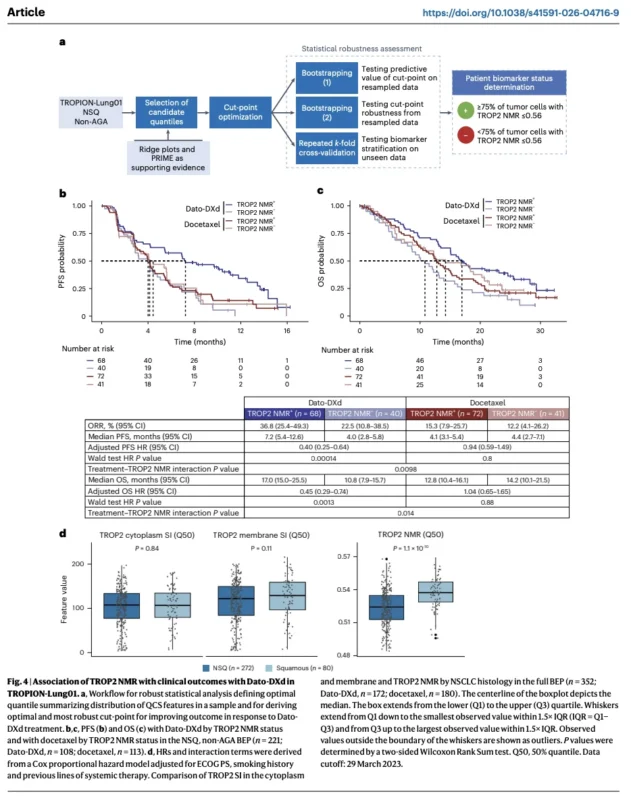
The primary intended-use population comprised 221 patients with nonsquamous NSCLC without actionable genomic alterations. Within this subgroup, 108 patients had received Dato-DXd and 113 had received docetaxel.
The investigators optimized and internally evaluated an NMR cutoff intended to distinguish tumors with a more favorable biological profile for Dato-DXd. The final definition classified a sample as TROP2 NMR-positive when at least 75% of tumor cells had an NMR value of 0.56 or lower.
This threshold was selected through statistical optimization, bootstrap analyses, and cross-validation. Importantly, the cutoff represents a research-stage biomarker definition and should not yet be treated as a validated routine clinical diagnostic threshold.
TROP2 NMR Identifies Differences in Progression-Free Survival
Among patients treated with Dato-DXd, the association between NMR status and treatment outcomes was substantial. Median PFS was 7.2 months in the NMR-positive group versus 4.0 months in the NMR-negative group. The adjusted HR was 0.40 (95% CI 0.25–0.64).
In contrast, patients treated with docetaxel demonstrated similar median PFS regardless of NMR status. Median PFS was 4.1 months among NMR-positive patients and 4.4 months among NMR-negative patients, with an adjusted HR of 0.94 (95% CI 0.59–1.49).
The treatment-by-biomarker interaction was statistically significant, with P = 0.0098. This interaction is particularly important because it suggests that NMR status modifies the association between treatment and outcome rather than merely identifying patients with a generally better prognosis.
The analysis also showed a higher objective response rate among Dato-DXd-treated patients with NMR-positive tumors. Response rates were 36.8% in the NMR-positive group and 22.5% in the NMR-negative group. These results provide evidence supporting the potential predictive value of the biomarker.
However, the adjusted HR of 0.40 compares NMR-positive with NMR-negative patients within the Dato-DXd treatment group. It is not the randomized treatment HR comparing Dato-DXd directly against docetaxel. That distinction is essential when interpreting the magnitude of the reported association.
Overall Survival Findings Reinforce the Signal
Although the NMR cutoff was optimized using PFS, exploratory overall survival analyses demonstrated a similar pattern. Among patients treated with Dato-DXd, median overall survival was 17.0 months in the NMR-positive group compared with 10.8 months in the NMR-negative group.
The adjusted HR was 0.45 (95% CI 0.29–0.74). In the docetaxel arm, median overall survival was 12.8 months among NMR-positive patients and 14.2 months among NMR-negative patients. The treatment-by-biomarker interaction for overall survival was statistically significant at P = 0.014.
These results strengthen the hypothesis that NMR may provide treatment-specific predictive information. Nevertheless, the overall survival analysis remains retrospective and exploratory.
The findings do not change the interpretation of the primary TROPION-Lung01 trial, which did not demonstrate a statistically significant overall survival benefit for Dato-DXd in the unselected overall population. Prospective studies are required to determine whether NMR-guided treatment selection can translate into improved clinical outcomes.
The Biological Explanation: ADC Internalization May Matter More Than Abundance
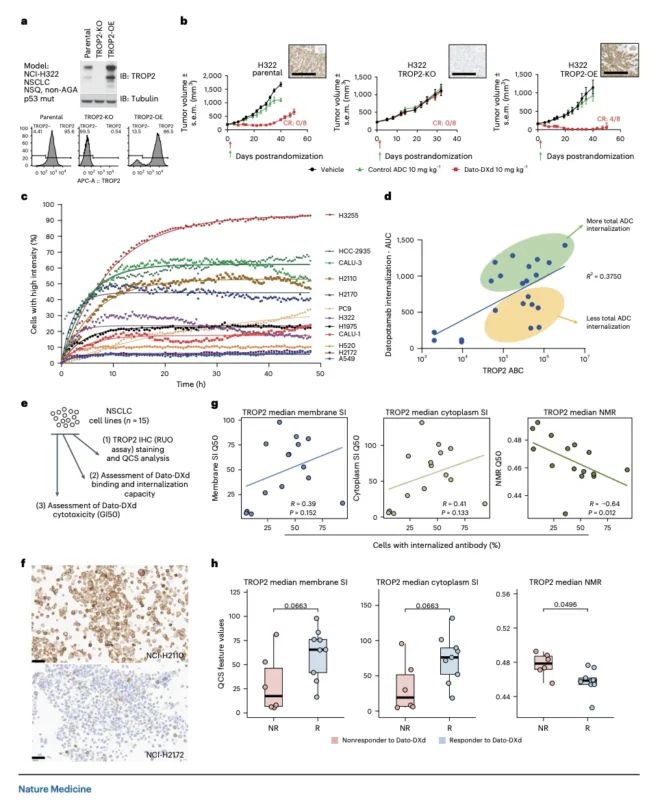
The investigators complemented the clinical analyses with preclinical experiments designed to understand the relationship between TROP2 distribution and Dato-DXd activity. Using genetically modified NSCLC cell lines, they demonstrated that TROP2 expression was necessary for Dato-DXd activity.
However, experimentally increasing TROP2 expression above baseline levels produced only limited additional antitumor benefit. Similarly, membrane or cytoplasmic staining intensity alone did not reliably predict ADC internalization.
By contrast, lower TROP2 NMR values were associated with greater datopotamab internalization in cell-line experiments. The reported association between NMR and internalization was significant, with a Spearman correlation coefficient of −0.64 and P = 0.012.
These observations provide a mechanistic rationale for the clinical findings. Dato-DXd requires intracellular processing to release its cytotoxic payload. Tumors with greater relative cytoplasmic TROP2 expression may have more active receptor trafficking and internalization, potentially facilitating drug delivery.
However, the study did not directly establish that NMR is a measure of receptor internalization in patients. The biological explanation remains a supported hypothesis rather than a definitively proven mechanism.
The results also do not establish that the same biomarker would predict response to other TROP2-directed ADCs, which may differ in linker stability, payload characteristics, and dependence on internalization.
A Predictive Biomarker Rather Than a General Prognostic Marker?
The distinction between prognostic and predictive biomarkers is central to this study. A prognostic biomarker provides information about the likely course of disease regardless of treatment. A predictive biomarker identifies differences in expected outcomes associated with a particular therapy.
The investigators examined NMR status in datasets from NEPTUNE and POSEIDON, studies evaluating immunotherapy-containing and chemotherapy-based regimens. In these analyses, NMR status was not associated with consistently different PFS outcomes across the treatment groups examined.
Together with the lack of comparable NMR-associated differences in the docetaxel arm of TROPION-Lung01, this supports a potentially treatment-specific association with Dato-DXd. However, these retrospective findings do not yet provide definitive prospective validation of predictive utility.
A biomarker can show promising treatment interactions in retrospective datasets and still fail to improve patient selection when evaluated prospectively. The clinical value of NMR therefore depends on whether future trials reproduce these findings using prespecified testing procedures and treatment strategies.
Reproducibility and the Role of AI-Assisted Pathology
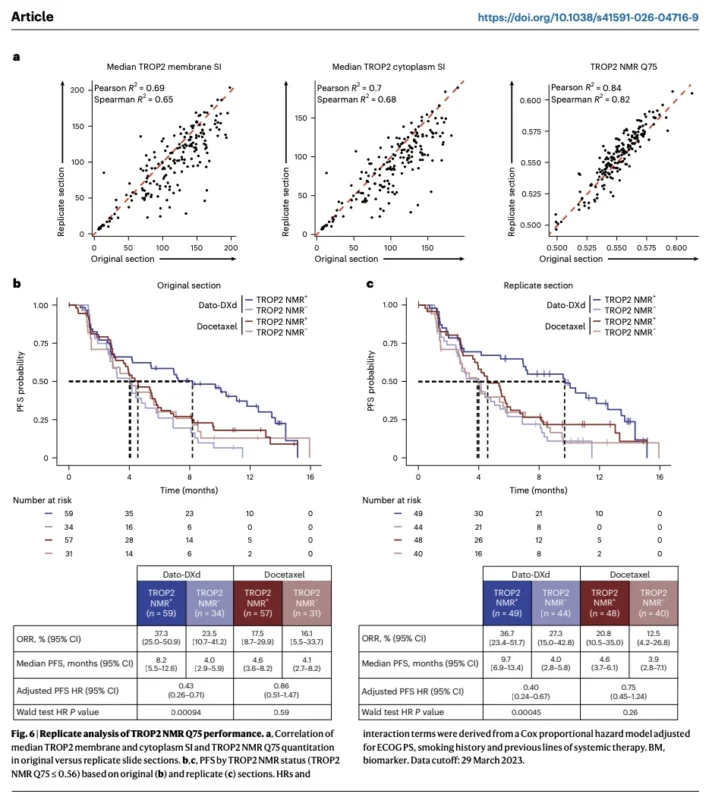
A major challenge for computational pathology biomarkers is whether results can be reproduced consistently across tissue sections, laboratories, staining conditions, and digital imaging systems. The investigators assessed reproducibility using adjacent tissue sections from TROPION-Lung01 samples.
NMR measurements demonstrated strong agreement between replicate sections, with a reported Pearson R² of 0.84. The association between NMR status and PFS was also maintained in the replicate analyses.
These findings support the technical robustness of the approach under the conditions evaluated. The research also reflects a broader transition toward computational analysis of pathological tissue. Traditional IHC scoring generally categorizes expression according to staining intensity and the proportion of positive cells.
Computational pathology can quantify more complex features, including subcellular localization, spatial heterogeneity, and relationships between different cellular compartments. Such characteristics may help explain therapeutic activity that conventional visual scoring fails to capture.
However, successful implementation requires validated software, standardized tissue processing, high-quality whole-slide imaging, regulatory oversight, and adequate laboratory infrastructure. The authors describe the development of the VENTANA TROP2 (EPR20043) RxDx Device through a collaboration between AstraZeneca and Roche Diagnostics.
The device received FDA Breakthrough Device Designation in April 2025. This designation recognizes its potential clinical importance but does not constitute regulatory approval for routine clinical use.
Does TROP2 NMR Predict Treatment Toxicity?
The study also examined whether NMR status was associated with differences in Dato-DXd safety. Among 344 treated patients in the biomarker-evaluable TROPION-Lung01 population, overall treatment-related adverse event rates were generally similar across NMR categories.
However, treatment-related adverse events of special interest, including stomatitis, ocular surface events, and adjudicated drug-related interstitial lung disease, were more frequent among NMR-positive patients.
Most events were grade 1 or 2. For grade 3 or higher adverse events of special interest, the main difference was stomatitis, reported in 7% of NMR-positive patients versus 3% of NMR-negative patients. These findings raise an important consideration.
A biomarker associated with greater antitumor activity may also identify patients with differences in treatment-related toxicity. However, the study does not establish NMR as a validated toxicity predictor. Irrespective of biomarker status, the known safety risks of Dato-DXd, including interstitial lung disease, stomatitis, and ocular toxicity, remain clinically relevant.
How Does This Fit Into the Current Dato-DXd Treatment Landscape?
Dato-DXd has already entered clinical practice for a molecularly defined population of patients with NSCLC.
On June 23, 2025, the US Food and Drug Administration granted accelerated approval for adults with locally advanced or metastatic EGFR-mutated NSCLC previously treated with an EGFR-directed therapy and platinum-based chemotherapy. This regulatory indication is distinct from the primary biomarker-development population examined in the new study.
The NMR analysis focused principally on patients with nonsquamous NSCLC without actionable genomic alterations, where the investigators considered an additional predictive biomarker particularly important.
Therefore, the results should not be interpreted as establishing NMR testing as a requirement for the existing EGFR-mutated NSCLC indication. Nor do they establish Dato-DXd as standard treatment for all patients with NMR-positive, non-EGFR-mutated NSCLC.
Clinical application in this population will depend on prospective validation, trial outcomes, and applicable regulatory decisions.
What Must Be Confirmed Before Clinical Adoption?
The new research has several important limitations. First, the clinical biomarker analyses were retrospective and exploratory.
Although the investigators used rigorous statistical methods, including bootstrap resampling and cross-validation, the final threshold was optimized using data from the same TROPION-Lung01 biomarker population in which clinical performance was evaluated.
Internal validation reduces concerns about overfitting but does not replace independent prospective validation. Second, the biomarker-evaluable population represented only a subset of patients enrolled in the original trials.
Differences between patients with suitable tissue samples and the broader randomized population may affect generalizability. Third, the analysis was developed principally for nonsquamous NSCLC without actionable genomic alterations.
Its predictive value in EGFR-mutated, ALK-rearranged, squamous, or other NSCLC populations remains uncertain. Fourth, the clinical relevance of NMR may differ across ADC platforms.
A biomarker associated with a drug that relies on internalization and intracellular linker cleavage may not perform similarly for agents with different linker or payload characteristics.
Finally, implementation will require an appropriately validated computational pathology platform. The underlying image-analysis source code is proprietary, and the assay has not yet been established as a universally available clinical diagnostic.
These limitations reinforce the need to avoid premature adoption of NMR-based treatment decisions.
Prospective Trials May Define the Next Step
Several ongoing phase III trials may help clarify the clinical relevance of TROP2 NMR. AVANZAR is evaluating Dato-DXd with durvalumab and carboplatin in first-line NSCLC without actionable genomic alterations.
TROPION-Lung07 is investigating Dato-DXd plus pembrolizumab, with or without platinum chemotherapy, in first-line nonsquamous NSCLC.
TROPION-Lung10 is evaluating Dato-DXd with rilvegostomig. The TROPION-Lung17 study is specifically investigating Dato-DXd monotherapy in previously treated TROP2 NMR-positive nonsquamous NSCLC without actionable genomic alterations.
These studies may provide an opportunity to assess whether NMR can improve patient selection in prospectively defined populations. The central question is no longer only whether NMR is associated with response.
It is whether selecting patients through this biomarker can improve treatment outcomes sufficiently to justify its integration into routine oncology practice.
OncoDaily Takeaway
The new Nature Medicine study introduces a potentially important shift in how predictive biomarkers for antibody–drug conjugates are developed. Rather than relying on conventional TROP2 expression intensity, investigators used computational pathology to measure the intracellular distribution of the target protein.
In the TROPION-Lung01 biomarker-evaluable nonsquamous, non-AGA population, TROP2 NMR positivity was associated with longer progression-free survival, longer overall survival, and higher response rates following Dato-DXd treatment.
The absence of a similar association in docetaxel-treated patients, together with statistically significant treatment–biomarker interactions, supports the hypothesis that NMR may be predictive rather than merely prognostic.
Preclinical experiments suggest that greater relative cytoplasmic TROP2 localization may reflect biological processes associated with ADC internalization and payload delivery. However, the findings remain retrospective, the biomarker is not yet prospectively validated for routine treatment selection, and its applicability across other ADCs and molecular subgroups is uncertain.
The central clinical implication is that ADC biomarkers may need to move beyond target abundance toward quantitative measurements of target biology, localization, and cellular trafficking. If confirmed prospectively, TROP2 NMR could represent an important step toward integrating AI-assisted pathology into precision treatment selection for lung cancer.
Sources
- Garassino MC, Ahn MJ, Schick M, et al. Normalized Membrane Ratio of TROP2 as a Predictor of Clinical Outcomes With Datopotamab Deruxtecan in Non-Small-Cell Lung Cancer. Nature Medicine. Published online November 11, 2026. DOI: 10.1038/s41591-026-04716-9
- Ahn MJ, et al. Datopotamab Deruxtecan Versus Docetaxel for Previously Treated Advanced or Metastatic Non-Small Cell Lung Cancer: The Randomized Phase III TROPION-Lung01 Study. Journal of Clinical Oncology. 2025;43:260–272.
- Shimizu T, et al. First-in-Human Phase I Study of Datopotamab Deruxtecan in Non-Small-Cell Lung Cancer: TROPION-PanTumor01. Journal of Clinical Oncology. 2023;41:4678–4687.
- US Food and Drug Administration. FDA Grants Accelerated Approval to Datopotamab Deruxtecan-dlnk for EGFR-Mutated Non-Small Cell Lung Cancer. June 23, 2025.