The phase 2b TRITON study, presented by Ferdinandos Skoulidis at the 2026 ASCO Annual Meeting, evaluated whether adding tremelimumab, an anti-CTLA-4 antibody, to durvalumab plus chemotherapy could improve outcomes compared with pembrolizumab plus chemotherapy in first-line non-squamous metastatic NSCLC with STK11, KEAP1, and/or KRAS mutations (Skoulidis et al., 2026).
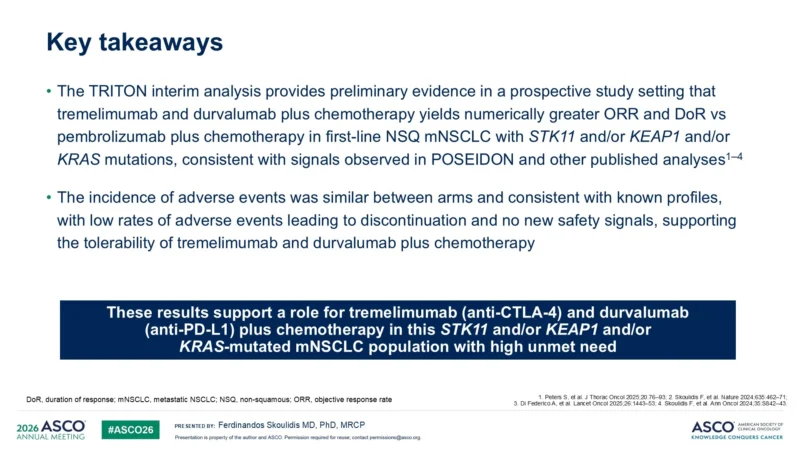
This is a clinically important population because tumors with STK11 and KEAP1 alterations, especially when co-mutated with KRAS, often have an immunologically “cold” tumor microenvironment and poorer outcomes with standard anti-PD-(L)1-based therapy.
Why TRITON Matters
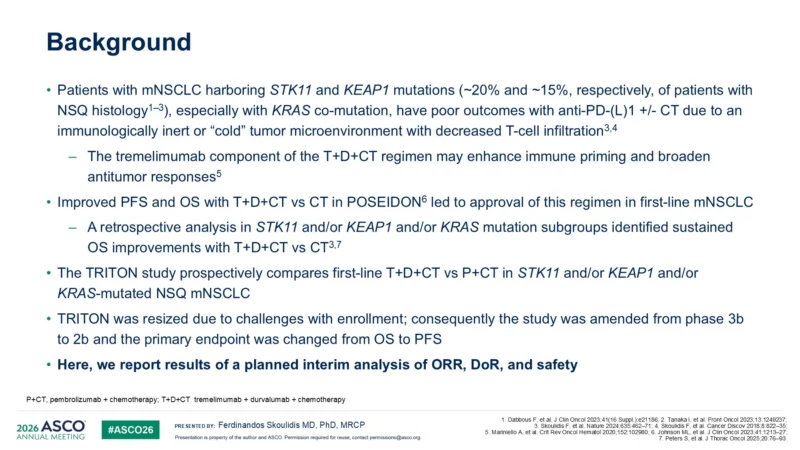
The rationale for TRITON comes from prior signals suggesting that adding CTLA-4 blockade may broaden immune priming and deepen antitumor responses in molecularly defined NSCLC subsets. In the phase 3 POSEIDON study, tremelimumab plus durvalumab and chemotherapy improved outcomes compared with chemotherapy alone, and retrospective analyses suggested sustained benefit in patients with STK11, KEAP1, and/or KRAS mutations.
TRITON was designed to prospectively test this strategy against a relevant modern comparator: pembrolizumab plus chemotherapy.
Study Design
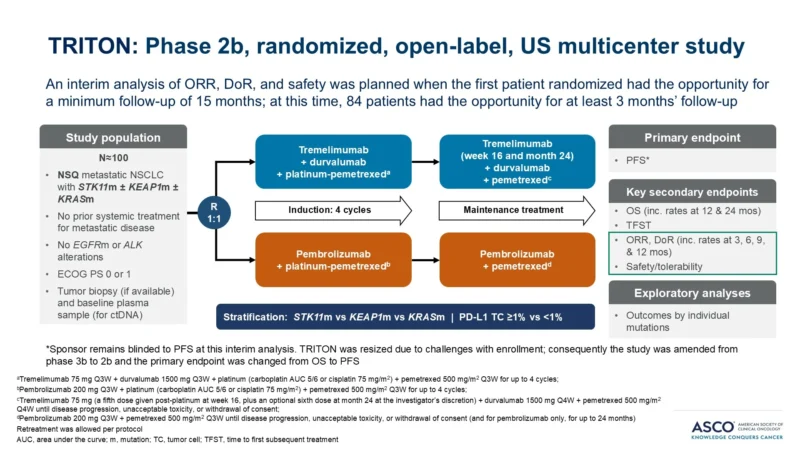
TRITON is a phase 2b, randomized, open-label, US multicenter study. Patients had treatment-naïve, EGFR/ALK wild-type, non-squamous metastatic NSCLC with STK11, KEAP1, and/or KRAS mutations and ECOG performance status 0 or 1.
Patients were randomized 1:1 to receive either tremelimumab plus durvalumab plus platinum-pemetrexed chemotherapy, followed by durvalumab plus pemetrexed maintenance, or pembrolizumab plus platinum-pemetrexed chemotherapy, followed by pembrolizumab plus pemetrexed maintenance.
The primary endpoint is progression-free survival, but the sponsor remained blinded to PFS at this interim analysis. The planned interim analysis focused on objective response rate, duration of response, and safety (Skoulidis et al., 2026).
Interim Efficacy Results
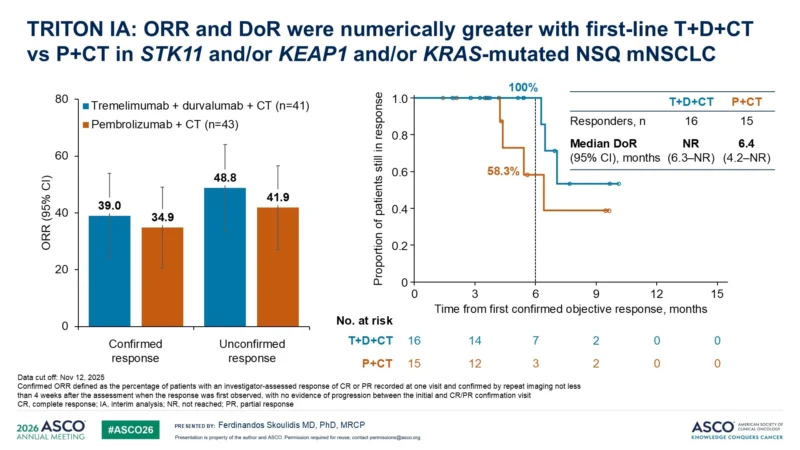
At the data cutoff of November 12, 2025, 41 patients had been randomized to tremelimumab plus durvalumab and chemotherapy, and 43 patients to pembrolizumab plus chemotherapy.
The confirmed objective response rate was numerically higher with the tremelimumab-containing regimen:
39.0% with tremelimumab plus durvalumab and chemotherapy versus 34.9% with pembrolizumab plus chemotherapy.
Unconfirmed response rates were also numerically higher:
48.8% versus 41.9%, respectively.
Duration of response also favored the tremelimumab plus durvalumab regimen. Median DoR was not reached with tremelimumab plus durvalumab and chemotherapy compared with 6.4 months with pembrolizumab plus chemotherapy. At 6 months, 100% of responders in the tremelimumab plus durvalumab arm remained in response compared with 58.3% in the pembrolizumab arm (Skoulidis et al., 2026).
In an exploratory subgroup of patients with KRAS mutation only, the ORR was 48.0% with tremelimumab plus durvalumab and chemotherapy versus 33.3% with pembrolizumab plus chemotherapy.
Safety Findings
Safety appeared broadly comparable between arms. Grade 3 or 4 treatment-related adverse events occurred in 41.5% of patients treated with tremelimumab plus durvalumab and chemotherapy and 41.9% of patients treated with pembrolizumab plus chemotherapy.
Treatment-related adverse events leading to discontinuation occurred in 2.4% versus 4.7% of patients, respectively. Treatment-related adverse events leading to death occurred in 0% of patients in the tremelimumab plus durvalumab arm and 2.3% in the pembrolizumab arm.
According to the presentation, no new safety signals were identified, and the adverse event profile was consistent with the known profiles of the study regimens (Skoulidis et al., 2026).
Clinical Meaning
The TRITON interim analysis suggests a potential role for CTLA-4 intensification in patients with STK11, KEAP1, and/or KRAS-mutated non-squamous metastatic NSCLC, a group with high unmet need and historically challenging immunotherapy outcomes.
However, the findings remain preliminary. The most important endpoint, progression-free survival, was not yet available at this interim analysis because the sponsor remained blinded. Therefore, the current data should be interpreted as an early signal based on response rate, response durability, and safety rather than definitive evidence of superiority.
The most clinically interesting signal is the longer duration of response with tremelimumab plus durvalumab and chemotherapy, especially the 6-month response durability rate of 100% versus 58.3%. If this translates into improved PFS and eventually survival, TRITON may help define a biomarker-driven role for CTLA-4-based chemoimmunotherapy in metastatic NSCLC.
Key Takeaway
The interim TRITON analysis showed numerically higher ORR and more durable responses with tremelimumab plus durvalumab and chemotherapy compared with pembrolizumab plus chemotherapy in first-line non-squamous metastatic NSCLC with STK11, KEAP1, and/or KRAS mutations.
The data support further follow-up, especially for PFS and OS, to determine whether this early response signal becomes a practice-relevant treatment strategy.