Small-cell lung cancer has entered a period of unusually rapid therapeutic change. After decades in which relapsed disease was dominated by cytotoxic chemotherapy and modest survival gains, two distinct immune-directed strategies are now challenging the traditional treatment paradigm: DLL3-directed T-cell engagement and B7-H3–directed antibody–drug conjugates.
The phase III TAISHAN-302 trial, published in The New England Journal of Medicine on September 12, 2026, provides some of the strongest evidence to date for the latter approach. In patients with SCLC progressing after first-line platinum-based therapy, tambotatug pelitecan (Tam-Peli) significantly improved overall survival, progression-free survival, and objective response compared with topotecan, while producing fewer grade ≥3 adverse events.
The magnitude of benefit is notable. Median overall survival reached 13.3 months with Tam-Peli versus 9.4 months with topotecan, corresponding to a 54% reduction in the risk of death. Median PFS improved from 2.8 to 7.4 months, and objective response increased from 9.7% to 59.1%.
For a disease in which second-line treatment has historically delivered limited durability, these results position B7-H3–directed ADC therapy as a potentially important new component of the relapsed SCLC landscape.
Why B7-H3 Is an Attractive Target in SCLC
B7-H3, also known as CD276, is an immune-regulatory member of the B7 family that is highly expressed across several malignancies while showing more limited expression in many normal tissues. In SCLC, earlier quantitative immunofluorescence studies detected B7-H3 in approximately 65% of tumor specimens, while more recent molecular profiling has demonstrated substantial expression across broader SCLC populations.
This makes B7-H3 particularly attractive in SCLC, where classic actionable genomic drivers remain uncommon. Tam-Peli, previously known as YL201, is a B7-H3–targeting ADC consisting of a human IgG1 anti–B7-H3 antibody linked through a tripeptide-based linker to YL0010014, a camptothecin-derived topoisomerase I inhibitor payload.
The therapeutic concept therefore differs fundamentally from checkpoint inhibition or DLL3-directed T-cell engagement. B7-H3 serves as the tumor-associated delivery address, allowing a potent cytotoxic payload to be transported preferentially into B7-H3–expressing cancer cells.
TAISHAN-302 Directly Challenged an Established Second-Line Standard
TAISHAN-302 was a phase III, open-label, randomized superiority trial conducted across 85 clinical sites in China.
Eligible patients had SCLC that had progressed or relapsed during or after first-line platinum-based therapy. Patients were required to have ECOG performance status 0–1, measurable disease, and adequate organ function. Selected patients with stable asymptomatic brain metastases were eligible.
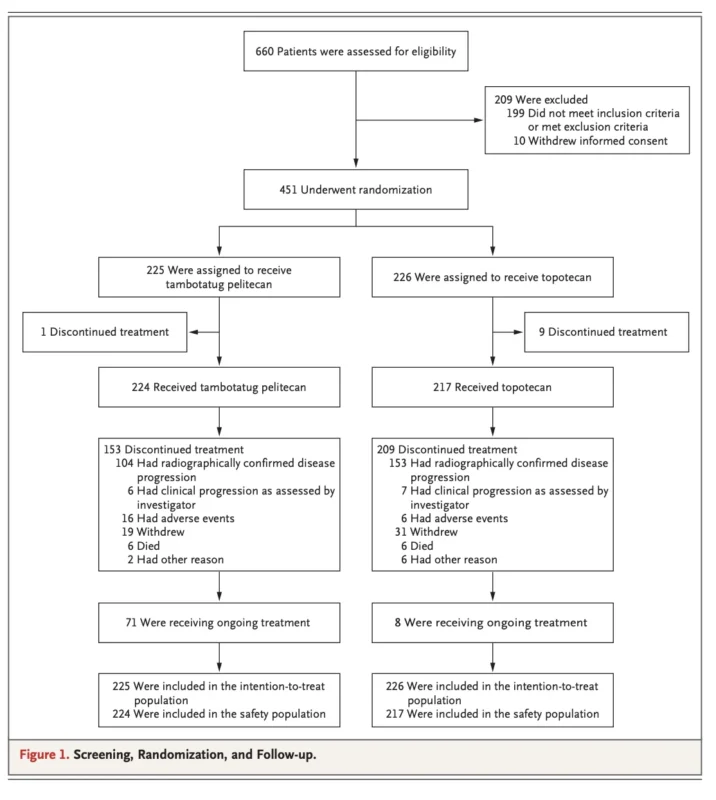
A total of 451 patients were randomized 1:1 to:
- Tam-Peli 2.0 mg/kg intravenously every 3 weeks
or
- topotecan 1.2 mg/m² intravenously on days 1–5 every 3 weeks.
The primary endpoint was overall survival, with investigator-assessed PFS and objective response as key secondary endpoints. Importantly, crossover between treatment groups was not permitted. This matters because the study did not rely primarily on response rate or PFS to establish clinical value. It was designed around the most definitive endpoint in relapsed SCLC: survival.
Overall Survival Improved by Nearly Four Months
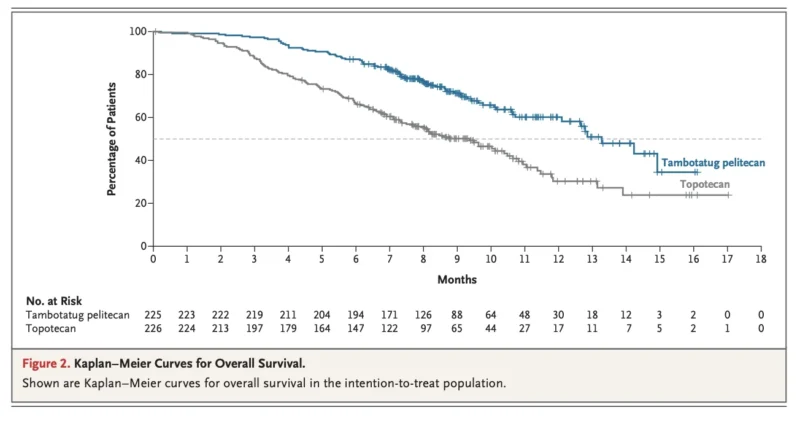
At the prespecified interim analysis, 200 deaths had occurred.
Median overall survival was:
- 13.3 months with Tam-Peli
versus
- 9.4 months with topotecan
with a hazard ratio for death of 0.46 (95% CI, 0.35–0.62; P<0.001).
That represents one of the most clinically compelling findings from the trial. The benefit was not limited to the overall population. Among the 434 patients with systemic disease, median OS was 12.8 months with Tam-Peli versus 8.8 months with topotecan, corresponding to an unstratified HR of 0.49. The investigators also reported an OS benefit across most prespecified subgroups.
The Kaplan–Meier curves on page 7 show an early and sustained separation between treatment groups, with the Tam-Peli survival curve remaining clearly above the topotecan curve throughout most of the observed follow-up.
PFS Benefit Was Even More Pronounced
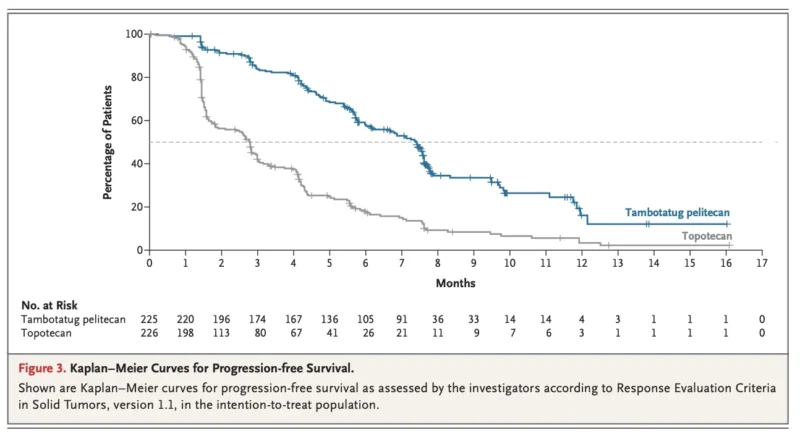
The progression-free survival result was similarly striking. Median PFS reached 7.4 months with Tam-Peli compared with 2.8 months with topotecan, corresponding to a hazard ratio of 0.29 (95% CI, 0.23–0.37; P<0.001).
This translates into a 71% reduction in the risk of progression or death. The PFS curves shown on page 8 separate rapidly after treatment initiation and remain distinctly apart through follow-up, illustrating the depth of difference in disease control between the two strategies.
The magnitude of the PFS benefit is particularly meaningful given the aggressive biology of relapsed SCLC, where disease can progress within weeks or months after first-line therapy.
Response Rate Increased From 9.7% to 59.1%
The tumor-response data further distinguish Tam-Peli from topotecan. A confirmed objective response was observed in 59.1% of patients receiving Tam-Peli compared with only 9.7% receiving topotecan. This approximately six-fold difference demonstrates that the ADC is not simply delaying disease progression through stabilization. A substantial proportion of patients experienced measurable tumor regression.
Median duration of response was 6.3 months with Tam-Peli and 7.8 months with topotecan, although interpretation of this comparison requires caution because far fewer patients responded to topotecan. The combination of a high response rate, large PFS improvement, and statistically significant OS advantage provides a coherent efficacy signal across all major trial endpoints.
Activity in Brain Metastases Adds Clinical Relevance
Central nervous system disease remains a major challenge in SCLC, making the intracranial results particularly important. A total of 143 patients had intracranial lesions at baseline. Investigator-assessed intracranial response was 32% with Tam-Peli compared with 3% with topotecan.
Median intracranial PFS was 6.1 versus 4.2 months, respectively. These results are exploratory rather than formally multiplicity-controlled primary outcomes, but they provide evidence that Tam-Peli has clinically relevant activity in a population where CNS progression is common.
The trial population itself was highly relevant to real-world SCLC: approximately 34% had a history or presence of brain metastases, almost half had platinum-resistant disease, and 87% had previously received PD-1 or PD-L1 therapy.
The Safety Comparison Is an Important Part of the Result
One of the most notable findings from TAISHAN-302 is that the major efficacy improvement was not accompanied by a higher overall incidence of severe toxicity.
Grade ≥3 adverse events occurred in:
- 55.4% with Tam-Peli
versus
- 77.9% with topotecan.
Serious adverse events occurred in 38.8% and 43.3%, respectively.
The detailed safety table on page 9 shows why the difference matters. Topotecan produced markedly higher rates of severe hematologic toxicity, particularly grade ≥3 thrombocytopenia at 54.8% versus 12.5%, anemia at 23.5% versus 10.7%, leukopenia at 32.3% versus 19.2%, and neutropenia at 35.5% versus 21.0%.
Tam-Peli still produced substantial myelosuppression, so hematologic surveillance remains necessary. However, its benefit-risk profile appears meaningfully different from that of topotecan. This is especially important because second-line SCLC patients may already have compromised marrow reserve after platinum–etoposide therapy.
ILD Remains a Relevant ADC Toxicity
Interstitial lung disease and pneumonitis occurred in 4.9% of patients receiving Tam-Peli compared with 1.4% receiving topotecan. Among the 11 Tam-Peli cases, nine were grade 1–2 and two were grade 3. There were no grade 4 or 5 ILD events. All affected patients received systemic glucocorticoids, and six permanently discontinued Tam-Peli.
The investigators note that this ILD incidence appeared lower than that reported with some other investigational B7-H3 ADCs, although cross-trial comparisons remain inappropriate. The practical message is that Tam-Peli may have a favorable overall severe-toxicity profile compared with topotecan, but pulmonary toxicity remains a class-relevant issue requiring active surveillance.
Tam-Peli and Tarlatamab May Define Two Different Paths Beyond Chemotherapy
The most interesting clinical question raised by TAISHAN-302 is not whether Tam-Peli is better than topotecan. The trial answers that question convincingly. The more difficult issue is how Tam-Peli should eventually be positioned relative to tarlatamab, the DLL3×CD3 bispecific T-cell engager that has also demonstrated an OS benefit in previously treated SCLC.
The TAISHAN-302 investigators explicitly discuss this comparison. In DeLLphi-304, median OS was 13.6 months with tarlatamab versus 8.3 months with chemotherapy. In TAISHAN-302, median OS was 13.3 months with Tam-Peli versus 9.4 months with topotecan.
These figures should not be used for indirect efficacy ranking. The patient populations, control regimens, subsequent therapies, geography, and study designs differed. What is clinically more relevant is that the two therapies use fundamentally different biology.
Tarlatamab: DLL3×CD3 T-cell engagement. Tam-Peli: B7-H3-directed delivery of a topoisomerase I payload
Their toxicity profiles also differ, with tarlatamab associated predominantly with cytokine-release syndrome and immune effector cell–associated neurotoxicity, while Tam-Peli is characterized more by myelosuppression and ADC-associated pulmonary toxicity.
Relapsed SCLC may therefore be moving away from a single chemotherapy standard toward multiple mechanistically distinct therapeutic classes. The next major research question is sequencing.
B7-H3 Selection Was Not Required
Another important aspect of TAISHAN-302 is that treatment was not described as requiring prospective B7-H3 biomarker selection.
That raises a potentially important question for future development: does the level, distribution, or heterogeneity of B7-H3 expression predict response?
If Tam-Peli proves broadly active without a biomarker requirement, its clinical implementation could be relatively straightforward. Conversely, if future translational analyses identify an expression threshold associated with deeper or more durable benefit, B7-H3 testing could eventually become relevant for treatment selection.
The trial itself establishes B7-H3 as a therapeutic entry point, but it does not yet establish B7-H3 expression as a validated predictive biomarker.
Important Limitations Remain
Despite the strength of the randomized survival data, the authors identify several limitations.
TAISHAN-302 was open label, which can influence treatment management and adverse-event reporting. PFS and response were assessed by investigators rather than blinded independent central review, although the primary endpoint of overall survival is not affected by radiographic interpretation.
More importantly, enrollment occurred entirely in China. The study included a relatively high proportion of never-smokers and was predominantly male, and the authors appropriately state that validation in more geographically and demographically diverse populations is required before the findings can be fully generalized worldwide.
The median follow-up was also still relatively short at approximately nine months at this prespecified interim analysis, meaning that longer-term survival and safety follow-up remain important.
Development Is Already Moving Into First Line
Perhaps the clearest indication of confidence in the platform is that Tam-Peli development is already moving earlier. The authors report that a phase III trial evaluating tambotatug pelitecan combined with a PD-1 inhibitor as first-line therapy for SCLC is ongoing.
That trajectory mirrors a broader pattern in thoracic oncology. Once a therapy demonstrates meaningful activity in relapsed disease, the next question becomes whether deploying it earlier can prevent resistant disease from becoming established.
For B7-H3 ADCs, TAISHAN-302 may therefore represent not the endpoint of development, but the beginning of a much broader SCLC program.
The Bottom Line
TAISHAN-302 provides phase III evidence that B7-H3–directed ADC therapy can meaningfully extend survival in relapsed SCLC.
Among 451 randomized patients, Tam-Peli improved:
- Overall survival: 13.3 vs 9.4 months; HR 0.46
- Progression-free survival: 7.4 vs 2.8 months; HR 0.29
- Objective response rate: 59.1% vs 9.7%
- Grade ≥3 adverse events: 55.4% vs 77.9%
These are not incremental differences. They represent substantial improvements over topotecan across survival, disease control, tumor response, and overall severe toxicity.
The findings also illustrate how rapidly the biology of relapsed SCLC is changing. The treatment conversation is shifting from which chemotherapy should follow platinum toward which tumor-associated immune target should be exploited, with which therapeutic modality, and in what sequence.
DLL3-directed T-cell engagement has already demonstrated that SCLC can be treated through surface-targeted immunobiology. TAISHAN-302 now provides phase III evidence that B7-H3 can support an entirely different but similarly powerful therapeutic strategy.
The immediate result is a compelling new second-line option. The larger implication is that relapsed SCLC may finally be moving beyond the chemotherapy era.
Reference
- Zhao Y, Liu H, Meng X, et al; TAISHAN-302 Investigators. Tambotatug Pelitecan in Small-Cell Lung Cancer after Platinum-Based Therapy. New England Journal of Medicine. Published September 12, 2026. doi:10.1056/NEJMoa2610229.