
Small-molecule inhibitors have become central to the treatment of oncogene-driven non-small cell lung cancer (NSCLC), but their expanding use has introduced a parallel challenge: the same drug may behave very differently depending on food intake, gastric pH, concomitant medications, and patient-specific toxicity risk.
A 2026 review in eClinicalMedicine by Lotte M. G. Hulskotte and colleagues provides a clinically focused overview of pharmacokinetic interactions and adverse-event management across FDA- and EMA-approved small-molecule inhibitors used in NSCLC.
The review emphasizes that inadequate exposure may compromise efficacy, whereas excessive exposure can increase toxicity. Food, proton-pump inhibitors (PPIs), CYP-enzyme modulators, and drug transporters therefore need to be considered as part of routine prescribing rather than as secondary pharmacologic details.
Why Drug Exposure Matters
Most NSCLC small-molecule inhibitors are weakly basic, lipophilic compounds whose absorption and metabolism can be highly sensitive to physiologic and pharmacologic factors.
Elevation of gastric pH can reduce absorption of some agents, while food can either increase or decrease exposure depending on the drug. Many inhibitors are also metabolized through CYP450 enzymes, particularly CYP3A, making strong enzyme inducers or inhibitors clinically important interaction partners.
The authors note that systemic exposure outside the conventional 80%–125% bioequivalence range may become clinically meaningful. Subtherapeutic concentrations can reduce efficacy, while increased exposure may increase toxicity.
Food Is Part of the Prescription
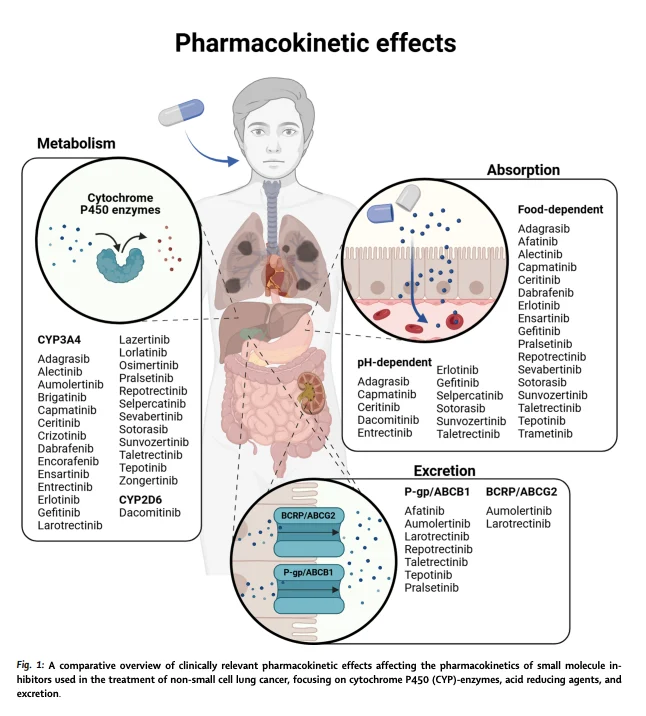
One of the review’s clearest practical messages is that food instructions should be treated as part of the treatment regimen. For ceritinib, an initial dose of 750 mg under fasting conditions was later replaced by 450 mg with food after studies demonstrated comparable systemic exposure with reduced gastrointestinal toxicity. Food may also mitigate gastrointestinal adverse effects with adagrasib and taletrectinib.
The magnitude of food effects can be substantial. For alectinib, exposure increased approximately 40% with a low-fat meal compared with fasting, while a high-fat meal produced an approximately 240% increase. In another study, 35% of patients taking alectinib with low-fat yogurt failed to reach the desired exposure threshold, compared with only 5% of those taking the drug with a continental breakfast or lunch.
Conversely, some agents are specifically intended to be taken in a fasted state because food can substantially increase systemic exposure. This variability underscores why standardized advice such as “take with food” cannot be generalized across targeted therapies.
PPIs Can Dramatically Change Exposure
Acid-suppressive therapy is another major source of clinically relevant interaction. PPIs increase gastric pH and can substantially reduce the bioavailability of pH-dependent small-molecule inhibitors.
For erlotinib, omeprazole reduced exposure by approximately 46%, while esomeprazole produced a similar reduction. Interestingly, administering erlotinib with cola during PPI therapy partly restored exposure, increasing AUC by approximately 39% compared with water. For sotorasib, omeprazole reduced exposure by approximately 42% in the fasted state and 57% when given with food. An acidic beverage attenuated the reduction to approximately 23%.
Selpercatinib illustrates how food can sometimes compensate for acid suppression: concomitant PPI use in the fasted state reduced exposure by approximately 69%, whereas administration with food largely preserved systemic exposure.
The review therefore recommends drug-specific strategies when acid suppression cannot be avoided, including minimizing PPI exposure, adjusting dose timing, or taking selected agents with food or an acidic beverage when supported by pharmacokinetic data.
CYP3A Interactions Can Be Even Larger
Strong CYP3A modulation can result in dramatic changes in exposure. For repotrectinib, rifampicin reduced AUC by more than 90%, whereas itraconazole increased exposure by nearly sixfold. Similarly, itraconazole increased exposure to entrectinib by more than 500%, while rifampicin reduced it by approximately 77%.
For osimertinib, rifampicin reduced systemic exposure by approximately 78%, illustrating why strong CYP3A induction can potentially lead to clinically relevant underexposure even with established targeted therapies. The practical implication is straightforward: medication reconciliation in patients receiving targeted therapy should include prescription drugs, over-the-counter medications, supplements, and dietary products that may influence CYP activity.
Pharmacology Also Determines Toxicity
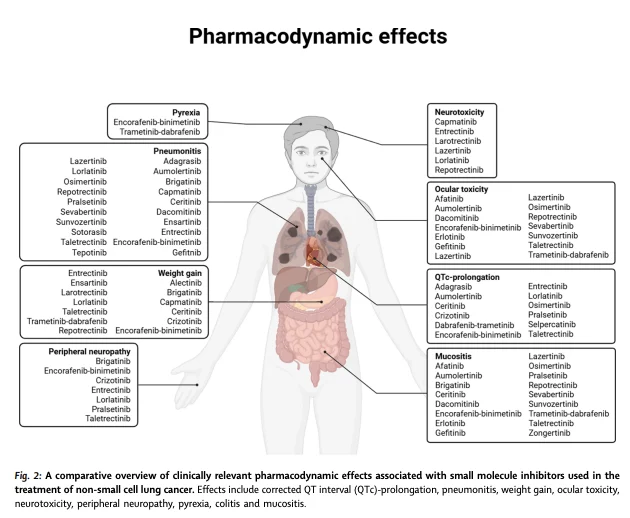
The review extends beyond pharmacokinetics to clinically important pharmacodynamic adverse effects. Highlighted toxicities include QTc prolongation, pneumonitis/ILD, ocular toxicity, hepatotoxicity, neurotoxicity, weight gain, pyrexia, mucositis, and colitis.
Importantly, these toxicities are not uniform across agents within the same drug class.
QTc Prolongation Requires Agent-Specific Monitoring
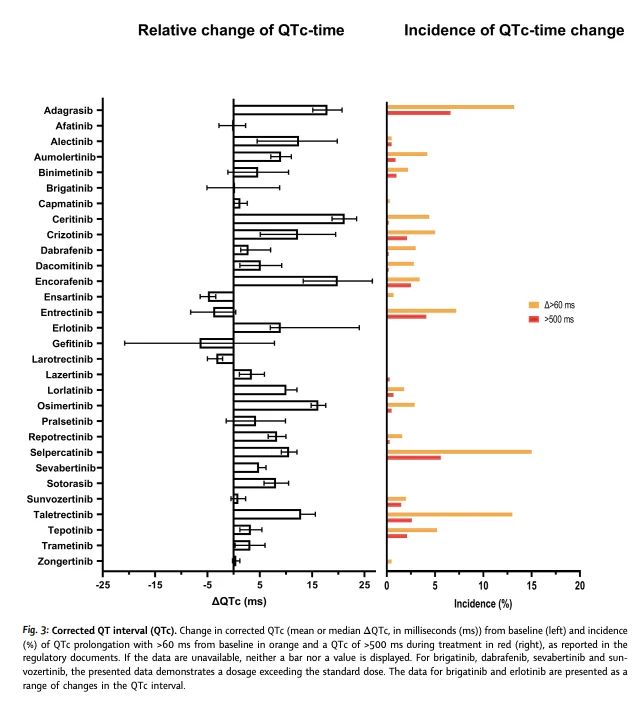
QTc prolongation is described as a class concern, but the magnitude varies considerably between drugs. Relatively larger median QTc increases were reported with adagrasib, ceritinib, crizotinib, encorafenib, osimertinib, and taletrectinib.
The highest frequencies of clinically significant QTc prolongation were reported with agents including adagrasib, encorafenib, taletrectinib, entrectinib, and selpercatinib. Because QT effects are often exposure-dependent, pharmacokinetic interactions that increase drug concentrations may simultaneously increase cardiac risk.
The authors emphasize individualized ECG and electrolyte monitoring, particularly in patients with cardiovascular disease, electrolyte disturbances, or concomitant QT-prolonging medications. Treatment interruption, dose reduction, or discontinuation may be necessary when QTc exceeds 500 ms or clinically significant arrhythmias occur.
Pneumonitis Remains a Potentially Serious Toxicity
Drug-induced pneumonitis and interstitial lung disease remain among the most clinically important complications of targeted therapy. The review reports relatively high rates with several agents. With brigatinib, approximately 9% of patients developed all-grade pneumonitis and 4%–6% experienced grade ≥3 events. With pralsetinib, all-grade pneumonitis was reported in approximately 12% and grade ≥3 toxicity in approximately 3%.
Adagrasib, capmatinib, ensartinib, and sunvozertinib were also associated with clinically meaningful rates of ILD or pneumonitis. The review additionally notes evidence suggesting increased susceptibility to SMI-associated ILD in some Asian populations, although this association varies by agent and underlying dataset.
Weight Gain Is Becoming a Relevant Long-Term Toxicity
Weight gain is increasingly recognized with selected targeted therapies, particularly agents such as lorlatinib and alectinib. Lorlatinib was associated with an approximately 8% increase in body weight during the first six months of therapy, compared with smaller changes reported with alectinib, brigatinib, and crizotinib.
The authors recommend routine weight monitoring together with assessment of metabolic and cardiovascular consequences. Lifestyle interventions remain first-line management, although pharmacologic approaches may sometimes be required.
This creates an interesting pharmacologic tension with agents such as alectinib, for which adequate food intake—and particularly meal composition, can materially affect exposure.
Pyrexia and Mucositis Have Distinct Class Patterns
Non-infectious pyrexia is particularly associated with BRAF/MEK inhibition. Dabrafenib plus trametinib was associated with pyrexia in approximately 39% of patients, with some experiencing clinically significant complications including dehydration, hypotension, renal dysfunction, or confusion.
Management includes temporary interruption, exclusion of infection, antipyretics, and, in selected severe cases, corticosteroids and dose reduction on rechallenge. Mucositis is particularly relevant with EGFR inhibitors.
All-grade stomatitis occurs in approximately 9%–17% of patients treated with first-generation EGFR inhibitors such as gefitinib and erlotinib but exceeds 70% with the second-generation agents afatinib and dacomitinib. Grade ≥3 stomatitis was reported in approximately 9% with afatinib and 5% with dacomitinib. The review recommends oral hygiene, pain management, nutritional support, and treatment interruption or dose reduction for clinically significant grade 2–3 events.
Hepatotoxicity May Not Necessarily End Targeted Therapy
Hepatotoxicity is observed with many NSCLC small-molecule inhibitors and can require dose interruption, reduction, or permanent discontinuation. However, limited evidence suggests that switching within the same therapeutic class may sometimes be feasible.
Patients who developed hepatotoxicity with gefitinib have in some reports subsequently tolerated erlotinib. Similarly, five patients successfully switched from sotorasib to adagrasib without recurrence of hepatotoxicity. These observations remain limited but suggest that liver toxicity may sometimes be drug-specific rather than an absolute class effect.
OncoDaily Takeaway
The expanding targeted-treatment landscape in NSCLC means that prescribing decisions increasingly extend beyond choosing the correct molecular target. Food, gastric pH, CYP modulation, drug transporters, and concomitant medications can meaningfully change systemic exposure, and therefore efficacy and toxicity.
At the same time, adverse events such as QTc prolongation, pneumonitis, neurotoxicity, weight gain, mucositis, ocular toxicity, pyrexia, and hepatotoxicity require agent-specific monitoring rather than a uniform “TKI toxicity” approach.
The review ultimately argues for a more pharmacologically informed model of precision oncology: molecular selection identifies which drug to prescribe, but pharmacokinetics and pharmacodynamics help determine how that drug should be prescribed safely and effectively. Future studies linking drug exposure more directly to efficacy and toxicity may further enable individualized dosing strategies and reduce both treatment failure and avoidable adverse events.
Source
- Hulskotte LMG, Veerman GDM, Lanser DAC, et al. Pharmacological considerations for prescribing of small molecule inhibitors in patients with non-small cell lung cancer. eClinicalMedicine. 2026;100:104199.