The phase III SigVie-002 trial has delivered an important reality check for antibody-drug conjugate development in previously treated non-small cell lung cancer.
In the global randomized study, sigvotatug vedotin, an integrin beta-6–directed antibody-drug conjugate, failed to significantly improve overall survival compared with docetaxel in patients with previously treated advanced nonsquamous NSCLC.
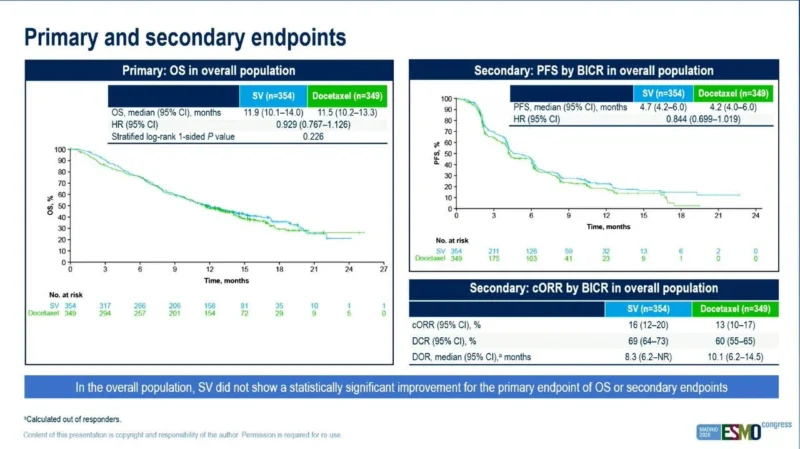
Median overall survival was 11.9 months with sigvotatug vedotin versus 11.5 months with docetaxel, corresponding to an HR of 0.929 (95% CI 0.767–1.126; one-sided P=0.226).
Progression-free survival was also not significantly improved in the overall population. Median PFS by blinded independent central review was 4.7 versus 4.2 months, with an HR of 0.844 (95% CI 0.699–1.019).
The negative primary endpoint means SigVie-002 cannot be interpreted as demonstrating superiority of sigvotatug vedotin over docetaxel in the broad population for which the phase III study was designed.
However, the presentation at ESMO Congress 2026 also identified a potentially important treatment-line interaction. In a post hoc analysis of patients receiving treatment in the second-line setting, sigvotatug vedotin showed a favorable PFS signal and a numerical improvement in OS compared with docetaxel.
That finding may help shape future development of the ADC, but it remains exploratory and does not reverse the negative overall result.
A Global Phase III Test of an IB6-Directed ADC
Sigvotatug vedotin was developed to target integrin beta-6, or IB6, a tumor-associated surface protein expressed across a substantial proportion of NSCLC tumors.
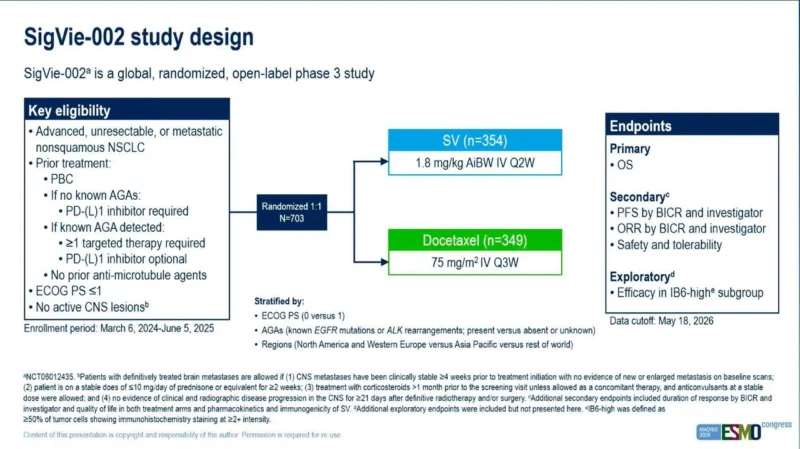
Early clinical development had shown encouraging antitumor activity in heavily pretreated advanced NSCLC, providing the rationale for a direct phase III comparison with docetaxel. SigVie-002, also known as NCT06012435, was a global, randomized, open-label phase III study.
A total of 703 patients with advanced, unresectable or metastatic nonsquamous NSCLC were randomized 1:1 to sigvotatug vedotin or docetaxel.
Patients assigned to sigvotatug vedotin received 1.8 mg/kg by adjusted ideal body weight intravenously every two weeks, while patients in the control arm received docetaxel 75 mg/m² intravenously every three weeks. All patients had previously received platinum-based chemotherapy.
For patients without a known actionable genomic alteration, prior PD-1 or PD-L1 inhibitor therapy was required. Patients with an actionable genomic alteration were required to have received at least one appropriate targeted therapy, while prior immunotherapy was optional.
The trial therefore included a clinically heterogeneous population incorporating both driver-negative disease previously exposed to chemoimmunotherapy and oncogene-driven disease progressing after targeted treatment. The primary endpoint was overall survival. Secondary endpoints included PFS, response and safety.
The Primary Overall Survival Endpoint Was Negative
At the May 18, 2026 data cutoff, 354 patients had been randomized to sigvotatug vedotin and 349 to docetaxel. Median OS was nearly identical between the two strategies: 11.9 months with sigvotatug vedotin and 11.5 months with docetaxel. The HR of 0.929 did not demonstrate a statistically significant reduction in the risk of death.
The survival curves were correspondingly close through much of follow-up, making the result fundamentally different from a trial that narrowly misses statistical significance despite a large numerical separation.
The primary phase III question was therefore answered clearly: in an unselected population of previously treated nonsquamous NSCLC, sigvotatug vedotin did not outperform docetaxel for overall survival.
That distinction matters when positioning the drug after a phase III failure. Exploratory subgroup signals may justify additional trials, but they cannot substitute for the prespecified primary endpoint.
PFS Also Failed to Show Clear Superiority
The secondary PFS analysis followed the same broad pattern. Median PFS was 4.7 months with sigvotatug vedotin versus 4.2 months with docetaxel. The HR was 0.844, with a 95% CI of 0.699–1.019.
The confidence interval crossing 1 means the study did not establish a statistically definitive PFS advantage in the overall population. Confirmed objective response rate by central review was 16% with sigvotatug vedotin versus 13% with docetaxel.
Disease control rate was 69% versus 60%. Interestingly, median duration of response was not longer with the ADC: it was 8.3 months with sigvotatug vedotin versus 10.1 months with docetaxel.
Taken together, these outcomes suggest that sigvotatug vedotin had genuine antitumor activity, but the degree of activity was insufficient to establish superiority over an active cytotoxic control.
The Second-Line Subgroup Looked Different
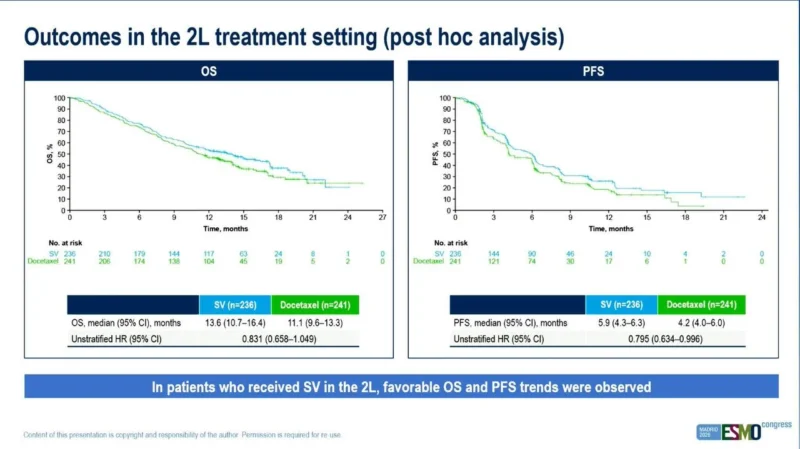
The most notable finding from the ESMO presentation came from a post hoc analysis of patients treated in the second-line setting. This subgroup represented approximately two-thirds of the study population, with 236 patients receiving sigvotatug vedotin and 241 receiving docetaxel.
Median OS was 13.6 months with sigvotatug vedotin versus 11.1 months with docetaxel, corresponding to an unstratified HR of 0.831 (95% CI 0.658–1.049). The numerical survival difference favored the ADC, but the confidence interval crossed 1.
For PFS, the result was more pronounced. Median PFS reached 5.9 months with sigvotatug vedotin compared with 4.2 months with docetaxel, with an HR of 0.795 (95% CI 0.634–0.996).
This is a potentially meaningful signal, particularly because the second-line subgroup largely consisted of patients without actionable genomic alterations. However, several qualifications are essential.
The analysis was post hoc. Treatment line was not the primary basis on which the study was powered. Multiple subgroup analyses increase the possibility of chance findings. And the primary OS endpoint in the overall population was negative.
The second-line result should therefore be viewed as hypothesis-generating evidence for future trial design, not as confirmation that sigvotatug vedotin is superior to docetaxel in second-line NSCLC.
Later-Line Disease Showed No Corresponding Benefit
The contrast with patients treated in the third line or later makes the second-line observation more interesting, but also more complex. Among patients receiving treatment in the third-line-or-later setting, median OS was 10.0 months with sigvotatug vedotin versus 11.9 months with docetaxel, with an HR of 1.187.
Median PFS was 4.2 months in both groups, with an HR of 1.024. There was therefore no efficacy trend favoring sigvotatug vedotin in the more heavily pretreated population.
One possible interpretation is that the activity of an IB6-directed ADC may be more clinically relevant earlier in the treatment course. Another is that the populations differed biologically.
The third-line-or-later cohort contained a substantially larger proportion of patients with actionable genomic alterations, whereas the second-line cohort was predominantly composed of patients without such alterations.
These differences make it difficult to conclude that treatment line itself is the sole explanation. A prospectively designed study would be needed to determine whether earlier use genuinely identifies a population with enhanced benefit.
IB6 Expression Did Not Solve the Selection Problem
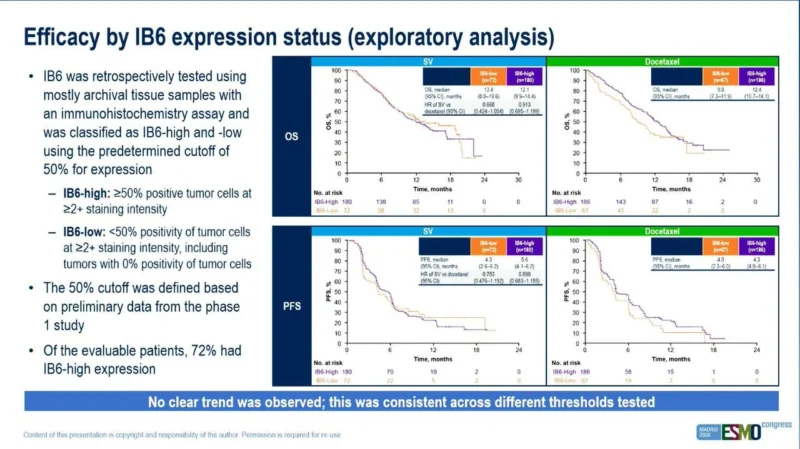
Perhaps the most important biomarker finding was also one of the most disappointing. IB6 expression was retrospectively assessed by immunohistochemistry, with tumors classified as IB6-high when at least 50% of tumor cells demonstrated staining at an intensity of 2+ or greater.
Approximately 72% of evaluable tumors were categorized as IB6-high. Yet no clear relationship between IB6 expression and clinical efficacy emerged. Across OS and PFS analyses, the presentation did not identify a consistent treatment effect favoring sigvotatug vedotin specifically in IB6-high disease.
Alternative expression thresholds also failed to produce a clear trend. This is important because target expression has become one of the central questions surrounding ADC development.
An ADC may bind a specific surface protein, but target expression alone does not necessarily function as a clinically useful predictive biomarker. Drug internalization, payload sensitivity, tumor heterogeneity, target distribution, drug delivery and resistance mechanisms may all influence efficacy.
For sigvotatug vedotin, IB6 expression by the tested immunohistochemical approach cannot currently be used to identify a population clearly more likely to benefit.
Safety Was Broadly Comparable With Docetaxel
The safety profile did not reveal a major overall disadvantage for sigvotatug vedotin relative to docetaxel. Any-grade treatment-related adverse events occurred in 91% of patients receiving sigvotatug vedotin and 87% receiving docetaxel.
Grade ≥3 treatment-related adverse events occurred in 33% versus 36%, respectively. Treatment-related adverse events resulted in treatment discontinuation in 11% with sigvotatug vedotin versus 9% with docetaxel.
The overall high-grade treatment-related toxicity burden was therefore broadly comparable between arms. This matters because a new ADC competing with docetaxel in previously treated NSCLC would ideally need to deliver either clearly superior efficacy, a substantially better tolerability profile, or both.
SigVie-002 did not establish the efficacy superiority required to make that case in the overall population.
Why the Negative Result Matters for the ADC Field
The NSCLC ADC landscape has expanded rapidly, but SigVie-002 reinforces a principle that is becoming increasingly important: ADC activity is highly molecule specific and setting specific. A biologically attractive target and encouraging phase I response rates do not guarantee phase III superiority.
Docetaxel also remains a meaningful comparator. Although it is an older chemotherapy with substantial toxicity, it retains clinically relevant activity in previously treated NSCLC and remains a difficult benchmark to beat when survival is the primary endpoint.
The SigVie-002 result therefore should not be interpreted as evidence that IB6 is an invalid ADC target. Rather, it suggests that sigvotatug vedotin monotherapy, at the tested dose and in the broad previously treated population, was not sufficiently superior to docetaxel.
The future of the molecule may depend less on monotherapy in later lines and more on combinations and earlier disease settings.
Development Is Moving Toward Earlier-Line Combinations
The phase III presentation specifically pointed toward continued evaluation of sigvotatug vedotin in combination strategies. Earlier studies combining sigvotatug vedotin with pembrolizumab have produced sufficient preliminary activity to support further development.
An ongoing first-line phase III program is evaluating the ADC with pembrolizumab in advanced NSCLC, while additional combinations involving a PD-1/VEGF bispecific antibody are also being explored. This development strategy is logical after SigVie-002.
If the second-line post hoc signal reflects greater effectiveness earlier in the disease course, moving the ADC into first-line combinations may provide a better opportunity to define its clinical value.
Combination therapy could also capitalize on mechanisms that monotherapy cannot address. But these programs should be viewed independently from the negative SigVie-002 primary result. A successful first-line trial would establish a different indication and a different treatment strategy rather than retrospectively converting SigVie-002 into a positive study.
OncoDaily Takeaway
SigVie-002 is a negative phase III trial in its overall population. Sigvotatug vedotin did not significantly improve overall survival over docetaxel in previously treated nonsquamous NSCLC, with median OS of 11.9 versus 11.5 months and an HR of 0.929. PFS was similarly close at 4.7 versus 4.2 months, and the HR of 0.844 did not establish superiority.
The most interesting signal emerged in the post hoc second-line subgroup, where median PFS was 5.9 versus 4.2 months with an HR of 0.795, while median OS numerically favored sigvotatug vedotin at 13.6 versus 11.1 months.
That finding warrants further investigation but should not be interpreted as confirmatory evidence. Equally important, IB6 expression did not identify a clearly responsive population, despite the ADC being directed against IB6.
The phase III failure therefore narrows rather than ends the development question. Sigvotatug vedotin has not established a role as a superior monotherapy alternative to docetaxel across broadly selected previously treated nonsquamous NSCLC.
Its future may instead depend on earlier-line use, more precisely selected populations and combination strategies, particularly with immunotherapy. That is now the central question for the sigvotatug vedotin program.
Source
- Peters S, et al. Phase 3 study of sigvotatug vedotin versus docetaxel in previously treated nonsquamous non-small cell lung cancer. LBA68, presented at ESMO Congress 2026, Madrid, October 25, 2026. ClinicalTrials.gov identifier: NCT06012435. The study randomized 703 patients and did not significantly improve its primary OS endpoint in the overall population.