
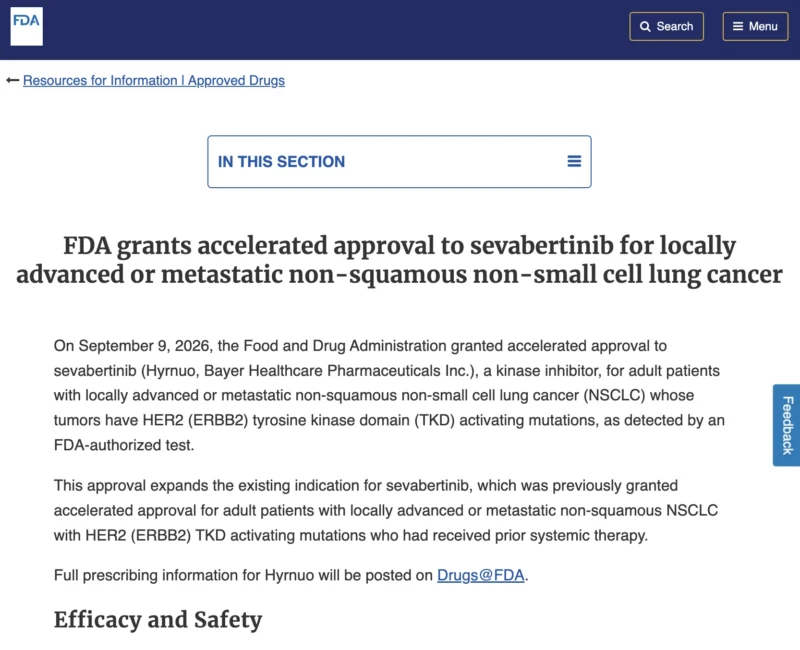
The therapeutic landscape of HER2-mutant non–small cell lung cancer continues to evolve rapidly. On September 9, 2026, the U.S. Food and Drug Administration granted accelerated approval to sevabertinib (Hyrnuo) for adults with locally advanced or metastatic non-squamous NSCLC whose tumors harbor HER2 (ERBB2) tyrosine kinase domain activating mutations, as identified by an FDA-authorized test.
The decision expands sevabertinib beyond its previous indication in patients who had already received systemic therapy and establishes its use in the previously untreated setting. The approval therefore introduces an oral, mutation-directed kinase inhibitor as an upfront treatment option for a molecularly defined subgroup of advanced NSCLC.
Importantly, the indication is specific to tumors with activating mutations in the HER2 tyrosine kinase domain. It should not be extrapolated to HER2 protein overexpression or HER2 amplification, which represent biologically distinct biomarkers and may have different therapeutic implications.
A First-Line Strategy Built Around HER2 Mutation Biology
HER2 alterations represent a heterogeneous group in lung cancer. Unlike breast cancer, where HER2-directed treatment has traditionally been guided predominantly by protein overexpression or gene amplification, therapeutic development in NSCLC increasingly distinguishes HER2-mutant disease as a separate molecular entity.
Sevabertinib is a kinase inhibitor designed to directly target HER2-driven signaling. Its move into the treatment-naïve setting reflects a broader trend in oncogene-driven NSCLC: once a driver alteration is identified and an active targeted therapy becomes available, treatment is increasingly being moved earlier in the disease course rather than being reserved for use after chemotherapy or other systemic therapy.
The FDA approval specifically requires detection of a qualifying HER2 TKD activating mutation using an FDA-authorized test, reinforcing the importance of comprehensive molecular profiling before initiating first-line therapy in advanced non-squamous NSCLC.
SOHO-01 Provides the Evidence for the Expanded Indication
The efficacy supporting the new indication was evaluated in SOHO-01 (NCT05099172), an open-label, single-arm, multicenter, multi-cohort clinical trial. HER2 activating mutations were identified in either tumor tissue or plasma before enrollment.
For the first-line population relevant to the approval, the analysis included 69 patients with locally advanced or metastatic non-squamous NSCLC with HER2 TKD activating mutations who had received no previous systemic therapy.
The major efficacy endpoints were confirmed objective response rate and duration of response, assessed by blinded independent central review according to RECIST version 1.1.
The observed antitumor activity was substantial. The confirmed objective response rate was 75% (95% CI, 64%–85%). Among responding patients, 73% maintained their response for at least 6 months, while 38% had responses lasting at least 12 months.
For a targeted therapy entering first-line development in a molecularly selected population, the high response rate is notable. However, because the evidence comes from a single-arm study, the current dataset does not provide a randomized comparison against other available first-line strategies. The durability data are encouraging, but longer follow-up will be important for defining progression-free survival, overall survival, intracranial activity, and the long-term position of sevabertinib within HER2-mutant NSCLC sequencing.
Why the First-Line Expansion Matters
The clinical importance of this approval extends beyond the response rate itself. Sevabertinib was already available for patients with HER2-mutant advanced NSCLC after previous systemic therapy. Expanding treatment into the first-line setting changes the sequencing question.
Instead of asking whether sevabertinib should be introduced after another systemic regimen has failed, clinicians can now consider whether a patient with a qualifying HER2 TKD mutation should receive molecularly matched treatment from the beginning of metastatic therapy.
This mirrors what has already occurred across several other oncogene-defined NSCLC populations. EGFR, ALK, ROS1, RET, MET exon 14 skipping, and other molecular alterations have progressively shifted treatment away from empiric systemic therapy toward driver-directed first-line strategies.
HER2-mutant NSCLC is now moving further along the same trajectory.
A High Response Rate, but Accelerated Approval Requires Careful Interpretation
The 75% objective response rate provides a strong efficacy signal, but the regulatory context is important. This is an accelerated approval, and the supporting trial was nonrandomized.
Response rate and duration of response can support earlier regulatory access when antitumor activity appears clinically meaningful, particularly in molecularly defined cancers with unmet need. They do not, however, answer every question relevant to long-term treatment selection.
For clinicians, several issues remain particularly important. The durability of disease control beyond the currently reported intervals, progression-free survival, overall survival, activity in patients with brain metastases, mechanisms of acquired resistance, and comparative effectiveness against alternative HER2-directed approaches will all help determine how sevabertinib is ultimately positioned.
The current approval therefore establishes a new treatment option while leaving the broader sequencing strategy open for refinement.
Safety Will Be Important in a Potentially Long First-Line Treatment Course
Moving a targeted therapy earlier in treatment also places greater emphasis on tolerability because patients may remain on therapy for prolonged periods.
The sevabertinib prescribing information includes warnings and precautions for diarrhea, hepatotoxicity, interstitial lung disease or pneumonitis, left ventricular dysfunction, ocular toxicity, pancreatic enzyme elevation, and embryo-fetal toxicity.
These adverse events are clinically relevant in the first-line setting, where treatment decisions increasingly balance efficacy against the cumulative burden of chronic therapy. In particular, interstitial lung disease and cardiac toxicity require careful recognition and monitoring because both may have significant clinical consequences if not identified early.
The recommended dose is sevabertinib 20 mg orally twice daily with food, continued until disease progression or unacceptable toxicity.
Molecular Testing Becomes Even More Important
The approval reinforces a broader principle in advanced NSCLC: adequate molecular characterization must occur before first-line treatment whenever clinically feasible.
HER2 TKD mutations are not interchangeable with HER2 overexpression or amplification. A patient cannot therefore be selected for sevabertinib solely because HER2 immunohistochemistry is positive or because another HER2-related abnormality is present.
The indication depends on identifying a specific class of HER2 activating mutations.
As the number of actionable molecular subsets increases, incomplete genomic testing carries an increasingly important consequence: a patient may begin nonspecific systemic treatment before a highly active targeted option is recognized.
The expanding first-line role of molecularly directed therapies therefore strengthens the case for broad next-generation sequencing early in the diagnostic pathway for advanced non-squamous NSCLC.
Sevabertinib Enters an Increasingly Competitive HER2 Landscape
HER2-mutant lung cancer has rapidly moved from an area with limited targeted options to one of active drug development. The growing availability of HER2-directed kinase inhibitors and antibody–drug conjugates means that the next challenge will be determining not only which treatments are effective, but how they should be sequenced.
An oral kinase inhibitor may offer advantages in convenience and continuous pathway suppression, while other HER2-directed modalities may have different efficacy, toxicity, and resistance profiles. These approaches should not be assumed to be interchangeable, particularly in the absence of head-to-head randomized data.
The sevabertinib approval therefore adds another important therapeutic option but also makes treatment selection more sophisticated. Future decisions may depend on mutation subtype, CNS involvement, previous HER2-directed therapy, toxicity profile, expected duration of treatment, and molecular mechanisms emerging at progression.
International Regulatory Review Is Also Underway
The FDA review was conducted through Project Orbis, the Oncology Center of Excellence initiative designed to facilitate concurrent international review of oncology therapies. For sevabertinib, the FDA collaborated with the United Kingdom’s Medicines and Healthcare products Regulatory Agency, while review remains ongoing at other participating regulatory agencies.
The application also received priority review, and sevabertinib had previously received both breakthrough therapy designation and orphan drug designation.
These expedited pathways reflect the regulatory interest in extending molecularly matched therapies to patients with uncommon but clinically actionable oncogenic drivers.
The Bottom Line
The FDA’s September 9, 2026 accelerated approval of sevabertinib expands targeted therapy for HER2 TKD–mutant advanced non-squamous NSCLC into the previously untreated setting.
In SOHO-01, 69 treatment-naïve patients achieved a confirmed objective response rate of 75%, with 73% of responders maintaining response for at least six months and 38% maintaining response for at least 12 months. Sevabertinib is administered orally at 20 mg twice daily with food until progression or unacceptable toxicity.
The approval is an important advance, but its interpretation should remain precise. Sevabertinib is approved for HER2 TKD activating mutations, not broadly for every HER2-positive phenotype, and the efficacy evidence supporting first-line use currently comes from a single-arm study.
Nevertheless, the direction of travel in thoracic oncology is increasingly clear. HER2-mutant NSCLC is joining the growing group of molecularly defined lung cancers in which biomarker testing can determine treatment before the first systemic therapy is administered.
The question is no longer simply whether HER2 is actionable in lung cancer. It is increasingly how early HER2-directed therapy should be used, which modality should be selected, and how resistance should be managed once it emerges.
Reference
- U.S. Food and Drug Administration. FDA grants accelerated approval to sevabertinib for locally advanced or metastatic non-squamous non-small cell lung cancer. September 9, 2026.