The phase III SANOVO trial has demonstrated statistically significant improvements in progression-free survival (PFS) with savolitinib plus osimertinib compared with osimertinib alone in treatment-naïve patients with EGFR-mutated, MET-overexpressing advanced non-small cell lung cancer (NSCLC). The combination also produced a substantial favorable overall survival (OS) signal, although the survival data remain immature.
Presented by Yi-Long Wu, MD, at the ESMO Congress 2026 in Madrid, the randomized, double-blind study evaluated whether simultaneous inhibition of EGFR and MET could improve outcomes when MET overexpression was already present at diagnosis, rather than emerging as an acquired resistance mechanism after EGFR-targeted therapy.
Among 326 randomized patients, median PFS in the intention-to-treat (ITT) population was 24.9 months with savolitinib plus osimertinib versus 13.8 months with osimertinib alone, corresponding to a 44% reduction in the hazard of progression or death (HR 0.56; 95% CI 0.43–0.74; p<0.0001).
The benefit was particularly pronounced in patients with high MET expression, defined as immunohistochemistry (IHC) 3+. In this population, median PFS reached 24.8 versus 11.1 months, representing a 13.7-month difference and a 55% reduction in the hazard of progression or death (HR 0.45; 95% CI 0.31–0.66; p<0.0001).
An encouraging survival difference was also observed. Median OS was 44.5 months with the combination compared with 34.9 months with osimertinib alone (HR 0.48; 95% CI 0.33–0.68), although survival maturity was approximately 40.5%.
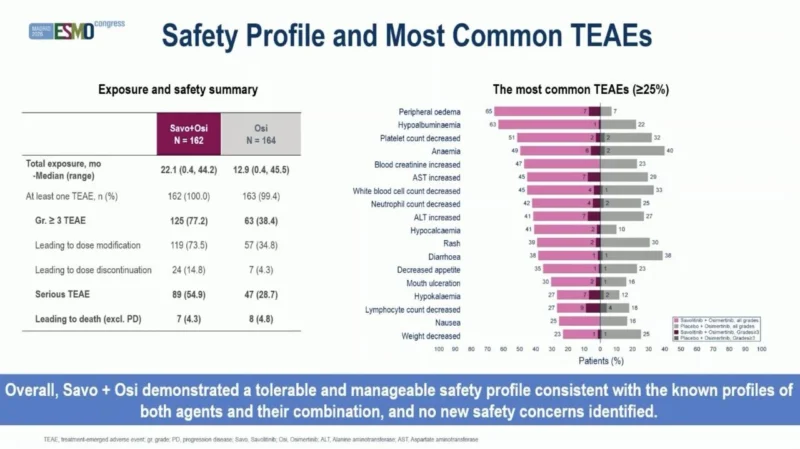
These efficacy findings were accompanied by substantially greater toxicity, with grade ≥3 treatment-emergent adverse events occurring in 77.2% of patients receiving dual EGFR/MET inhibition versus 38.4% with osimertinib alone.
Together, the results introduce a promising biomarker-directed strategy for first-line EGFR-mutated NSCLC while raising important questions about patient selection, comparative effectiveness, and the balance between improved disease control and treatment-related burden.
Why SANOVO Matters: Targeting MET Overexpression Before Acquired Resistance
Osimertinib has established a central role in first-line treatment of advanced NSCLC harboring common activating EGFR mutations, including exon 19 deletions and L858R substitutions.
However, despite durable responses in many patients, disease progression remains inevitable for most individuals with metastatic disease. MET pathway activation is among the clinically important mechanisms capable of sustaining downstream oncogenic signaling despite EGFR inhibition.
MET amplification is well recognized as a mechanism of acquired resistance to osimertinib. In contrast, MET protein overexpression may be present before treatment begins, potentially identifying tumors with biological features associated with reduced sensitivity to EGFR inhibitor monotherapy.
These abnormalities are not interchangeable. MET amplification reflects increased gene copy number, whereas MET overexpression is assessed at the protein level and does not necessarily establish genomic amplification or exclusive dependence on MET signaling.
The clinical rationale for SANOVO was to investigate whether targeting both EGFR and MET from treatment initiation could overcome the reduced effectiveness of EGFR inhibition observed in a biomarker-selected population.
Savolitinib is an oral, selective MET tyrosine kinase inhibitor designed to suppress MET-dependent signaling. Combined with osimertinib, it provides simultaneous blockade of the primary EGFR driver and a potentially relevant bypass pathway.
The approach differs fundamentally from post-osimertinib resistance management. Instead of introducing MET inhibition after progression, SANOVO tested upfront dual inhibition in patients whose tumors already demonstrated MET overexpression.
Study Design and Patient Population
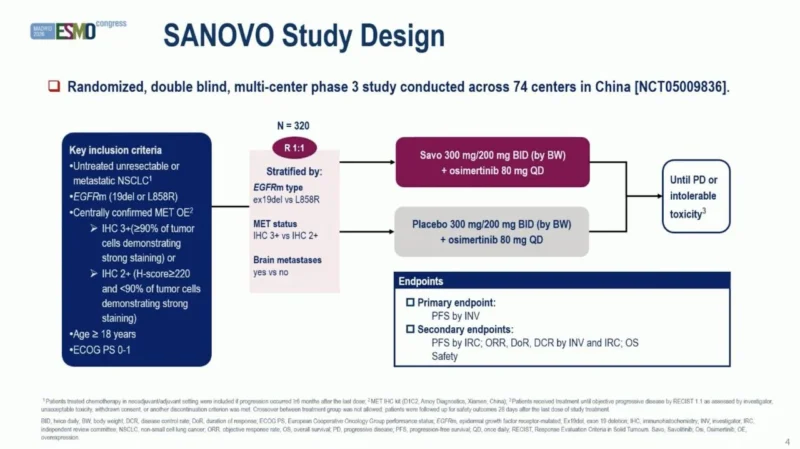
SANOVO (NCT05009836) was a randomized, double-blind, multicenter phase III study conducted across 74 centers in China. The trial enrolled previously untreated adults with unresectable locally advanced or metastatic NSCLC harboring EGFR exon 19 deletions or L858R mutations, together with centrally confirmed MET overexpression.
MET positivity was defined using prespecified IHC criteria. Patients qualified with either IHC 3+, representing strong MET staining in at least 90% of tumor cells, or IHC 2+, defined by an H-score of at least 220 with fewer than 90% of tumor cells demonstrating strong staining.
Eligible patients had ECOG performance status 0–1. A total of 326 patients were randomized 1:1 to receive savolitinib plus osimertinib (n=162) or placebo plus osimertinib (n=164).
Osimertinib was administered orally at 80 mg once daily. Savolitinib or matching placebo was administered twice daily at a body-weight-adjusted dose of 300 mg or 200 mg. Randomization was stratified by EGFR mutation type, baseline brain metastases, and MET expression category (IHC 3+ versus IHC 2+).
Treatment continued until disease progression, unacceptable toxicity, or another protocol-defined discontinuation criterion.
The primary endpoint was investigator-assessed PFS, evaluated through a hierarchical testing strategy that first assessed the MET IHC 3+ population, followed by the overall ITT population if the initial test was positive.
Secondary endpoints included independently reviewed PFS, overall survival, objective response rate, duration of response, disease control rate, and safety. The primary analysis used a July 31, 2026 data cutoff.
High MET Expression: A 55% Reduction in the Hazard of Progression or Death
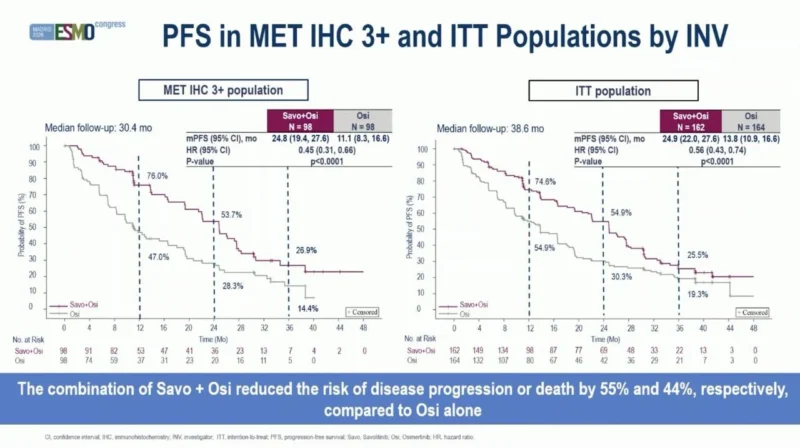
SANOVO demonstrated a substantial PFS benefit in the prespecified MET IHC 3+ population, which included 98 patients in each treatment arm. Median investigator-assessed PFS was 24.8 months (95% CI 19.4–27.6) with savolitinib plus osimertinib compared with 11.1 months (95% CI 8.3–16.6) with osimertinib alone.
The HR was 0.45 (95% CI 0.31–0.66; p<0.0001), corresponding to a 55% reduction in the hazard of progression or death. The benefit extended beyond the median PFS estimates. At 12 months, approximately 76.0% of patients receiving dual targeted therapy remained progression-free compared with 47.0% receiving osimertinib alone.
At 24 months, the corresponding PFS rates were 53.7% and 28.3%, respectively. By 36 months, estimated PFS was 26.9% with the combination versus 14.4% with monotherapy.
These results suggest that patients meeting the stringent MET IHC 3+ criterion may represent a population in which upfront MET inhibition substantially improves disease control.
Importantly, however, the magnitude of benefit in the IHC 3+ population should not be interpreted as proof that MET IHC 3+ is a superior predictive biomarker compared with IHC 2+ without formal treatment-by-biomarker interaction testing.
Overall Population: Median PFS Extends Beyond Two Years
The PFS advantage was also statistically significant in the overall ITT population, which included patients meeting either MET IHC 2+ or IHC 3+ criteria.
Median PFS was 24.9 months (95% CI 22.0–27.6) with savolitinib plus osimertinib compared with 13.8 months (95% CI 10.9–16.6) with osimertinib alone. The HR was 0.56 (95% CI 0.43–0.74; p<0.0001), representing a 44% reduction in the hazard of progression or death.
At 12 months, PFS was 74.6% with the combination versus 54.9% with monotherapy. At 24 months, the corresponding rates were 54.9% and 30.3%, demonstrating an absolute difference of 24.6 percentage points. By 36 months, estimated PFS rates were 25.5% and 19.3%, respectively.
The overall median PFS improvement of 11.1 months is clinically relevant, particularly given that the study compared dual targeted therapy with an established active EGFR inhibitor rather than conventional chemotherapy.
The concordant benefit in both hierarchically tested populations supports the efficacy of adding MET inhibition in the trial-defined MET-overexpressing population.
Nevertheless, the findings apply specifically to patients meeting SANOVO’s IHC selection thresholds. They should not be generalized to all EGFR-mutated NSCLC or to patients with lower MET expression.
Overall Survival: A Substantial but Still-Maturing Benefit Signal
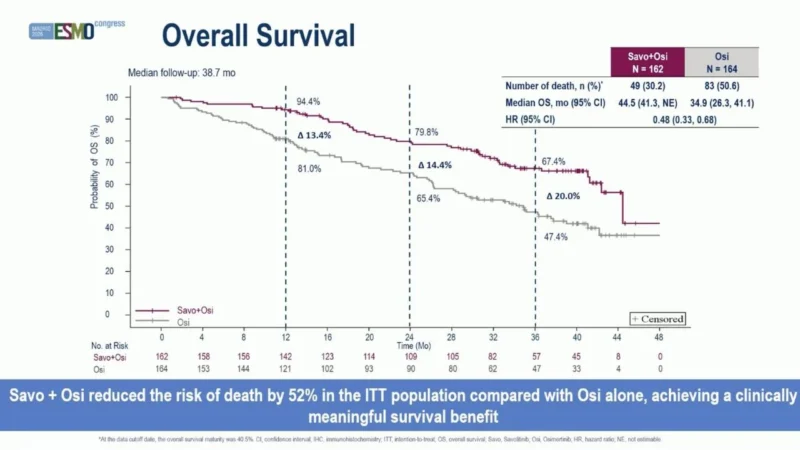
One of the most important findings from SANOVO was the favorable overall survival result. At a median follow-up of 38.7 months, median OS was 44.5 months (95% CI 41.3–not estimable) with savolitinib plus osimertinib compared with 34.9 months (95% CI 26.3–41.1) with osimertinib alone.
The reported HR was 0.48 (95% CI 0.33–0.68), corresponding to a 52% lower estimated hazard of death. By the analysis cutoff, 49 patients (30.2%) had died in the combination arm compared with 83 patients (50.6%) in the monotherapy arm.
The survival curves showed sustained separation across several clinically relevant timepoints. At 12 months, estimated OS was 94.4% with savolitinib plus osimertinib versus 81.0% with osimertinib alone.
At 24 months, the corresponding OS rates were 79.8% and 65.4%, respectively. At 36 months, survival remained 67.4% in the combination arm compared with 47.4% in the monotherapy arm, representing an absolute difference of 20 percentage points.
These findings provide an encouraging indication that improved disease control may translate into longer survival.
However, overall survival maturity was only 40.5%, and the reported results did not provide a formal OS p-value or establish the status of multiplicity-controlled confirmatory testing for this secondary endpoint.
Consequently, the OS findings should be characterized as a substantial favorable survival signal rather than an independently confirmed statistically significant OS benefit. Longer follow-up will be important to assess the durability of the effect and the influence of subsequent therapies.
Biomarker Selection: The Importance of MET Expression at Diagnosis
SANOVO introduces an important shift in how MET pathway abnormalities may be evaluated in EGFR-mutated NSCLC. Traditionally, MET testing has been particularly relevant at disease progression, when acquired resistance to EGFR-targeted therapy is investigated.
The SANOVO strategy instead relies on identifying MET overexpression before first-line treatment. The study’s stringent central IHC assessment was essential to its biomarker-enriched design.
Patients with high MET expression demonstrated a particularly pronounced PFS benefit, suggesting that the degree of MET pathway activation may be clinically relevant when selecting an upfront combination strategy. However, several questions remain unresolved.
MET protein overexpression does not necessarily indicate MET gene amplification. Furthermore, whether MET overexpression independently predicts greater benefit from adding savolitinib cannot be established without a broader comparator population or sufficiently informative biomarker interaction analyses.
Standardization of MET IHC testing, reproducibility of staining thresholds, and access to validated assays will be important if this treatment strategy moves toward wider clinical implementation.
Safety: Substantially Greater Grade ≥3 Toxicity With Dual EGFR/MET Inhibition
The efficacy advantages of savolitinib plus osimertinib were accompanied by a meaningful increase in adverse events. Any-grade treatment-emergent adverse events (TEAEs) occurred in 100% of patients receiving the combination and 99.4% receiving osimertinib alone.
More importantly, grade ≥3 TEAEs occurred in 77.2% versus 38.4% of patients, respectively. Serious TEAEs were also more frequent with dual targeted therapy, occurring in 54.9% compared with 28.7% in the control arm.
Adverse events leading to dose modification occurred in 73.5% of patients receiving the combination versus 34.8% receiving monotherapy. Treatment discontinuation due to TEAEs was reported in 14.8% versus 4.3%, respectively.
Among commonly reported toxicities, peripheral edema occurred in approximately 65% of patients receiving the combination compared with 7% receiving osimertinib alone. Hypoalbuminemia was reported in approximately 63% versus 22%.
Other frequently observed abnormalities included decreased platelet count, anemia, elevated creatinine, increased liver enzymes, rash, and gastrointestinal events.
Median treatment exposure was substantially longer with savolitinib plus osimertinib, at 22.1 months compared with 12.9 months in the control group, which should be considered when interpreting unadjusted adverse-event frequencies.
TEAEs leading to death, excluding disease progression, occurred in 4.3% and 4.8% of patients, respectively. These all-causality fatal event figures should not be interpreted as equivalent to treatment-related death rates.
Although no new safety signals were identified, the marked differences in severe adverse events, serious events, dose modifications, and discontinuations indicate a substantial additional treatment burden. This distinction is clinically important: an all-oral regimen is not necessarily a low-toxicity regimen, particularly when prolonged dual pathway inhibition is required.
Clinical Interpretation: A New Frontline Strategy for a Biomarker-Defined Population?
SANOVO provides randomized phase III evidence supporting upfront dual EGFR/MET inhibition in a carefully selected population with EGFR-mutated, MET-overexpressing advanced NSCLC.
The magnitude of PFS improvement is substantial, particularly in patients with high MET expression, while the favorable OS estimates strengthen the biological rationale for early suppression of MET-mediated bypass signaling. However, the trial must be interpreted in the context of an evolving first-line treatment landscape.
Osimertinib monotherapy remains an established treatment option, but combination approaches have expanded through studies such as FLAURA2, evaluating osimertinib plus platinum–pemetrexed, and MARIPOSA, evaluating amivantamab plus lazertinib.
These trials enrolled different populations and used different strategies. Cross-trial comparisons cannot establish whether savolitinib plus osimertinib is superior to currently available intensification regimens.
SANOVO also differs from the phase III SAFFRON study, which evaluated osimertinib plus savolitinib after progression on osimertinib in patients with MET overexpression and/or amplification.
Together, these investigations support the broader clinical importance of MET pathway targeting, but they address distinct treatment settings and biomarker-defined populations.
At the time of the SANOVO presentation, the savolitinib–osimertinib combination was approved in China for a specific post-EGFR-TKI, MET-amplified NSCLC population, but its use as an upfront treatment for MET-overexpressing EGFR-mutated NSCLC remained a proposed new indication.
The practical question is therefore not simply whether dual targeted therapy improves PFS, but which patients derive enough additional benefit to justify its toxicity compared with other available first-line approaches.
Limitations and Remaining Questions
Several limitations should be considered when interpreting SANOVO. First, the trial was conducted entirely in China. Although EGFR-mutated NSCLC is especially prevalent in Asian populations, the generalizability of these results to more geographically and ethnically diverse populations requires evaluation.
Second, the study enrolled patients with MET overexpression defined by specific IHC thresholds. The applicability of its findings to patients with MET amplification but different protein expression profiles remains uncertain.
Third, OS remains immature, with only 40.5% of the planned information represented by observed deaths at the analysis cutoff. The favorable survival HR requires longer follow-up and clarification of its formal statistical testing status.
Fourth, grade ≥3 TEAEs and serious adverse events were substantially more frequent with combination treatment, underscoring the need for careful patient selection and toxicity monitoring. Fifth, SANOVO compared savolitinib plus osimertinib with osimertinib alone rather than other contemporary combination strategies.
Finally, detailed independently reviewed efficacy outcomes, intracranial efficacy results, and quantitative response outcomes were not available in the presented primary dataset, limiting further characterization of the regimen’s comparative clinical advantages.
OncoDaily Takeaway
SANOVO introduces compelling phase III evidence that targeting MET overexpression at diagnosis may improve outcomes for patients with EGFR-mutated advanced NSCLC before acquired resistance to osimertinib develops.
The primary endpoint findings were robust. Median PFS increased from 11.1 to 24.8 months in the MET IHC 3+ population and from 13.8 to 24.9 months in the overall trial population, corresponding to reductions in the hazard of progression or death of 55% and 44%, respectively.
The overall survival results add further interest, with median OS of 44.5 versus 34.9 months and an HR of 0.48. However, these findings remain preliminary because survival maturity was only 40.5%, and confirmatory OS significance was not established in the reported analysis.
The principal clinical trade-off is toxicity. Grade ≥3 TEAEs occurred in more than three-quarters of patients receiving the combination, compared with fewer than 40% receiving osimertinib alone. Serious adverse events and treatment discontinuations were also substantially more frequent.
For clinicians, SANOVO reinforces the potential importance of evaluating MET expression alongside EGFR mutation status before systemic therapy. Yet biomarker testing standardization, regulatory authorization, and comparisons with other first-line regimens remain important barriers to routine adoption.
SANOVO establishes a substantial PFS benefit for upfront savolitinib plus osimertinib in MET-overexpressing EGFR-mutated NSCLC. Its ultimate position in clinical practice will depend on mature survival evidence, careful toxicity assessment, and defining which patients benefit most from early dual targeted inhibition.
Source
- Wu YL, et al. Savolitinib or Placebo Combined With Osimertinib in Treatment-Naïve Advanced NSCLC With EGFR Mutation and MET Overexpression: Results From the Phase 3 SANOVO Study.