
Resistance to EGFR tyrosine kinase inhibition has traditionally been treated as a problem that emerges after therapy begins. The phase III SANOVO trial raises a different possibility: in patients whose tumors already show MET overexpression at diagnosis, should the MET pathway be targeted from the start rather than waiting for it to contribute to resistance?
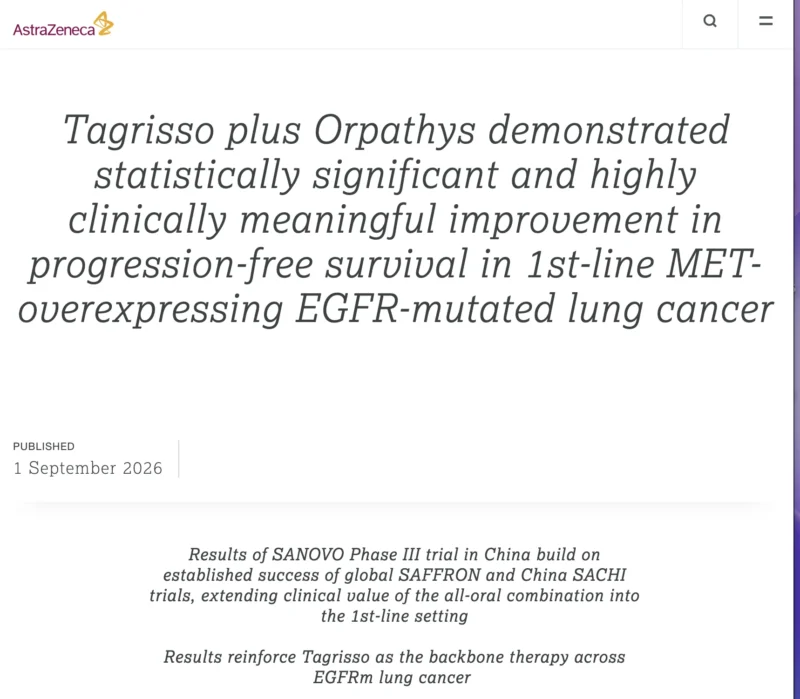
On September 1, 2026, AstraZeneca announced positive high-level results from SANOVO, a randomized phase III study conducted in China evaluating osimertinib (Tagrisso) plus savolitinib (Orpathys) versus osimertinib alone in previously untreated patients with locally advanced or metastatic EGFR-mutated NSCLC with MET overexpression.
The trial met its primary progression-free survival endpoint.
According to the announcement, the combination produced a statistically significant and highly clinically meaningful improvement in PFS in both the high-MET population defined as IHC 3+ and the broader intention-to-treat population including MET IHC 2+ and IHC 3+ tumors.
Overall survival also showed what the company described as a very encouraging clinical benefit in both populations, although follow-up is continuing. The result is potentially important because it extends a therapeutic strategy already being investigated after osimertinib resistance into the first-line setting.
But the available information remains a topline corporate disclosure. No PFS hazard ratio, median PFS, response rate, duration of response or quantitative OS data have yet been released. SANOVO is therefore clearly positive, but the magnitude of benefit still needs to be seen.
MET May Be More Than a Mechanism of Acquired Resistance
MET activation is well established as an important biological mechanism through which EGFR-mutated NSCLC can escape EGFR inhibition. MET amplification or overexpression can activate alternative downstream signaling despite continued suppression of EGFR, allowing tumor cells to bypass dependence on the original driver pathway.
Historically, this has largely been approached as a post-progression problem. A patient begins osimertinib, progresses, molecular testing identifies MET-driven resistance, and a MET inhibitor is subsequently added. SANOVO asks whether that sequence may be too late for a biologically selected subgroup.
If substantial MET overexpression is already present before treatment begins, the tumor may contain a parallel signaling pathway capable of limiting the durability of EGFR-TKI monotherapy from the outset. The therapeutic hypothesis is therefore straightforward:
- EGFR + MET dependence may need EGFR + MET inhibition upfront.
That is a more proactive model of precision oncology. Instead of waiting for resistance to become clinically visible, treatment attempts to intercept a potential resistance pathway before progression occurs.
SANOVO Selected Patients Before First-Line Treatment
SANOVO is a blinded, randomized, controlled phase III trial conducted in China. The study enrolled 326 treatment-naïve patients with locally advanced or metastatic NSCLC harboring an activating EGFR exon 19 deletion or L858R mutation together with MET overexpression.
Patients were randomized 1:1 to receive:
- osimertinib 80 mg once daily plus savolitinib
or
- osimertinib plus placebo.
Savolitinib was administered at 300 mg or 200 mg twice daily according to body weight. The primary endpoint is investigator-assessed PFS.
Other endpoints include independently reviewed PFS, overall survival, objective response rate, duration of response, disease control rate, time to response and safety. That design directly tests whether dual pathway suppression provides an advantage before any prior systemic treatment has selected for resistant clones.
The PFS Endpoint Was Positive in Both MET Populations
The most important topline finding is that the PFS benefit was not limited to the most strongly MET-expressing group. AstraZeneca reports a significant and clinically meaningful advantage with osimertinib plus savolitinib in:
- high MET: IHC 3+
and
- the ITT population: IHC 2+ and IHC 3+.
That distinction could ultimately become important for biomarker selection. If the eventual full dataset shows substantial benefit across both IHC 2+ and IHC 3+ disease, the clinically actionable population could be broader.
If benefit is markedly greater in IHC 3+ tumors, however, the intensity of MET expression could become important for selecting patients for combination therapy. At present, the announcement does not provide subgroup hazard ratios or median PFS values.
It is therefore too early to determine whether MET IHC behaves as a binary biomarker or whether greater MET expression predicts greater therapeutic benefit. That may become one of the most important questions when the data are presented.
The Result Extends a Strategy Already Tested After Osimertinib Resistance
SANOVO does not stand alone. The source places the trial within a broader development program examining osimertinib plus savolitinib in MET-driven EGFR-mutated NSCLC.
In China, the combination is already approved for locally advanced or metastatic EGFR-mutated NSCLC with MET amplification after progression on EGFR-TKI therapy, based on the phase III SACHI trial.
The global phase III SAFFRON study has also reported positive high-level results in patients with MET overexpression or amplification following progression on osimertinib, demonstrating statistically significant and clinically meaningful improvements in both PFS and OS. SANOVO moves the same biological principle one stage earlier.
That creates an emerging continuum:
- MET identified after EGFR-TKI resistance → add MET inhibition
versus
- MET identified before first-line therapy → potentially prevent or delay MET-mediated escape.
The second strategy may ultimately be more effective if a pre-existing MET-dependent clone is already capable of undermining osimertinib monotherapy.
This Is Precision Combination Therapy Rather Than Universal Intensification
The result should also be distinguished from broader first-line intensification strategies. Osimertinib already has several roles across EGFR-mutated NSCLC, including first-line monotherapy and first-line use with chemotherapy.
SANOVO explores a different approach. Rather than intensifying treatment for all patients with EGFR-mutated disease, it selects a subgroup according to a second biomarker, MET overexpression.
This creates a more biologically targeted model, EGFR mutation identifies the backbone treatment. MET overexpression identifies the potential need for combination therapy. That may be increasingly representative of the future of oncogene-driven lung cancer.
Finding one driver may no longer be enough. The clinically relevant question may become:
What additional pathway is already present that could limit the durability of targeting the dominant driver alone?
The All-Oral Strategy Is Clinically Attractive
Both osimertinib and savolitinib are oral tyrosine kinase inhibitors. Savolitinib is described as a potent, highly selective MET inhibitor targeting aberrant MET pathway activation arising through mechanisms including mutation, amplification and protein overexpression.
That gives the combination a practical advantage compared with treatment intensification strategies requiring intravenous chemotherapy. An all-oral regimen may reduce infusion burden and potentially provide a more targeted approach for appropriately selected patients.
But convenience alone cannot define treatment choice. The ultimate clinical value will depend on the size of the PFS benefit, overall survival, duration of treatment, toxicity, quality of life and whether dual inhibition meaningfully delays the emergence of subsequent resistance.
Those data have not yet been disclosed.
Overall Survival Is Encouraging, but Still Undefined
The company states that the combination demonstrated very encouraging clinical benefit in overall survival in both the high-MET and ITT populations. This is important because improving PFS through upfront intensification does not automatically guarantee an improvement in overall survival.
Patients receiving osimertinib alone may later receive effective MET-directed therapy after progression, potentially narrowing long-term differences between the treatment arms.
If upfront dual blockade ultimately produces a meaningful OS advantage despite access to later therapies, that would strengthen the argument for treating MET biology before progression rather than after it. But no numerical OS result has yet been provided.
The appropriate interpretation is therefore the OS signal is encouraging, but not yet quantitatively assessable.
Safety Will Be Central to the First-Line Risk-Benefit Calculation
The safety profile of osimertinib plus savolitinib was reported to be consistent with the known profiles of the individual drugs, with no new safety findings. That is reassuring, but the detailed adverse-event profile remains essential. First-line therapy may be administered for a prolonged period.
Adding a second targeted agent means exposing patients to additional treatment-related toxicity from the start, including patients who might otherwise have had prolonged disease control with osimertinib alone. The critical clinical question is therefore not simply whether the combination is more active.
It is the incremental disease-control benefit large enough to justify chronic dual inhibition? That calculation will require data on grade ≥3 events, dose interruptions, dose reductions, treatment discontinuations and patient-reported outcomes.
None are available in the current announcement.
Biomarker Definition May Become the Most Important Practical Issue
If SANOVO ultimately changes clinical practice, implementation will depend heavily on how MET overexpression is defined and tested.
The trial distinguishes:
- MET IHC 3+ as the high-MET population,
and
- MET IHC 2+/3+ as the broader ITT population.
This is different from selecting patients solely through MET amplification or MET exon 14 skipping.
MET biology can be measured at multiple levels:
- gene alteration
- copy-number amplification
- RNA expression
- protein overexpression
These are related but not interchangeable biomarkers.
SANOVO therefore has the potential to make baseline MET protein expression clinically relevant in EGFR-mutated disease. If the full results validate MET IHC as a predictive biomarker, baseline diagnostic work-up for EGFR-mutated metastatic NSCLC may need to become more complex.
Testing might no longer stop after an activating EGFR mutation is identified.
The next question could become:
How much MET is already present?
China-Only Enrollment Matters for Interpretation
SANOVO was conducted in China. That does not diminish the biological importance of the result, particularly given the high prevalence of EGFR-mutated NSCLC in Asian populations. But it does mean global generalizability will need consideration.
The source notes that EGFR mutations occur in approximately 30%–40% of NSCLC in Asia compared with around 10%–15% in the United States and Europe. Whether the magnitude of benefit is consistent across broader international populations remains to be established.
The positive global SAFFRON experience in the post-osimertinib setting adds supporting evidence for the combination, but it does not substitute for global randomized first-line data.
Positive Topline Data Are Not Yet a New Standard
This distinction is particularly important.
The September 1 announcement does not provide the:
- PFS hazard ratio
- median PFS
- absolute improvement in PFS
- objective response rate
- duration of response
- quantitative overall survival result
- detailed subgroup analysis
- complete safety profile
The company states that the results will be presented at a forthcoming medical meeting and shared with regulatory authorities.
Until then, SANOVO should be considered a highly promising positive phase III readout, not a fully interpretable practice-changing dataset.
The difference matters.
A statistically significant PFS improvement may represent anything from a modest incremental benefit to a transformative change in disease control. Only the complete numerical results will tell us where SANOVO lies on that spectrum.
From Treating Resistance to Preventing It
The most interesting implication of SANOVO may be conceptual.
Precision oncology has traditionally been reactive. Identify the dominant driver. Treat it. Wait for progression. Biopsy or perform liquid biopsy. Identify the resistance mechanism. Then introduce another targeted agent.
SANOVO explores a more anticipatory strategy.
If a resistance-associated pathway is already biologically evident at baseline, perhaps it should not be considered only a future resistance mechanism. It may already be part of the disease.
That changes the treatment philosophy from:
- target resistance after it emerges
to
- intercept resistance before it produces progression.
For EGFR-mutated NSCLC with MET overexpression, that is precisely the hypothesis SANOVO is testing.
The Bottom Line
The phase III SANOVO trial has met its primary PFS endpoint in previously untreated, locally advanced or metastatic EGFR-mutated NSCLC with MET overexpression.
The combination of osimertinib plus savolitinib produced a statistically significant and highly clinically meaningful PFS improvement over osimertinib alone in both the MET IHC 3+ population and the broader IHC 2+/3+ ITT population. An encouraging OS signal was also reported, with follow-up ongoing.
The trial enrolled 326 patients with EGFR exon 19 deletion or L858R disease and represents an important extension of dual EGFR/MET inhibition from the acquired-resistance setting into first-line treatment. But the decisive numbers remain unavailable.
Before SANOVO can be positioned within the increasingly complex first-line EGFR-mutated NSCLC landscape, clinicians need to see the actual PFS magnitude, OS data, subgroup outcomes and detailed toxicity. For now, the study provides an important proof of strategy: MET-driven resistance may not always be something we need to wait for.
In selected tumors, it may be detectable, and potentially targetable, from day one.
Reference
- AstraZeneca. Tagrisso plus Orpathys demonstrated statistically significant and highly clinically meaningful improvement in progression-free survival in 1st-line MET-overexpressing EGFR-mutated lung cancer. Published September 1, 2026.