A new phase III study is testing whether direct inhibition of RAS G12D can improve outcomes when added to standard first-line chemoimmunotherapy for metastatic non-squamous non-small-cell lung cancer.
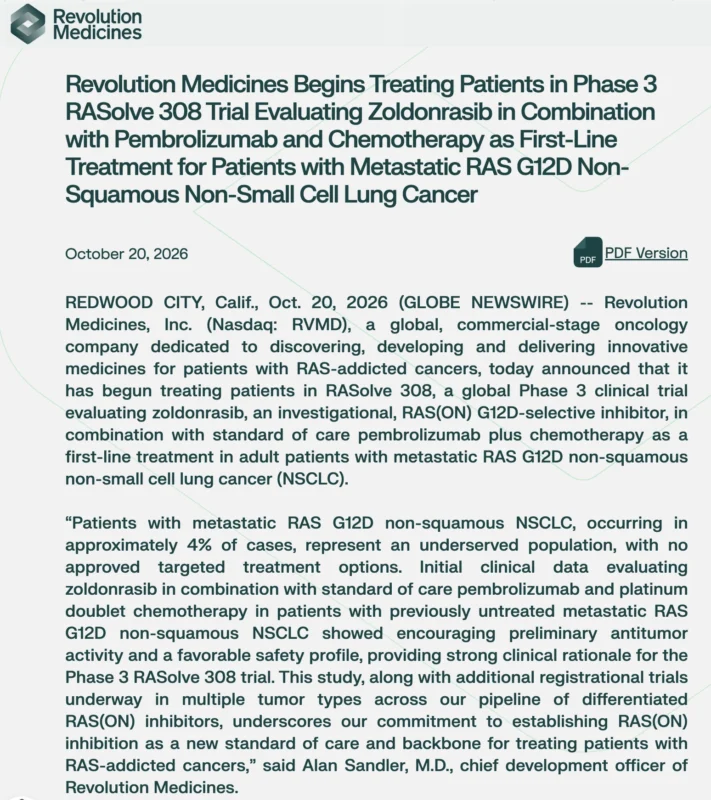
On October 20, 2026, Revolution Medicines announced that the first patients had begun treatment in RASolve 308, a global randomized, double-blind phase III trial evaluating the investigational RAS(ON) G12D-selective inhibitor zoldonrasib in combination with pembrolizumab and platinum-based chemotherapy.
The study represents an important escalation in the development of direct RAS G12D targeting. Rather than evaluating zoldonrasib after standard treatment failure, RASolve 308 is testing the drug from the first line, layered onto an established chemoimmunotherapy backbone in previously untreated metastatic disease.
RAS G12D Remains an Unmet Target in NSCLC
RAS alterations are among the most common oncogenic drivers in NSCLC, occurring in approximately 30% of cases, according to the company announcement.
RAS G12D mutations account for about 4% of NSCLC, defining a clinically meaningful subgroup for which the press release states that there is currently no approved targeted therapy. That makes RAS G12D particularly important from a precision-oncology perspective.
The development of targeted therapy in RAS-mutant lung cancer has historically been difficult because RAS proteins were long considered challenging to inhibit directly. The emergence of allele-selective inhibitors is now changing that paradigm. Zoldonrasib is one of the agents designed specifically around this problem.
What Is Zoldonrasib?
Zoldonrasib is an investigational, oral RAS(ON) G12D-selective covalent tri-complex inhibitor. Its mechanism differs from conventional small-molecule inhibition. The compound first binds cyclophilin A, forming a binary complex. That complex then binds to the active oncogenic RAS(ON) G12D protein and inhibits it.
This approach is designed to target RAS in its active signaling state rather than relying on a single conventional binding pocket. The company also notes that RAS G12D is the most prevalent RAS mutation across tumor types, accounting for approximately 29% of all RAS-driven cancers, with an estimated 61,000 new RAS G12D cancer cases annually in the United States across malignancies.
RASolve 308 Moves Zoldonrasib Directly Into the First Line
RASolve 308, NCT07777822, is a global, randomized, double-blind phase III study. The experimental arm receives:
- zoldonrasib + pembrolizumab + platinum-based chemotherapy doublet
while the control arm receives:
- placebo + pembrolizumab + platinum-based chemotherapy doublet
Eligible patients have previously untreated metastatic RAS G12D non-squamous NSCLC. This design is important because it does not ask whether zoldonrasib can replace standard chemoimmunotherapy. Instead, it asks whether direct RAS G12D inhibition can add meaningful benefit on top of an established first-line systemic backbone.
Progression-Free Survival Is the Primary Endpoint
The primary endpoint of RASolve 308 is:
- Progression-free survival
Key secondary endpoints include:
- overall survival
- objective response rate
- duration of response
- safety and tolerability
- patient-reported outcomes
The inclusion of both survival and patient-reported outcomes will be important if the combination proves effective.
An added targeted therapy must demonstrate not only greater disease control, but also an acceptable toxicity burden when combined with pembrolizumab and platinum chemotherapy.
Why Add a RAS Inhibitor to Chemoimmunotherapy?
The biological rationale is straightforward. Pembrolizumab plus platinum-based chemotherapy remains a major first-line strategy for metastatic non-squamous NSCLC without another established targeted first-line option.
RASolve 308 attempts to add oncogene-directed suppression without removing the immune and cytotoxic components of treatment. This creates a potentially different treatment paradigm from other oncogene-driven NSCLC subsets.
In EGFR- or ALK-driven disease, targeted therapy commonly replaces chemoimmunotherapy in the first line. RASolve 308 instead asks whether RAS inhibition should become an additional treatment layer within chemoimmunotherapy.
If successful, this could establish a model in which targeted therapy and immunotherapy are deployed concurrently rather than sequentially.
Preliminary Combination Activity Supported Phase III Development
According to Revolution Medicines, earlier clinical data evaluating zoldonrasib with pembrolizumab and platinum-doublet chemotherapy in previously untreated metastatic RAS G12D non-squamous NSCLC showed encouraging preliminary antitumor activity and a favorable safety profile.
However, the current announcement does not provide numerical response, PFS or toxicity data for that preliminary cohort. Those claims should therefore be interpreted as the company’s rationale for advancing into phase III rather than as mature evidence of clinical benefit.
That distinction is important. RASolve 308 itself will need to determine whether adding zoldonrasib translates into statistically and clinically meaningful improvement over standard chemoimmunotherapy.
A Potentially Important First-Line Strategy
The decision to move directly into a global phase III trial is notable. Targeted therapies for rare oncogenic subgroups often begin in heavily pretreated populations before gradually moving earlier. RASolve 308 is testing zoldonrasib at the point where treatment decisions may have the greatest long-term impact: initial systemic therapy for metastatic disease.
If PFS improves meaningfully and the safety profile remains manageable, the combination could create the first targeted first-line strategy specifically built around RAS G12D in this NSCLC population. But several questions will need to be answered.
Safety Will Be Critical
Adding another systemic agent to pembrolizumab plus platinum chemotherapy inevitably raises the question of cumulative toxicity. The release states that initial combination data showed a favorable safety profile, but it does not provide detailed adverse-event rates.
Phase III evaluation will therefore need to clarify:
- whether zoldonrasib increases hematologic toxicity
- whether liver, gastrointestinal or dermatologic toxicity becomes clinically important
- whether immune-related adverse events are altered
- whether dose interruptions or reductions compromise treatment intensity
- whether the combination remains practical for long-term administration
Because the regimen is intended for first-line use, tolerability may be almost as important as efficacy.
The Trial May Also Clarify Whether RAS G12D Behaves Like a True First-Line Target
Another important question is conceptual. The presence of a molecular driver does not automatically mean the tumor should be treated with targeted therapy alone. RAS G12D NSCLC may represent a setting where the optimal strategy involves integrating molecular targeting into a broader systemic regimen.
RASolve 308 is therefore testing more than one drug. It is testing a treatment philosophy: can direct oncogene inhibition enhance standard chemoimmunotherapy without needing to replace it?
That question could have implications beyond RAS G12D if similar combinations prove feasible across other RAS-driven cancers.
Zoldonrasib Is Part of a Broader RAS(ON) Programme
Zoldonrasib is also being studied in other treatment settings and tumor types. The company reports that it is under investigation both as monotherapy and in combination approaches, including combinations with daraxonrasib, Revolution Medicines’ RAS(ON) multi-selective inhibitor, as well as standard-of-care regimens in lung and gastrointestinal cancers.
This broader programme reflects an emerging strategy of targeting active RAS signaling through both allele-selective and multi-RAS approaches.
Whether these drugs ultimately work best alone, with immunotherapy, with chemotherapy or in RAS-directed combinations remains an open clinical question.
What RASolve 308 Needs to Show
The phase III study will ultimately need to answer several clinically important questions. First, does adding zoldonrasib produce a meaningful PFS advantage over pembrolizumab plus chemotherapy alone?
Second, does that improvement translate into overall-survival benefit? Third, does deeper RAS pathway inhibition meaningfully increase objective responses or duration of response?
And finally, can the efficacy benefit be achieved without creating enough additional toxicity to undermine the value of the regimen? Because the trial includes patient-reported outcomes, it may also provide important information on how a four-drug strategy affects symptoms and quality of life.
OncoDaily Takeaway
The initiation of RASolve 308 marks an important step in the development of direct RAS G12D therapy for metastatic NSCLC.
The global phase III trial is evaluating zoldonrasib + pembrolizumab + platinum-based chemotherapy against placebo + pembrolizumab + chemotherapy in previously untreated metastatic RAS G12D non-squamous NSCLC.
The study’s primary endpoint is PFS, with OS, ORR, duration of response, safety and patient-reported outcomes among the major secondary endpoints.
The strategy is particularly notable because it does not attempt to replace standard first-line chemoimmunotherapy. Instead, it adds a molecularly targeted RAS G12D inhibitor directly to that backbone.
If successful, RASolve 308 could establish a new model for oncogene-driven NSCLC in which targeted therapy and chemoimmunotherapy are integrated from the beginning. For now, however, zoldonrasib remains investigational, and the current announcement represents trial initiation rather than a phase III efficacy readout.
The key question is now clear:
Can direct RAS G12D inhibition make first-line chemoimmunotherapy better — and do so safely enough to redefine treatment for this molecular subgroup?
Source
- Revolution Medicines. Revolution Medicines Begins Treating Patients in Phase 3 RASolve 308 Trial Evaluating Zoldonrasib in Combination with Pembrolizumab and Chemotherapy as First-Line Treatment for Patients with Metastatic RAS G12D Non-Squamous Non-Small Cell Lung Cancer. October 20, 2026.