Replacing platinum-pemetrexed chemotherapy with a TROP2-directed antibody-drug conjugate has produced a major progression-free survival improvement in the first-line treatment of PD-L1–negative advanced nonsquamous non-small cell lung cancer.
The randomized phase III OptiTROP-Lung06 trial, presented at ESMO Congress 2026, showed that sacituzumab tirumotecan (sac-TMT) plus pembrolizumab reduced the risk of progression or death by 51% compared with pembrolizumab plus platinum-pemetrexed chemotherapy.
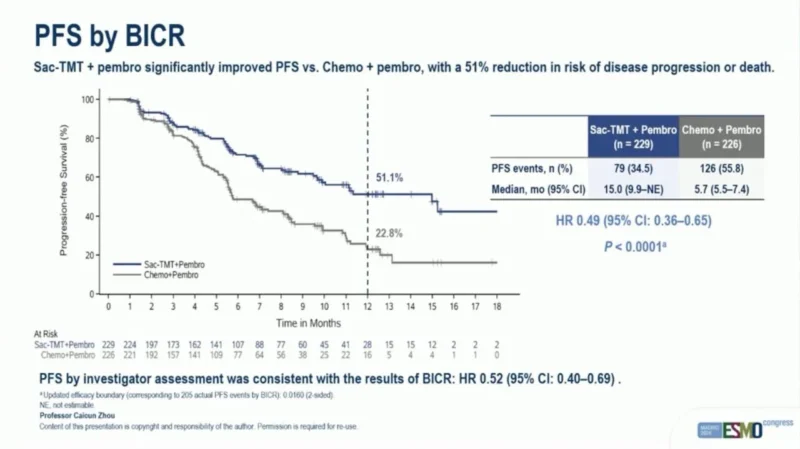
Median progression-free survival by blinded independent central review reached 15.0 months with sac-TMT plus pembrolizumab versus 5.7 months with chemoimmunotherapy, corresponding to an HR of 0.49 (95% CI 0.36–0.65; P<0.0001).
At 12 months, 51.1% of patients receiving sac-TMT plus pembrolizumab remained progression free compared with 22.8% in the chemotherapy arm.
Perhaps equally important, the improvement was not achieved simply by generating dramatically more initial tumor responses. Objective response rates were relatively similar—50.2% versus 47.3%—but responses lasted substantially longer with the ADC strategy, with median duration of response of 13.6 months compared with 6.8 months.
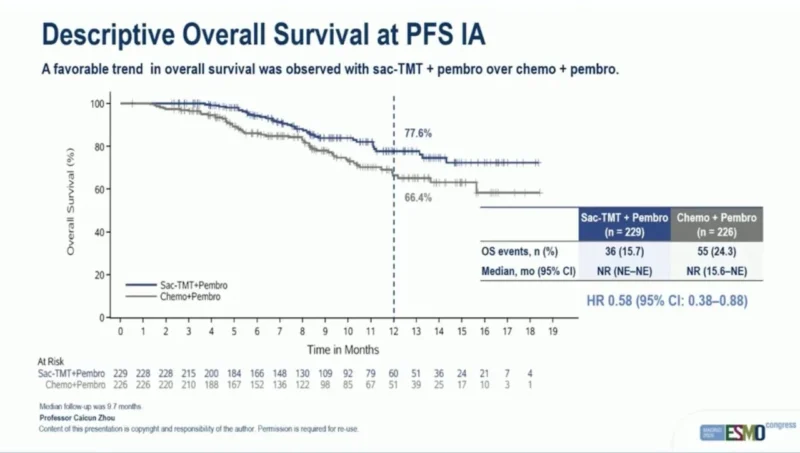
Overall survival remains immature. However, the first descriptive analysis also favored sac-TMT plus pembrolizumab, with an HR for death of 0.58 (95% CI 0.38–0.88). Twelve-month survival was 77.6% versus 66.4%.
The findings position OptiTROP-Lung06 as one of the most consequential first-line ADC studies in NSCLC to date: rather than adding another agent to chemotherapy, the trial tested whether an ADC could replace the conventional chemotherapy backbone altogether.
A Direct Challenge to the Chemoimmunotherapy Standard
For patients with advanced nonsquamous NSCLC without actionable oncogenic alterations and PD-L1 TPS below 1%, pembrolizumab combined with pemetrexed and platinum chemotherapy has been a foundational first-line strategy.
Unlike patients with high PD-L1 expression, these tumors generally cannot rely on pembrolizumab monotherapy, making chemotherapy an integral part of the first-line regimen. OptiTROP-Lung06 directly challenged that architecture.
Instead of pembrolizumab plus pemetrexed and platinum, patients received pembrolizumab combined with sac-TMT—a TROP2-directed ADC designed to deliver a topoisomerase I inhibitor payload directly to tumor cells.
This is therefore not simply another positive ADC trial. It asks whether a targeted cytotoxic delivery platform can perform the role historically occupied by platinum-based chemotherapy while preserving immune checkpoint inhibition.
That distinction makes the magnitude of the PFS result particularly important.
The Trial Enrolled 455 Previously Untreated Patients
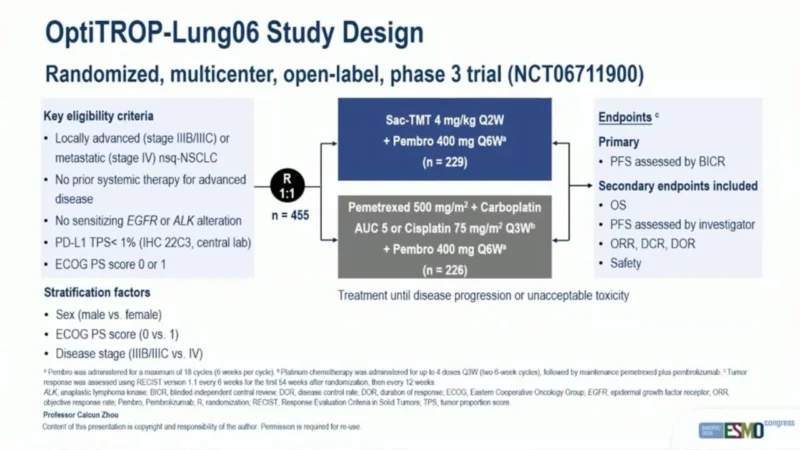
OptiTROP-Lung06 was a randomized, multicenter, open-label phase III trial involving patients with locally advanced stage IIIB/IIIC or metastatic stage IV nonsquamous NSCLC. Patients had received no prior systemic therapy for advanced disease and had ECOG performance status 0 or 1.
Tumors were required to have PD-L1 TPS below 1% by central 22C3 testing. Patients with sensitizing EGFR alterations or ALK alterations were excluded. A total of 455 patients were randomized 1:1.
The experimental group included 229 patients who received sac-TMT 4 mg/kg every two weeks plus pembrolizumab 400 mg every six weeks.
The control group included 226 patients treated with pemetrexed plus carboplatin or cisplatin together with pembrolizumab, followed by maintenance pemetrexed and pembrolizumab according to the study regimen. The primary endpoint was PFS by blinded independent central review.
The study was conducted at sites in China, an important consideration when assessing how readily the findings can be extrapolated globally. Public trial reporting identifies the study as a China-based phase III program.
PFS Increased From 5.7 to 15 Months
At the prespecified interim analysis, median follow-up was 9.7 months. The primary endpoint was clearly positive. Median PFS increased from 5.7 months with chemotherapy plus pembrolizumab to 15.0 months with sac-TMT plus pembrolizumab.
The HR of 0.49 represents a 51% reduction in the hazard of progression or death. The separation was also evident at the clinically intuitive 12-month landmark. Just over half of patients receiving sac-TMT plus pembrolizumab remained progression free at one year, compared with fewer than one quarter receiving the conventional chemoimmunotherapy regimen.
Investigator-assessed PFS was consistent with the central review, with an HR of 0.52, supporting the robustness of the treatment effect.
The control-arm median PFS of 5.7 months is broadly within the historical range seen with pembrolizumab plus chemotherapy in PD-L1-negative disease. A KEYNOTE-189 PD-L1-negative subgroup analysis has been reported with median PFS around 6.2 months, making it difficult to explain the OptiTROP-Lung06 result simply by unusually poor control-arm performance.
Similar Response Rates, Very Different Response Durability
One of the most informative findings is the relationship between response rate and response duration. ORR was 50.2% with sac-TMT plus pembrolizumab and 47.3% with chemotherapy plus pembrolizumab.
That is a relatively modest difference. Yet median duration of response was 13.6 months with sac-TMT plus pembrolizumab versus 6.8 months with chemotherapy plus pembrolizumab.
This helps explain how PFS could more than double despite broadly similar initial response rates. Sac-TMT did not simply generate more responses. It appears to have generated more durable disease control once a response occurred.
This distinction is clinically important in metastatic NSCLC, where prolonging the duration of benefit can matter as much as increasing the proportion of patients who initially respond.
The Early OS Signal Is Encouraging, but Still Descriptive
Overall survival was a secondary endpoint and was immature at this interim analysis. Only 36 deaths had occurred in the sac-TMT arm and 55 in the chemoimmunotherapy arm. Median OS had not been reached in either group.
The descriptive HR was 0.58, corresponding to a 42% lower observed hazard of death with sac-TMT plus pembrolizumab. At 12 months, estimated survival was 77.6% versus 66.4%.
The direction and magnitude are encouraging, but this should not yet be described as a definitive overall survival benefit. The trial remains ongoing, and longer follow-up with the prespecified OS analysis is essential.
This matters because first-line NSCLC standards are increasingly judged not only by PFS but by whether improvements ultimately translate into longer life. For now, OptiTROP-Lung06 has definitively established a major PFS benefit; the OS question remains open.
Safety May Strengthen the Case for Replacing Chemotherapy
A first-line ADC strategy would be substantially less compelling if it simply replaced one form of cytotoxic toxicity with another equally burdensome profile.
In OptiTROP-Lung06, however, grade ≥3 treatment-emergent adverse events were less frequent with sac-TMT plus pembrolizumab than with chemotherapy plus pembrolizumab: 47.6% versus 60.6%. Several classic chemotherapy-associated hematologic toxicities were reduced.
Grade ≥3 decreased neutrophil counts occurred in 19.7% versus 28.8%. Grade ≥3 leukopenia occurred in 9.6% versus 16.4%. Grade ≥3 anemia was markedly lower at 6.1% versus 20.4%. Grade ≥3 thrombocytopenia occurred in 3.9% versus 14.6%.
Sac-TMT introduces a different toxicity profile, and stomatitis is particularly relevant. Grade ≥3 stomatitis occurred in 2.2% of patients.
The broader safety assessment nevertheless suggests that replacing platinum-pemetrexed with sac-TMT may reduce some of the hematologic burden associated with conventional chemotherapy. Longer follow-up remains important for delayed or cumulative ADC-associated toxicities.
Why TROP2 May Work Even in PD-L1–Negative Disease
PD-L1-negative NSCLC is a particularly interesting setting for an ADC–immunotherapy combination. These tumors have, by definition, little detectable PD-L1 expression using conventional tissue testing and are generally less responsive to checkpoint inhibitor monotherapy.
Sac-TMT provides a separate mechanism of direct tumor-cell killing through TROP2 targeting and intracellular delivery of a topoisomerase I inhibitor payload. Cell death generated by an ADC may also alter the immune microenvironment, potentially increasing tumor-antigen release and immune activation.
Whether true pharmacologic synergy between sac-TMT and pembrolizumab explains the magnitude of the OptiTROP-Lung06 benefit cannot be determined from this trial because there was no sac-TMT monotherapy arm.
But the clinical strategy is clear: the ADC supplies substantial tumor-directed activity while checkpoint inhibition maintains an immunologic component.
OptiTROP-Lung05 and Lung06 Now Cover Both Sides of PD-L1
OptiTROP-Lung06 becomes even more important when considered alongside OptiTROP-Lung05. In Lung05, patients with PD-L1-positive advanced NSCLC were randomized to sac-TMT plus pembrolizumab or pembrolizumab alone.
At interim analysis, median PFS was not reached with the combination versus 5.7 months with pembrolizumab, with an HR of 0.35. The PFS benefit was present in both PD-L1 TPS 1%–49% and TPS ≥50% subgroups. The results were published in The Lancet in 2026.
Lung05 therefore asks whether sac-TMT should be added when immunotherapy alone is an accepted option. Lung06 asks whether sac-TMT can replace chemotherapy when chemotherapy is still conventionally required.
Together, the two studies suggest a potential development strategy spanning the entire PD-L1 spectrum.
Sac-TMT Is Building a Broader NSCLC Evidence Base
The lung program is not limited to first-line disease. Sac-TMT has already demonstrated randomized phase III efficacy in EGFR-mutated advanced NSCLC after progression on EGFR-directed therapy.
In OptiTROP-Lung04, sac-TMT improved median PFS from 4.3 to 8.3 months compared with platinum-based chemotherapy and subsequently demonstrated a statistically significant OS benefit, with an HR for death of 0.60.
That means sac-TMT now has phase III signals across biologically distinct NSCLC settings: EGFR-mutated post-TKI disease, PD-L1-positive first-line disease, and PD-L1-negative first-line disease.
Merck has described sac-TMT as a major component of a broad late-stage oncology program, with numerous global phase III studies underway across solid tumors.
Global Validation Still Matters
One limitation should remain prominent. OptiTROP-Lung06 was conducted in China. The magnitude of the effect is large enough that the results cannot simply be dismissed as population specific, and Lung05 has provided consistent evidence for the same ADC–pembrolizumab strategy.
Nevertheless, regulatory and practice-changing adoption outside China will require confidence that efficacy and safety translate across broader global populations.
That issue is particularly relevant because prior TROP2 ADC programs in NSCLC have not all produced consistent global phase III success.
ADC performance depends on much more than the target alone. Antibody design, linker chemistry, payload, drug-to-antibody ratio, tumor penetration and pharmacokinetics can all materially influence clinical behavior.
The success of sac-TMT should therefore be interpreted as evidence for this specific molecule and regimen rather than proof that all TROP2 ADCs will behave similarly.
The First-Line NSCLC Architecture Could Be Changing
For more than a decade, first-line systemic therapy for driver-negative metastatic NSCLC has been organized around three broad components: platinum chemotherapy, pemetrexed or another histology-appropriate cytotoxic partner, and PD-1/PD-L1 inhibition. OptiTROP-Lung06 suggests the cytotoxic component of that architecture may be replaceable.
An ADC is still a cytotoxic treatment, but it delivers chemotherapy through a substantially different mechanism. Rather than exposing normal and malignant tissue broadly to freely circulating cytotoxic drugs, an ADC attempts to concentrate its payload in target-expressing tumor cells.
The clinical question is therefore no longer simply whether ADCs work after chemotherapy has failed.
It is whether they can move ahead of conventional chemotherapy and become the preferred cytotoxic platform from the first treatment line.
OptiTROP-Lung06 provides one of the strongest phase III arguments yet that this transition is possible.
OncoDaily Takeaway
OptiTROP-Lung06 represents a major first-line advance for PD-L1-negative, nonsquamous advanced NSCLC without EGFR or ALK alterations.
Sac-TMT plus pembrolizumab increased median PFS from 5.7 to 15.0 months, reducing the hazard of progression or death by 51%. At one year, 51.1% versus 22.8% of patients remained progression free.
The objective response rates themselves were surprisingly similar—50.2% versus 47.3%—but the duration of response nearly doubled from 6.8 to 13.6 months, suggesting that the principal advantage lies in more durable disease control rather than simply generating more initial responses.
Safety also favored the ADC combination for several important high-grade hematologic toxicities, while overall grade ≥3 treatment-emergent adverse events were lower than with platinum-pemetrexed chemoimmunotherapy.
The early OS signal is encouraging, with an HR of 0.58 and 12-month OS of 77.6% versus 66.4%, but survival remains immature and should not yet be considered definitively improved.
The clinical concept, however, is already clear. OptiTROP-Lung06 is not asking whether an ADC can be added after conventional therapy fails. It is asking whether an ADC can replace conventional chemotherapy from day one. For PD-L1-negative nonsquamous NSCLC, the phase III PFS result strongly suggests that it can.
Source
- Zhou C, et al. Sacituzumab tirumotecan plus pembrolizumab versus chemotherapy plus pembrolizumab as first-line treatment for PD-L1-negative advanced non-squamous NSCLC: Randomized phase III OptiTROP-Lung06 study. Presented at ESMO Congress 2026, October 25, 2026. LBA66. ClinicalTrials.gov identifier NCT06711900.