
The European Society for Medical Oncology has updated its Living Guideline for oncogene-addicted metastatic non-small-cell lung cancer, incorporating new treatment recommendations for EGFR exon 20 insertions, acquired EGFR resistance, ALK and ROS1 fusions, HER2 alterations, NRG1 fusions, and high c-MET protein expression. Published as an accepted manuscript in Annals of Oncology, the update reflects the rapid expansion of targeted therapies and antibody–drug conjugates, while emphasizing the growing importance of precise biomarker testing, treatment sequencing, and regulatory access.
The treatment of oncogene-addicted metastatic non-small-cell lung cancer (NSCLC) is undergoing another substantial transformation.
Molecular profiling has already established targeted treatment as the preferred strategy for many patients whose tumors harbor actionable genomic alterations. Yet the therapeutic landscape has become increasingly complicated as newer agents demonstrate activity in previously treated disease and move into earlier lines of therapy.
For clinicians, the challenge is no longer simply determining whether a tumor carries an EGFR mutation, ALK rearrangement, or another oncogenic driver.
The exact molecular alteration, its biological consequences, previous treatment exposure, central nervous system involvement, and availability of approved drugs can all influence the preferred treatment sequence.
In November 2026, the European Society for Medical Oncology (ESMO) released version 1.4 of its Oncogene-Addicted Metastatic NSCLC Living Guideline. The accompanying update, authored by Lizza E. L. Hendriks, Antonio Passaro, Sanjay Popat, and Martin Reck, was accepted by Annals of Oncology on October 20, 2026.
The publication introduces updated recommendations across multiple molecularly defined NSCLC populations, incorporating evidence from studies including WU-KONG1B, eXalt3, TRUST-I/II, ARROS-1, Beamion LUNG-1, SOHO-01, LUMINOSITY, and studies of antibody–drug conjugates.
Importantly, the manuscript is a focused update to the existing Living Guideline, rather than a completely new guideline covering every aspect of lung cancer management. Its implications extend across several treatment settings.
EGFR Exon 20 Insertions: Sunvozertinib Expands Post-Platinum Treatment
EGFR exon 20 insertion mutations represent a distinct molecular subgroup of NSCLC. Unlike common sensitizing EGFR exon 19 deletions and L858R mutations, most exon 20 insertions respond poorly to conventional EGFR inhibitors developed for classical EGFR-mutated disease.
Their management has therefore required specialized targeted approaches. The ESMO update incorporates sunvozertinib, an oral EGFR inhibitor with activity against exon 20 insertion mutations. The recommendation is based on clinical activity demonstrated in the phase II WU-KONG1B trial, which evaluated sunvozertinib in patients previously treated with platinum-based chemotherapy.
ESMO states that sunvozertinib may be recommended for patients whose disease has progressed on or after platinum-based doublet chemotherapy. The recommendation carries a level of evidence III, grade B [III, B]. At the time covered by the update, sunvozertinib was FDA-approved but not EMA-approved.
The guideline also retains amivantamab as a possible treatment after prior therapy that did not include amivantamab. This recommendation is graded [III, B], with an ESMO Magnitude of Clinical Benefit Scale (MCBS) v2.0 score of 3.
In the first-line setting, the broader ESMO Living Guideline recommends amivantamab combined with carboplatin and pemetrexed for eligible patients with EGFR exon 20 insertion-positive metastatic NSCLC.
The major clinical consideration is therefore treatment sequencing. Patients who have already received amivantamab-containing first-line therapy are not necessarily represented by the evidence supporting every subsequent targeted approach.
Similarly, data supporting sunvozertinib after platinum-based chemotherapy should not automatically be interpreted as establishing its optimal use after every possible prior combination. The update expands the therapeutic options available for this difficult-to-treat EGFR subgroup, while leaving several sequencing questions unresolved.
EGFR-Mutated NSCLC After Osimertinib: Molecular Reassessment Remains Central
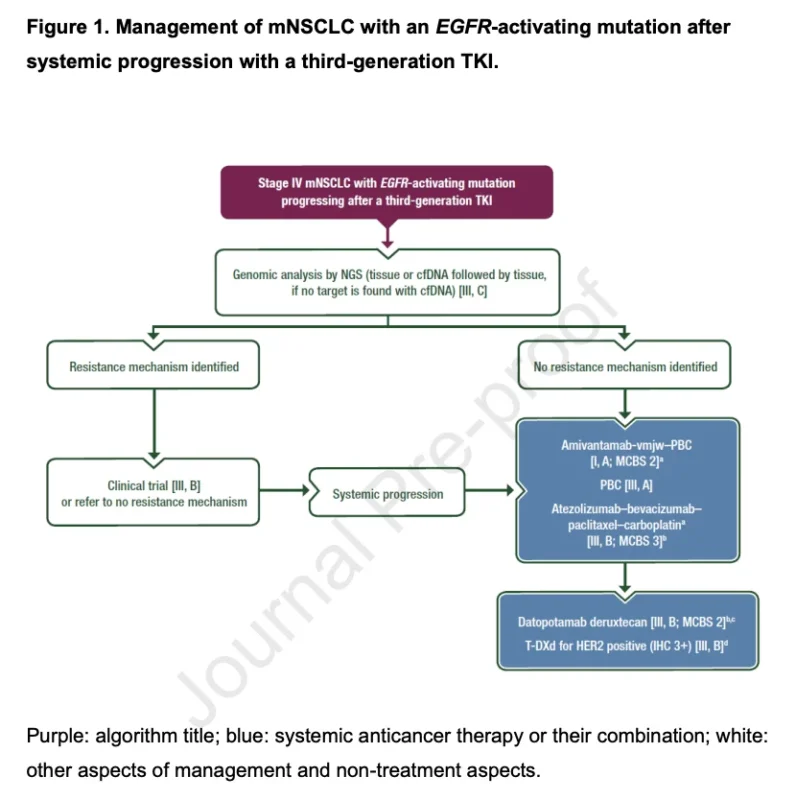
Acquired resistance to third-generation EGFR inhibitors remains a defining challenge in advanced EGFR-mutated NSCLC. The 2026 recommendations reinforce the importance of distinguishing limited or slowly progressive disease from clinically meaningful systemic progression.
For patients experiencing moderate, slowly growing, asymptomatic radiological progression while continuing to derive clinical benefit, ESMO states that continuation of the EGFR tyrosine kinase inhibitor may be considered [III, B].
This recommendation recognizes that radiological progression does not always require an immediate change in systemic therapy. For patients with true systemic progression, determining the underlying resistance mechanism becomes particularly important.
The guideline states that next-generation sequencing using tumor tissue or circulating cell-free DNA may be made available after EGFR TKI resistance [III, C]. If plasma testing does not identify an actionable resistance alteration, tissue testing is recommended as a complementary approach where feasible.
This sequencing reflects the limitations of liquid biopsy. A negative plasma result does not necessarily establish that a targetable resistance mechanism is absent. For patients progressing after first- or second-generation EGFR inhibitors, ESMO continues to recommend testing for EGFR T790M resistance [I, A].
Patients with T790M-positive disease should receive osimertinib as second-line treatment [I, A], while patients without T790M are generally directed toward platinum-based chemotherapy according to the guideline. Following progression on osimertinib monotherapy, the updated treatment pathway incorporates newer therapeutic options.
Amivantamab Plus Chemotherapy Remains a Recommended Post-Osimertinib Approach
For systemic progression after osimertinib monotherapy, ESMO recommends amivantamab combined with carboplatin and pemetrexed as one treatment option. The recommendation is graded [I, A], with an ESMO-MCBS v2.0 score of 2.
Platinum-based doublet chemotherapy alone remains another recommended approach [III, A]. The guideline explicitly emphasizes the additional toxicity associated with amivantamab. This distinction is clinically relevant because combination treatment may improve disease control while introducing adverse events that influence tolerability and quality of life.
Treatment selection therefore requires consideration of patient fitness, previous toxicity, clinical disease burden, and the expected benefit of treatment intensification. ESMO also allows consideration of atezolizumab combined with bevacizumab, paclitaxel, and carboplatin after EGFR TKI failure in selected patients.
This recommendation applies to patients with performance status 0–1 and no contraindication to immune checkpoint inhibition. It carries a grade of [III, B], with an MCBS score of 3. By contrast, single-agent immune checkpoint inhibition is listed only as a possible option following progression on EGFR TKIs and chemotherapy [IV, C].
The relatively limited position of checkpoint inhibitor monotherapy reflects the different immunobiology of EGFR-driven disease and the clinical evidence supporting available treatment strategies.
Antibody–Drug Conjugates Enter the Post-EGFR-TKI Algorithm
One of the most important updates concerns antibody–drug conjugates (ADCs). ESMO now includes datopotamab deruxtecan (Dato-DXd) among treatments that can be considered after progression following EGFR-directed therapy and platinum-based chemotherapy.
The recommendation is [III, B], with an ESMO-MCBS v2.0 score of 2. Dato-DXd targets TROP2 and delivers a topoisomerase I inhibitor payload, providing an alternative treatment mechanism after failure of EGFR-directed therapy. The recommendation is supported by clinical evidence demonstrating activity in previously treated EGFR-mutated NSCLC.
However, its inclusion should not be interpreted as establishing superiority over all other available post-progression regimens. The optimal sequence of Dato-DXd relative to other emerging ADCs and targeted approaches remains incompletely defined.
The update also incorporates trastuzumab deruxtecan (T-DXd) for patients with EGFR-mutated disease whose tumors demonstrate HER2 protein overexpression at IHC 3+. For eligible patients progressing after EGFR-directed therapy and platinum chemotherapy, T-DXd may be considered [III, B].
This is a particularly important development because it recognizes that an oncogenic driver and an actionable protein-expression biomarker may coexist. A patient with EGFR-mutated NSCLC may retain an EGFR-driven molecular classification while also expressing high levels of HER2 protein.
Such findings can create additional treatment opportunities beyond conventional resistance-mutation targeting. However, HER2 overexpression must not be confused with HER2 activating mutations. These represent different biological and diagnostic categories, with different supporting clinical evidence.
At the time of the ESMO update, the relevant Dato-DXd and HER2-overexpression-based T-DXd indications were FDA-approved but not EMA-approved.
ALK-Positive NSCLC: Ensartinib Joins the First-Line Options
ALK-rearranged NSCLC has become one of the most successful areas of molecularly targeted lung cancer treatment. Second- and third-generation ALK inhibitors offer substantial systemic and intracranial activity, often producing prolonged disease control.
The ESMO update incorporates ensartinib among recommended first-line options. The recommendation follows the randomized phase III eXalt3 study, in which ensartinib demonstrated superior progression-free survival compared with crizotinib in ALK TKI-naive disease.
ESMO now recommends first-line treatment with alectinib, brigatinib, lorlatinib, or ensartinib. The recommendations are graded:
- Alectinib [I, A; MCBS 4].
- Brigatinib [I, A; MCBS 4].
- Lorlatinib [I, A; MCBS 4].
- Ensartinib [I, B; MCBS 3].
The guideline identifies lorlatinib as a preferred option, particularly in patients with brain metastases [II, A]. This reflects the importance of intracranial disease control in ALK-positive NSCLC.
Brain metastases are common during the disease course, and central nervous system efficacy can be a major factor in treatment selection. Nevertheless, the preference for lorlatinib does not eliminate the role of other recommended ALK inhibitors.
Patient comorbidities, anticipated toxicities, access, and individual treatment goals remain important. Ensartinib was FDA-approved but not EMA-approved at the time of the update. Following progression on a second-generation ALK inhibitor, ESMO recommends lorlatinib [III, A]. After progression on lorlatinib, platinum-based doublet chemotherapy is recommended [III, A].
Atezolizumab–bevacizumab–paclitaxel–carboplatin may also be considered in this later setting [III, C]. As more effective ALK inhibitors are used earlier, the management of resistance after lorlatinib is becoming an increasingly important research priority.
ROS1-Positive NSCLC: A Growing Therapeutic Sequence
The ROS1 section receives substantial attention in the updated recommendations. Historically, crizotinib and entrectinib represented key initial targeted treatments for ROS1-rearranged NSCLC. However, newer agents are expanding both the first-line and post-progression treatment landscape.
ESMO continues to recommend crizotinib or entrectinib as first-line options [III, A]. For patients with brain metastases, entrectinib is preferred over crizotinib when available [III, A]. Repotrectinib is recommended as an additional treatment option [III, A; MCBS 3]. The 2026 update also includes taletrectinib, supported by results from the TRUST-I and TRUST-II studies.
Taletrectinib is recommended as another option [III, A]. Following prior treatment with at least one ROS1 inhibitor, the guideline recommends taletrectinib or zidesamtinib [III, A]. Zidesamtinib’s recommendation reflects evidence from the ARROS-1 study in previously treated ROS1-positive disease.
For patients who received crizotinib initially, repotrectinib or platinum-based chemotherapy also remain guideline-listed subsequent options. The expanding number of ROS1 inhibitors introduces important clinical questions.
These include the relative activity of different drugs against acquired resistance mutations, intracranial efficacy, tolerability, and the optimal sequence after exposure to newer-generation inhibitors. The guideline identifies several treatment options but does not establish that they are interchangeable or that one sequence is superior in every patient.
At the time of the update, taletrectinib and zidesamtinib were FDA-approved but not EMA-approved for the relevant indications described.
HER2-Mutated NSCLC: Zongertinib and Sevabertinib Move Into First-Line Treatment
The treatment of HER2-mutated NSCLC is one of the most rapidly changing areas of thoracic precision oncology. The HER2 pathway can be altered through activating mutations, gene amplification, or protein overexpression.
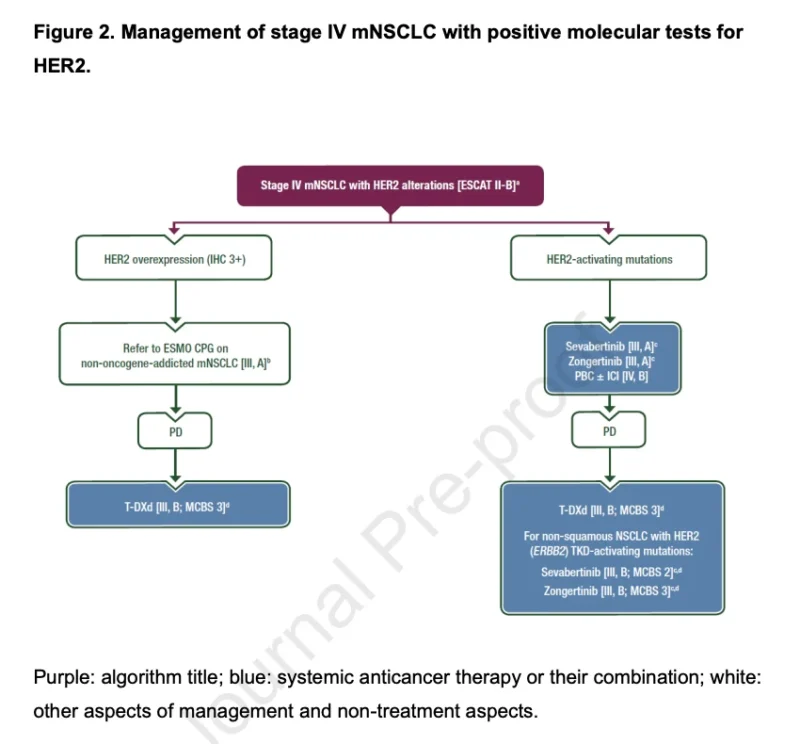
Although these alterations involve the same receptor family, they cannot be treated as equivalent biomarkers. The new guideline emphasizes this distinction. For patients with HER2 tyrosine kinase domain (TKD) activating mutations, ESMO recommends sevabertinib or zongertinib as first-line therapy [III, A].
These recommendations are supported by clinical activity observed in SOHO-01 and Beamion LUNG-1. Both agents are targeted HER2 inhibitors designed for molecularly selected populations. For patients who cannot access these medicines, or whose HER2 mutations fall outside the specified TKD category, platinum-based chemotherapy with or without immune checkpoint inhibition remains a recommended first-line approach [IV, B].
The guideline also addresses treatment after progression. T-DXd remains recommended after previous systemic treatment [III, B; MCBS 3]. For patients with nonsquamous NSCLC harboring HER2 TKD mutations who have received prior systemic treatment, sevabertinib or zongertinib may also be considered [III, B].
The MCBS scores listed for these later-line indications are 2 for sevabertinib and 3 for zongertinib. These recommendations provide more than one treatment option across the disease course. However, their inclusion does not resolve whether a HER2 TKI should always be followed by T-DXd, or whether an alternative sequence may be preferable.
Those questions require comparative evidence and a clearer understanding of treatment-specific resistance mechanisms.
HER2 Overexpression Is a Separate Therapeutic Category
An especially important aspect of the new ESMO algorithm is the separation of HER2 activating mutations from HER2 protein overexpression.
For metastatic NSCLC with HER2 IHC 3+ overexpression, the guideline initially directs clinicians toward the treatment framework for non-oncogene-addicted disease, rather than automatically applying the HER2-mutated treatment algorithm.
Following progression, T-DXd may be recommended [III, B; MCBS 3]. This distinction has practical implications for molecular pathology. A tumor with HER2 IHC 3+ staining does not necessarily harbor an activating ERBB2 mutation.
Similarly, the presence of an ERBB2 mutation does not guarantee high HER2 protein expression. Comprehensive molecular profiling and appropriately interpreted immunohistochemistry therefore serve complementary purposes.
The choice of treatment should follow the actual alteration and the indication supported by clinical evidence. This is particularly relevant as HER2-directed drugs with different mechanisms of action enter routine oncology practice.
NRG1 Fusions: Zenocutuzumab Becomes a Recommended Option
NRG1 fusions represent a rare but therapeutically relevant molecular subgroup of NSCLC. These rearrangements can activate signaling through HER3-associated receptor complexes and contribute to oncogenic growth.
The ESMO update incorporates zenocutuzumab, a HER2/HER3-directed bispecific antibody with activity in NRG1 fusion-positive malignancies. The recommendation follows clinical evidence showing activity in patients with NRG1 fusion-positive cancers, including NSCLC.
ESMO generally recommends platinum-based chemotherapy with or without immune checkpoint inhibition as first-line treatment [IV, B]. After previous first-line therapy, zenocutuzumab-zbco may be considered [III, B].
The drug was FDA-approved but not EMA-approved for the relevant indication at the time of the manuscript. The importance of this recommendation extends beyond the individual therapy. NRG1 fusions can be missed when molecular testing is limited to common mutations or when fusion-sensitive methods are unavailable.
As targeted options expand, comprehensive genomic profiling becomes increasingly important for detecting rare but actionable alterations.
High c-MET Overexpression: Telisotuzumab Vedotin Enters the Algorithm
The 2026 update also expands treatment options for selected patients with high c-MET protein expression. The recommendation concerns telisotuzumab vedotin, an antibody–drug conjugate targeting c-MET. Clinical activity was demonstrated in the phase II LUMINOSITY study among patients with previously treated EGFR-wild-type, nonsquamous NSCLC and c-MET protein overexpression.
ESMO recommends telisotuzumab vedotin after first-line treatment for patients with high c-MET overexpression [III, B]. The required biomarker definition is specific: at least 50% of tumor cells must show strong (3+) c-MET staining.
This threshold is important. c-MET protein overexpression is not equivalent to MET exon 14 skipping or MET gene amplification. Each represents a different type of molecular or protein-level alteration and may have different therapeutic implications.
The guideline directs initial treatment toward the relevant non-oncogene-addicted NSCLC algorithm before considering telisotuzumab vedotin in the appropriate later-line setting. At the time of the guideline update, the drug was FDA-approved but not EMA-approved. The recommendation reinforces the expanding role of quantitative protein biomarkers in addition to DNA-based genomic testing.
A New Era of Precision Testing: The Biomarker Must Match the Drug
Taken together, the recommendations reflect a substantial change in how clinicians must approach molecular profiling. For some targets, a specific activating mutation is required. For others, a gene fusion or protein-expression threshold defines eligibility. This distinction is particularly evident for HER2 and MET.
An effective testing strategy may therefore require next-generation sequencing, fusion-sensitive analysis, immunohistochemistry, and repeat molecular assessment at progression. Testing should also consider the possibility of acquired resistance alterations that were not detectable at initial diagnosis.
The new ESMO recommendations emphasize that treatment decisions increasingly depend on the quality and completeness of molecular characterization. A broad diagnosis such as EGFR-mutated, HER2-positive, or MET-altered NSCLC may no longer provide enough detail to select the most appropriate therapy. The exact alteration matters.
ESMO Recommendations Are Not the Same as Regulatory Approval
One of the most important aspects of the update is the distinction between professional guideline recommendations and national or regional drug authorization. Several newer agents included in the ESMO algorithms were FDA-approved but not EMA-approved at the time the manuscript was prepared.
These include treatments in the EGFR exon 20 insertion, ROS1, HER2, NRG1, and c-MET categories. Consequently, an ESMO recommendation does not automatically establish that a drug is available or reimbursed in every European country.
The guideline also uses different evidence levels and recommendation grades to describe the strength of the supporting research. Recommendations graded [I, A] generally reflect a stronger evidence base than those graded [III, B] or [IV, C].
Many treatments for rare molecular subgroups are supported by single-arm or early-phase evidence because sufficiently large randomized trials are challenging to conduct. Their inclusion may be clinically justified, but the uncertainty surrounding comparative benefit, sequencing, and long-term outcomes remains important.
Similarly, ESMO-MCBS scores describe the magnitude of clinical benefit assessed within the scale’s framework. They should not be used as simplistic head-to-head rankings between agents studied in different populations.
What Remains Unresolved?
Despite the expanding therapeutic options, several important questions remain unanswered. The optimal sequence after modern first-line combinations is often uncertain because many subsequent therapies were evaluated in patients exposed to older regimens.
For EGFR-mutated disease, the growing use of third-generation EGFR TKIs in combinations may affect the applicability of post-osimertinib evidence. For HER2-mutated NSCLC, the availability of selective HER2 inhibitors and T-DXd creates new questions regarding cross-resistance and treatment order.
ROS1-positive NSCLC faces similar uncertainty as multiple next-generation inhibitors move into earlier treatment lines. The clinical integration of ADCs also requires careful management of toxicity, including potential interstitial lung disease and other agent-specific adverse events.
Finally, access remains a major obstacle. Patients cannot benefit from precision treatment if molecular testing is unavailable, results are delayed, or the recommended drug cannot be obtained. The clinical impact of the updated guideline will therefore depend not only on scientific advances but also on the ability of healthcare systems to implement them.
OncoDaily Takeaway
The November 2026 ESMO Living Guideline update marks another important expansion of precision treatment for oncogene-addicted metastatic NSCLC. Sunvozertinib adds a targeted option after platinum-based chemotherapy for EGFR exon 20 insertion-positive disease.
Datopotamab deruxtecan and selected use of trastuzumab deruxtecan are incorporated into the post-EGFR-TKI treatment landscape. Ensartinib expands first-line ALK treatment options, while taletrectinib and zidesamtinib broaden the ROS1 therapeutic sequence.
Sevabertinib and zongertinib become recommended options for HER2 TKD-mutated disease, including first-line treatment. Zenocutuzumab introduces a targeted approach after previous treatment for NRG1 fusion-positive disease, while telisotuzumab vedotin offers a new option for selected patients with high c-MET protein overexpression.
However, the updated recommendations should not be interpreted as establishing an optimal sequence for every patient. Evidence strength varies across alterations, several treatment recommendations remain supported by nonrandomized studies, and regulatory availability differs between the United States and Europe.
The central clinical message is that precision oncology in metastatic NSCLC now requires more than identifying an oncogenic driver. It requires defining the exact alteration, understanding the prior treatment sequence, recognizing new therapeutic vulnerabilities, and matching each patient to the most appropriate evidence-supported treatment.
The ESMO Living Guideline provides a continuously updated framework for these decisions, while future randomized studies and real-world evidence will be essential to resolve the remaining uncertainties.
Sources
- Hendriks LEL, Passaro A, Popat S, Reck M, on behalf of the ESMO Guidelines Committee. Updated Treatment Recommendations for Systemic Treatment: From the ESMO Oncogene-Addicted Metastatic Non-Small Cell Lung Cancer Living Guideline. Annals of Oncology. 2026. Accepted October 20, 2026; journal pre-proof. DOI: 10.1016/j.annonc.2026.10.1291
- European Society for Medical Oncology. ESMO Oncogene-Addicted Metastatic Non-Small-Cell Lung Cancer Living Guideline. Version 1.4, November 2026.
- Yang JC, et al. WU-KONG1B: Sunvozertinib in Platinum-Pretreated EGFR Exon 20 Insertion NSCLC. Journal of Clinical Oncology. 2025.
- Horn L, et al. Ensartinib Versus Crizotinib for ALK-Positive NSCLC: eXalt3. JAMA Oncology. 2021.
- Pérol M, et al. Taletrectinib in ROS1-Positive NSCLC: TRUST. Journal of Clinical Oncology. 2025.
- Heymach JV, et al. First-Line Zongertinib in Advanced HER2-Mutant NSCLC. New England Journal of Medicine. 2026.
- Schram AM, et al. Efficacy of Zenocutuzumab in NRG1 Fusion-Positive Cancer. New England Journal of Medicine. 2025.
- Camidge DR, et al. Telisotuzumab Vedotin in Previously Treated c-MET-Overexpressing Advanced NSCLC: LUMINOSITY. Journal of Clinical Oncology. 2024.