
The management of non-metastatic non–small cell lung cancer has become increasingly complex as molecular testing, perioperative immunotherapy, targeted therapy, advanced radiotherapy, and evolving surgical strategies move into earlier stages of disease.
Although international guidelines provide evidence-based recommendations, many real-world situations remain incompletely defined. Questions continue around mediastinal restaging after induction therapy, the use of liquid biopsy and minimal residual disease, treatment of multistation or bulky N2 disease, and the sequencing of immunotherapy and targeted therapy in oncogene-driven tumors.
An international multidisciplinary panel has now developed a structured consensus to address these clinical gray zones.
Published as a journal pre-proof in the Journal of Thoracic Oncology, the project involved 89 thoracic oncology experts who assessed 96 clinical statements covering staging, pathology, biomarker testing, surgery, perioperative treatment, unresectable stage III disease, and oncogene-driven NSCLC.
Consensus was reached for 62 statements, or 64%, while 31 statements remained unresolved and three were rejected. The results provide a practical framework for areas where evidence and international guidance do not yet offer a single clear approach (Meyer et al., 2026).
Why Was an International Consensus Needed?
Treatment decisions in non-metastatic NSCLC now involve multiple specialties and an expanding number of diagnostic and therapeutic variables.
Accurate staging can determine whether a patient receives surgery, chemoradiotherapy, systemic therapy, or a multimodality strategy. Molecular and PD-L1 results can affect perioperative and adjuvant treatment. Pathological response after neoadjuvant therapy may provide prognostic information, while emerging tools such as circulating tumor DNA could eventually influence treatment intensity and surveillance.
However, the available evidence is not equally mature across all of these areas.
The authors emphasized that the consensus was not intended to replace formal clinical guidelines or define new standards of care. Instead, it was designed as a pragmatic decision-support tool for situations in which guidelines remain ambiguous, evidence is limited, or clinical practice varies substantially between institutions and regions.
How Was the Consensus Developed?
The modified Delphi process was conducted during a three-day meeting in Barcelona, Spain, from September 3 to 5, 2025.
The panel included medical oncologists, pulmonologists, thoracic surgeons, radiation oncologists, radiologists, and pathologists from institutions across multiple regions.
Experts independently scored each statement on a nine-point scale. Consensus required at least 75% of ratings to fall within the seven-to-nine agreement range. A statement was considered rejected when at least 75% of ratings were in the one-to-three disagreement range.
This method allowed the investigators to distinguish areas of strong agreement from topics that remain genuinely controversial.
PET–CT Was Strongly Supported, but Staging Questions Remain
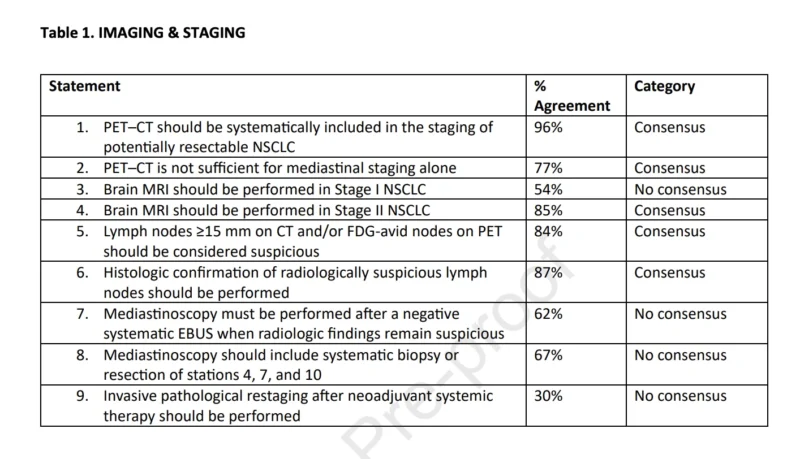
The panel reached 96% agreement that FDG PET–CT should be systematically included when staging potentially resectable NSCLC.
However, PET–CT alone was not considered sufficient for mediastinal staging. Suspicious lymph nodes—including nodes measuring at least 15 mm on CT or demonstrating FDG uptake—were considered to require histological confirmation.
Agreement reached 87% for obtaining pathological confirmation of radiologically suspicious lymph nodes.
The role of brain imaging remained more stage dependent. Brain MRI in stage II disease reached consensus, with 85% agreement. In contrast, routine brain MRI in stage I NSCLC remained unresolved, receiving only 54% agreement.
No consensus was reached on whether mediastinoscopy must follow a negative systematic endobronchial ultrasound when imaging remains suspicious. Invasive mediastinal restaging after neoadjuvant treatment was also unresolved, with only 30% agreement.
These results reflect continuing uncertainty about how extensively patients should be restaged after induction therapy and how best to identify persistent nodal disease before surgery.
Reflex Molecular Testing Moves Into Early-Stage Practice
One of the clearest areas of agreement involved biomarker testing at diagnosis.
The panel supported:
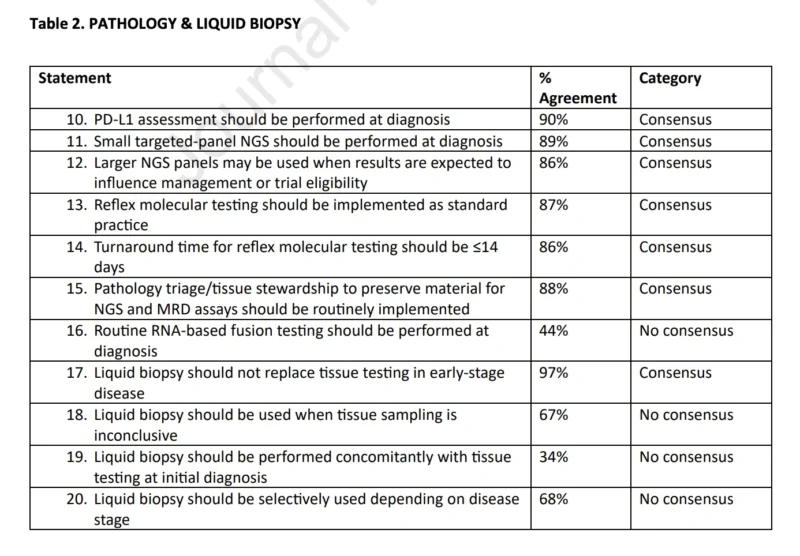
- PD-L1 assessment at diagnosis, with 90% agreement.
- Small targeted DNA-based NGS panels at diagnosis, with 89% agreement.
- Reflex molecular testing as standard practice, with 87% agreement.
- A turnaround time of no more than 14 days, with 86% agreement.
The panel also supported larger DNA-based NGS panels when the findings could influence treatment decisions or clinical trial eligibility.
Pathology triage and tissue stewardship received 88% agreement, reflecting the importance of conserving limited biopsy material for molecular testing and other biomarker analyses.
These recommendations indicate that molecular profiling is no longer viewed only as a metastatic-disease requirement. The increasing use of adjuvant targeted therapies and perioperative systemic treatments has made biomarker availability relevant before definitive treatment decisions in non-metastatic NSCLC.
RNA Testing and Liquid Biopsy Remain Less Defined
Despite strong support for DNA-based testing, the panel did not reach consensus on routine RNA-based fusion testing at diagnosis.
Only 44% supported its systematic use.
There was also no agreement on whether liquid biopsy should be performed at the same time as tissue testing, used selectively according to disease stage, or introduced when tissue sampling is inconclusive.
However, the panel reached 97% agreement that liquid biopsy should not replace tissue testing in early-stage disease.
The consensus therefore distinguishes between the potential value of plasma-based analysis and its current limitations in non-metastatic NSCLC. Tissue remains central for diagnosis, histological assessment, PD-L1 testing, and molecular evaluation.
MRD Was Considered Promising but Not Ready to Guide Treatment
Circulating tumor DNA and minimal residual disease were among the most controversial areas.
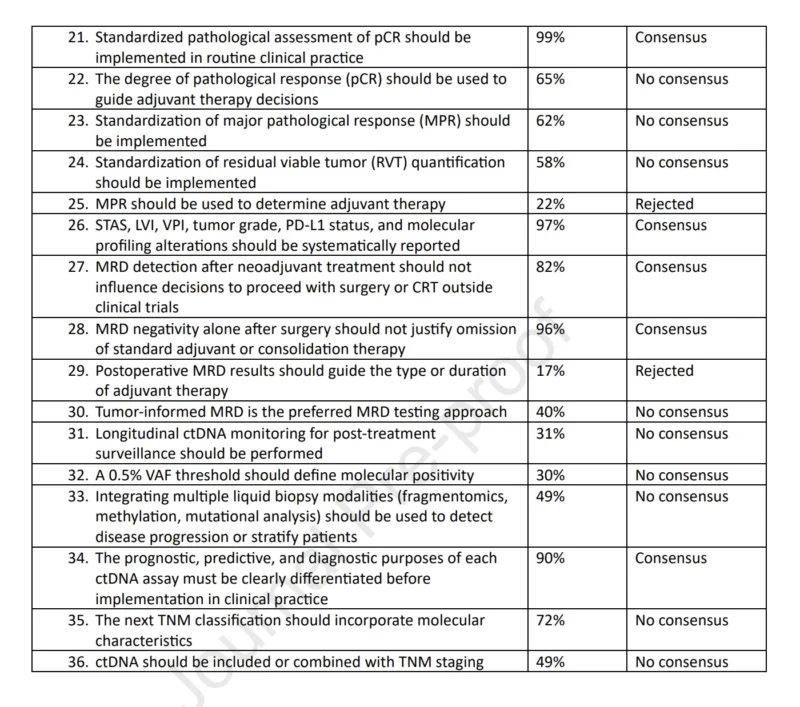
The panel reached 82% agreement that MRD detection after neoadjuvant therapy should not determine whether a patient proceeds to surgery or chemoradiotherapy outside a clinical trial.
There was even stronger agreement, 96% that MRD negativity after surgery should not justify omitting established adjuvant or consolidation treatment.
A statement proposing that postoperative MRD results guide the type or duration of adjuvant therapy was rejected.
The panel also did not agree on routine longitudinal ctDNA surveillance, a preferred tumor-informed MRD approach, or a universal variant allele frequency threshold for molecular positivity.
Nevertheless, 90% agreed that the prognostic, predictive, and diagnostic purposes of each ctDNA assay must be clearly distinguished before clinical implementation.
The findings recognize the potential of MRD while emphasizing that assay standardization, sensitivity, clinical validity, and treatment utility remain insufficiently established.
Surgery Remains Anchored in Resectability and Nodal Quality
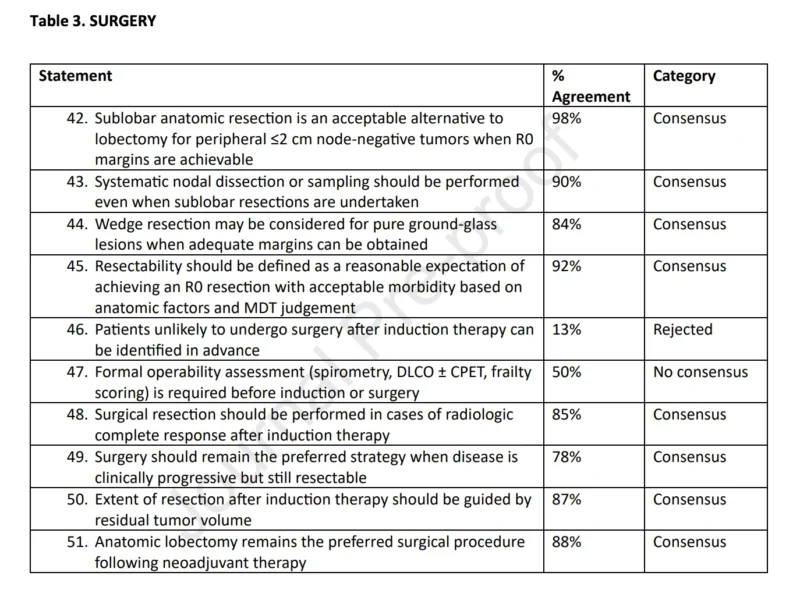
The consensus strongly supported sublobar surgery for selected small tumors.
An anatomic sublobar resection was considered an acceptable alternative to lobectomy for peripheral, node-negative tumors measuring 2 cm or less, provided an R0 resection could be achieved. Agreement reached 98%.
Systematic nodal dissection or sampling remained necessary even when a sublobar procedure was performed, with 90% agreement.
Wedge resection was considered appropriate for selected pure ground-glass lesions when adequate margins could be obtained.
The panel defined resectability according to the reasonable expectation of achieving an R0 resection with acceptable morbidity, based on anatomical factors and multidisciplinary team judgment.
After neoadjuvant therapy, surgery remained supported even when imaging showed a complete response. The extent of surgery was considered dependent on residual tumor volume, while anatomic lobectomy remained the preferred procedure following neoadjuvant treatment.
The panel rejected the idea that clinicians can reliably identify in advance which patients beginning induction treatment will ultimately fail to proceed to surgery.
Stage I Treatment Should Remain Selective
Routine adjuvant chemotherapy was not recommended for low-risk stage I NSCLC, with 97% agreement.
Adjuvant systemic therapy could still be considered for selected patients with high-risk stage I disease following multidisciplinary review.
The panel also reached 93% agreement that immune checkpoint inhibitors should not be used in stage I NSCLC outside clinical trials, regardless of whether they are considered before surgery, after surgery, or around stereotactic body radiotherapy.
Postoperative radiotherapy was supported after an R1 resection when repeat surgery was not feasible. However, routine postoperative radiotherapy after complete resection of pN2 disease remained controversial.
Concurrent administration of postoperative radiotherapy and adjuvant immunotherapy was not supported.
Chemoimmunotherapy Was Favored for Resectable Stage II Disease
For operable and resectable stage II NSCLC, the panel favored neoadjuvant or perioperative chemoimmunotherapy.
Agreement reached 85% for this strategy and 84% for offering it irrespective of PD-L1 expression.
The panel also supported three to four cycles of platinum-based chemotherapy in line with major perioperative trials.
When patients underwent upfront surgery without neoadjuvant immunotherapy, PD-L1 expression was considered relevant to adjuvant immunotherapy decisions. A planned adjuvant immunotherapy duration of 12 months received 96% agreement.
These statements reflect the growing integration of immunotherapy into multimodality treatment for resectable stage II and selected stage III NSCLC.
Multistation N2 Disease Remains an MDT Decision
For upfront resectable stage III NSCLC without an oncogenic driver, surgery within a multimodality strategy was supported after multidisciplinary review.
Induction chemoimmunotherapy was considered a valid option for medically operable patients with resectable multistation N2 disease, reaching the 75% consensus threshold.
However, the same strategy did not reach consensus for bulky N2 disease.
The panel also could not define a standardized treatment pathway for persistent N2 disease after neoadjuvant therapy.
When a patient could no longer proceed to surgery but remained eligible for definitive radiotherapy, the panel strongly supported switching to concurrent chemoradiotherapy with curative intent.
These findings reinforce the importance of repeated multidisciplinary assessment rather than relying on a fixed treatment pathway established at diagnosis.
The PACIFIC Approach Remains Central in Unresectable Disease
For unresectable stage III NSCLC, consolidation immunotherapy after concurrent chemoradiotherapy was supported regardless of PD-L1 expression.
Patients with performance status 2 could also be considered for consolidation immunotherapy, provided treatment timing, dosing, and toxicity monitoring were individualized.
The panel supported consolidation immunotherapy after sequential chemoradiotherapy when concurrent treatment was not feasible and no progression had occurred.
In contrast, routine immunotherapy after radiotherapy alone did not reach consensus and was considered more appropriate for clinical trials or exceptional multidisciplinary cases.
Advanced radiotherapy techniques, including intensity-modulated radiotherapy and volumetric-modulated arc therapy, were considered standard components of non-metastatic NSCLC treatment involving radiotherapy.
The PACIFIC strategy of chemoradiotherapy followed by durvalumab was also supported for inoperable stage II N1 disease.
Oncogene-Driven NSCLC Requires a Different Framework
The strongest consensus statements emerged in EGFR- and ALK-driven disease.
The panel reached 98% agreement that consolidation immunotherapy should not be routinely offered after chemoradiotherapy in EGFR-mutated NSCLC. The same position received 93% agreement for ALK-rearranged disease.
For oncogene-driven tumors other than EGFR or ALK, consolidation immunotherapy was considered an individualized decision or one that should be restricted to clinical trials.
The only statement to achieve 100% agreement supported continuing PACIFIC-type chemoradiotherapy followed by durvalumab for unresectable KRAS G12C-mutated NSCLC outside clinical trials.
After curative-intent resection, adjuvant targeted therapy was supported for tumors with sensitizing EGFR mutations or ALK rearrangements, in line with the ADAURA and ALINA trials.
When chemotherapy and an EGFR-targeted therapy were both planned, chemotherapy was considered the first treatment in a sequential strategy.
Routine neoadjuvant targeted therapy did not reach consensus. For actionable alterations other than EGFR or ALK—including ROS1, MET exon 14, RET, NTRK, BRAF V600E, and HER2—the panel supported restricting adjuvant targeted therapy to clinical trials.
The experts also agreed that the choice between perioperative immunotherapy and targeted therapy should reflect the presence of an actionable alteration and the strength of the available evidence.
The Consensus Captures a Rapidly Changing Field
The authors noted that the voting reflected evidence available at the September 2025 meeting.
Since then, results from the phase 3 LIBRETTO-432 trial have reported improved event-free survival with adjuvant selpercatinib in resected RET fusion-positive NSCLC. The consensus paper included these later findings in its discussion but acknowledged that they were not available during the voting process.
This example illustrates one of the challenges of developing recommendations in early-stage lung cancer: the evidence can change before a consensus document reaches publication.
The areas without agreement should therefore not be interpreted as failures of the process. They identify questions that require prospective trials, assay validation, or more mature clinical evidence.
What Does This Mean for Clinical Practice?
The consensus provides strong support for several practical steps that can already improve care consistency.
Potentially resectable NSCLC requires systematic PET–CT staging, pathological confirmation of suspicious nodes, early PD-L1 and DNA-based molecular testing, tissue preservation, and multidisciplinary assessment.
For selected peripheral tumors measuring 2 cm or less, sublobar surgery is considered acceptable when oncological margins and nodal evaluation are adequate.
Chemoimmunotherapy has become central for resectable stage II disease and selected stage III presentations, while the PACIFIC approach remains the reference strategy for unresectable disease.
At the same time, liquid biopsy, MRD-guided treatment, mediastinal restaging, bulky N2 disease, and neoadjuvant targeted therapy remain areas where evidence is not yet sufficient to support uniform practice.
The Bottom Line
The international consensus demonstrates how far non-metastatic NSCLC treatment has moved beyond a simple choice between surgery and chemoradiotherapy.
Among 96 statements, 62 reached consensus. The strongest agreement supported systematic PET–CT, histological confirmation of suspicious nodes, reflex PD-L1 and DNA-based NGS, molecular turnaround within 14 days, careful tissue stewardship, quality nodal assessment during surgery, perioperative chemoimmunotherapy in appropriate stage II disease, and consolidation treatment after chemoradiotherapy.
The document also defines the limits of current evidence. Routine MRD-guided treatment, widespread liquid biopsy use, neoadjuvant targeted therapy, and several complex stage III strategies remain unresolved.
Rather than creating a new guideline, the consensus provides a multidisciplinary map of where clinical practice is aligned, and where the next generation of evidence is still needed.
Reference
- Meyer ML, Peters S, Borghaei H, Cascone T, Dacic S, Faivre-Finn C, et al. Bridging evidence and practice: international multidisciplinary consensus on non-metastatic NSCLC. Journal of Thoracic Oncology. 2026. doi:10.1016/j.jtho.2026.104111.