Lung cancer is often viewed primarily as a smoking-related disease, yet a substantial proportion of cases occur in people with little or no lifetime tobacco exposure.
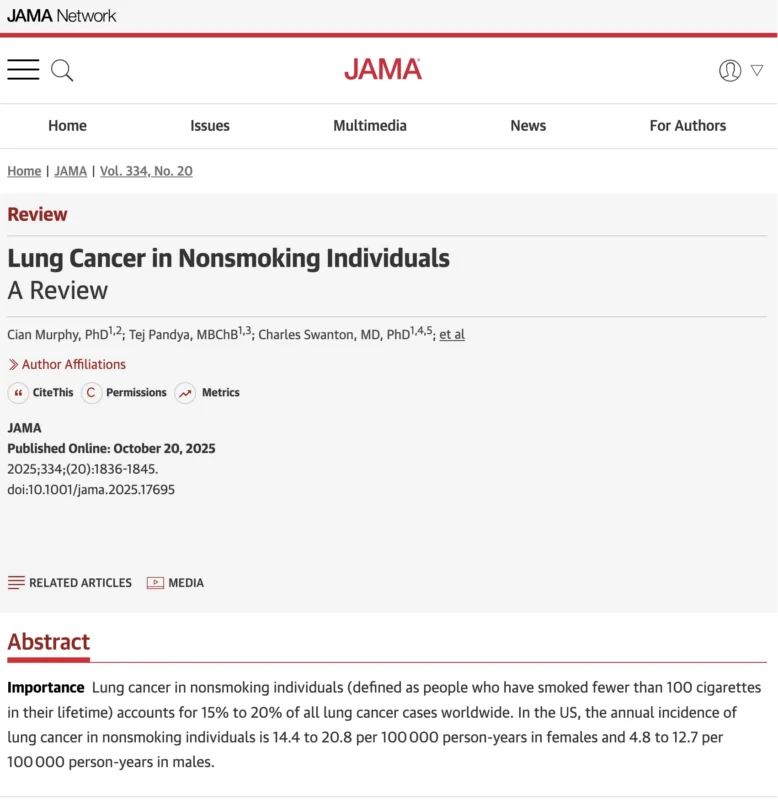
A 2025 review published in JAMA estimates that lung cancer in nonsmoking individuals accounts for 15% to 20% of all lung cancer cases worldwide. The review defines nonsmoking individuals as people who have smoked fewer than 100 cigarettes during their lifetime.
In the United States, the annual incidence is estimated at 14.4 to 20.8 cases per 100,000 person-years among females and 4.8 to 12.7 cases per 100,000 person-years among males.
These tumors differ from smoking-associated lung cancers in several important ways. Adenocarcinoma is more common, actionable genomic alterations are identified more frequently, and tumor mutation burden is generally lower. However, current screening programs often do not include nonsmoking individuals, creating challenges in early detection (Murphy et al., 2025).
How Common Is Lung Cancer in Nonsmoking Individuals?
Globally, approximately one in every five to seven lung cancer cases occurs in someone classified as a nonsmoking individual.
Although the overall incidence remains lower than among people with a smoking history, the absolute disease burden is considerable because lung cancer is one of the most frequently diagnosed cancers worldwide.
The sex difference reported in the United States is also notable. Annual incidence among females is approximately two to four times higher than among males, depending on the estimates used.
These findings reinforce that the absence of a smoking history does not eliminate the possibility of lung cancer and should not automatically lower clinical suspicion when relevant symptoms or imaging abnormalities are present (Murphy et al., 2025).
Which Histological Type Is Most Common?
Most lung cancers diagnosed in nonsmoking individuals are adenocarcinomas.
The JAMA review reported the following histological distribution:
- Adenocarcinoma: 60% to 80%
- Squamous or adenosquamous carcinoma: 10% to 20%
- Small cell lung cancer: less than 10%
The predominance of adenocarcinoma is clinically relevant because this histological subtype is frequently associated with genomic alterations that can be targeted with molecularly matched treatments.
However, other lung cancer subtypes can also occur in nonsmoking individuals. Histological confirmation remains essential rather than assuming the tumor type based on smoking history alone (Murphy et al., 2025).
What Causes Lung Cancer in People Who Have Never Smoked?
Lung cancer in nonsmoking individuals does not have a single cause.
The review identified several established or recognized risk factors, including exposure to secondhand tobacco smoke, residential or occupational radon, ambient air pollution, asbestos, and a history of lung cancer in a first-degree family member.
These factors may contribute differently across populations and geographic regions. Indoor air quality, occupational exposures, environmental regulation, housing conditions, and inherited susceptibility can all influence individual risk.
In many patients, however, no single clear exposure is identified. The absence of an obvious environmental or familial risk factor does not exclude the possibility of lung cancer (Murphy et al., 2025).
Why Is the Molecular Profile Different?
One of the clearest differences between lung cancer in nonsmoking individuals and smoking-associated disease is the frequency of therapeutically actionable genomic alterations.
According to the review, EGFR mutations are present in approximately 43% of tumors from nonsmoking individuals, compared with 11% among people with a current or former smoking history.
ALK rearrangements were reported in:
- 12% of nonsmoking individuals
- 2% of people with a smoking history
These differences have direct therapeutic implications because EGFR mutations and ALK rearrangements can identify patients who are candidates for targeted tyrosine kinase inhibitors.
The higher prevalence of actionable alterations also means that smoking history should never replace molecular testing. A nonsmoking history can increase suspicion for an oncogenic driver, but treatment decisions must be based on validated tumor testing (Murphy et al., 2025).
How Does Tumor Mutation Burden Differ?
Tumor mutation burden is generally lower in lung cancers arising in nonsmoking individuals.
The review reported mutation burdens of approximately 0 to 3 mutations per megabase in nonsmoking-associated lung cancers, compared with a broader range of 0 to 30 mutations per megabase among tumors from people with a smoking history.
This difference reflects distinct biological processes contributing to tumor development.
Smoking-related carcinogenesis can produce extensive DNA damage and a higher number of somatic mutations. In contrast, tumors in nonsmoking individuals are more frequently driven by specific genomic alterations rather than by a high overall mutation burden.
The review did not suggest that tumor mutation burden alone should determine treatment. Molecular drivers, disease stage, histology, performance status, and other clinical factors remain central to therapeutic planning (Murphy et al., 2025).
Are the Symptoms Different?
The symptoms of lung cancer are generally similar regardless of smoking history.
Patients may present with:
- Wheezing
- Chest pain
- Shortness of breath
- Hemoptysis
- Symptoms associated with metastatic disease, including bone pain or headache
Some cancers are identified incidentally during imaging performed for another clinical reason.
Because patients and clinicians may associate lung cancer primarily with tobacco use, symptoms in nonsmoking individuals can potentially be attributed to other respiratory or musculoskeletal conditions. The review emphasizes the importance of recognizing that conventional lung cancer symptoms remain relevant even when the patient has never smoked (Murphy et al., 2025).
Why Is Screening a Major Unresolved Issue?
Current US lung cancer screening recommendations are based largely on age and cumulative smoking exposure.
The US Preventive Services Task Force does not currently recommend routine low-dose computed tomography screening for nonsmoking individuals. As a result, people without a qualifying smoking history are generally excluded from established US screening programs, even when they have other environmental or familial risk factors.
Screening recommendations differ internationally, and research continues into whether risk models incorporating family history, air pollution, radon exposure, genetics, or other factors could identify nonsmoking individuals who might benefit from low-dose CT.
The evidence summarized in the review does not establish a universal screening strategy for this population. It highlights a continuing gap between the substantial number of lung cancers occurring in nonsmoking individuals and the smoking-based eligibility criteria used by many screening programs (Murphy et al., 2025).
Why Is Comprehensive Molecular Testing Essential?
The review recommends comprehensive next-generation sequencing of tumor tissue in nonsmoking individuals with stage IB to IIIA lung cancer.
This recommendation reflects the higher likelihood of identifying genomic alterations that may influence the use of targeted therapy.
In advanced non–small cell lung cancer, broad molecular testing is also critical because treatment selection may depend directly on the presence of an actionable driver.
The review specifically identifies EGFR mutations and ALK rearrangements as clinically important alterations. It notes that these can be treated with tyrosine kinase inhibitors, including osimertinib for EGFR-mutated disease and lorlatinib for ALK-rearranged disease.
Molecular testing should therefore be integrated into the diagnostic pathway rather than deferred until after conventional systemic treatment has begun (Murphy et al., 2025).
How Is Lung Cancer in Nonsmoking Individuals Treated?
Treatment remains determined primarily by cancer stage, performance status, histological findings, and the molecular characteristics of the tumor.
Management can include surgery, radiotherapy, systemic therapy, or a combination of these approaches.
For localized disease, surgery or radiotherapy may form the basis of curative-intent treatment. Systemic treatment can be incorporated according to pathological stage and molecular findings.
In locally advanced or metastatic disease, genomic testing can identify patients eligible for targeted therapy. When no actionable alteration is detected, treatment selection follows the broader therapeutic framework used for lung cancer, taking into account tumor histology, disease extent, patient condition, and relevant biomarkers.
The defining difference is not that all nonsmoking individuals receive targeted therapy, but that they have a substantially higher probability of carrying a targetable genomic alteration (Murphy et al., 2025).
How Do Actionable Alterations Affect Survival?
The presence of an actionable genomic alteration can substantially influence outcomes in advanced disease.
The review reported that median survival among nonsmoking individuals with stage IIIB or more advanced non–small cell lung cancer and an actionable genomic alteration can exceed three to five years when patients receive appropriate targeted therapy.
For patients without actionable alterations, median survival was reported as approximately one to two years, broadly similar to outcomes among patients with lung cancer and a smoking history.
These figures illustrate the clinical importance of identifying molecular drivers. The prognostic difference is not created by nonsmoking status alone; it is strongly influenced by whether the tumor contains a genomic alteration that can be matched to an effective treatment (Murphy et al., 2025).
What Does This Review Change in Practice?
The review reinforces several practical principles.
A nonsmoking history should not be interpreted as protection against lung cancer. Persistent respiratory symptoms, hemoptysis, unexplained chest pain, or symptoms suggestive of metastatic disease still require appropriate evaluation.
Smoking history should also not be used as a substitute for tumor profiling. Although EGFR mutations and ALK rearrangements are more common in nonsmoking individuals, molecular testing is required to identify the specific alteration and guide treatment.
Finally, current screening criteria leave many nonsmoking individuals outside established low-dose CT programs. Developing validated risk-based approaches for this population remains an important area of research.
The Bottom Line
Lung cancer in nonsmoking individuals accounts for 15% to 20% of lung cancer cases worldwide and has a distinct clinical and molecular profile.
Most tumors are adenocarcinomas, while actionable genomic alterations are substantially more common than in smoking-associated lung cancer.
EGFR mutations occur in approximately 43% versus 11%, and ALK rearrangements in 12% versus 2%, when nonsmoking individuals are compared with people who currently or previously smoked.
Symptoms are similar regardless of smoking history, but nonsmoking individuals are generally not included in US low-dose CT screening recommendations.
Comprehensive molecular testing is therefore central to management. In advanced disease, patients with actionable alterations can experience median survival exceeding three to five years when treated with matched tyrosine kinase inhibitors.
The absence of tobacco exposure should not reduce clinical vigilance. It should increase attention to the tumor’s molecular biology.
Reference
- Murphy C, Pandya T, Swanton C, et al. Lung cancer in nonsmoking individuals: a review. JAMA. 2025;334(20):1836–1845. doi:10.1001/jama.2025.17695.