
The expansion of precision oncology has transformed the management of non small-cell lung cancer (NSCLC), allowing treatment decisions to be increasingly guided by specific molecular alterations. However, as more targeted therapies become available, a new challenge has emerged: determining the optimal treatment sequence when multiple therapeutic approaches are possible.
This question is particularly relevant for patients with MET exon 14 skipping mutations, a rare but clinically important subgroup of NSCLC.
Selective MET tyrosine kinase inhibitors (MET-TKIs), including tepotinib and capmatinib, have established meaningful activity in this population and represent an important targeted treatment option. However, unlike several other oncogene-driven lung cancers, the role of immune checkpoint inhibitors (ICIs) in MET exon 14 skipping NSCLC remains uncertain.
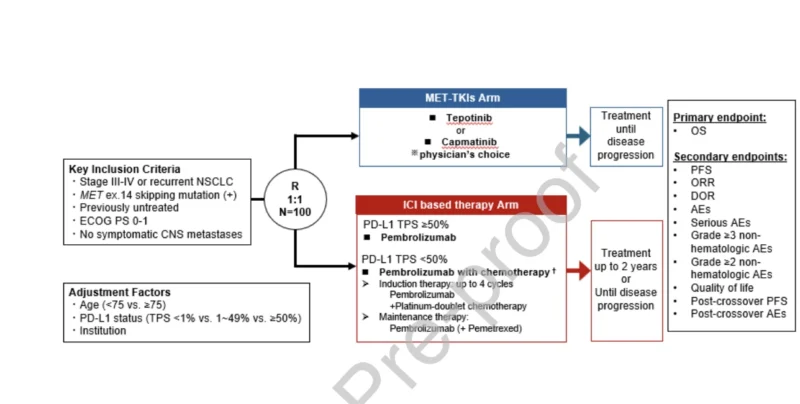
The ongoing phase III JCOG2506 (DECIDE-MET) trial is designed to address this unanswered question by directly comparing MET inhibitor therapy with pembrolizumab-based immunotherapy strategies in the first-line setting.
The outcome of this study may provide important evidence for how clinicians should approach treatment selection in rare molecular subgroups where targeted therapy and immunotherapy both represent potential options.
MET Exon 14 Skipping NSCLC: A Rare Molecular Driver With Therapeutic Implications
MET exon 14 skipping alterations represent a distinct biological subtype of NSCLC caused by disruption of normal MET receptor regulation. These mutations prevent proper degradation of the MET protein, resulting in increased receptor activity and sustained downstream signaling.
Although MET exon 14 skipping mutations occur in only a minority of NSCLC cases, estimated at approximately 3–4% of advanced disease, their identification has major clinical implications because they represent an actionable molecular alteration.
Patients with MET exon 14 skipping NSCLC often differ from patients with other oncogenic drivers. They are frequently older, may have significant comorbidities, and can present with clinical characteristics that influence treatment selection.
The availability of selective MET inhibitors has therefore represented a major therapeutic advance. However, the optimal position of these agents within the broader treatment landscape remains an area of active investigation.
The Unresolved Question: How Should First-Line Therapy Be Selected?
For many molecularly defined NSCLC populations, the treatment paradigm is relatively established: identify the driver alteration and use the corresponding targeted therapy.
However, MET exon 14 skipping NSCLC presents a more complex situation.
MET inhibitors have demonstrated strong biological rationale and clinical activity, but immune checkpoint inhibitors remain widely used in NSCLC and may provide durable responses in selected patients.
The challenge is that MET-driven tumors do not fit perfectly into traditional categories.
Some tumors may demonstrate features associated with immune sensitivity, including PD-L1 expression, while others may depend predominantly on MET signaling. As a result, clinicians currently lack randomized evidence directly comparing these approaches.
DECIDE-MET was developed to address this gap.
JCOG2506 (DECIDE-MET): A Direct Comparison of Two Treatment Strategies
The multicenter randomized phase III JCOG2506 trial is evaluating first-line treatment strategies for patients with advanced NSCLC harboring MET exon 14 skipping mutations.
The trial plans to enroll 100 patients who will be randomized equally between two treatment approaches.
One group receives MET-targeted therapy with tepotinib or capmatinib, while the other receives pembrolizumab-based therapy selected according to PD-L1 tumor proportion score.
Patients with higher PD-L1 expression receive pembrolizumab monotherapy, whereas patients with lower PD-L1 expression receive pembrolizumab combined with chemotherapy.
The primary endpoint is overall survival, with additional evaluation of progression-free survival, response rate, duration of response, safety, and quality of life.
The choice of overall survival as the primary endpoint highlights the clinical importance of this comparison. The question is not only which treatment produces tumor responses, but which strategy provides the greatest long-term benefit.
Why This Trial Could Influence Future Treatment Algorithms
The significance of DECIDE-MET extends beyond a comparison of two therapies.
The trial represents a broader movement in oncology: moving from biomarker identification toward biomarker-guided treatment sequencing.
In the early era of precision medicine, the primary question was whether a tumor contained an actionable mutation.
Today, the question has become more complex:
- When several effective therapies exist, which one should come first?
For MET exon 14 skipping NSCLC, this involves balancing several factors, including the depth and durability of response with MET inhibitors, potential immune sensitivity, toxicity considerations, and treatment options available after progression.
A positive result for MET inhibitors would reinforce the importance of molecularly matched therapy as the preferred initial strategy.
Conversely, evidence supporting pembrolizumab-based approaches in selected patients could introduce a more individualized treatment model incorporating both molecular and immune biomarkers.
PD-L1 Expression and the Challenge of Biomarker Integration
PD-L1 remains one of the most widely used biomarkers for immunotherapy selection in NSCLC. However, its role in oncogene-driven tumors remains complicated.
In many molecular subgroups, including EGFR-mutated NSCLC, immunotherapy benefit has historically been limited despite occasional high PD-L1 expression.
MET exon 14 skipping NSCLC may represent a different biological scenario, but the relationship between PD-L1 expression and immunotherapy response remains incompletely understood.
By incorporating PD-L1-guided pembrolizumab treatment, DECIDE-MET may provide valuable information about whether immune biomarkers can meaningfully influence treatment decisions in MET-driven disease.
Beyond Efficacy: Safety and Quality of Life Will Be Essential
Treatment selection in MET exon 14 skipping NSCLC is not determined by efficacy alone.
Because many patients with MET exon 14 skipping mutations are older and may have additional health conditions, treatment tolerability represents an important consideration.
MET inhibitors and immune checkpoint inhibitors have distinct toxicity profiles.
Targeted therapy may provide rapid disease control with predictable adverse effects, while immunotherapy offers the possibility of durable immune responses but carries the risk of immune-related complications.
The incorporation of quality-of-life assessment in DECIDE-MET is therefore clinically important because the preferred treatment strategy should improve survival while maintaining patient well-being.
DECIDE-MET Within the Changing Landscape of Precision Lung Cancer
The importance of DECIDE-MET reflects a larger transformation occurring across thoracic oncology.
As more actionable alterations are discovered, clinical trials are increasingly moving beyond demonstrating whether a drug works. The next challenge is defining the optimal therapeutic pathway for each molecular subgroup.
Similar questions are emerging across lung cancer:
- Should targeted therapy always precede immunotherapy?
- Can biomarkers predict treatment sequence?
- How should resistance mechanisms influence subsequent treatment choices?
Answering these questions requires randomized trials designed specifically for molecularly defined populations.
Conclusion
The JCOG2506 (DECIDE-MET) trial addresses one of the most important unanswered questions in MET exon 14 skipping NSCLC: whether first-line treatment should prioritize MET inhibition or pembrolizumab-based immunotherapy.
While MET inhibitors have become an important therapeutic option for this rare molecular subgroup, comparative evidence is needed to define the optimal treatment strategy.
By directly comparing targeted therapy with immunotherapy-based approaches and using overall survival as the primary endpoint, DECIDE-MET has the potential to influence future treatment algorithms and provide a model for evidence-based decision-making in rare genomic subsets of lung cancer.
As precision oncology continues to evolve, the future of treatment selection will depend not only on identifying molecular alterations but also on understanding the optimal sequence, combination, and timing of available therapies.