Lung cancer remains one of the leading causes of cancer mortality, largely because many tumors are discovered only after they have spread beyond the lung. Over the past decade, however, the stage at diagnosis has begun to shift.
A nationwide surveillance study published in JAMA Oncology found that the proportion of lung cancers diagnosed at an early stage increased from 17.6% in 2003 to 30.1% in 2022.
The rise accelerated after lung cancer screening was recommended in the United States and Medicare coverage was introduced. Although the study cannot prove that screening directly caused the change, the timing suggests that low-dose computed tomography screening has contributed to earlier detection across the country.
The trend is encouraging, but the findings also highlight an unresolved challenge: even in 2022, fewer than one-third of lung cancers were diagnosed at an early stage, while screening participation among eligible adults remained low (Henley et al., 2026).
How Much Has Early Detection Improved?
The investigators analyzed 4,363,687 new lung cancer cases reported in the United States between 2003 and 2022.
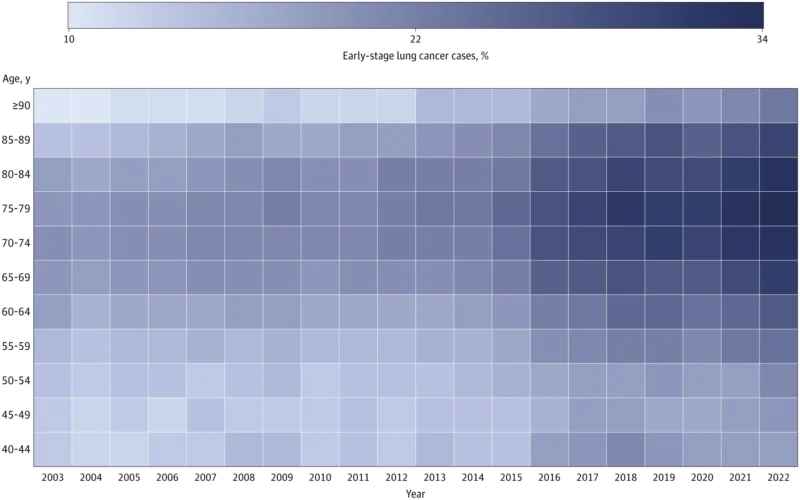
The proportion diagnosed at a localized stage increased gradually from 17.6% in 2003 to 20.2% in 2014. It then rose sharply from 21.4% in 2015 to 24.6% in 2016, before continuing upward to 30.1% in 2022.
Among adults aged 50 to 80 years, the age range included in current US screening recommendations, the early-stage diagnosis rate reached 30.3% in 2022.
This represents a major change in the stage distribution of lung cancer. In 2003, fewer than one in five cases were diagnosed early. By 2022, the figure had increased to nearly one in three (Henley et al., 2026).
Why Did the Increase Accelerate After 2015?
The timing of the increase coincided with several important changes in US lung cancer screening policy.
The US Preventive Services Task Force first recommended annual low-dose CT screening in December 2013 for adults at high risk because of age and smoking history. In February 2015, the Centers for Medicare & Medicaid Services introduced national coverage for lung cancer screening, expanding access for many adults at elevated risk.
Screening eligibility was broadened again in 2021. The minimum eligible age was lowered from 55 to 50 years, while the required smoking history was reduced from at least 30 pack-years to at least 20 pack-years (Moyer, 2014; Krist et al., 2021).
The study found that the percentage of early-stage diagnoses increased sharply around 2016, shortly after Medicare coverage began. Another increase was seen after the 2021 expansion of eligibility.
These patterns support the view that screening implementation has contributed to stage migration. However, the analysis did not include information about whether individual patients had undergone screening before diagnosis, so a direct causal relationship cannot be established (Henley et al., 2026).
Earlier Diagnosis Increased in Every State
The shift toward earlier detection was not limited to a small number of regions.
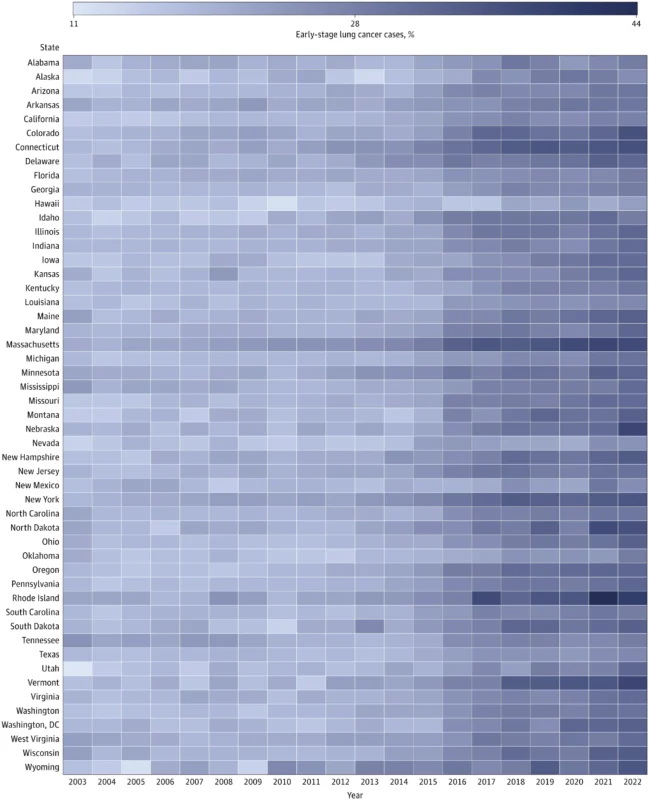
Among adults aged 50 to 80 years, the percentage of lung cancers diagnosed early increased in every US state, with the rise beginning around 2016 in most areas.
In 2003, state-level early-stage diagnosis rates ranged from 11.2% to 24.0%. By 2022, the range had increased to 22.0% to 40.2%.
Across states, the percentage of early-stage diagnoses increased by an average of 66%. The rate more than doubled in Colorado, Connecticut, Montana, Nebraska, Utah, Vermont, and Wyoming.
These findings suggest that earlier detection has improved across diverse geographic regions. At the same time, the wide variation between states indicates that screening access, awareness, referral pathways, insurance coverage, and local infrastructure remain uneven (Henley et al., 2026).
Why Stage at Diagnosis Matters
Early-stage lung cancer is associated with substantially better survival because curative-intent treatment is more often possible.
Patients with localized disease may be eligible for surgery, stereotactic body radiotherapy, or other definitive local treatments. Patients diagnosed with distant metastatic disease generally require systemic treatment, and durable disease control remains more difficult.
US Cancer Statistics data cited in the study showed five-year relative survival rates of 61% for localized lung cancer, compared with 35% for regional disease and 9% for distant disease.
These differences demonstrate why shifting diagnosis toward earlier stages can have a major population-level impact, even before accounting for advances in surgery, radiotherapy, targeted therapy, and immunotherapy (Henley et al., 2026).
Screening Uptake Remains Far Below Its Potential
Despite the improvement in early detection, lung cancer screening remains underused.
Population-based survey data indicate that fewer than one in five eligible adults were up to date with screening in 2024.
Low participation has been linked to limited awareness of screening eligibility, transportation barriers, lack of paid leave, unequal access to screening centers, differences in Medicaid coverage, and insufficient discussion between patients and healthcare professionals.
This means that the national increase in early diagnosis has occurred despite relatively low screening uptake. Greater participation could potentially shift an even larger proportion of lung cancers toward stages where curative treatment remains possible.
State Programs May Help Close the Gap
The state-level findings provide examples of how organized public health programs may support early detection.
Vermont, which experienced one of the largest increases in early-stage diagnoses, assessed barriers to screening and developed training for primary care clinicians. Delaware combined professional education with public awareness initiatives through its Screening for Life Program and reported one of the higher screening participation rates.
These examples suggest that publishing eligibility recommendations is not enough. Effective screening programs require clinician education, patient navigation, accessible imaging facilities, clear referral pathways, and public communication.
Mobile screening programs may also help reach communities facing transportation or geographic barriers (Bade et al., 2025).
The COVID-19 Pandemic Temporarily Interrupted Progress
The total number of lung cancer diagnoses declined in 2020, reflecting disruptions in healthcare access during the COVID-19 pandemic.
The percentage diagnosed at an early stage also fell slightly, from 27.2% in 2019 to 26.8% in 2020.
The trend recovered quickly. Early-stage diagnoses increased to 28.8% in 2021 and 30.1% in 2022, suggesting that the broader movement toward earlier detection continued despite the temporary interruption.
What the Study Cannot Prove
The analysis was descriptive and relied on population-based cancer registry data.
Its greatest strength was scale: the dataset covered the entire US population and included more than 4.3 million lung cancer cases over two decades.
However, the registries did not contain individual-level screening histories. The investigators could therefore identify temporal associations between screening policies and stage at diagnosis, but they could not determine how many early-stage cancers were directly detected through low-dose CT screening.
Other factors may also have contributed, including more frequent diagnostic imaging, incidental detection, changes in clinical practice, and improved access to thoracic care.
The results should therefore be interpreted as evidence of a national stage shift that coincided with screening implementation, rather than proof that screening alone caused the change.
What This Means for Lung Cancer Control
The study provides strong population-level evidence that lung cancer is increasingly being diagnosed at a stage when curative treatment is more likely.
The increase began gradually, accelerated after national screening recommendations and Medicare coverage, and was observed across every state.
However, more than two-thirds of lung cancers were still diagnosed beyond the localized stage in 2022. Considerable room for improvement remains.
Future progress will depend on identifying eligible adults, strengthening clinician-patient communication, reducing geographic and financial barriers, expanding navigation systems, addressing disparities, and connecting screening with smoking cessation support.
The clinical tools already exist. The challenge is delivering them consistently to the people most likely to benefit.
The Bottom Line
The proportion of US lung cancers diagnosed at an early stage increased from 17.6% in 2003 to 30.1% in 2022, according to a nationwide JAMA Oncology surveillance study.
The increase accelerated after lung cancer screening was recommended in 2013 and Medicare coverage was introduced in 2015. Early-stage diagnosis rates improved in every state, with some states more than doubling their rates over the study period.
These findings represent meaningful progress. However, most lung cancers are still diagnosed after the disease has moved beyond the localized stage, and fewer than one in five eligible adults remain up to date with screening.
Expanding awareness, access, and uptake of low-dose CT screening remains one of the clearest opportunities to improve lung cancer outcomes.
References
- Henley SJ, Adam EE, Kava CM, et al. Temporal trends in lung cancer cases diagnosed at early stage. JAMA Oncology. 2026;12(7):762-766. doi:10.1001/jamaoncol.2026.1199.
- Moyer VA; US Preventive Services Task Force. Screening for lung cancer: US Preventive Services Task Force recommendation statement. Annals of Internal Medicine. 2014;160(5):330-338.
- Krist AH, Davidson KW, Mangione CM, et al. Screening for lung cancer: US Preventive Services Task Force recommendation statement. JAMA. 2021;325(10):962-970.
- Bade B, Faiz SA, Tan M, et al. The impact of health care disparities on lung cancer screening and treatment. Chest. 2025;168(4):1057-1066.