
Jazz Pharmaceuticals announced that the phase 3 LAGOON trial did not meet its primary endpoint of overall survival in patients with relapsed metastatic small cell lung cancer treated in the second-line setting.
The study evaluated Zepzelca, also known as lurbinectedin, either as monotherapy or in combination with irinotecan. Both investigational approaches were compared with investigator’s choice of topotecan or irinotecan.
According to the company, neither lurbinectedin monotherapy nor lurbinectedin plus irinotecan significantly improved overall survival versus the control arm. No new safety signals were identified, and the safety profiles were consistent with the known safety profile of each agent.
The LAGOON results are clinically important because relapsed small cell lung cancer remains an aggressive disease with limited durable treatment options after platinum-based chemotherapy.
Why This Update Matters
Small cell lung cancer is one of the most aggressive forms of lung cancer.
Although many patients initially respond to first-line platinum-based chemotherapy, relapse is common, and disease can return quickly with more resistant biology. In the second-line setting, outcomes remain poor, and the need for more effective treatment strategies remains high.
Lurbinectedin has been used as a treatment option for adults with metastatic small cell lung cancer whose disease progressed on or after platinum-based chemotherapy. Its second-line indication in the United States was originally approved under accelerated approval based on response rate and duration of response.
LAGOON was intended to provide phase 3 confirmatory evidence in the second-line setting.
The negative OS result means the role of lurbinectedin in relapsed SCLC may need further regulatory discussion, while its first-line maintenance approval remains unaffected.
LAGOON Trial Design
LAGOON was a phase 3, randomized, multicenter, open-label trial.
The study enrolled 724 patients from more than 200 sites globally, including the United States, Canada, and Europe.
Patients had small cell lung cancer that progressed after prior platinum-containing chemotherapy, with or without prior anti-PD-1 or anti-PD-L1 therapy.
Patients were randomized 1:1:1 to one of three treatment arms:
Lurbinectedin 3.2 mg/m² as monotherapy
Lurbinectedin 2.0 mg/m² plus irinotecan 75 mg/m²
Investigator’s choice of topotecan or irinotecan
The primary endpoint was overall survival.
Overall Survival Results
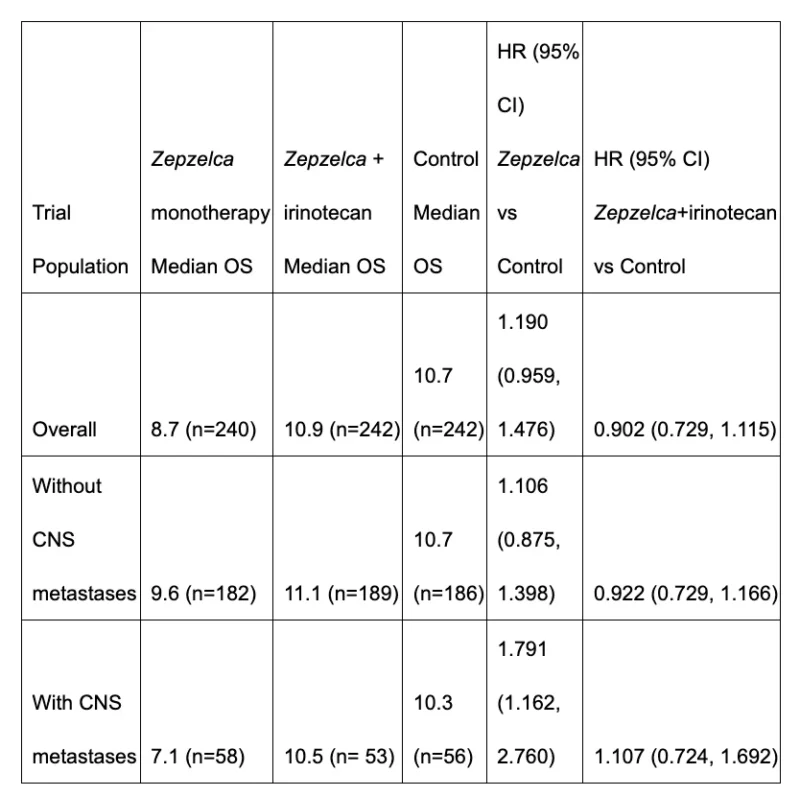
In the overall trial population, median OS was 8.7 months with lurbinectedin monotherapy, 10.9 months with lurbinectedin plus irinotecan, and 10.7 months with the control arm.
For lurbinectedin monotherapy versus control, the hazard ratio was 1.190, with a 95% confidence interval of 0.959 to 1.476.
For lurbinectedin plus irinotecan versus control, the hazard ratio was 0.902, with a 95% confidence interval of 0.729 to 1.115.
These results did not demonstrate a statistically significant OS benefit.
CNS Metastases Subgroup
The LAGOON population was broader than the earlier phase 2 pivotal trial that supported accelerated approval, including patients with a history of CNS involvement.
Among patients without CNS metastases, median OS was 9.6 months with lurbinectedin monotherapy, 11.1 months with lurbinectedin plus irinotecan, and 10.7 months with control.
In this subgroup, the hazard ratio was 1.106 for lurbinectedin monotherapy versus control and 0.922 for lurbinectedin plus irinotecan versus control.
Among patients with CNS metastases, median OS was 7.1 months with lurbinectedin monotherapy, 10.5 months with lurbinectedin plus irinotecan, and 10.3 months with control.
The hazard ratio for lurbinectedin monotherapy versus control in patients with CNS metastases was 1.791. For lurbinectedin plus irinotecan versus control, the hazard ratio was 1.107.
These exploratory subgroup findings suggest that outcomes differed by CNS involvement, but the study overall did not meet its primary endpoint.
Safety Findings
No new safety signals were identified with lurbinectedin monotherapy or lurbinectedin plus irinotecan.
The overall safety profile for lurbinectedin monotherapy was described as favorable relative to the control arm.
Treatment-related adverse events occurred in 78.5% of patients receiving lurbinectedin, 95.0% receiving lurbinectedin plus irinotecan, and 93.8% in the control arm.
Grade 3 or higher treatment-related adverse events occurred in 35.0% with lurbinectedin monotherapy, 62.6% with lurbinectedin plus irinotecan, and 64.4% with control.
This indicates that lurbinectedin monotherapy had a lower rate of grade 3 or higher treatment-related adverse events compared with the irinotecan-containing and control arms, although efficacy did not improve overall survival.
What This Means for Second-Line SCLC
The LAGOON result is a setback for confirming lurbinectedin’s second-line benefit through an OS endpoint.
Second-line SCLC remains difficult to treat. Topotecan has long been used, but its benefit is modest and toxicity can be substantial. Irinotecan is another option in some settings.
The LAGOON trial showed that the control arm performed better than historical expectations, which may have affected the ability to demonstrate superiority.
Still, the key conclusion remains that neither lurbinectedin monotherapy nor lurbinectedin plus irinotecan significantly improved OS compared with investigator’s choice therapy in the overall population.
Jazz Pharmaceuticals stated that it has shared the LAGOON results with the FDA and will discuss next steps with the agency regarding post-marketing requirements for the second-line indication.
First-Line Maintenance Approval Remains Unchanged
Importantly, the LAGOON results do not affect Zepzelca’s approval in the first-line maintenance setting.
In 2025, the FDA approved lurbinectedin in combination with atezolizumab, or atezolizumab and hyaluronidase-tqjs, as maintenance treatment for adults with extensive-stage SCLC whose disease had not progressed after first-line induction therapy with atezolizumab, carboplatin, and etoposide.
That approval was based on the phase 3 IMforte trial.
In IMforte, lurbinectedin plus atezolizumab significantly improved both overall survival and progression-free survival compared with atezolizumab maintenance alone.
The company reported that the combination reduced the risk of disease progression or death by 46% and the risk of death by 27% compared with atezolizumab maintenance therapy alone.
This distinction is important. LAGOON tested lurbinectedin in relapsed second-line metastatic SCLC, while IMforte tested lurbinectedin as part of first-line maintenance therapy after induction treatment.
Clinical Meaning
The LAGOON findings reinforce the complexity of drug development in relapsed SCLC.
A therapy may have activity in one disease setting but fail to improve survival in another. Timing, disease biology, prior therapy, CNS involvement, and comparator performance can all shape trial outcomes.
For lurbinectedin, the strongest current phase 3 signal appears to be in first-line maintenance therapy with atezolizumab, not in second-line relapsed disease.
For clinicians, the LAGOON update means that full interpretation of the second-line data will require careful review once detailed results are presented or published.
For patients, the study underscores the continuing need for better post-platinum treatment strategies in SCLC.
Key Takeaway
The phase 3 LAGOON trial did not meet its primary overall survival endpoint in relapsed metastatic small cell lung cancer.
Median OS was 8.7 months with lurbinectedin monotherapy, 10.9 months with lurbinectedin plus irinotecan, and 10.7 months with investigator’s choice of topotecan or irinotecan.
No new safety signals were observed.
The results do not affect lurbinectedin’s first-line maintenance approval with atezolizumab in extensive-stage SCLC, which was supported by the positive IMforte trial.
Overall, LAGOON narrows the evidence for lurbinectedin in second-line SCLC while keeping attention on its role in first-line maintenance treatment.