Brain metastases remain one of the most difficult treatment settings in KRASG12C-mutated non-small-cell lung cancer.
Direct KRASG12C inhibitors changed a long-standing assumption that KRAS could not be effectively targeted. Sotorasib and adagrasib established clinically meaningful systemic activity in previously treated disease, while a growing group of newer agents is being developed to improve potency, durability, and penetration of the central nervous system.
However, systemic response does not automatically translate into durable intracranial control.
The blood–brain barrier, molecular co-alterations, heterogeneous drug exposure, and rapid adaptive resistance all contribute to treatment failure in the brain. A recent review in Cancer Gene Therapy evaluates the available evidence for KRASG12C-targeted agents in NSCLC brain metastases and outlines why future progress will probably depend on treatment combinations rather than inhibitor monotherapy alone. [1]
Why Are Brain Metastases a Major Issue in KRASG12C-Mutated NSCLC?
KRAS mutations are among the most common molecular alterations in NSCLC. KRASG12C accounts for approximately 40% of KRAS-mutant cases and is particularly relevant because it can be targeted with covalent small-molecule inhibitors. [1]
Brain metastases are common in this population. The review reports that around 28% of patients with KRASG12C-mutated NSCLC have detectable brain metastases at diagnosis, while up to 40% develop intracranial disease during follow-up. [1]
This is clinically important because brain metastases can cause neurologic symptoms, require corticosteroids or local treatment, complicate systemic therapy selection, and reduce overall prognosis.
Targeted therapies have reduced the need for immediate radiation in selected patients with other oncogenic drivers, particularly EGFR- and ALK-altered NSCLC. The situation is less established in KRASG12C-mutated disease.
Many early KRASG12C inhibitor trials excluded patients with active or untreated brain metastases. As a result, systemic trial outcomes cannot be assumed to represent the level of activity achieved in the central nervous system.
What Have First-Generation KRASG12C Inhibitors Shown?
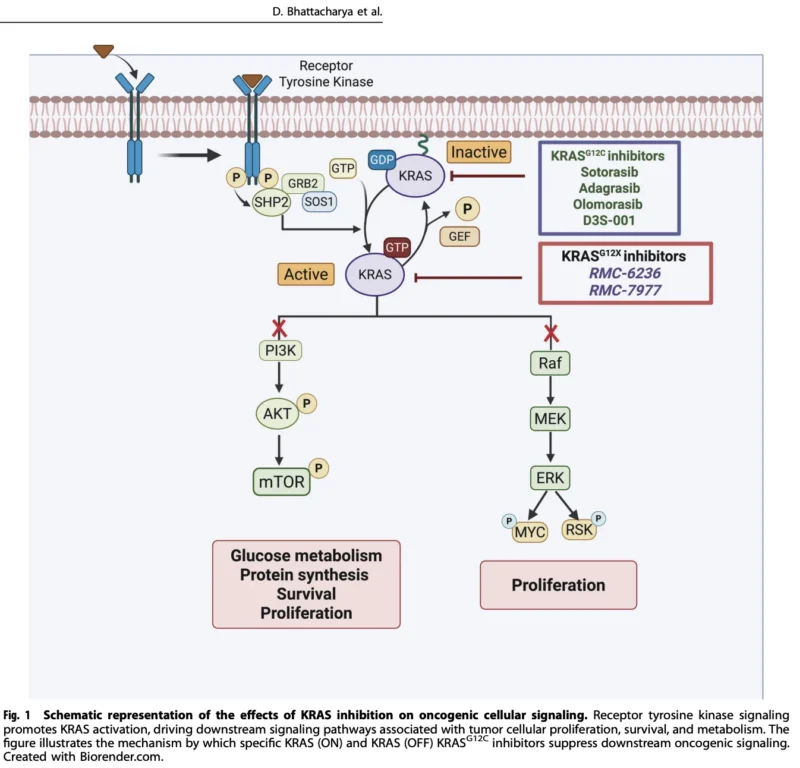
Sotorasib and adagrasib both bind the inactive, GDP-bound form of KRASG12C. By locking the protein in its inactive state, they reduce downstream MAPK and PI3K signaling.
Both agents produced clinically meaningful systemic responses in previously treated KRASG12C-mutated NSCLC. However, median progression-free survival with first-generation monotherapy has generally remained in the range of approximately 5–6 months, emphasizing the limited durability of response. [2,3]
Intracranial evidence is more limited and should be interpreted separately from systemic outcomes.
For sotorasib, a post-hoc analysis of CodeBreaK 100 included patients with stable, previously treated brain metastases. Among 16 evaluable patients, intracranial disease control was reported in 14 patients, including two complete responses. [4]
However, this evidence does not establish sotorasib as a treatment for untreated or active brain metastases. A retrospective series discussed in the review reported frequent intracranial progression among patients treated with sotorasib, particularly when active brain metastases were present. [1]
The distinction matters. Stable, previously irradiated intracranial disease is biologically and clinically different from untreated, growing, or symptomatic brain metastases.
Why Does Adagrasib Have the Strongest Intracranial Dataset?
Among direct KRASG12C inhibitors, adagrasib has the clearest prospective evidence in untreated CNS metastases.
In the KRYSTAL-1 cohort of patients with untreated brain metastases, adagrasib produced an intracranial objective response rate of 42%. Intracranial disease control was 90%, median intracranial progression-free survival was 5.4 months, and median intracranial duration of response was 12.7 months. [5]
These results are important because they show that a KRASG12C inhibitor can produce measurable intracranial activity without mandatory prior local treatment in selected patients.
At the same time, the cohort was small. The untreated brain metastasis analysis included 25 patients, and the median intracranial progression-free survival remained limited. [5]
Adagrasib therefore provides proof of principle for CNS activity, not a complete solution to the problem of intracranial resistance.
Why Does Drug Penetration Alone Not Solve the Problem?
Crossing the blood–brain barrier is necessary, but it is not sufficient.
A drug may enter the CNS and still fail because tumor cells activate alternative signaling pathways, acquire secondary KRAS alterations, or rely on co-mutations that reduce dependence on KRASG12C alone.
The review identifies several co-alterations associated with more aggressive disease biology or reduced benefit from KRASG12C inhibition, including alterations in KEAP1, STK11, CDKN2A/B, and SMARCA4. [1]
These alterations may influence tumor metabolism, immune evasion, cell-cycle control, and resistance to therapy.
Resistance can also develop through reactivation of the MAPK pathway. Receptor tyrosine kinases may increase signaling upstream of KRAS and shift more KRASG12C into the active GTP-bound state, reducing the effectiveness of inhibitors designed to bind the inactive GDP-bound form.
Non-genetic mechanisms also contribute. Epithelial-to-mesenchymal transition, tumor microenvironment remodeling, and activation of bypass pathways such as AXL and Hedgehog signaling may allow cancer cells to continue growing despite KRASG12C inhibition. [1]
Which Next-Generation Agents Are Being Studied?
The next wave of KRAS-directed therapy is focused on three major goals: deeper target inhibition, activity against the active KRAS state, and better CNS exposure.
Olomorasib is a next-generation KRASG12C inhibitor designed to bind the inactive GDP-bound protein. Early clinical data have shown systemic activity, including in patients previously exposed to KRASG12C inhibitors. Its role in NSCLC brain metastases remains under evaluation, and prospective intracranial outcomes are not yet established. [1]
Divarasib has also shown substantial systemic activity in early studies. In a phase 1 study of KRASG12C-mutated solid tumors, the NSCLC cohort had a confirmed objective response rate of 55.6% and a median progression-free survival of 13.8 months. However, active brain metastases were excluded from that trial, limiting conclusions regarding untreated intracranial disease. [6]
D3S-001 is of particular interest because of preclinical CNS penetration and rapid target engagement. In mouse models of NSCLC brain metastases, D3S-001 produced sustained intracranial tumor suppression in settings where sotorasib and adagrasib were followed by tumor regrowth. Early phase clinical data in KRASG12C inhibitor-resistant NSCLC reported an objective response rate of 30% and disease control in 80% of patients, although intracranial outcomes remain preliminary. [1,7]
Daraxonrasib, also known as RMC-6236, represents a different strategy. Rather than selectively targeting inactive KRASG12C, it is designed to inhibit active RAS signaling through a cyclophilin A-mediated tri-complex. The agent has shown brain penetration and antitumor activity in preclinical models, including KRAS-mutant CNS disease. Its clinical role in NSCLC brain metastases remains investigational. [1]
Why Are Combination Strategies Central to Future Progress?
The review makes a clear point: monotherapy is unlikely to provide durable control for many patients with KRASG12C-mutated NSCLC brain metastases.
Combination strategies are being developed to suppress both KRAS signaling and the pathways that allow cancer cells to escape KRAS inhibition.
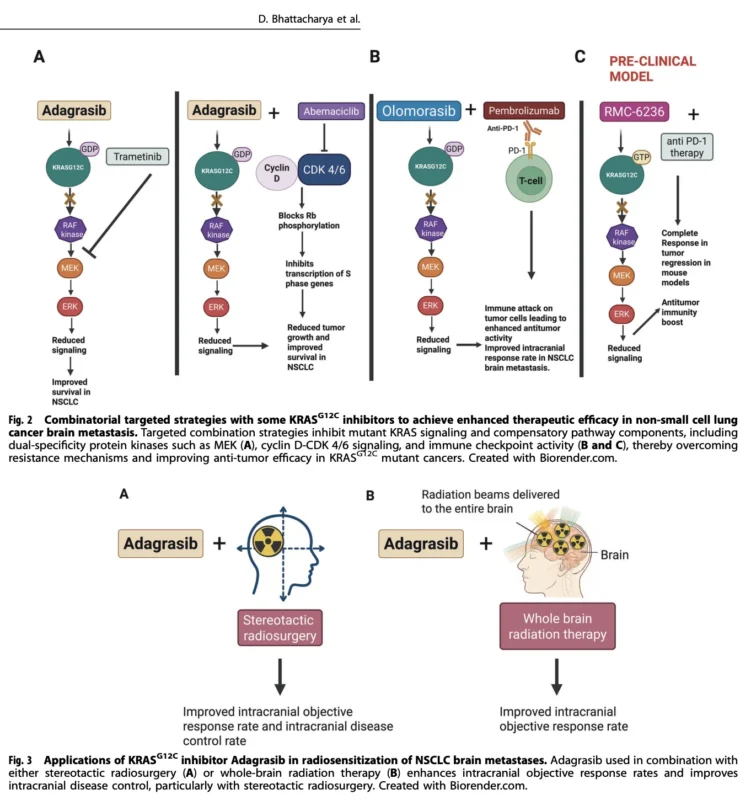
One approach combines KRASG12C inhibition with CDK4/6 inhibition. In preclinical models of KRASG12C- and CDKN2A-altered NSCLC brain metastases, the combination of adagrasib and abemaciclib extended survival in one model where either drug alone was insufficient. [8]
Another strategy is vertical MAPK pathway suppression. Combining a KRASG12C inhibitor with a MEK inhibitor may reduce downstream pathway reactivation. Early clinical evidence for sotorasib plus trametinib remains limited, and the safety and intracranial activity of this approach require further study. [1]
SHP2 inhibition is also being investigated. SHP2 helps transmit receptor tyrosine kinase signaling to RAS and may contribute to the accumulation of active, GTP-bound KRAS. Preclinical studies suggest that dual KRAS and SHP2 inhibition can delay pathway reactivation and improve tumor control. [1]
Immunotherapy combinations are another area of interest. KRASG12C inhibition can alter the tumor microenvironment and increase T-cell infiltration in preclinical models. However, the activity and safety of KRAS inhibitor plus PD-1 or PD-L1 blockade in patients with active brain metastases remain incompletely defined.
The available evidence supports further study. It does not yet establish a standard intracranial combination strategy.
Can KRASG12C Inhibitors Improve the Effect of Radiation?
Local therapy remains important for many patients with NSCLC brain metastases.
Surgery, stereotactic radiosurgery, and whole-brain radiation therapy may be necessary for symptomatic lesions, large tumors, lesions causing mass effect, or disease requiring rapid local control.
The review discusses preclinical evidence suggesting that KRASG12C inhibition may increase radiosensitivity. By reducing RAS-MAPK signaling, these agents may enhance DNA damage responses and reduce survival signaling after radiation exposure. [1]
Adagrasib is being evaluated in combination with stereotactic radiosurgery in patients with NSCLC brain metastases. The clinical question is not only whether the combination improves intracranial tumor control, but also whether it can do so without increasing neurotoxicity or treatment-related complications.
For now, the combination of KRASG12C inhibitors and radiation remains investigational.
What Should Future Brain Metastasis Trials Measure?
The review highlights a gap that applies broadly to targeted therapy development.
Trials should not simply allow patients with stable brain metastases and then report only systemic outcomes. They need dedicated CNS cohorts, prospective intracranial imaging assessments, standardized response criteria, and clinically meaningful endpoints such as intracranial response, intracranial progression-free survival, neurologic symptom control, corticosteroid use, radiation requirements, and neurocognitive outcomes.
Co-mutation profiling should also be incorporated. KRASG12C alone may not adequately predict sensitivity to therapy in the brain. Alterations in KEAP1, STK11, CDKN2A/B, SMARCA4, and other genes may help identify patients at higher risk of resistance or early CNS progression.
The Bottom Line
KRASG12C inhibitors have created a new treatment option for patients with KRASG12C-mutated NSCLC, but brain metastases remain a major therapeutic challenge.
Adagrasib currently has the most direct prospective evidence of activity in untreated brain metastases, with an intracranial response rate of 42% in the KRYSTAL-1 cohort. Sotorasib has shown intracranial disease control in selected patients with stable, previously treated CNS disease, but evidence in active brain metastases remains limited.
Next-generation agents such as olomorasib, divarasib, D3S-001, and daraxonrasib may improve CNS exposure or address resistance through different mechanisms. However, most clinical evidence remains early, systemic, or preclinical.
The future of treatment is likely to depend on better drug delivery to the CNS, molecular selection beyond KRASG12C alone, and rational combinations with radiation, immunotherapy, CDK4/6 inhibitors, MEK inhibitors, or SHP2 inhibitors.
For patients with KRASG12C-mutated NSCLC and brain metastases, intracranial disease should be evaluated as a distinct therapeutic problem, not as a secondary extension of systemic disease.
References
- Bhattacharya D, Roman B, Reddy S. Therapeutic advances with KRASG12C inhibitors and combination strategies in non-small cell lung cancer brain metastases. Cancer Gene Therapy. 2026;33:323–337. doi:10.1038/s41417-026-01003-0.
- Skoulidis F, Li BT, Dy GK, et al. Sotorasib for lung cancers with KRAS p.G12C mutation. New England Journal of Medicine. 2021;384:2371–2381.
- Jänne PA, Riely GJ, Gadgeel SM, et al. Adagrasib in non-small-cell lung cancer harboring a KRASG12C mutation. New England Journal of Medicine. 2022;387:120–131.
- Ramalingam S, Skoulidis F, Govindan R, et al. Efficacy of sotorasib in KRAS p.G12C-mutated NSCLC with stable brain metastases: a post-hoc analysis of CodeBreaK 100. Journal of Thoracic Oncology. 2021;16.
- Negrao MV, Spira AI, Heist RS, et al. Intracranial efficacy of adagrasib in patients from the KRYSTAL-1 trial with KRASG12C-mutated non-small-cell lung cancer who have untreated CNS metastases. Journal of Clinical Oncology. 2023;41:4472–4477.
- Sacher A, LoRusso P, Patel MR, et al. Single-agent divarasib in solid tumors with a KRAS G12C mutation. New England Journal of Medicine. 2023;389:710–721.
- Zhang J, Lim SM, Yu MR, et al. D3S-001, a KRAS G12C inhibitor with rapid target engagement kinetics, overcomes nucleotide cycling and demonstrates robust preclinical and clinical activities. Cancer Discovery. 2024;14:1675–1698.
- Migliarese C, Sadeh Y, Torrini C, et al. Combination therapy of adagrasib and abemaciclib in non-small cell lung cancer brain metastasis models characterized by KRASG12C and homozygous loss of CDKN2A. Acta Neuropathologica Communications. 2025;13:88.