
The phase III KEYNOTE-867 trial has demonstrated that adding pembrolizumab to stereotactic body radiotherapy (SBRT) does not significantly improve event-free survival (EFS) in patients with unresected stage I or II non-small cell lung cancer (NSCLC). Instead, the combination was associated with substantially greater treatment-related toxicity, including five treatment-related deaths.
Published on October 28, 2026, in the Journal of Clinical Oncology, the randomized, double-blind study led by Salma K. Jabbour, MD, evaluated whether adding PD-1 inhibition to definitive SBRT could reduce recurrence or death in patients considered medically inoperable or unwilling to undergo surgery.
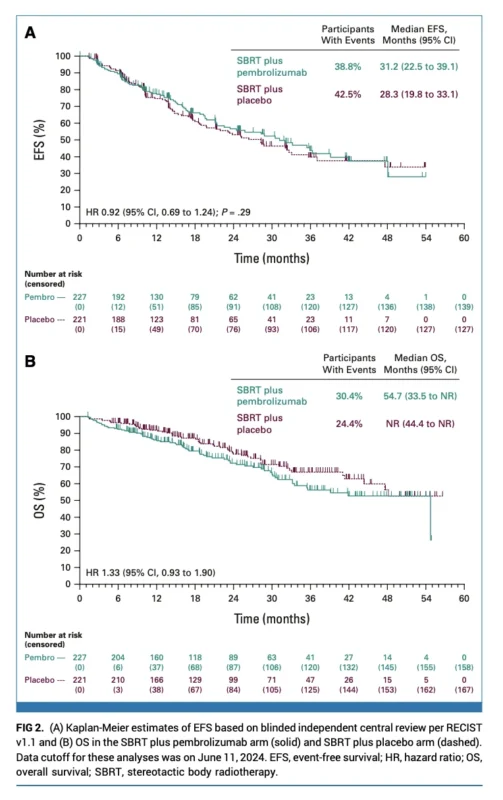
Among 448 randomized patients, median EFS was 31.2 months with SBRT plus pembrolizumab versus 28.3 months with SBRT plus placebo, corresponding to a hazard ratio (HR) of 0.92 (95% CI 0.69–1.24; p=0.2932).
No overall survival (OS) improvement was observed. The OS HR was 1.33 (95% CI 0.93–1.90), numerically favoring the control arm, although the confidence interval included the possibility of no difference.
Importantly, grade 3–5 treatment-related adverse events occurred in 20.4% of patients receiving pembrolizumab versus 3.7% receiving placebo. Five treatment-related deaths occurred in the pembrolizumab arm, compared with none in the control group.
Following the prespecified first interim analysis, the study was stopped prematurely because of the unfavorable benefit-risk profile, and all study treatment was discontinued.
These findings challenge the assumption that adding immune checkpoint blockade to highly effective local therapy necessarily improves outcomes in early-stage lung cancer.
Why KEYNOTE-867 Matters: The Challenge of Improving Outcomes After SBRT
Surgical resection remains the preferred curative treatment for many patients with early-stage NSCLC. However, a substantial proportion of patients cannot undergo surgery because of advanced age, limited pulmonary reserve, cardiovascular disease, or other significant comorbidities.
For patients with medically inoperable, node-negative stage I–II NSCLC, SBRT has become an established definitive local treatment, delivering highly conformal ablative radiation doses over a limited number of fractions.
Although SBRT provides excellent local tumor control in appropriately selected patients, regional and distant recurrence remain important causes of treatment failure. This has prompted investigation into whether systemic immune checkpoint inhibition could improve outcomes beyond those achieved with local radiotherapy alone.
The biological rationale is compelling. Radiation can increase tumor antigen release, promote antigen presentation, and alter the tumor microenvironment, potentially enhancing immune recognition and antitumor T-cell activity.
Pembrolizumab, a monoclonal antibody targeting PD-1, has already demonstrated substantial clinical benefits across metastatic and perioperative NSCLC treatment settings. Earlier randomized phase II findings also supported further investigation of immunotherapy combined with stereotactic radiotherapy.
However, translating biological synergy into improved clinical outcomes requires appropriately powered randomized evidence. KEYNOTE-867 was designed to provide that evidence in a potentially curable population for whom SBRT represented definitive treatment.
Study Design and Patient Population
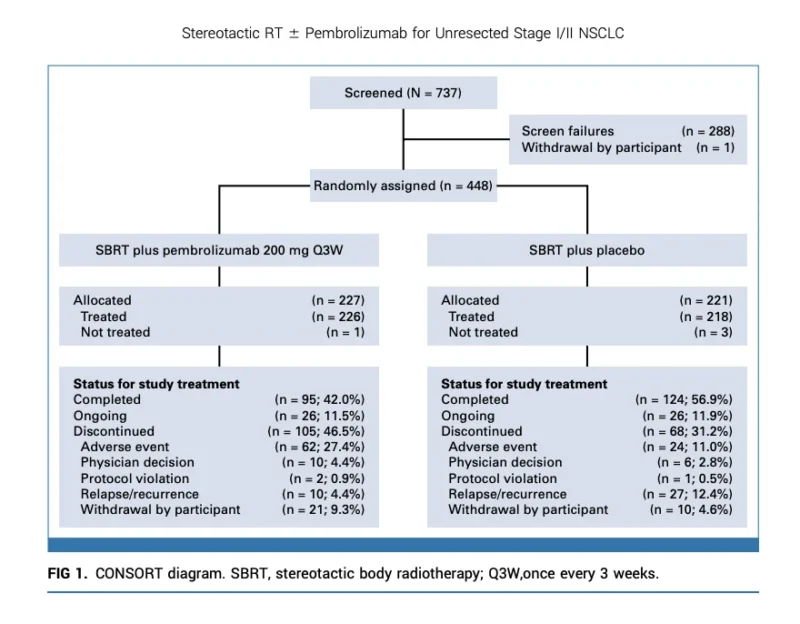
KEYNOTE-867 (NCT03924869) was a global, randomized, double-blind, placebo-controlled phase III trial conducted across 193 study sites.
The study enrolled adults with previously untreated, unresected stage I or II NSCLC, including T1 to selected T3 tumors without lymph node involvement or distant metastases, according to the eighth edition of the AJCC staging system.
Patients were eligible if they were considered medically inoperable or had declined surgery. ECOG performance status 0–2 was permitted, reflecting the clinical characteristics of a population frequently affected by substantial comorbidity.
Patients with ultracentral tumors abutting or invading critical thoracic structures were excluded. A total of 448 patients were randomized 1:1 to receive SBRT plus pembrolizumab (n=227) or SBRT plus placebo (n=221).
Pembrolizumab was administered intravenously at 200 mg every three weeks for up to 17 cycles, corresponding to approximately one year of systemic treatment. SBRT was delivered concurrently over no more than two weeks, with fractionation selected according to tumor location and anatomical considerations.
Patients with peripheral lesions could receive three- to five-fraction treatment schedules, while central tumors could receive more fractionated regimens. Randomization was stratified by disease stage, performance status, geographic region, and reason for not undergoing surgery.
The primary endpoint was EFS, defined as the time from randomization to local, regional, or distant disease recurrence or death from any cause, assessed through blinded independent central review.
Secondary endpoints included OS, time to distant metastases or death, safety, and patient-reported outcomes. The trial population had a median age of 73 years, and approximately 85% of patients were aged 65 years or older. Most patients had stage I disease, and 82.4% were considered medically inoperable.
At the June 11, 2024 data cutoff for the prespecified first interim analysis, the median time from randomization to cutoff was 20.6 months.
Primary Endpoint: No Significant Improvement in Event-Free Survival
KEYNOTE-867 failed to meet its primary endpoint. Median EFS was 31.2 months (95% CI 22.5–39.1) with SBRT plus pembrolizumab compared with 28.3 months (95% CI 19.8–33.1) with SBRT plus placebo.
The HR was 0.92 (95% CI 0.69–1.24; p=0.2932), demonstrating no statistically significant difference between treatment arms. EFS events occurred in 88 patients (38.8%) receiving pembrolizumab and 94 patients (42.5%) receiving placebo.
Although the median EFS estimate was numerically 2.9 months longer with pembrolizumab, the confidence interval was compatible with either a modest benefit or a clinically relevant disadvantage.
Therefore, the result does not establish that adding pembrolizumab improves disease control following SBRT. The absence of a meaningful separation between treatment groups is particularly important given the intensity and duration of the experimental treatment.
Patients received a short course of definitive radiotherapy followed by a prolonged systemic treatment schedule, yet the additional immune checkpoint inhibition did not produce the anticipated reduction in recurrence or death.
Overall Survival: No Benefit and an Unfavorable Numerical Direction
Overall survival findings further questioned the value of adding pembrolizumab. Median OS was 54.7 months (95% CI 33.5–not reached) with pembrolizumab, while median OS was not reached in the placebo group.
The OS HR was 1.33 (95% CI 0.93–1.90), numerically favoring SBRT without pembrolizumab. Deaths occurred in 69 patients (30.4%) in the combination arm compared with 54 patients (24.4%) in the control arm.
These results should be interpreted carefully. Because the primary EFS endpoint was not statistically significant, the hierarchical testing procedure did not permit formal confirmatory OS testing. Furthermore, the OS confidence interval crossed 1.0, meaning the analysis cannot establish a statistically significant detrimental survival effect.
Nevertheless, the absence of a favorable survival signal is clinically important, particularly when considered alongside the substantial increase in severe toxicity. Additional efficacy analyses were similarly negative.
Median time to death or distant metastases was 39.1 months with pembrolizumab versus 41.3 months with placebo (HR 1.02; 95% CI 0.74–1.42). Disease-specific survival, evaluated using a later January 2025 cutoff, also showed no demonstrated improvement (HR 1.44; 95% CI 0.75–2.76).
Taken together, the efficacy findings provide no convincing evidence that pembrolizumab improves recurrence-related or survival outcomes when added to definitive SBRT in this population.
Subgroup Analyses: Exploratory Signals Do Not Reverse the Negative Result
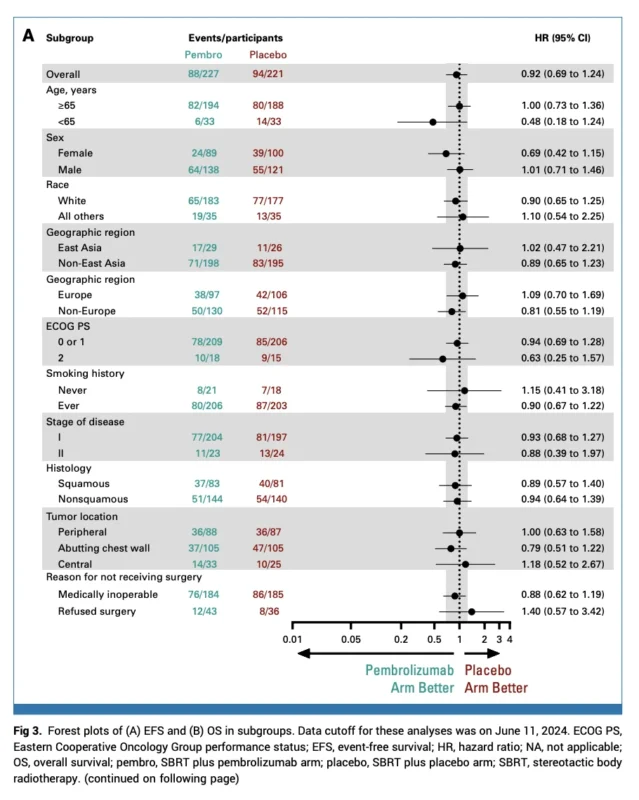
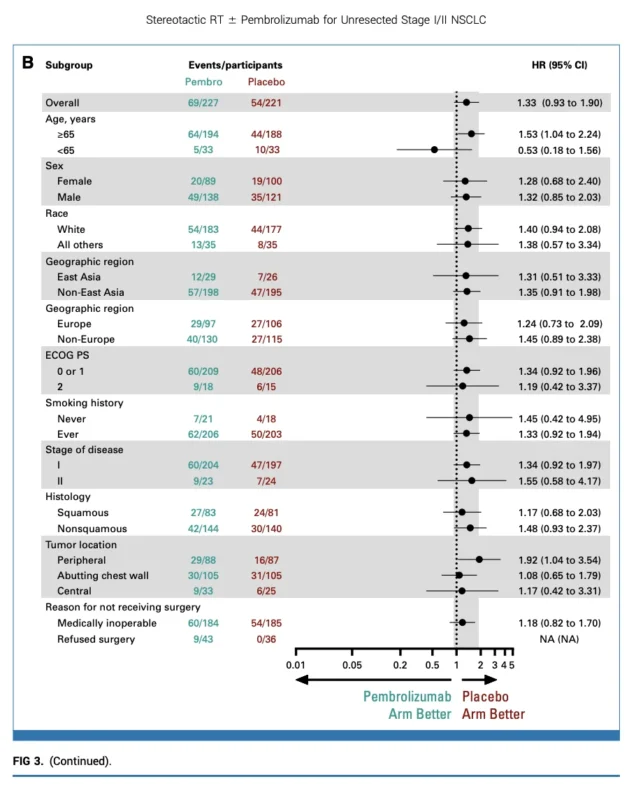
The investigators explored treatment effects across baseline clinical and demographic characteristics. Most EFS subgroup estimates were consistent with the negative overall findings. One potentially interesting observation involved patient age.
Among patients younger than 65 years, the EFS HR was 0.48 (95% CI 0.18–1.24), compared with 1.00 (95% CI 0.73–1.36) among patients aged 65 years or older. A similarly favorable numerical OS estimate was observed in younger patients, with an HR of 0.53 (95% CI 0.18–1.56).
However, only 66 patients were younger than 65 years, evenly divided between treatment arms, and relatively few events occurred. The confidence intervals were wide, and the analyses were not designed to establish treatment efficacy in age-defined populations.
Among patients aged 65 years or older, the exploratory OS HR was 1.53 (95% CI 1.04–2.24). Although this raises concern regarding the benefit-risk balance in older patients, it cannot be interpreted as independently confirmed evidence of treatment-related survival harm.
Age may be associated with differences in competing mortality, comorbidity, immune function, and vulnerability to treatment-related adverse events. Nevertheless, the current results do not establish age as a validated predictive biomarker for selecting pembrolizumab with SBRT.
Further investigation would be required before any age-based treatment strategy could be recommended.
Safety: Severe Toxicity Increased Substantially
The safety findings were among the most consequential results of KEYNOTE-867. Treatment-related adverse events of any grade occurred in 73.5% of patients receiving pembrolizumab compared with 50.0% receiving placebo.
More importantly, grade 3–5 treatment-related adverse events occurred in 20.4% versus 3.7%, respectively. Serious treatment-related adverse events occurred in 14.2% of patients in the pembrolizumab arm compared with 2.3% in the placebo arm.
Treatment-related adverse events leading to treatment discontinuation were reported in 15.9% versus 2.3%. Five treatment-related deaths occurred with pembrolizumab, representing 2.2% of treated patients, compared with none in the control arm.
These fatal events included three cases of pneumonia, one bronchopneumopathy, and one pneumonitis. The pulmonary toxicity findings were particularly relevant given the underlying lung disease and prior exposure to thoracic radiotherapy.
All-cause pneumonitis occurred in 20.8% of patients receiving pembrolizumab compared with 10.6% receiving placebo. Although reported radiation pneumonitis rates were similar between arms, 9.7% versus 9.2%, grade 3–5 pneumonitis or radiation pneumonitis occurred in seven patients, all in the pembrolizumab group.
Other commonly reported treatment-related events included hypothyroidism, rash, pruritus, and fatigue. These adverse events were generally consistent with known checkpoint inhibitor toxicity, but their increased frequency and severity substantially altered the benefit-risk assessment.
In patients receiving curative-intent SBRT, many of whom are older and medically inoperable, even relatively uncommon severe respiratory adverse events may have major clinical consequences. Without a demonstrated improvement in EFS or OS, the additional toxicity cannot be justified by the reported efficacy findings.
Quality of Life: No Compensating Patient-Reported Benefit
Patient-reported outcomes did not identify a clinically meaningful advantage with pembrolizumab. Both treatment groups experienced reductions in global health status and functional measures during follow-up, without meaningful between-group differences.
Disease-related symptom scores, including cough, dyspnea, and chest pain, were generally stable during the assessed period. These results reinforce the overall interpretation: pembrolizumab did not demonstrate improved disease outcomes or meaningful patient-reported benefit sufficient to offset the additional treatment burden.
Why Did Earlier Immunotherapy-SBRT Studies Produce Different Results?
The negative KEYNOTE-867 results contrast with the earlier randomized phase II I-SABR study, which evaluated stereotactic ablative radiotherapy with or without nivolumab.
I-SABR demonstrated improved four-year EFS with combined treatment, encouraging further investigation of immunotherapy in early-stage NSCLC. However, important design differences limit direct comparison.
The nivolumab study included patients with treatment-naïve early-stage disease and isolated recurrent lung cancer, used a substantially shorter immunotherapy course, and enrolled a higher proportion of patients with smaller tumors.
KEYNOTE-867, in contrast, evaluated up to 17 cycles of pembrolizumab in a larger phase III population. These differences highlight why positive phase II findings require confirmatory validation before becoming routine practice.
The broader randomized evidence has also become less favorable for unselected immunotherapy intensification after SBRT. The phase III SWOG/NRG S1914 study, published in The Lancet in October 2026, evaluated induction and consolidation atezolizumab with SBRT versus SBRT alone in high-risk early-stage NSCLC.
That trial also failed to demonstrate an OS benefit (HR 1.04; 95% CI 0.69–1.58), while grade ≥3 adverse events were more frequent with immunotherapy. Together, KEYNOTE-867 and S1914 raise substantial concerns about routinely adding checkpoint inhibition to SBRT without a validated strategy for identifying patients likely to benefit.
Results from other studies, including PACIFIC-4/RTOG-3515, remain important for clarifying whether specific agents, sequencing approaches, or patient populations may produce different outcomes.
Clinical Interpretation: SBRT Alone Remains the Standard Approach
KEYNOTE-867 provides important evidence against routine pembrolizumab intensification in unresected, node-negative stage I–II NSCLC. Its findings should not be extrapolated to all clinical settings involving thoracic radiotherapy and immunotherapy.
The established benefit of durvalumab consolidation after definitive concurrent chemoradiotherapy in unresectable stage III NSCLC, for example, concerns a biologically and clinically different population. Similarly, neoadjuvant and perioperative immunotherapy strategies in resectable NSCLC cannot be directly compared with checkpoint inhibition added to definitive SBRT.
The essential distinction is that the indication, timing, tumor burden, and local treatment approach may substantially influence the benefit-risk profile of immunotherapy. For medically inoperable early-stage NSCLC, SBRT alone remains an evidence-based definitive treatment.
The current evidence does not support adding pembrolizumab outside a clinical trial in the absence of a separate established indication.
Future investigations may focus on molecular residual disease, tumor-specific risk factors, immune biomarkers, treatment duration, and radiation fractionation to identify whether a narrower population could benefit from systemic intensification.
Limitations and Remaining Questions
Several limitations should be considered. First, KEYNOTE-867 was stopped after its first prespecified interim analysis, limiting the opportunity to observe longer-term differences in recurrence and survival.
Second, the population was predominantly older, medically inoperable, and affected by stage I disease. These characteristics are highly representative of many patients receiving definitive SBRT but may limit generalization to younger and lower-comorbidity populations.
Third, the study did not establish whether individual biomarkers, including PD-L1 expression or molecular residual disease, could identify patients more likely to benefit. Fourth, exploratory subgroup findings were statistically imprecise and should not be used to guide treatment selection.
Finally, the trial evaluated one specific treatment strategy involving concurrent SBRT and up to one year of pembrolizumab. It does not definitively exclude the possibility that different agents, schedules, or biomarker-selected approaches could improve outcomes.
Nevertheless, the combination of a negative primary endpoint and increased fatal toxicity provides a strong reason against routine use of the tested regimen.
OncoDaily Takeaway
KEYNOTE-867 delivers a clear and clinically important negative phase III result: adding pembrolizumab to definitive SBRT did not improve event-free survival in unresected stage I–II NSCLC and substantially increased treatment-related toxicity.
Median EFS was 31.2 versus 28.3 months, with an HR of 0.92 and no statistical significance. Overall survival also failed to favor pembrolizumab, although the OS result was not formally tested after failure of the primary endpoint.
The safety findings are particularly concerning. Grade 3–5 treatment-related adverse events occurred in 20.4% versus 3.7% of patients, and all five treatment-related deaths occurred in the pembrolizumab arm.
These findings reinforce an important principle in curative-intent oncology: treatment intensification must produce a clinically meaningful benefit sufficient to justify additional toxicity, particularly in older and medically vulnerable patients.
The results also underscore the limitations of extrapolating immunotherapy success from metastatic or stage III NSCLC into early-stage disease treated with SBRT. The interaction between radiation, tumor biology, immune response, and competing mortality requires direct randomized validation.
For current clinical practice, KEYNOTE-867 supports continued use of definitive SBRT without routine pembrolizumab addition in medically inoperable, node-negative early-stage NSCLC.
The next challenge is determining whether carefully selected patients, alternative immunotherapy schedules, or molecularly guided strategies can achieve a better balance between disease control and treatment-related harm.
Source
- Jabbour SK, Sótér S, Eaton M, et al. KEYNOTE-867: A Phase III, Randomized, Double-Blind Study of Stereotactic Body Radiotherapy With Pembrolizumab for Unresected Stage I or II Non–Small Cell Lung Cancer. Journal of Clinical Oncology. Published online October 28, 2026.