First-line targeting of KRAS G12C is moving closer to becoming a realistic treatment strategy in metastatic non-small cell lung cancer.
Updated results from the phase I KANDLELIT-001 study, presented at ESMO Congress 2026, showed substantial and durable activity with the investigational KRAS G12C inhibitor calderasib, particularly when combined with pembrolizumab in previously untreated metastatic NSCLC.
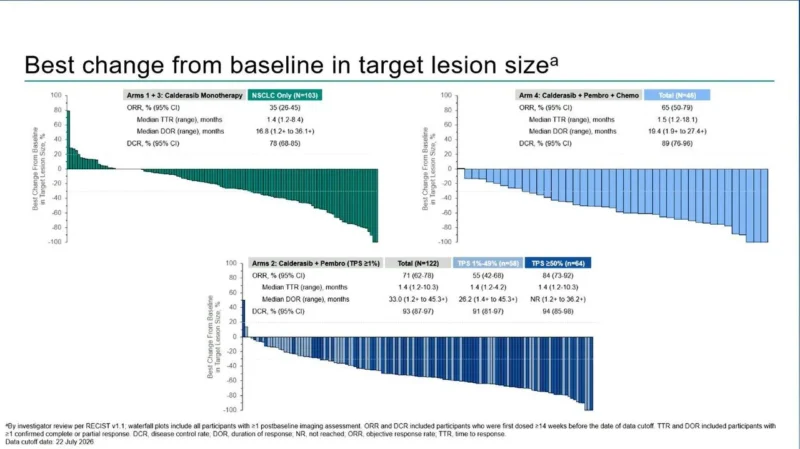
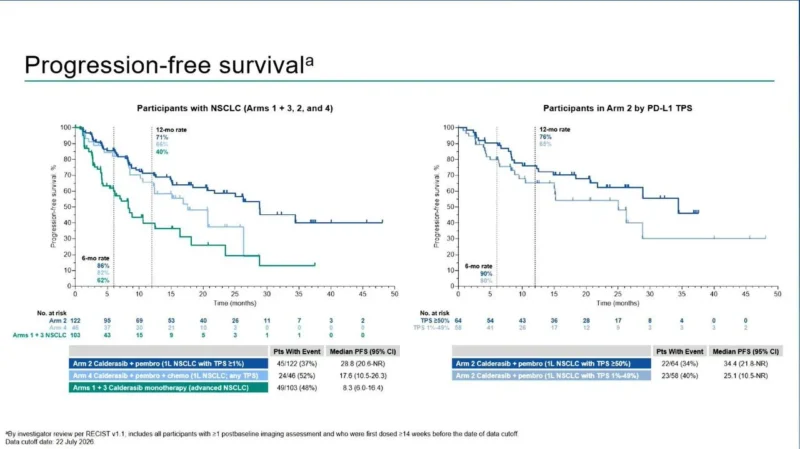
Among treatment-naïve patients with KRAS G12C-mutated NSCLC and PD-L1 tumor proportion score of at least 1%, calderasib plus pembrolizumab produced an objective response rate of 71%, disease control rate of 93%, and median progression-free survival of 28.8 months.
Activity was particularly high in tumors with PD-L1 TPS ≥50%, where ORR reached 84% and median PFS reached 34.4 months. Even in the PD-L1 TPS 1%–49% subgroup, ORR was 55% and median PFS was 25.1 months.
Calderasib combined with pembrolizumab and platinum-pemetrexed chemotherapy also demonstrated substantial activity in an all-comer first-line population, with an ORR of 65%, DCR of 89%, and median PFS of 17.6 months.
The findings are among the strongest early signals to date for integrating direct KRAS G12C inhibition into the first-line treatment of metastatic NSCLC. However, KANDLELIT-001 remains an early-phase, non-randomized study, and randomized phase III trials will be required before the strategy can challenge established immunotherapy-based standards.
KRAS G12C Has So Far Been Targeted Mainly After Progression
KRAS was historically considered one of the most difficult oncogenic drivers to target. The development of covalent KRAS G12C inhibitors changed that paradigm.
Sotorasib and adagrasib are both FDA-approved for KRAS G12C-mutated locally advanced or metastatic NSCLC after at least one previous systemic therapy.
Their introduction established KRAS G12C as a clinically actionable driver, but the first-line setting has remained dominated by immunotherapy, with or without platinum-based chemotherapy depending largely on PD-L1 expression and other clinical factors. Calderasib is attempting to move direct KRAS inhibition considerably earlier.
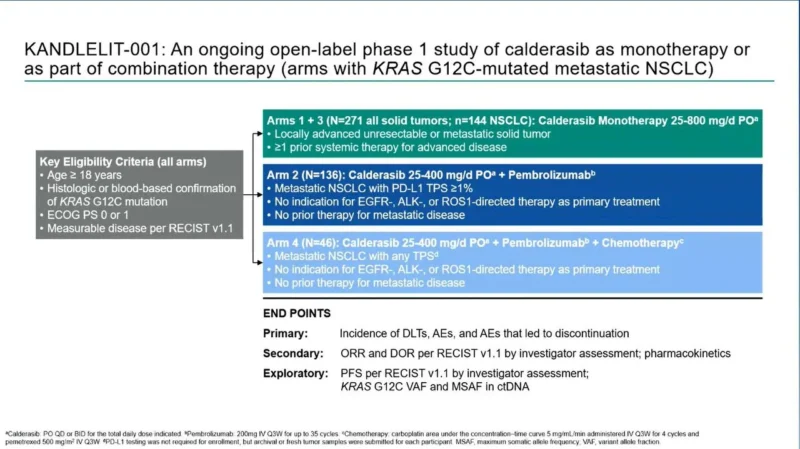
Also known as MK-1084, calderasib is an oral covalent inhibitor that targets the GDP-bound inactive form of KRAS G12C. The KANDLELIT-001 program is evaluating the agent both as monotherapy and in combinations with pembrolizumab and chemotherapy. The study includes previously treated and treatment-naïve KRAS G12C-mutated metastatic NSCLC populations.
The Updated ESMO Dataset Is More Mature Than the Abstract
The final ESMO presentation used a July 22, 2026 data cutoff, substantially later than the January 5 cutoff reported in the initial congress abstract. That distinction matters because several efficacy estimates matured between the two analyses.
The updated presentation included 103 evaluable patients with advanced NSCLC treated with calderasib monotherapy, 122 patients receiving first-line calderasib plus pembrolizumab, and 46 receiving calderasib plus pembrolizumab and chemotherapy.
These updated presentation values should therefore be considered the more current dataset for interpreting KANDLELIT-001.
Calderasib Plus Pembrolizumab Produced a 71% ORR
The strongest signal came from treatment-naïve patients with PD-L1 TPS ≥1%. Among 122 evaluable patients receiving calderasib plus pembrolizumab, ORR was 71%.
Responses also appeared durable. Median duration of response was approximately 33 months, while median time to response was only 1.4 months.
Disease control was achieved in 93% of patients. The PFS curve was similarly encouraging. Median PFS reached 28.8 months, with approximately 86% of patients progression free at six months and 71% at 12 months.
For a first-line phase I cohort, this duration of disease control is striking. The main question now is whether these results will remain reproducible in randomized testing.
PD-L1 ≥50% Disease Showed Particularly Deep Activity
The first-line pembrolizumab cohort also allowed assessment according to PD-L1 expression. Among patients with PD-L1 TPS ≥50%, ORR reached 84%.
Disease control rate was approximately 94%. Median PFS reached 34.4 months. At 12 months, approximately 76% of these patients remained progression free. These numbers provide a strong biological rationale for the ongoing KANDLELIT-004 phase III trial.
KANDLELIT-004 is directly testing calderasib plus pembrolizumab against pembrolizumab plus placebo as first-line therapy for KRAS G12C-mutated advanced NSCLC with PD-L1 TPS ≥50%. The randomized study is recruiting and has an estimated enrollment of 600 patients.
If the phase III trial confirms the magnitude of benefit seen in KANDLELIT-001, it could change how high-PD-L1 KRAS G12C disease is approached.
Activity Was Not Restricted to PD-L1-High Tumors
The combination also remained active in the PD-L1 TPS 1%–49% population. ORR was 55%, disease control approximately 91%, and median PFS 25.1 months.
That finding is important because the rationale for combining KRAS G12C inhibition with checkpoint blockade should not necessarily depend entirely on high baseline PD-L1 expression.
Direct suppression of oncogenic KRAS signaling may influence the tumor microenvironment and potentially increase immune susceptibility.
Whether the combination actually creates biological synergy rather than simply adding the independent activity of two drugs cannot be established from a single-arm phase I cohort. Still, the durability of the signal across both PD-L1 strata supports broader randomized evaluation.
The FDA granted calderasib plus pembrolizumab Breakthrough Therapy designation in May 2026 for first-line advanced or metastatic KRAS G12C-mutated NSCLC with PD-L1 TPS ≥1%, based on KANDLELIT-001 data.
The Chemotherapy Triplet Produced a 65% Response Rate
KANDLELIT-001 also evaluated a chemotherapy-containing strategy. Forty-six treatment-naïve patients received calderasib plus pembrolizumab with platinum-pemetrexed chemotherapy.
Unlike the pembrolizumab-only combination cohort, this group enrolled patients regardless of PD-L1 expression. ORR reached 65%, while DCR was 89%. Median duration of response was approximately 19.4 months. Median PFS was 17.6 months in the updated presentation.
Approximately 82% of patients were progression free at six months and 66% at one year. This provides a potential pathway for extending first-line KRAS G12C targeting beyond PD-L1-selected populations.
But the efficacy must be balanced against a clearly greater toxicity burden.
Toxicity Increased Substantially With Chemotherapy
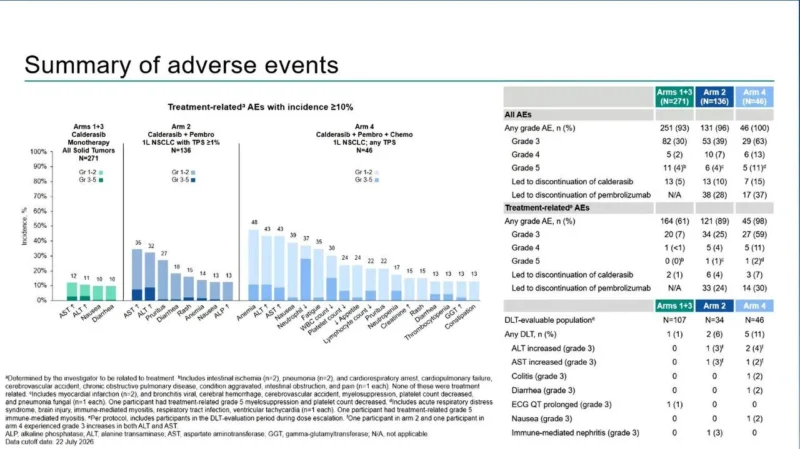
Calderasib monotherapy showed the most favorable safety profile. Across the broader monotherapy population, treatment-related adverse events occurred in approximately 61%, with grade 3 events in about 7%, grade 4 events in less than 1%, and no treatment-related grade 5 events.
With calderasib plus pembrolizumab, treatment-related adverse events occurred in approximately 89% of patients. Grade 3 treatment-related events occurred in approximately 25%, grade 4 in 4%, and grade 5 events in 1%.
The chemotherapy-containing triplet produced the highest toxicity burden. Treatment-related adverse events occurred in 98%, including grade 3 events in approximately 59%, grade 4 events in 11%, and grade 5 events in 2%.
This difference is clinically important. The triplet may broaden treatment to patients across PD-L1 groups, but the added chemotherapy clearly comes with substantially greater treatment burden.
Liver Enzyme Elevation Remains an Important Safety Issue
Combining KRAS G12C inhibitors with immune checkpoint blockade has historically raised concerns about hepatotoxicity. KANDLELIT-001 therefore provides important safety information.
In the pembrolizumab combination cohort, increased AST and ALT were among the most frequent treatment-related events.
Treatment discontinuation due to calderasib-related toxicity occurred in approximately 6% of patients in the pembrolizumab arm, while pembrolizumab discontinuation occurred more frequently, in approximately 24%.
In the triplet cohort, calderasib discontinuation was approximately 7%, while pembrolizumab discontinuation occurred in approximately 30%. The overall data suggest the combination can be administered, but hepatic monitoring remains particularly relevant as development moves into larger first-line populations.
Monotherapy Also Demonstrated Activity After Previous Treatment
Calderasib was not active only in the first-line setting. Among 103 evaluable patients with previously treated advanced NSCLC receiving calderasib monotherapy, ORR was 35% and DCR 78%.
Median duration of response was 16.8 months. Median PFS was 8.3 months. These findings are consistent with calderasib having meaningful direct activity against KRAS G12C even without checkpoint blockade.
The response rate is broadly within the range established for the KRAS G12C inhibitor class in previously treated disease, although cross-trial comparisons with sotorasib or adagrasib should be avoided.
The clinical development priority, however, appears increasingly focused on the much more ambitious first-line setting.
The Key Question Is Whether First-Line KRAS Targeting Adds to Immunotherapy
The KANDLELIT-001 results raise an important strategic question for KRAS-mutant NSCLC. Unlike EGFR- or ALK-driven disease, where targeted therapy is clearly preferred before immunotherapy, KRAS G12C-mutated tumors frequently arise in smokers, often retain immunogenic biology, and may respond meaningfully to PD-1 blockade.
This creates an opportunity that is also a challenge. The goal is not simply to replace effective immunotherapy with targeted treatment. Instead, first-line development must demonstrate that adding KRAS G12C inhibition to an already effective immune strategy produces deeper and more durable benefit without unacceptable toxicity.
That is exactly what KANDLELIT-004 and the broader phase III development program are designed to determine. The KANDLELIT-001 abstract also identifies KANDLELIT-007 as an ongoing phase III program examining calderasib-based first-line treatment across a broader PD-L1 population.
Current KRAS G12C Inhibitors Have Not Yet Established a First-Line Standard
This context is essential when interpreting KANDLELIT-001. Sotorasib remains approved for patients with KRAS G12C-mutated locally advanced or metastatic NSCLC after at least one prior systemic therapy.
Adagrasib likewise remains approved in previously treated KRAS G12C-mutated NSCLC. Calderasib is still investigational. Therefore, despite its striking phase I results, KRAS G12C inhibition should not yet replace established first-line immunotherapy or chemoimmunotherapy outside a clinical trial.
The phase III results will determine whether that treatment paradigm changes.
OncoDaily Takeaway
The updated KANDLELIT-001 presentation provides one of the strongest early signals yet for moving KRAS G12C inhibition into first-line metastatic NSCLC. In untreated patients with PD-L1 TPS ≥1%, calderasib plus pembrolizumab produced a 71% ORR, 93% disease control rate, and median PFS of 28.8 months.
The signal was especially strong in PD-L1 TPS ≥50% disease, where ORR reached 84% and median PFS 34.4 months. Patients with PD-L1 TPS 1%–49% also derived substantial benefit, with 55% ORR and median PFS of 25.1 months.
Adding chemotherapy broadened the strategy across PD-L1 levels and produced a 65% ORR and 17.6-month median PFS, but at the cost of substantially greater grade 3–4 toxicity.
Calderasib monotherapy also remained active in previously treated disease, with a 35% response rate and median PFS of 8.3 months. These findings do not yet establish calderasib as a first-line standard.
KANDLELIT-001 is an early-phase study without randomized control groups, and the unusually long first-line PFS estimates require confirmation.
But the phase III question is now clearly defined. For KRAS G12C-mutant NSCLC, the next therapeutic step may not be choosing between targeted therapy and immunotherapy.
It may be learning how to use both together from the beginning.
Source
- Sendur MAN, et al. Calderasib (MK-1084), alone or in combination, for KRAS G12C-mutant metastatic non-small cell lung cancer. Presented at ESMO Congress 2026, October 25, 2026. Abstract 2680RO. KANDLELIT-001; NCT05067283. The study evaluates calderasib monotherapy and combinations with pembrolizumab with or without chemotherapy.