Antibody-drug conjugates have changed treatment across several solid tumors, including breast cancer and lung cancer. Their growing role has also brought a clinically important safety issue into sharper focus: interstitial lung disease and pneumonitis.
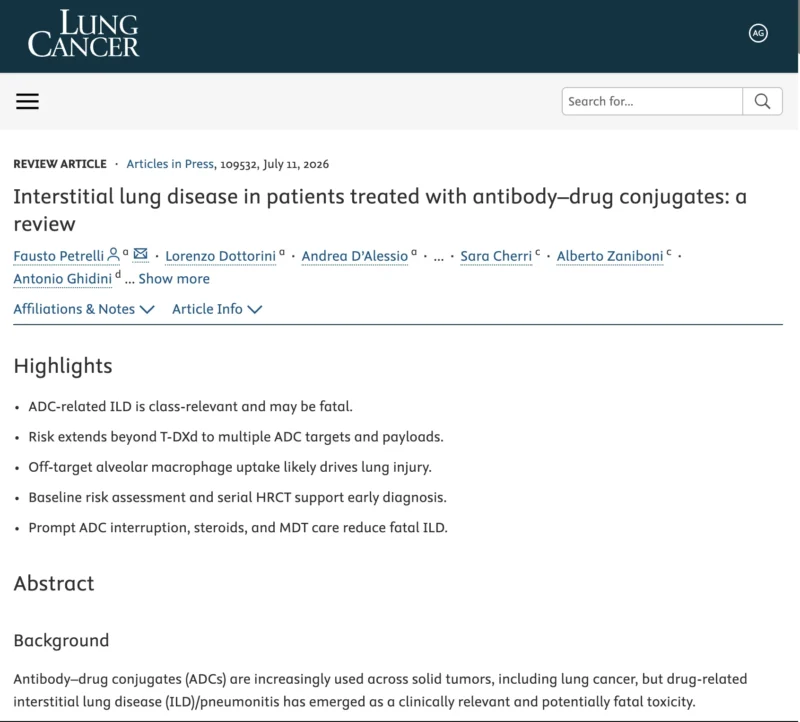
A review by Fausto Petrelli and colleagues summarizes evidence from clinical trials, pooled analyses, pharmacovigilance data, mechanistic studies, and consensus recommendations on ADC-related interstitial lung disease. The authors emphasize that this toxicity is not limited to one drug or one target. It is increasingly understood as a class-relevant risk that can be severe and, in some cases, fatal [1-9].
A Toxicity Beyond One ADC
Interstitial lung disease has been most extensively described with trastuzumab deruxtecan, where pooled analyses have reported an incidence of approximately 10% to 15%, a median onset of 5 to 6 months, and a fatal-event rate of about 2.2% [6,8].
However, the review highlights that pulmonary toxicity is not restricted to HER2-directed ADCs. ILD and pneumonitis have also been reported with deruxtecan-based ADCs targeting TROP2 and HER3, as well as with non-deruxtecan ADCs [1,7,9].
This matters because ADCs are moving rapidly into earlier lines of therapy, broader biomarker-defined populations, and multiple tumor types. As exposure increases, clinicians may encounter ADC-related lung injury more often.
What Pharmacovigilance Data Show
Real-world pharmacovigilance data reinforce the clinical relevance of this toxicity.
In a pharmacovigilance analysis of 1,277 pulmonary toxicity cases associated with ADCs, interstitial lung disease accounted for 40.6% of events, pneumonitis for 27.9%, and acute respiratory distress syndrome for 7.6% [1].
Acute respiratory distress syndrome showed the earliest onset and the highest case-fatality rate, underscoring the need for rapid recognition and urgent intervention when symptoms or imaging changes emerge [1].
Why ADCs Can Injure the Lung
The biological mechanism of ADC-related ILD is still being clarified, but the review points to an important model.
Mechanistic studies suggest that lung injury may occur through antigen-independent, dose-dependent uptake of ADCs by alveolar macrophages through Fcγ receptors. After internalization, intracellular release of the cytotoxic payload may trigger cytokine-mediated inflammation and lung tissue injury [7,12].
This mechanism helps explain why ILD risk may extend beyond a single target such as HER2. It also supports the concept that the payload, linker stability, dose, tissue distribution, and immune-cell uptake may all influence pulmonary toxicity [3,7].
Who May Be at Higher Risk
ADC-related ILD risk appears to be influenced by several factors.
The review identifies ADC type, payload, dose, older age, pre-existing lung disease, and concomitant pulmonary-toxic therapies as important considerations. Prior thoracic radiotherapy, baseline lung abnormalities, lung cancer itself, and previous pneumonitis may also complicate diagnosis and increase clinical concern [1,4-7].
This is particularly relevant in lung cancer, where patients may already have smoking-related lung disease, tumor-related respiratory symptoms, prior radiation exposure, or treatment-related pneumonitis from immunotherapy.
Diagnosis Requires Suspicion and Imaging
Early diagnosis depends on structured surveillance and a low threshold for evaluation.
The review supports baseline risk assessment before ADC initiation and serial high-resolution chest computed tomography during treatment, especially in higher-risk patients. Symptoms such as cough, dyspnea, fever, fatigue, or new oxygen requirement should prompt immediate evaluation, but imaging changes may appear before severe symptoms develop [2,5,6].
The diagnosis is often one of exclusion. Infection, tumor progression, pulmonary embolism, radiation pneumonitis, immune checkpoint inhibitor pneumonitis, and other drug-related lung injuries must be considered.
Management Starts With Holding the ADC
The key management principle is early action.
The review emphasizes prompt ADC interruption, grade-based corticosteroid therapy, and multidisciplinary care involving oncology, pulmonology, radiology, and, when needed, infectious disease specialists [2,5,6].
For asymptomatic radiographic ILD, treatment interruption and close monitoring may be sufficient in some cases, depending on grade and drug-specific guidance. For symptomatic ILD, corticosteroids are typically required, and permanent discontinuation is often recommended for grade 2 or higher events with several ADCs, including trastuzumab deruxtecan-based regimens [2,4-6].
Delayed recognition can allow progression to severe pneumonitis, respiratory failure, or fatal lung injury.
What This Means for Oncology Practice
ADC-related ILD is becoming a practical safety challenge across tumor boards.
The review makes a clear point: this toxicity requires anticipation, not reaction. Baseline assessment, patient education, regular imaging, rapid evaluation of new symptoms, and early corticosteroid use may reduce severe and fatal outcomes [2,5,6].
As ADCs expand across breast cancer, lung cancer, gastric cancer, urothelial cancer, and other solid tumors, ILD surveillance will need to become part of routine ADC care.
The Bottom Line
ADC-related interstitial lung disease is a class-relevant and potentially fatal toxicity.
Although trastuzumab deruxtecan has generated the largest body of evidence, ILD risk extends to multiple ADC platforms, targets, and payloads.
The review by Petrelli and colleagues reinforces the need for baseline lung-risk assessment, serial high-resolution CT imaging, early treatment interruption, grade-based corticosteroids, and multidisciplinary management.
For ADCs, efficacy is no longer the only story. Lung safety is now a central part of how these therapies must be used.
References
- Shi J, Liu X, Wu L, et al. Interstitial lung disease with antibody-drug conjugates: a real-world pharmacovigilance study based on the FAERS database during the period 2014-2023. Therapeutic Advances in Respiratory Disease. 2024;18:17534666241299935.
- Tarantino P, Tolaney SM. Detecting and managing T-DXd-related interstitial lung disease: the five “S” rules. JCO Oncology Practice. 2023;19(8):526-527.
- Nguyen TD, Bordeau BM, Balthasar JP. Mechanisms of ADC toxicity and strategies to increase ADC tolerability. Cancers. 2023;15(3):713.
- Tarantino P, Modi S, Tolaney SM, et al. Interstitial lung disease induced by anti-ERBB2 antibody-drug conjugates: a review. JAMA Oncology. 2021;7(12):1873-1881.
- Rugo HS, Crossno CL, Gesthalter YB, et al. Real-world perspectives and practices for pneumonitis/interstitial lung disease associated with trastuzumab deruxtecan use in HER2-expressing metastatic breast cancer. JCO Oncology Practice. 2023;19(8):539-546.
- Powell CA, Modi S, Iwata H, et al. Pooled analysis of drug-related interstitial lung disease and/or pneumonitis in nine trastuzumab deruxtecan monotherapy studies. ESMO Open. 2022;7(4):100554.
- Koganemaru S, Fuchigami H, Morizono C, et al. Potential mechanisms of interstitial lung disease induced by antibody-drug conjugates based on quantitative analysis of drug distribution. Molecular Cancer Therapeutics. 2025;24(2):242-250.
- Abuhelwa Z, Alloghbi A, Alqahtani A, et al. Trastuzumab deruxtecan-induced interstitial lung disease/pneumonitis in ERBB2-positive advanced solid malignancies: a systematic review. Drugs. 2022;82(9):979-987.
- Zhu Y, Liu K, Wang K, et al. Treatment-related adverse events of antibody-drug conjugates in clinical trials: a systematic review and meta-analysis. Cancer. 2023;129(2):283-295.
- Modi S, Jacot W, Yamashita T, et al. Trastuzumab deruxtecan in previously treated HER2-low advanced breast cancer. New England Journal of Medicine. 2022;387(1):9-20.
- Li BT, Smit EF, Goto Y, et al. Trastuzumab deruxtecan in HER2-mutant non-small-cell lung cancer. New England Journal of Medicine. 2022;386(3):241-251.
- Kumagai K, Aida T, Tsuchiya Y, et al. Interstitial pneumonitis related to trastuzumab deruxtecan, a HER2-targeting antibody-drug conjugate, in monkeys. Cancer Science. 2020;111(12):4636-4645.