
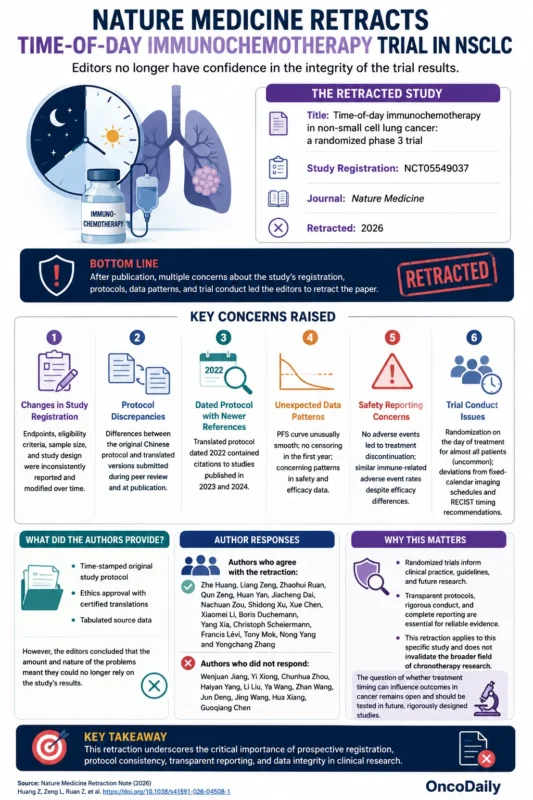
Nature Medicine has retracted a randomized phase III trial that investigated whether the timing of immunochemotherapy administration could influence outcomes for patients with non-small cell lung cancer (NSCLC).
The retracted study, titled “Time-of-day immunochemotherapy in non-small cell lung cancer: a randomized phase 3 trial,” explored an important and emerging question in oncology: whether circadian biology and treatment timing may affect anticancer efficacy or toxicity. However, according to the retraction notice, serious concerns emerged after publication regarding the study registration, protocol history, reported trial design, source data, safety reporting, and imaging assessments.
After reviewing the available materials, the editors concluded that they could no longer rely on the integrity of the results. The findings from this individual trial should therefore no longer be used to guide clinical treatment timing, inform oncology practice, or support research assumptions without independent validation.
What Was the Trial About?
The original study evaluated time-of-day administration of immunochemotherapy in NSCLC. Research into treatment timing, sometimes called chronotherapy, is based on the idea that the body’s biological rhythms may influence immune activity, drug metabolism, tumor biology, and treatment tolerability.
This is a scientifically plausible area of research. Immune function and inflammatory signaling can vary throughout the day, and several studies across oncology have explored whether treatment timing could affect clinical outcomes.
However, a biologically interesting hypothesis does not remove the need for rigorous trial methods, transparent protocols, prespecified endpoints, reliable randomization, standardized imaging schedules, and complete reporting of safety outcomes.
The retraction does not invalidate the broader field of chronotherapy or circadian oncology. It specifically concerns the reliability and reporting of this particular phase III NSCLC trial.
Why Did Nature Medicine Retract the Study?
The retraction notice described concerns about substantial modifications to the trial registration record for NCT05549037.
According to the journal, important trial components appeared to have been inconsistently reported or changed over time. These included:
- Study endpoints
- Eligibility criteria
- Sample size
- Trial design
Changes to a clinical trial protocol can occur for legitimate reasons. But they should be clearly documented, prospectively dated, justified, and reflected transparently in the trial registry, ethics documentation, statistical analysis plan, and final publication.
In this case, the editors reported that the modifications and inconsistencies raised concerns about whether the study had been conducted and reported according to a stable, prospectively defined plan.
Protocol Documentation Raised Additional Questions
The journal also identified discrepancies between different versions of the study protocol.
A translated protocol published alongside the manuscript was dated 2022, but it contained citations to studies published in 2023 and 2024. The editors also found differences between the original Chinese-language study protocol and the translated versions submitted during peer review and publication.
The authors reportedly attributed many of these issues to administrative errors rather than formally documented amendments.
However, protocol inconsistencies are particularly significant in randomized trials. The protocol establishes how patients are selected, how treatment groups are assigned, what outcomes are measured, when scans are performed, and how results are analyzed. When these elements cannot be reliably traced and verified, confidence in the study findings becomes difficult to maintain.
Concerns About Data Patterns and Safety Reporting
The retraction notice also cited unexpected patterns in the reported data.
One concern involved the shape of the progression-free survival curve. The editors noted that it appeared smoother than is typically seen in similarly sized phase III oncology trials.
The notice also described an absence of censoring during the first year of the trial. In survival analyses, censoring commonly occurs when patients are lost to follow-up, withdraw consent, remain event-free at the last assessment, or have incomplete follow-up at data cutoff. A complete absence of censoring over a prolonged period may be unusual and can prompt further review.
Another concern was the reported absence of adverse events leading to treatment discontinuation throughout the trial. In a large phase III immunochemotherapy study, treatment discontinuations due to toxicity would generally be expected to occur in at least some patients.
The editors additionally questioned the similar rates of immune-related adverse events between treatment groups despite differences in reported therapeutic efficacy. This observation alone does not prove a problem, but in combination with other issues it contributed to the journal’s concerns.
Randomization and Imaging Schedules Were Also Questioned
The source data reviewed by the editors indicated that randomization occurred on the day of treatment for almost all participants. The retraction notice described this as uncommon.
Randomization procedures should be predefined, documented, and implemented in a way that protects allocation concealment and minimizes the possibility of selection bias. Same-day randomization is not automatically invalid, but it requires careful explanation and a transparent operational framework.
The authors also acknowledged deviations from fixed-calendar imaging schedules due to COVID-19-related delays and cycle-based assessments.
In oncology trials, progression-free survival typically depends on scheduled imaging assessments using standardized criteria such as RECIST. When imaging timing becomes inconsistent, the precise date of radiologic progression may be more difficult to determine. This can influence progression-free survival estimates and complicate comparisons between treatment groups.
The editors concluded that these deviations suggested a lack of adherence to standard RECIST timing recommendations.
What Information Did the Authors Provide?
The authors supplied a time-stamped version of the original protocol, ethics approval documentation with certified translations, and tabulated source data.
However, the journal determined that these materials did not adequately resolve the wider concerns.
According to the retraction notice, the amount and nature of the identified issues meant that the editors no longer had confidence in the integrity of the findings. A number of listed authors agreed with the retraction, while others did not respond to editorial correspondence.
Why Retractions Matter in Oncology
Clinical trials can shape treatment recommendations, guideline discussions, regulatory decisions, future research priorities, and patient expectations. This is especially true for randomized phase III trials, which are often viewed as high-level evidence.
Retractions are an important part of scientific self-correction. They help prevent unreliable evidence from continuing to influence clinical practice or future research.
For clinicians and researchers, this case also underscores the importance of checking whether an influential study has received corrections, expressions of concern, or retraction notices before citing it in publications, presentations, guidelines, or educational materials.
What Does This Mean for Treatment Timing in NSCLC?
The retraction means that the specific results from this trial should not be used as evidence that a particular time of day improves outcomes with immunochemotherapy in NSCLC.
However, it does not answer the broader question of whether circadian rhythms influence cancer therapy. That question remains open and should be addressed through independently conducted, prospectively registered trials with transparent protocols, robust randomization, standardized imaging schedules, and complete safety reporting.
The field of time-based cancer treatment remains scientifically interesting. But future studies will need to meet high methodological standards before treatment timing can be incorporated into routine NSCLC care.