
As comprehensive genomic profiling becomes increasingly central to metastatic non-small cell lung cancer (NSCLC), a key implementation question remains: should broad next-generation sequencing (NGS) be performed upfront for every patient, or can a staged testing strategy sometimes deliver results more efficiently?
A decision-analytic study published in JTO Clinical and Research Reports evaluated the clinical and economic implications of four molecular testing strategies for newly diagnosed metastatic NSCLC in Hong Kong: sequential single-gene testing, hotspot panel testing, an “exclusionary” strategy using EGFR and ALK testing followed by NGS in negative cases, and upfront NGS.
In the model, the exclusionary strategy produced the lowest testing costs and shortest time to an actionable result, although upfront NGS remained the most comprehensive strategy for identifying genomic alterations. The findings illustrate how local mutation prevalence, reimbursement structures, and testing costs can substantially influence the optimal diagnostic pathway.
Why Molecular Testing Strategy Matters
The expansion of targeted therapy has transformed the treatment of metastatic NSCLC from a largely chemotherapy-based approach to one increasingly determined by tumor genotype.
At the time of the analysis, the model incorporated alterations involving EGFR, ALK, ROS1, BRAF, MET, RET, KRAS G12C, NTRK, and HER2, alongside PD-L1 testing. The authors emphasized that identifying oncogenic drivers promptly is essential to selecting appropriate targeted therapy and avoiding delays in treatment initiation.
This issue has particular relevance in East Asian populations, where EGFR mutations are substantially more prevalent than in Western cohorts. The authors cited frequencies of approximately 40%–60% in East Asian lung adenocarcinoma populations compared with 10%–20% in Western populations. That epidemiologic difference became central to the model’s results.
Four Testing Strategies Compared
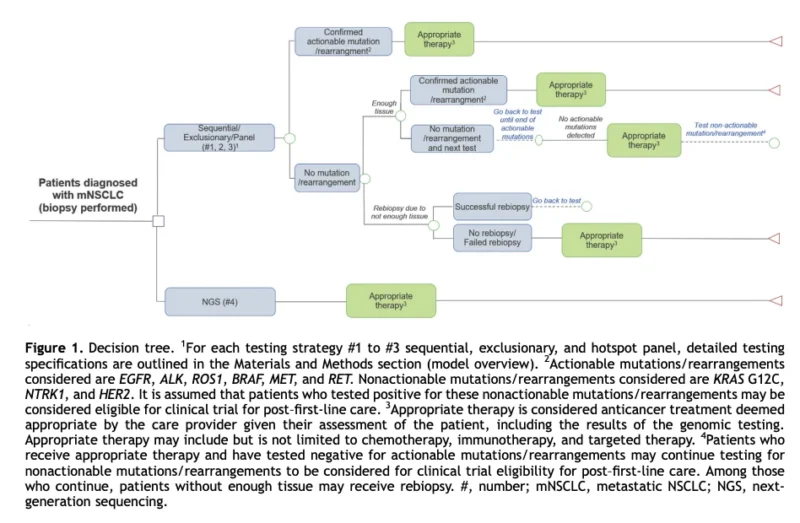
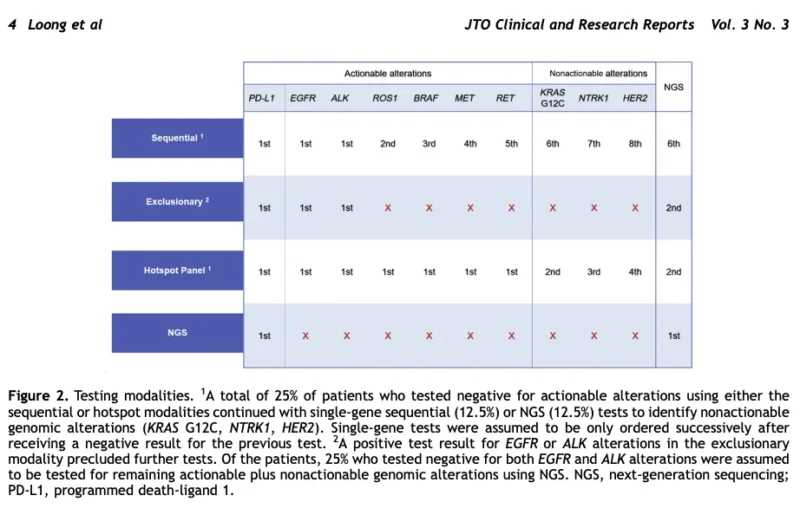
The investigators modeled four approaches: Sequential testing: individual genomic alterations were tested one after another. Exclusionary testing: EGFR and ALK were tested first, followed by NGS in a proportion of patients who tested negative.
Hotspot panel testing: several actionable alterations were assessed simultaneously, with additional testing where required. Upfront NGS: broad genomic profiling was performed at the beginning of the diagnostic pathway. The model assumed an annual population of 4,094 adults with metastatic NSCLC in Hong Kong and used local alteration frequencies, laboratory costs, rebiopsy assumptions, and testing turnaround times.
NGS was assigned a testing cost of $3,222, compared with lower individual costs for EGFR, ALK, ROS1, BRAF, MET, and RET assays. The model assumed approximately 2 weeks to receive NGS or hotspot panel results and 1.5 weeks for individual gene tests.
Exclusionary Testing Was the Least Expensive Strategy
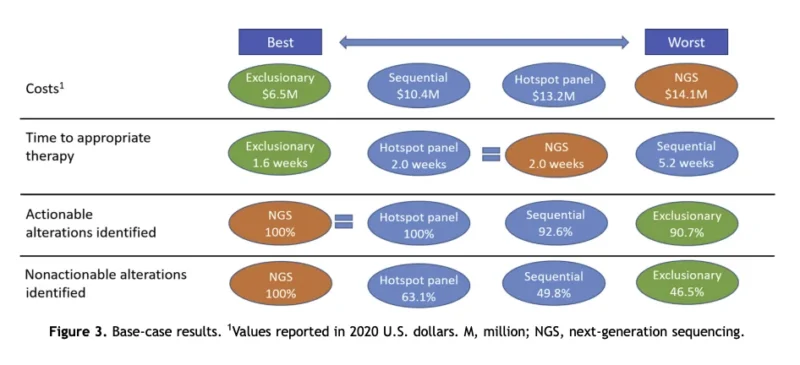
In the base-case analysis, total testing-related costs were lowest with the EGFR/ALK-first exclusionary approach:
- Exclusionary testing: $6.54 million
- Sequential testing: approximately $10.4 million
- Hotspot panel: approximately $13.2 million
- Upfront NGS: $14.08 million
Compared with upfront NGS, exclusionary testing reduced modeled costs by approximately $7.55 million. The figure on page 6 illustrates this clearly: exclusionary testing ranked best for cost, while upfront NGS was the most expensive under the assumptions used in the study.
Exclusionary Testing Also Produced the Fastest Actionable Result
The same strategy also generated the shortest modeled time to appropriate therapy. Median modeled time to an actionable result was:
- Exclusionary testing: 1.6 weeks
- NGS: 2.0 weeks
- Hotspot panel: 2.0 weeks
- Sequential testing: 5.2 weeks
The advantage reflected the high prevalence of EGFR and ALK alterations in the modeled Hong Kong population and the ability to detect these common drivers rapidly before proceeding to broader profiling.
But Upfront NGS Identified More Genomic Alterations
Cost and speed were not the entire story. Upfront NGS and hotspot panel testing identified 100% of patients with modeled actionable alterations, whereas exclusionary testing identified 90.7% and sequential testing 92.6%.
The difference was even larger for nonactionable or investigational alterations:
- NGS: 100%
- Hotspot panel: 63.1%
- Sequential testing: 49.8%
- Exclusionary testing: 46.5%
Broad NGS therefore provided the most complete molecular characterization, including alterations that could support clinical trial enrollment or later targeted treatment. This is an important counterweight to the economic analysis: a strategy can be less expensive while simultaneously leaving clinically relevant genomic information undiscovered.
The Economics of NGS Were Highly Price Sensitive
The study also examined how falling sequencing costs could change the preferred strategy. If upfront NGS were adopted for all modeled patients at the original price, annual testing costs increased by approximately $2.91 million compared with current practice.
However, upfront NGS became cost-saving when its price fell by approximately 28%, from $3,222 to $2,320.When the investigators modeled a future scenario in which all included genomic alterations were actionable, NGS required only a 5.5% price reduction, to approximately $3,044, to become cost-saving.
The result highlights the dynamic nature of molecular-testing economics: the value proposition of NGS improves as sequencing costs fall and the number of therapeutically actionable alterations increases.
Why the Results Differed From U.S. Models
Previous U.S. economic analyses had suggested that upfront NGS could be the most cost-efficient strategy. The Hong Kong model reached the opposite conclusion largely because of differences in molecular epidemiology.
EGFR and ALK together accounted for approximately 30% of the modeled Hong Kong metastatic NSCLC population, making rapid initial testing for these alterations highly productive. The authors contrasted this with U.S. populations, in which these alterations constituted a smaller proportion of cases.
The study therefore underscores a broader principle: the optimal genomic testing pathway may depend heavily on the population in which it is implemented.
Important Limitations
The findings require careful interpretation. First, this was a decision-analytic model rather than a prospective clinical trial. Second, the economic assumptions were based on Hong Kong testing costs and clinical practice patterns from around 2020. Treatment costs, longitudinal monitoring costs, and the downstream clinical benefits of receiving matched targeted therapy were not included.
The model also classified some alterations as nonactionable based on the availability of treatments in Hong Kong at the time. Since publication in 2022, the therapeutic landscape for alterations such as KRAS G12C, HER2, NTRK, and other molecular subsets has continued to evolve.
For that reason, the study should not be interpreted as evidence that EGFR/ALK-first testing remains superior to comprehensive upfront NGS in contemporary practice. Instead, it demonstrates how testing cost, local driver prevalence, access to therapies, and reimbursement policy can change the economic balance between focused and broad molecular testing.
OncoDaily Takeaway
The Hong Kong model found that an EGFR/ALK-first strategy followed by NGS in selected negative cases was faster and less expensive than upfront NGS under the economic and molecular assumptions used in the study.
However, upfront NGS provided the most comprehensive genomic information, identifying 100% of modeled actionable and nonactionable alterations. The most important finding may therefore be less about which strategy “wins” and more about how quickly the equation can change.
As additional genomic alterations become actionable and sequencing costs continue to fall, the economic advantage shifts progressively toward broad molecular profiling. Indeed, the authors’ own scenario analyses showed that relatively modest reductions in NGS cost could make upfront sequencing cost-saving.
For contemporary precision oncology, molecular testing strategies should therefore be evaluated not only according to their immediate cost, but also according to completeness of genomic information, turnaround time, tissue preservation, access to matched therapy, and the rapidly evolving number of actionable targets.
Source
- Loong HH, Wong CKH, Chan CPK, et al. Clinical and Economic Impact of Upfront Next-Generation Sequencing for Metastatic NSCLC in East Asia. JTO Clinical and Research Reports. 2022;3:100290. PIIS2666364322000145