






A new study published in Clinical Lung Cancer suggests that high PD-L1 expression may identify a subgroup of patients with ALK-rearranged non-small cell lung cancer (NSCLC) who experience shorter progression-free survival with first-line ALK tyrosine kinase inhibitors (TKIs).
The study, led by Yunan Nie and colleagues from the University of Colorado, evaluated clinical outcomes in 130 TKI-naïve patients with ALK-rearranged NSCLC treated with first-line ALK TKIs. The investigators found that patients with PD-L1 tumor proportion score (TPS) ≥50% had significantly shorter progression-free survival compared with those with lower PD-L1 expression, despite similar initial radiographic response rates.
The findings add an important layer to the biology of ALK-positive lung cancer, where PD-L1 expression is often elevated but immune checkpoint inhibitors have historically shown limited benefit.
Why This Study Matters
ALK-rearranged NSCLC is one of the major targetable subtypes of lung cancer. The introduction of ALK TKIs has substantially improved outcomes, with agents such as alectinib, brigatinib, crizotinib, and lorlatinib changing the treatment course for many patients.
At the same time, PD-L1 expression is frequently used in advanced NSCLC to guide immunotherapy decisions. However, ALK-positive tumors are biologically different from smoking-associated, non-oncogene-driven NSCLC. Multiple studies have shown poor activity of single-agent immune checkpoint inhibitors in ALK-rearranged disease, even when PD-L1 expression is high.
This creates an important clinical question: if PD-L1 expression does not reliably predict immunotherapy benefit in ALK-positive NSCLC, does it still have prognostic or predictive value for targeted therapy outcomes?
Nie and colleagues addressed this question by examining whether PD-L1 expression at diagnosis is associated with the durability of response to first-line ALK TKIs.
Study Design
The study included patients with metastatic, TKI-naïve ALK-rearranged NSCLC treated at the University of Colorado between January 2015 and January 2022. Eligible patients received first-line ALK TKI therapy with alectinib, brigatinib, or crizotinib. PD-L1 expression was assessed by tumor proportion score using clinical immunohistochemistry assays.
Patients were divided into two groups: high PD-L1 expression, defined as TPS ≥50%, and low PD-L1 expression, defined as TPS <50%. The primary clinical analyses included progression-free survival, overall survival, time to next treatment, objective response rate, and intracranial progression.
The investigators also performed translational experiments using murine EML4-ALK lung cancer models engineered to overexpress PD-L1. These preclinical models were used to test whether tumor cell PD-L1 directly altered sensitivity to ALK TKIs.
Patient Population
Among the 130 TKI-naïve patients, 57 patients had high PD-L1 expression and 73 had low PD-L1 expression. The two groups were generally balanced at baseline.
Median age was 52 years in the PD-L1-high group and 48 years in the PD-L1-low group. Most patients were never-smokers, and adenocarcinoma was the dominant histology in both cohorts. Baseline brain metastases were also similar, occurring in 35% of the PD-L1-high group and 37% of the PD-L1-low group.
Most patients received alectinib as first-line therapy, while smaller proportions received crizotinib or brigatinib. TP53 alterations and ALK variant 3a/b status were also balanced between the two groups.
High PD-L1 Was Associated With Shorter PFS
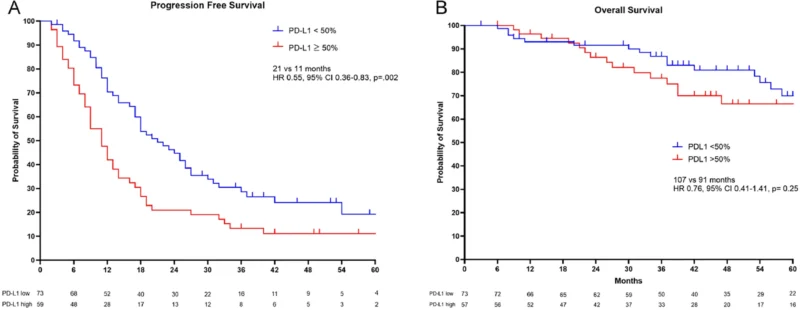
After a median follow-up of 48 months, high PD-L1 expression was associated with significantly shorter progression-free survival on first-line ALK TKI therapy.
After multivariable adjustment for ALK TKI type, brain metastases, tumor burden, and prior chemotherapy exposure, median PFS was 11 months in the PD-L1-high group versus 21 months in the PD-L1-low group. This corresponded to a hazard ratio of 2.29 (95% CI, 1.51–3.49; P≤.001).
The PFS difference was also seen in the subset of patients who received first-line alectinib. In this subgroup, patients with PD-L1 TPS ≥50% had shorter PFS compared with those with lower PD-L1 expression.
The survival curves shown in Figure 1 of the paper visually reinforce this pattern: the PD-L1-high curve drops earlier and more steeply for progression-free survival, while the overall survival curves are more similar.
Overall Survival Was Not Significantly Different
Despite the shorter PFS, high PD-L1 expression was not associated with a statistically significant overall survival difference.
Median overall survival was 91 months in the PD-L1-high group versus 107 months in the PD-L1-low group, with a hazard ratio of 1.16 (95% CI, 0.62–2.17).
The authors note that subsequent therapies may have influenced overall survival outcomes. Most patients who progressed later received additional ALK-directed treatment, including lorlatinib. In patients who specifically received second-line lorlatinib, there was no significant difference in time to next treatment between PD-L1-high and PD-L1-low groups.
This suggests that high PD-L1 expression may influence the durability of benefit from earlier-generation ALK TKIs, but later effective therapies may partially mitigate its impact on overall survival.
Initial Radiographic Response Was Similar
One of the most clinically interesting findings is that high PD-L1 expression did not appear to reduce the initial chance of radiographic response.
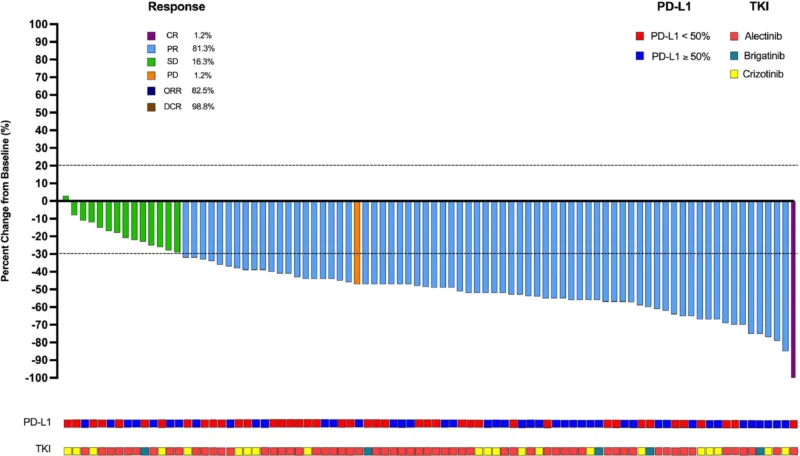
Among 86 patients with measurable disease, the overall objective response rate was 82.5%, and the disease control rate was 98.8%. In the PD-L1-low group, ORR was 83.3%, while in the PD-L1-high group, ORR was 81.8%. Disease control was also high in both groups.
The waterfall plot in Figure 2 shows that most patients had tumor shrinkage with first-line ALK TKI therapy, regardless of PD-L1 status.
This distinction matters. The data suggest that PD-L1-high ALK-rearranged tumors can still respond initially to ALK inhibition, but the response may be less durable.
CNS Progression Findings Need Careful Interpretation
The study also evaluated intracranial progression. Without adjustment for TKI type, CNS progression was more frequent in the PD-L1-low group compared with the PD-L1-high group. The authors suggest that this may reflect a “time-at-risk” effect rather than a true biological predisposition.
Patients with lower PD-L1 expression had longer systemic PFS, giving them more time to develop or document CNS progression while remaining on first-line therapy. When focusing on patients receiving alectinib or brigatinib, the low PD-L1 group still had a higher cumulative rate of intracranial progression, but intracranial PFS was longer in the low PD-L1 group.
This finding reinforces the complexity of interpreting CNS outcomes in ALK-positive NSCLC, especially when systemic disease control differs between groups.
PD-L1 Overexpression Did Not Directly Reduce ALK TKI Sensitivity
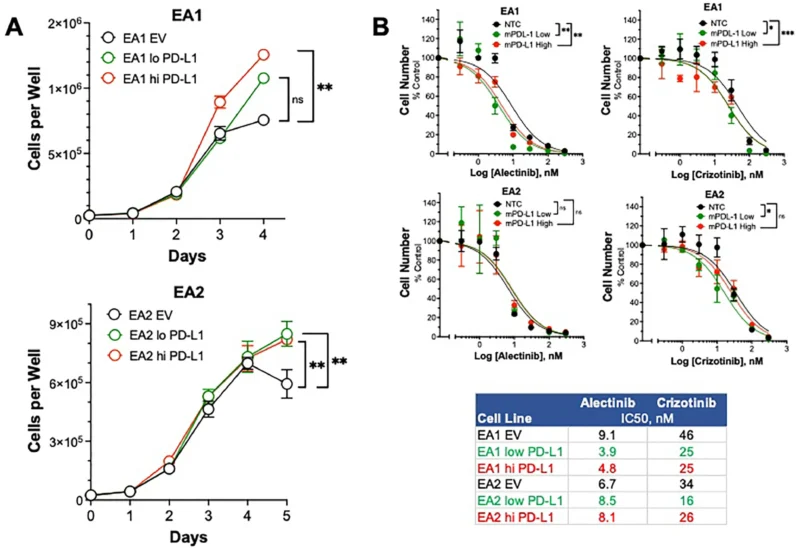
To explore mechanism, the investigators engineered murine EML4-ALK lung cancer cell lines to overexpress PD-L1. They then tested whether increased PD-L1 expression altered sensitivity to ALK TKIs such as alectinib and crizotinib.
In vitro, PD-L1 overexpression modestly increased baseline cell growth in some models, but it did not reduce sensitivity to alectinib or crizotinib. In some cases, PD-L1-overexpressing cells had lower IC50 values than empty-vector control cells.
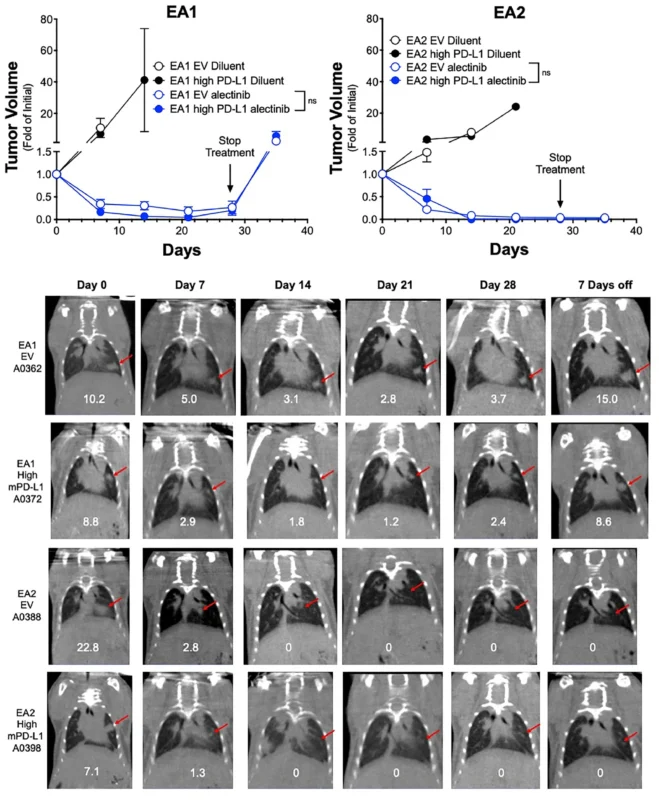
The in vivo results were similar. In immune-competent orthotopic mouse models, PD-L1-overexpressing EML4-ALK tumors responded to alectinib similarly to control tumors. Figure 4 shows equivalent tumor shrinkage and no significant difference in depth or durability of response between PD-L1-overexpressing tumors and control tumors.
These preclinical findings suggest that tumor-cell-intrinsic PD-L1 signaling is unlikely to directly explain shorter PFS in patients.
A Possible Role For The Tumor Microenvironment
Because direct PD-L1 overexpression did not reduce ALK TKI sensitivity, the authors explored whether high PD-L1 expression might instead act as a marker of an immunosuppressive tumor microenvironment.
In a subset of 19 pretreatment patient samples, the investigators quantified lymphocytes and polymorphonuclear neutrophils. They found that neutrophil content, but not lymphocyte content, was positively associated with PD-L1 expression.
This supports a hypothesis that high PD-L1 expression may reflect a myeloid-rich, immunosuppressive microenvironment, potentially involving polymorphonuclear neutrophils or myeloid-derived suppressor cells. Such a microenvironment could reduce the durability of ALK TKI response without changing the initial sensitivity of tumor cells to ALK inhibition.
The authors appropriately caution that this analysis was limited and should be expanded in future studies to include broader immune profiling, including macrophage subtypes and other myeloid populations.
Clinical Meaning
This study suggests that PD-L1 expression may have a different meaning in ALK-rearranged NSCLC than it does in immunotherapy-sensitive NSCLC.
In many advanced NSCLC settings, high PD-L1 expression is used as a biomarker for immune checkpoint inhibitor benefit. In ALK-positive NSCLC, however, high PD-L1 does not reliably predict immunotherapy response. Instead, this study suggests it may identify patients more likely to experience shorter PFS on first-line ALK TKIs.
The practical message is not that patients with high PD-L1 should avoid ALK TKIs. Initial response rates remained high, and ALK TKIs remain the standard first-line treatment in ALK-rearranged NSCLC. Rather, high PD-L1 may help identify a subgroup at higher risk for earlier progression, where closer monitoring, treatment sequencing, and the potential role of newer-generation ALK inhibitors may deserve further study.
Limitations
The study has several limitations. It was a single-center retrospective analysis, and larger external validation cohorts are needed. Some ALK rearrangements were detected by FISH rather than uniform next-generation sequencing, limiting the ability to fully assess fusion variants and co-occurring genomic alterations. The immune microenvironment analysis was also limited to a small subset of pretreatment samples.
In addition, post-progression biopsies were uncommon, so the relationship between baseline PD-L1 expression and later mechanisms of ALK TKI resistance remains unclear.
Key Takeaway
In this study of 130 TKI-naïve patients with ALK-rearranged NSCLC, high PD-L1 expression was associated with significantly shorter PFS on first-line ALK TKI therapy, with median PFS of 11 months versus 21 months for PD-L1-high versus PD-L1-low tumors. However, PD-L1 expression did not meaningfully affect initial radiographic response or overall survival.
Preclinical models showed that PD-L1 overexpression did not directly impair alectinib sensitivity, suggesting that the clinical association may be driven by tumor microenvironment factors rather than tumor-cell-intrinsic resistance.
These findings position high PD-L1 expression as a potential marker of reduced response durability in ALK-rearranged NSCLC and support further research into the immune and myeloid biology shaping outcomes with ALK-targeted therapy.
