
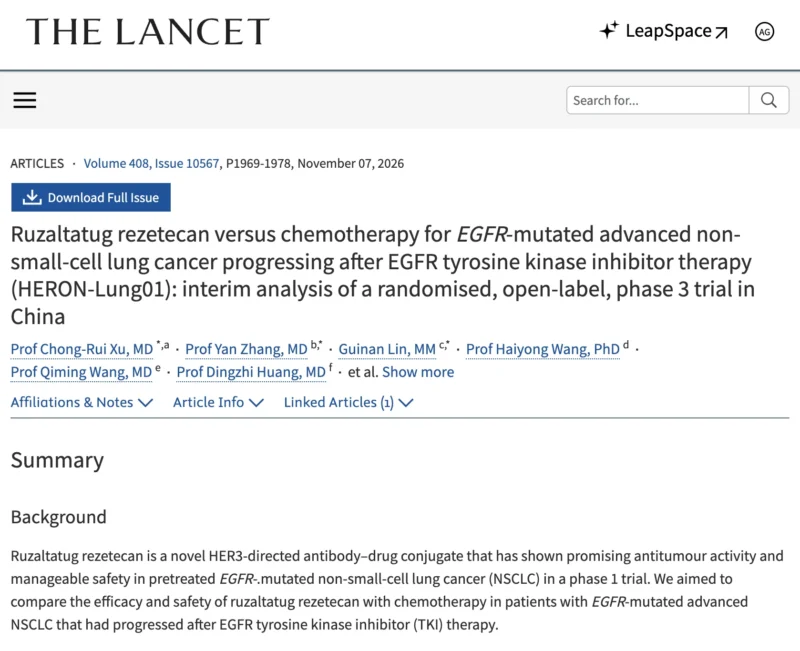
A phase III trial published in The Lancet has demonstrated that the HER3-directed antibody-drug conjugate (ADC) ruzaltatug rezetecan significantly improves progression-free survival compared with platinum-based chemotherapy in patients with EGFR-mutated advanced non-small-cell lung cancer (NSCLC) progressing after EGFR tyrosine kinase inhibitor (TKI) therapy. The HERON-Lung01 study reported a 53% relative reduction in the hazard of progression or death, providing important evidence for a new antibody-based treatment strategy in a population with persistent unmet clinical needs.
The randomized study, led by Chong-Rui Xu, Yan Zhang, Guinan Lin, and colleagues, was conducted across 62 centers in China and enrolled 498 patients with locally advanced or metastatic nonsquamous NSCLC harboring EGFR exon 19 deletions or L858R mutations.
At the prespecified interim analysis, median progression-free survival (PFS), assessed by blinded independent central review, reached 8.3 months with ruzaltatug rezetecan compared with 5.4 months with platinum–pemetrexed chemotherapy. The hazard ratio (HR) was 0.47 (95% CI 0.36–0.60; one-sided p<0.0001).
Results presented at ESMO Congress 2026 provided additional evidence of antitumor activity, with an objective response rate (ORR) of 60.0% compared with 34.3% for chemotherapy and a median duration of response of 8.5 versus 4.4 months.
Although these results support HER3-directed ADCs as an emerging therapeutic class in EGFR-mutated NSCLC, overall survival remains immature, and the optimal position of ruzaltatug rezetecan relative to other contemporary post-EGFR-TKI approaches requires further evaluation.
The Unmet Need After EGFR-TKI Progression
Targeted treatment has dramatically improved outcomes for patients with EGFR-mutated advanced NSCLC. Third-generation EGFR inhibitors, particularly osimertinib, have become foundational treatments for tumors harboring EGFR exon 19 deletions or exon 21 L858R mutations.
More recently, combination strategies have further expanded first-line and subsequent treatment options. Nevertheless, acquired resistance remains almost inevitable in patients with metastatic disease. Resistance mechanisms are heterogeneous and may include MET amplification, secondary EGFR alterations, activation of alternative signaling pathways, and histological transformation.
In a proportion of patients, no clearly actionable resistance mechanism is identified. The therapeutic challenge becomes particularly important when patients progress after third-generation EGFR-TKI treatment without a targetable resistance alteration.
Platinum–pemetrexed chemotherapy has historically been a standard subsequent option. However, the development of amivantamab-based combinations and newer ADCs is creating a more complex treatment landscape.
The phase III MARIPOSA-2 trial established a significant PFS benefit with amivantamab combined with carboplatin and pemetrexed after progression on osimertinib. At the same time, ADCs targeting HER3, TROP2, and other tumor-associated antigens are being investigated as alternatives to conventional cytotoxic therapy.
HERON-Lung01 directly addresses this evolving treatment setting by evaluating whether a HER3-directed ADC can improve outcomes compared with platinum-based chemotherapy.
Ruzaltatug Rezetecan: A New HER3-Directed ADC
Ruzaltatug rezetecan, also known as SHR-A2009, is an investigational ADC directed against human epidermal growth factor receptor 3 (HER3). The agent consists of a fully human HER3-targeting IgG1 monoclonal antibody linked through a cleavable peptide linker to rezetecan, an exatecan-derived topoisomerase I inhibitor payload.
Following binding to HER3 on the tumor-cell surface, the ADC undergoes internalization and intracellular processing. The released cytotoxic payload interferes with topoisomerase I activity, producing DNA damage and ultimately tumor-cell death.
This mechanism is particularly relevant in EGFR-mutated lung cancer because HER3 is frequently expressed in these tumors and may remain accessible as a drug-delivery target after resistance to EGFR inhibition develops.
Importantly, the therapeutic concept differs from directly blocking an acquired EGFR resistance pathway. The ADC uses HER3 as a route for intracellular delivery of a potent cytotoxic agent. Therefore, its potential activity is not necessarily dependent on reversing the specific molecular mechanism responsible for EGFR-TKI resistance.
Earlier phase I evidence demonstrated promising antitumor activity and manageable toxicity in previously treated EGFR-mutated NSCLC, providing the rationale for phase III evaluation. However, HER3 expression has not been established as a validated quantitative predictive biomarker for ruzaltatug rezetecan benefit.
The HERON-Lung01 population was selected primarily by EGFR mutation status and treatment history, rather than a prespecified HER3 expression cutoff.
HERON-Lung01: Study Design and Patient Population
HERON-Lung01 (NCT06671379) is an open-label, randomized phase III trial conducted at 62 centers in China. Eligible patients were aged 18–75 years and had locally advanced or metastatic nonsquamous NSCLC harboring EGFR exon 19 deletions or L858R mutations, with progression during or after EGFR-TKI treatment.
A total of 498 patients were randomly assigned in a 1:1 ratio. The investigational group received ruzaltatug rezetecan at 8.0 mg/kg intravenously every three weeks. The control group received pemetrexed at 500 mg/m² combined with carboplatin AUC 5 or cisplatin 75 mg/m² for four cycles, followed by maintenance pemetrexed.
Randomization was stratified according to brain metastasis status, EGFR mutation subtype, and prior first-line use of a third-generation EGFR-TKI. The primary endpoint was PFS assessed by blinded independent central review in the intention-to-treat population.
Secondary endpoints included objective response, duration of response, overall survival, and safety. Between November 29, 2024, and January 29, 2026, 250 patients were assigned to ruzaltatug rezetecan and 248 to chemotherapy.
Median age was approximately 60 years, and 55% of patients were women. The ESMO 2026 presentation indicated that virtually all patients had received a third-generation EGFR inhibitor previously, including approximately 78% who had received one as first-line treatment.
Baseline brain metastases were present in approximately 19% of patients. The cohort was predominantly composed of patients with stage IV adenocarcinoma, reflecting the molecular and histological population most frequently treated with EGFR-directed therapies.
Primary Endpoint: A Significant Progression-Free Survival Advantage
At the prespecified interim analysis, median follow-up was 7.7 months. The study met its primary endpoint. Median BICR-assessed PFS reached 8.3 months with ruzaltatug rezetecan versus 5.4 months with chemotherapy, corresponding to an HR of 0.47 (95% CI 0.36–0.60; one-sided p<0.0001).
The result represents a 53% relative reduction in the hazard of disease progression or death. The ESMO presentation also reported a marked separation in landmark PFS rates. At six months, estimated PFS was 59.8% with ruzaltatug rezetecan compared with 32.4% with chemotherapy.
At nine months, the corresponding rates were 46.3% and 16.7%. The PFS analysis recorded 108 events in the ADC group and 156 in the chemotherapy group. Investigator-assessed PFS showed a consistent advantage, with an HR of 0.46.
These findings support a substantial improvement in disease control compared with the conventional platinum–pemetrexed treatment strategy. However, the absolute difference in median PFS was 2.9 months, and the relatively short follow-up limits assessment of longer-term disease control.
The treatment effect should therefore be described through both the median difference and hazard ratio, rather than either statistic alone.
Objective Response and Duration of Response Support the PFS Findings
The PFS improvement was accompanied by a substantially higher response rate. According to the ESMO 2026 analysis, the BICR-assessed ORR reached 60.0% with ruzaltatug rezetecan compared with 34.3% with chemotherapy. This represented an absolute difference of 25.7 percentage points.
Disease control rates were 92.8% and 83.1%, respectively. Responses were also more durable with the HER3-directed ADC. Median duration of response reached 8.5 months compared with 4.4 months in the chemotherapy group. These findings strengthen the biological and clinical rationale for HER3-directed payload delivery following EGFR-TKI resistance.
The combination of higher response rates and prolonged response duration is particularly relevant for patients with symptomatic or progressive metastatic disease requiring effective tumor reduction. However, response activity alone does not establish superiority over other contemporary post-osimertinib treatment combinations. Direct randomized comparisons remain necessary.
PFS Benefit Across EGFR Mutation Subtypes
Exploratory analyses presented at ESMO 2026 suggested that the treatment benefit was maintained across the principal sensitizing EGFR mutation subtypes. Among patients with EGFR exon 19 deletions, the PFS HR was 0.48 (95% CI 0.35–0.66). For patients harboring L858R mutations, the HR was 0.41 (95% CI 0.27–0.62).
These findings suggest that ruzaltatug rezetecan activity is not limited to a single EGFR mutation subgroup. An important observation was the benefit among patients previously treated with first-line third-generation EGFR inhibitors.
In this subgroup, the HR was 0.50 (95% CI 0.38–0.66). This is particularly relevant because third-generation EGFR-TKI treatment represents a dominant contemporary approach. The consistency of treatment effect across these analyses supports the potential use of HER3-directed ADC treatment after modern EGFR-targeted therapy.
Nevertheless, the subgroup analyses were exploratory, and differences between individual hazard ratios do not establish statistically different treatment effects without formal interaction testing.
Brain Metastases: Encouraging but Inconclusive Evidence
Central nervous system involvement remains an important challenge in EGFR-mutated NSCLC. HERON-Lung01 included patients with baseline brain metastases, allowing exploratory evaluation of PFS according to intracranial disease status.
Among patients with brain metastases, the PFS HR favored ruzaltatug rezetecan at 0.61 (95% CI 0.36–1.02). In patients without brain metastases, the HR was 0.42 (95% CI 0.32–0.56). Although the direction of effect was favorable in both groups, the confidence interval in the brain-metastasis subgroup crossed 1.0.
Consequently, a statistically conclusive PFS benefit within that subgroup was not established. Furthermore, the reported subgroup analysis does not demonstrate intracranial response activity or CNS-specific PFS benefit.
This distinction is important when comparing HER3-directed ADCs with EGFR inhibitors and combination therapies that have prospectively evaluated CNS endpoints. Additional dedicated intracranial efficacy analyses will be needed to determine the role of ruzaltatug rezetecan in patients with active or progressive brain metastases.
Overall Survival Remains Immature
Although the interim analysis demonstrated a significant PFS improvement, overall survival remains an important unresolved endpoint. The ESMO 2026 presentation reported 29 deaths in the ruzaltatug rezetecan arm compared with 37 in the chemotherapy arm.
The preliminary OS HR was 0.70 (95% CI 0.43–1.14). The confidence interval crossed 1.0, and the data were not sufficiently mature to establish a statistically significant survival advantage.
Crossover from chemotherapy to ruzaltatug rezetecan was permitted after progression. Approximately 19.4% of patients assigned to chemotherapy crossed over to receive the investigational ADC, potentially influencing later OS comparisons.
These findings should therefore be interpreted cautiously. The observed PFS improvement is clinically important, but the study has not yet established that ruzaltatug rezetecan extends overall survival compared with platinum–pemetrexed chemotherapy. Longer follow-up remains essential.
Safety: Hematologic Toxicity and ILD Require Attention
The safety profile of ruzaltatug rezetecan was broadly manageable, although treatment-related adverse events were common. Grade 3 or higher treatment-related adverse events occurred in 40.7% of patients receiving ruzaltatug rezetecan compared with 38.9% receiving chemotherapy.
The most common severe toxicity was decreased neutrophil count, reported in 25.8% versus 19.2%. Grade 3 or higher decreases in white blood cell count occurred in 11.7% versus 12.1%, while severe anemia occurred in 6.0% versus 10.9%.
The differences indicate that the ADC does not eliminate the hematologic burden associated with cytotoxic treatment. Other common adverse events associated with ruzaltatug rezetecan included alopecia, nausea, reduced appetite, asthenia, and liver enzyme abnormalities.
Dose reductions due to treatment-related adverse events occurred in approximately 14.5% versus 10.0%. Permanent discontinuation due to treatment-related toxicity remained uncommon, occurring in approximately 1% of patients in each group.
One death of unknown cause in the ADC group was considered possibly treatment-related by the investigator. Interstitial lung disease (ILD) is an especially important safety consideration with topoisomerase I inhibitor-based ADCs.
At ESMO 2026, ILD was reported in six patients receiving ruzaltatug rezetecan, corresponding to 2.4%. Five events were grade 1–2 and one was grade 3. No ILD events were reported in the chemotherapy comparator group in that presentation.
Although the observed ILD frequency was relatively low, the short follow-up and limited cumulative treatment exposure must be considered. The data do not establish long-term pulmonary safety or justify direct toxicity comparisons with other ADCs across different trials.
Continued surveillance for pneumonitis, treatment-related cytopenias, and gastrointestinal adverse events will be important as clinical development progresses.
Positioning Ruzaltatug Rezetecan Among Emerging Post-EGFR-TKI Therapies
The positive HERON-Lung01 findings arrive during a period of rapid expansion in the treatment of EGFR-mutated NSCLC after targeted-therapy progression. Amivantamab plus platinum–pemetrexed is an established option following progression on osimertinib, supported by MARIPOSA-2 and incorporated into contemporary treatment guidance.
At the same time, new ADC-based approaches are creating potential alternatives. The phase III PANKU-Lung01 trial evaluated the EGFR/HER3 bispecific ADC izalontamab brengitecan after progression on third-generation EGFR inhibitors and also reported a significant PFS improvement compared with chemotherapy.
Other studies are investigating TROP2-directed ADCs, combinations of ADCs with EGFR inhibitors, and targeted approaches for specific resistance mechanisms. However, HERON-Lung01 did not compare ruzaltatug rezetecan with amivantamab-based treatment, izalontamab brengitecan, or another ADC.
Its demonstrated benefit applies specifically to comparison with platinum–pemetrexed chemotherapy in the studied population. Cross-trial comparison is particularly problematic because eligibility criteria, prior treatment exposure, baseline disease characteristics, and endpoint assessments differ.
An additional consideration is that the trial was conducted entirely in China and enrolled patients no older than 75 years. Its findings therefore require further evaluation in broader international populations and patients with greater comorbidity burdens.
Furthermore, treatment selection after EGFR-TKI progression increasingly depends on identifying actionable resistance mechanisms. Patients with acquired MET amplification, for example, may have opportunities for molecularly targeted combination treatment.
A HER3-directed ADC offers a potentially broader treatment approach, but it should not replace appropriate molecular reassessment at progression. The clinical position of ruzaltatug rezetecan will ultimately depend on additional survival data, regulatory decisions, treatment access, and comparative evidence.
Future Development: Moving HER3-Directed ADCs Into Combination Treatment
The findings also support investigation of ruzaltatug rezetecan in earlier treatment settings and combination strategies. The investigators reported ongoing clinical development of the ADC in combination with other agents, including EGFR-directed therapies.
A phase III study evaluating ruzaltatug rezetecan plus aumolertinib as first-line treatment for EGFR-mutated advanced NSCLC is underway. The biological rationale for combining an EGFR inhibitor with a HER3-directed ADC is compelling.
EGFR inhibition may suppress oncogenic signaling, while HER3-directed payload delivery provides an additional mechanism for eliminating tumor cells. However, combination treatment could also produce cumulative hematologic, gastrointestinal, and pulmonary toxicity.
Prospective randomized evidence will therefore be required to determine whether the combination offers meaningful advantages over existing first-line approaches. An important translational priority is identifying biomarkers that predict ADC sensitivity and resistance.
Although HER3 expression provides the molecular basis for drug targeting, the optimal role of quantitative HER3 assessment, antigen heterogeneity, payload sensitivity, and acquired resistance mechanisms remains unclear.
Future research should also investigate whether prior topoisomerase I inhibitor ADC exposure influences subsequent treatment efficacy.
OncoDaily Takeaway
HERON-Lung01 provides compelling phase III evidence supporting HER3-directed antibody-drug conjugate treatment after EGFR-TKI progression in EGFR-mutated advanced nonsquamous NSCLC. Ruzaltatug rezetecan significantly improved median PFS to 8.3 months compared with 5.4 months with platinum–pemetrexed chemotherapy, corresponding to an HR of 0.47.
The treatment also achieved a higher objective response rate of 60.0% versus 34.3%, with longer response duration. These results demonstrate substantial antitumor activity and support further development of HER3-directed ADC therapy in this setting.
However, the findings must be interpreted alongside important uncertainties. Overall survival remains immature, the brain-metastasis subgroup did not establish a definitive benefit independently, and long-term toxicity requires continued assessment. The treatment has not been directly compared with modern amivantamab-based strategies or other emerging ADCs.
The central clinical implication is that HER3 is becoming an increasingly important therapeutic delivery target in EGFR-mutated lung cancer, offering a potential way to treat resistant disease without requiring identification of a specific targetable resistance mutation.
HERON-Lung01 strengthens the evidence for moving beyond conventional chemotherapy after EGFR-TKI progression, while highlighting the next priority for clinical research: defining how HER3-directed ADCs should be sequenced and combined with existing targeted therapies to maximize survival benefit.
Sources
- Xu C-R, Zhang Y, Lin G, et al. Ruzaltatug Rezetecan Versus Chemotherapy for EGFR-Mutated Advanced Non-Small-Cell Lung Cancer Progressing After EGFR Tyrosine Kinase Inhibitor Therapy (HERON-Lung01): Interim Analysis of a Randomised, Open-Label, Phase 3 Trial in China. The Lancet. Published October 26, 2026. DOI: 10.1016/S0140-6736(26)01899-4