The molecular definition of HER2-mutant non–small cell lung cancer is becoming more precise, and the commonly used term “HER2 exon 20 insertions” may no longer adequately describe the full spectrum of clinically relevant HER2 alterations.
An editorial published in the Journal of Thoracic Oncology argues that HER2-mutant NSCLC should increasingly be classified according to the location and biological behavior of the mutation, rather than grouping all tumors under a single HER2-mutant category.
The authors highlight three major molecular regions: the tyrosine kinase domain, the extracellular domain, and the transmembrane or juxtamembrane domain. These alterations appear to differ in patient characteristics, tumor biology, response to targeted therapies, and potentially sensitivity to chemoimmunotherapy.
The central message is straightforward: mutation location matters, and modern next-generation sequencing should evaluate the entire HER2 gene rather than focusing exclusively on exon 20 insertions (Li et al., 2026).
How Has the Definition of HER2-Mutant NSCLC Changed?
Activating HER2 mutations in lung cancer were first described in 2004, and many of the earliest recognized alterations were insertions in exon 20. This historical association led “HER2 mutation” and “HER2 exon 20 insertion” to become closely linked in clinical terminology.
However, subsequent molecular profiling has identified activating alterations across a much wider portion of the ERBB2 gene.
The editorial divides clinically relevant mutations into three broad regions. Extracellular domain mutations occur approximately within codons 1–647, transmembrane and juxtamembrane mutations within codons 648–713, and tyrosine kinase domain mutations within codons 714–987.
The tyrosine kinase domain spans exons 18–24, meaning that even within the kinase domain, clinically relevant HER2 alterations extend beyond exon 20.
The authors therefore argue that describing HER2-mutant NSCLC primarily as an “exon 20 insertion” disease is increasingly inconsistent with current molecular knowledge (Li et al., 2026).
How Common Are the Different HER2 Mutation Domains?
The editorial discusses a study by Stockhammer and colleagues that evaluated HER2-mutant NSCLC in two independent populations: 483 patients in the GENIE cohort and 286 patients in the FH cohort.
Tyrosine kinase domain mutations were the most common, accounting for 75% and 71% of HER2 alterations in the two cohorts.
Extracellular domain mutations represented 18% and 24%, while transmembrane or juxtamembrane domain mutations accounted for approximately 7% and 5%, respectively.
These numbers show why kinase-domain disease dominates clinical trials, but they also demonstrate that a substantial proportion of HER2-mutant cancers fall outside the conventional exon 20 framework.
The editorial argues that these non-TKD alterations should not be treated simply as rare variants of the same biological disease.
Why Does Mutation Location Matter Biologically?
Tyrosine kinase domain mutations affect the catalytic region of HER2 and can directly produce abnormal activation of the kinase.
This creates a clear therapeutic rationale for highly selective HER2 tyrosine kinase inhibitors capable of suppressing the altered kinase.
Extracellular and transmembrane-domain mutations behave differently. Rather than directly changing kinase activity, these alterations can modify protein structure and promote abnormal dimerization with other members of the HER receptor family, including EGFR and HER3.
These different mechanisms of activation could explain why a drug that performs particularly well against a kinase-domain mutation might have less activity against an extracellular-domain alteration.
The editorial therefore challenges a “one-size-fits-all” approach to HER2-mutant NSCLC (Li et al., 2026).
Is the Classic HER2-Mutant NSCLC Phenotype Really Universal?
HER2-mutant NSCLC has traditionally been associated with younger patients, women, nonsmokers, and adenocarcinoma histology.
The data discussed by Li and colleagues suggest that this phenotype is largely driven by patients with tyrosine kinase domain mutations, particularly the classic Y772_A775dup alteration.
Extracellular-domain mutations showed a very different clinical profile.
According to the editorial, patients with ECD mutations were more often male and older, had a higher frequency of squamous cell carcinoma, and almost universally had a smoking history in the analyzed cohort.
The authors describe this as a distinct “smoker’s phenotype.”
This difference further supports molecular separation of HER2-mutant disease according to mutation location rather than assuming that all HER2 alterations share the same clinical characteristics.
What Is Different About HER2 S310F?
One extracellular-domain alteration receives particular attention: HER2 S310F.
Stockhammer and colleagues reported that S310F represented approximately 42% of extracellular-domain HER2 mutations in NSCLC.
The mutation can behave as an oncogenic driver and has demonstrated sensitivity to some HER2-directed inhibitors. However, sensitivity is not uniform across HER2-targeted agents.
The editorial notes experimental evidence of sensitivity to neratinib while also describing resistance to the HER2 monoclonal antibody pertuzumab.
This illustrates why the simple presence of a HER2 mutation is not enough to predict response. The specific alteration and its structural location can influence how HER2 is activated and how effectively an individual drug can inhibit it (Li et al., 2026).
Why Is the Relationship Between HER2 S310F and EGFR Important?
Another important observation is the apparent relationship between extracellular-domain HER2 mutations and EGFR alterations.
HER2 S310F/Y mutations showed strong co-occurrence with EGFR L858R in the study discussed by the editorial.
These co-mutated tumors were also characterized by higher tumor mutation burden, more frequent TP53 and RB1 co-alterations, and primary resistance to EGFR tyrosine kinase inhibitors.
The authors suggest that this could represent a biologically distinct and potentially more aggressive molecular subgroup.
However, the editorial does not establish a standard treatment strategy for these tumors. Simultaneously targeting EGFR and HER2 or using a non-TKI approach is presented as a biological and therapeutic question requiring further investigation, rather than an established clinical recommendation.
How Have Earlier HER2-Targeted Treatments Performed?
Earlier approaches to HER2-mutant NSCLC included nonselective HER-family TKIs such as afatinib, pyrotinib, and poziotinib, as well as HER2-directed antibodies and antibody–drug conjugates.
According to the editorial, these earlier strategies generally produced modest activity or substantial toxicity, particularly because nonselective kinase inhibitors also inhibit EGFR.
Pan-HER TKIs historically achieved objective response rates of up to approximately 30%, with median progression-free survival reaching up to 6.9 months in reported studies.
The treatment landscape has changed with the emergence of more selective HER2 TKIs and more active HER2-directed antibody–drug conjugates.
The editorial identifies zongertinib and sevabertinib as recently approved TKIs for HER2 tyrosine kinase domain mutations, while trastuzumab deruxtecan and trastuzumab rezetecan represent HER2-directed ADC approaches used for broader HER2 sensitizing mutations in their respective approved settings (Li et al., 2026).
Do HER2 TKIs Work Equally Across Mutation Domains?
Available evidence suggests they do not.
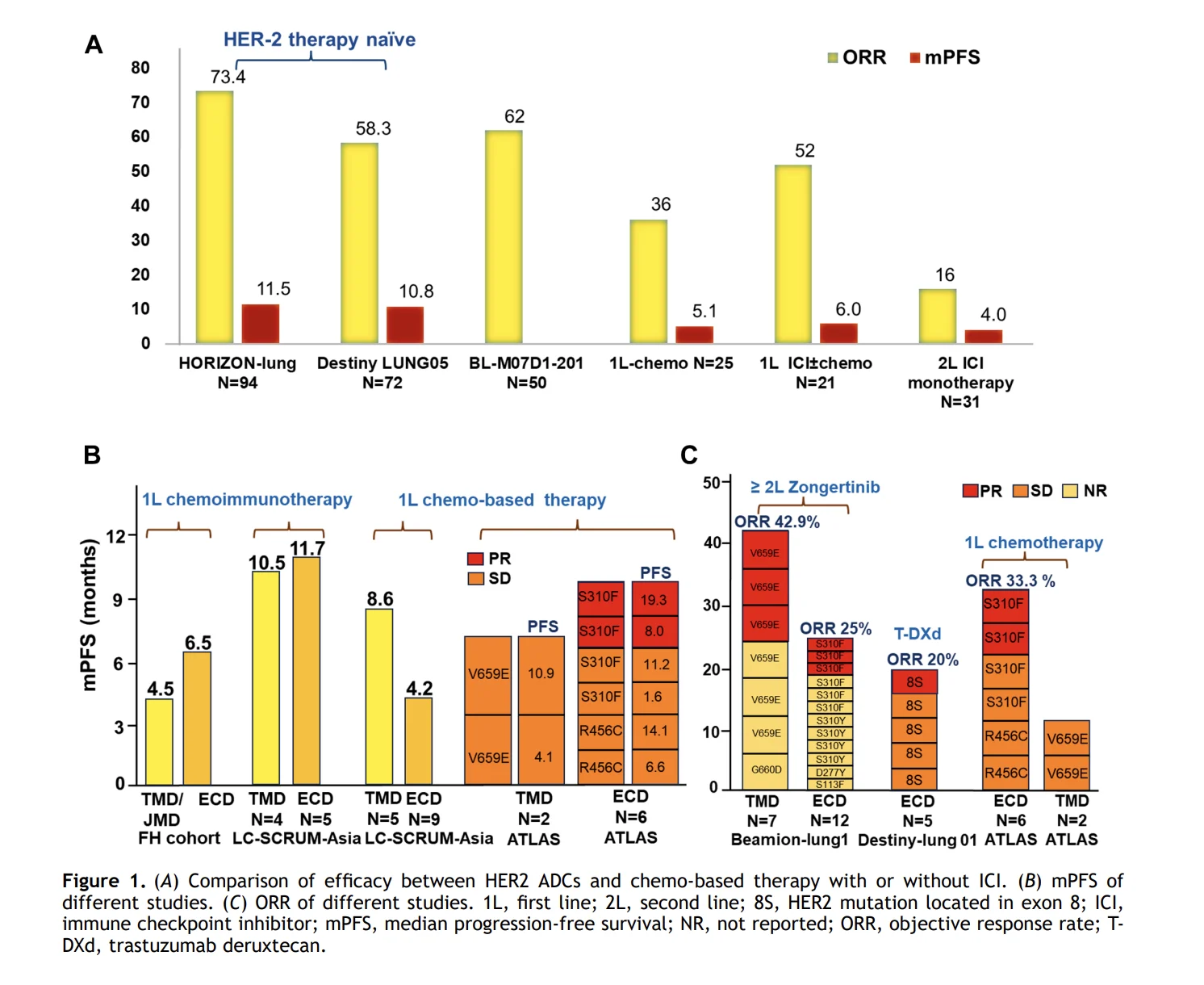
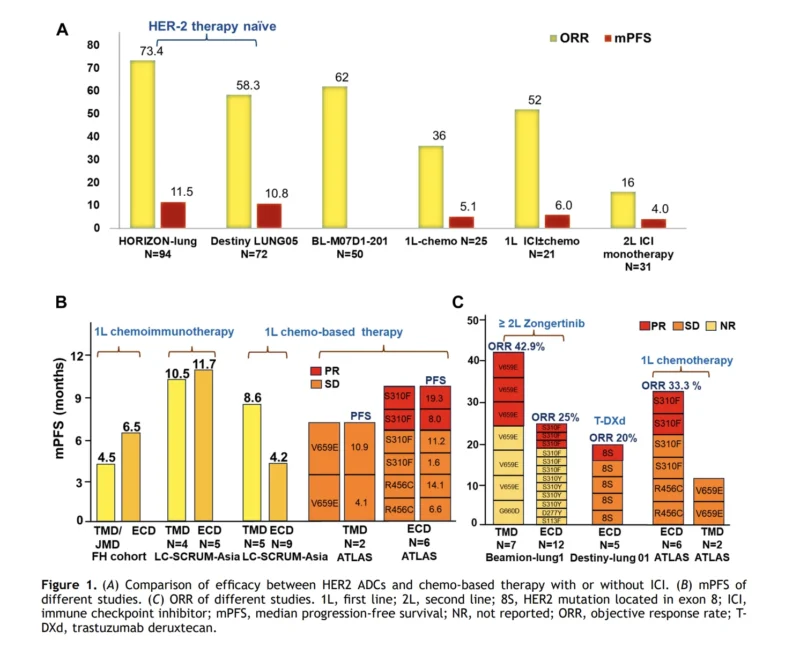
The editorial highlights data from Beamion-LUNG 1 showing a major difference in response according to mutation location.
The reported objective response rate with zongertinib was approximately 84% among patients with tyrosine kinase domain mutations, whereas activity in patients with extracellular or transmembrane-domain mutations was substantially lower, at approximately 30%.
The figure on page 2 of the editorial illustrates this separation and compares treatment activity across different HER2 domains and therapeutic approaches.
These findings support the argument that HER2 mutation location could have predictive relevance rather than serving only as a molecular description.
However, the available non-TKD datasets remain small. The authors emphasize that larger prospective analyses are needed before definitive domain-specific sequencing strategies can be established.
Could Extracellular-Domain Mutations Be More Sensitive to Immunotherapy?
Historically, HER2-mutant NSCLC has often been described as an immunologically “cold” disease, characterized by low PD-L1 expression, relatively low tumor mutation burden, and limited benefit from immune checkpoint inhibition.
The editorial argues that this characterization might again be driven largely by the dominant TKD population.
Patients with extracellular-domain alterations can display different biological characteristics, including smoking-associated features and higher tumor mutation burden.
In retrospective data discussed by the authors, patients with ECD mutations appeared to experience longer progression-free survival with chemoimmunotherapy than patients with TKD or TMD/JMD mutations.
The authors therefore raise the possibility that extracellular-domain disease could retain greater sensitivity to chemotherapy plus immunotherapy.
This remains hypothesis-generating. The editorial specifically cautions that the available evidence is retrospective and requires prospective confirmation (Li et al., 2026).
What About Transmembrane-Domain HER2 Mutations?
Transmembrane-domain alterations represent a small but biologically interesting subgroup.
Mutations such as V659 and G660 can increase HER2 homo- and heterodimerization and enhance interactions with EGFR and HER3.
Previous reports have demonstrated activity of afatinib against selected transmembrane-domain alterations, suggesting that these mutations can retain sensitivity to HER-family kinase inhibition.
However, the editorial authors question whether TKI responses in this group will be as durable as those observed with TKD disease.
They suggest that HER2-directed antibody–drug conjugates could have an important role, while emphasizing that current drug labels do not necessarily treat all HER2 mutation domains identically.
This regulatory distinction is one reason why precise molecular terminology has become increasingly important.
Should HER2 TKIs Be Restricted to Tyrosine Kinase Domain Mutations?
Current approved indications discussed by the editorial distinguish between HER2 TKIs directed toward TKD-mutated disease and HER2 antibody–drug conjugates with broader language around HER2 sensitizing mutations.
Yet emerging evidence indicates that selective HER2 TKIs can have activity outside the kinase domain.
The authors therefore question whether future HER2 TKI indications should remain restricted to TKD mutations.
The answer is not yet established.
The considerably higher response rates currently observed in TKD-mutated disease support their existing role in that population. At the same time, measurable activity in extracellular and transmembrane alterations provides a rationale for dedicated trials rather than excluding these populations from further development.
Why Do the Authors Want to Retire “HER2 Exon 20 Insertions”?
The problem is primarily one of precision.
Most early HER2 alterations identified in NSCLC were exon 20 insertions, and many sensitizing HER2 mutations still fall into this category. As a result, “HER2 mutation,” “HER2 sensitizing mutation,” and “HER2 exon 20 insertion” are sometimes used as though they describe the same molecular population.
They do not.
Some activating kinase-domain mutations occur outside exon 20. Other clinically relevant sensitizing mutations occur outside the kinase domain entirely.
The editorial gives examples including L755P/S and V659 alterations, which would be obscured by an exon 20-focused classification.
As precision oncology becomes increasingly dependent on matching individual genomic variants to specific treatments, the authors argue that imprecise terminology risks becoming clinically misleading (Li et al., 2026).
Why Should NGS Cover the Entire HER2 Gene?
The practical conclusion of the editorial is that next-generation sequencing should identify the specific HER2 alteration and its molecular location.
Testing strategies focused only on exon 20 could miss potentially actionable alterations in other parts of the gene.
Whole-gene coverage also allows clinicians and researchers to distinguish kinase-domain disease from extracellular and transmembrane alterations, which could become increasingly important as treatment options become mutation specific.
The authors summarize this principle clearly: before selecting treatment, the location of the mutation must first be established.
For precision oncology, HER2-positive molecular reporting therefore increasingly needs to answer not only whether ERBB2 is mutated, but where and how it is mutated (Li et al., 2026).
Which Trials Could Clarify the Treatment Strategy?
Several ongoing first-line studies are expected to provide additional evidence regarding the optimal treatment approach for HER2-mutant NSCLC.
The editorial highlights Beamion LUNG-2, SOHO-02, DESTINY-Lung04, and HORIZON-Lung2 as particularly important studies.
Beyond their overall results, domain-specific subgroup analyses could be critical.
If response and survival continue to differ substantially between TKD, ECD, and TMD/JMD alterations, future treatment algorithms may need to move from the broad category of “HER2-mutant NSCLC” toward mutation-specific therapeutic pathways.
The Bottom Line
HER2-mutant NSCLC is increasingly understood as a molecularly heterogeneous group rather than a single disease entity.
Most HER2 mutations occur within the tyrosine kinase domain, but substantial subsets involve the extracellular and transmembrane or juxtamembrane domains. These groups appear to differ in clinical phenotype, underlying biology, and treatment sensitivity.
In the cohorts discussed in the editorial, TKD mutations represented 71%–75%, ECD mutations 18%–24%, and TMD/JMD mutations approximately 5%–7%.
Emerging selective HER2 TKIs demonstrate particularly strong activity in TKD-mutated disease, while ECD and TMD alterations appear to have different therapeutic behavior. HER2 S310F also illustrates the complexity of co-occurring EGFR alterations and mutation-specific drug sensitivity.
The authors therefore argue that the traditional term “HER2 exon 20 insertions” should no longer be used as a substitute for the broader and biologically diverse category of HER2 sensitizing mutations.
The future of HER2-directed precision oncology in NSCLC will likely depend not simply on identifying an ERBB2 mutation, but on defining its exact location and molecular behavior.
References
- Li X, Qi K, Ou SHI, Hu Y. Exploring the continuum of HER2 TKD mutations and HER2 “sensitizing mutations” in NSCLC and retiring the term “HER2 exon 20 insertions.” Journal of Thoracic Oncology. 2026;21(8):103943. doi:10.1016/j.jtho.2026.103943.
- Stockhammer P, El Zarif T, Schillo JL, et al. ERBB2-activating mutations and co-occurring genomic alterations contribute to disease heterogeneity in patients with ERBB2-mutant lung cancer. Journal of Thoracic Oncology. 2026;21:103708.
- Heymach JV, Ruiter G, Ahn MJ, et al. Zongertinib in previously treated HER2-mutant non-small-cell lung cancer. New England Journal of Medicine. 2025;392:2321–2333.
- Le X, Kim TM, Loong HH, et al. Sevabertinib in advanced HER2-mutant non-small-cell lung cancer. New England Journal of Medicine. 2025;393:1819–1832.
- Li BT, Smit EF, Goto Y, et al. Trastuzumab deruxtecan in HER2-mutant non-small-cell lung cancer. New England Journal of Medicine. 2022;386:241–251.