
Uncommon EGFR mutations remain one of the more difficult areas of precision treatment in non-small-cell lung cancer (NSCLC). While classical EGFR exon 19 deletions and L858R mutations have well-established treatment pathways, patients with structurally distinct P-loop and αC-helix compressing (PACC) mutations have considerably less prospective evidence to guide first-line therapy.
A new translational and clinical analysis published in Cancer Cell suggests that firmonertinib, a brain-penetrant, mutant-selective third-generation EGFR tyrosine kinase inhibitor (TKI), could offer a targeted strategy specifically suited to this molecular subgroup.
In the phase Ib FURTHER trial, first-line firmonertinib produced a confirmed objective response rate of 68% at 240 mg once daily, with median progression-free survival reaching 16.0 months. The lower 160-mg dose produced an ORR of 43% and median PFS of 11.1 months.
Importantly, activity extended beyond extracranial disease: among patients with baseline CNS metastases, intracranial ORR reached 47%, including a high proportion of complete intracranial responses.
The study is particularly notable because it connects structural biology, preclinical modeling, clinical efficacy and ctDNA dynamics to explain why firmonertinib may be particularly active against PACC-mutated EGFR.
What Are EGFR PACC Mutations?
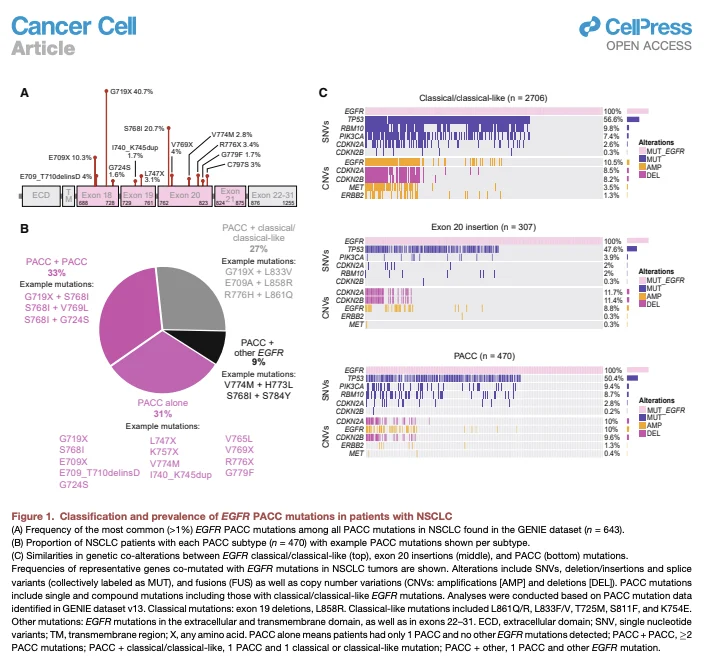
EGFR-mutated NSCLC is molecularly heterogeneous. Rather than classifying mutations solely according to exon number, structural analyses have proposed four broad groups, classical or classical-like mutations, T790M-like mutations, exon 20 loop insertions, and P-loop and αC-helix compressing mutations, or PACC mutations.
PACC mutations alter the structural configuration of the EGFR kinase domain, particularly around the ATP-binding pocket, which can change susceptibility to different EGFR TKIs Examples include G719X, S768I, E709X, G724S, V769X, V774M and R776X, among others.
In the AACR Project GENIE dataset analyzed by the investigators, 643 PACC alterations were identified among 470 patients, corresponding to approximately 2.4% of all 19,208 NSCLC cases in the database. Within the PACC group, the most frequent alterations were:
- G719X — 40.7%
- S768I — 20.7%
- E709X — 10.3%.
An additional challenge is that PACC mutations often occur as part of a compound EGFR genotype. Only 31% of patients in the GENIE analysis had a single PACC mutation without another EGFR alteration. The remaining 69% had compound EGFR mutations, including PACC + PACC or PACC combined with classical or classical-like alterations.
This molecular heterogeneity has made therapeutic evidence difficult to generate and helps explain why uncommon EGFR mutations cannot necessarily be treated as a single biological category.
Current Treatment Options Remain Imperfect
Current guidelines have generally supported EGFR TKIs such as osimertinib or afatinib for selected uncommon mutations including G719X and S768I. However, prospective evidence is much less robust than for classical EGFR-mutated disease, and there is no clearly established strategy for many of the less common PACC variants.
Previous prospective studies have demonstrated activity. The UNICORN study of first-line osimertinib in uncommon EGFR-mutated NSCLC reported an ORR of approximately 55% and median PFS of 9.4 months.
The ACHILLES study of first-line afatinib reported an ORR of approximately 62% and median PFS of 10.6 months, although gastrointestinal toxicity, particularly severe diarrhea, remained an important consideration.
These data establish that uncommon EGFR mutations remain targetable, but they also leave considerable room for improvement in duration of disease control and tolerability. Firmonertinib was developed with structural characteristics that may be particularly relevant to PACC-mutant EGFR.
Why Firmonertinib May Be Different
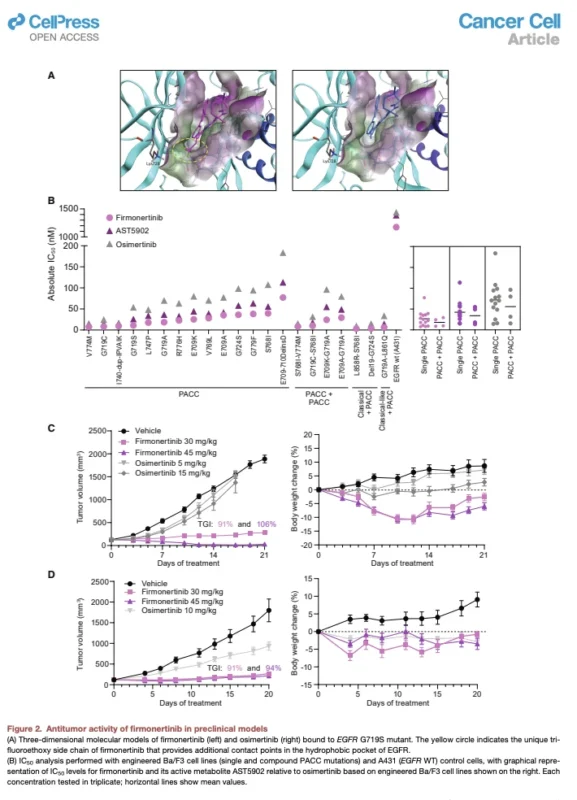
Firmonertinib, also known as furmonertinib, is a third-generation irreversible EGFR TKI with activity against mutant EGFR and CNS penetration. The molecule contains a unique trifluoroethoxy side chain that appears particularly important for binding PACC-mutated EGFR.
Structural modeling showed that firmonertinib covalently binds EGFR through cysteine 797, similarly to other third-generation TKIs. However, its trifluoroethoxy group occupies a partially hydrophobic pocket formed by residues including leucine 792 and proline 794.
This creates additional interactions with the kinase domain of PACC-mutated EGFR that are not present to the same extent with osimertinib. That structural difference translated into greater potency in laboratory models.
Across engineered cell lines carrying single and compound PACC mutations, firmonertinib and its active metabolite AST5902 showed lower inhibitory concentrations than osimertinib. The advantage was seen across both single PACC mutations and compound PACC genotypes.
Strong Preclinical Tumor Suppression
The activity was also reproduced in animal models. In a G719A-mutated xenograft model, firmonertinib produced tumor-growth inhibition of approximately 91%–106%, depending on dose. In a patient-derived xenograft carrying compound G719A + S768I mutations, tumor-growth inhibition reached approximately 91%–94%.
The higher preclinical dose approximated exposure achieved with 240 mg once daily in humans. Together, these data provided a mechanistic rationale for testing high-dose firmonertinib specifically in patients with EGFR PACC-mutant NSCLC.
FURTHER Tested Two Firmonertinib Doses
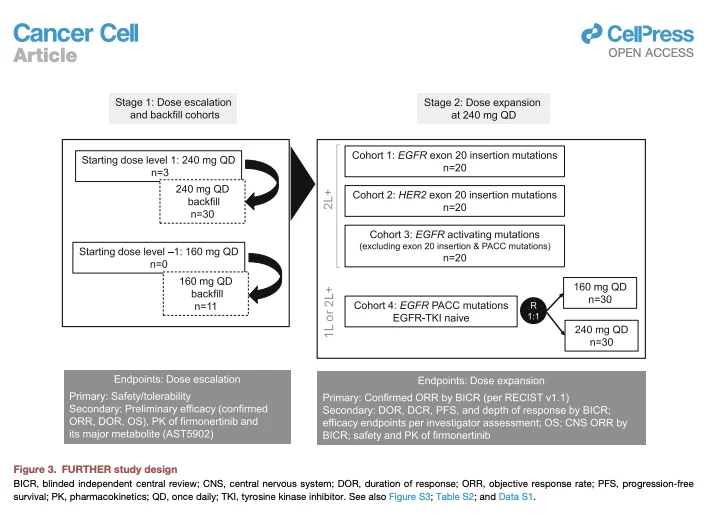
The FURTHER study, also known as FURMO-002, is a global phase Ib dose-escalation and expansion trial conducted across 40 sites in 10 countries. The program enrolled patients with several uncommon EGFR and HER2 mutation groups.
The PACC-specific expansion cohort included patients with locally advanced or metastatic NSCLC carrying single or compound EGFR PACC mutations. Importantly, patients entering the PACC cohort could not have received a previous EGFR TKI.
Patients with asymptomatic brain metastases, including lesions that had not previously received radiotherapy, were eligible. Patients were randomized to:
- firmonertinib 160 mg once daily
or
- firmonertinib 240 mg once daily.
Treatment continued until disease progression, intolerable toxicity or death. The primary clinical efficacy endpoint was confirmed ORR according to blinded independent central review. Median follow-up in the PACC cohort was 16.5 months.
The Population Reflected Typical EGFR-Mutant Clinical Features
Across the PACC cohort, approximately two-thirds of patients were women, around 72% were Asian and roughly 72% had never smoked. All patients had ECOG performance status 0–1. About 53% had compound PACC mutations, while 47% had single PACC alterations.
Approximately 77% carried the more commonly recognized PACC alterations G719X and/or S768I. One-third had a history or presence of CNS metastases. Around 75% had received no previous systemic therapy for advanced disease, allowing the study to provide meaningful first-line efficacy data.
Higher Activity Was Seen With 240 mg
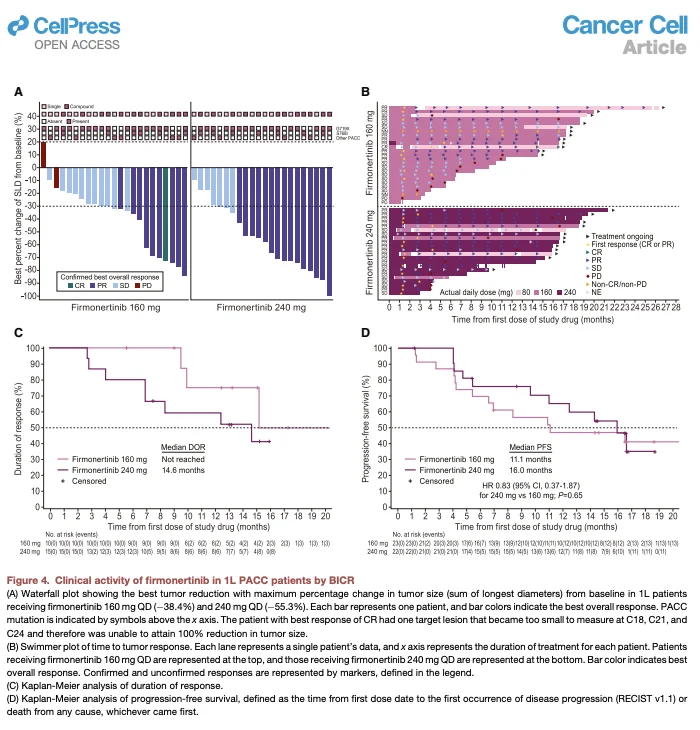
Among patients receiving firmonertinib as first-line treatment, confirmed ORR was:
- 43% with 160 mg once daily
versus
- 68% with 240 mg once daily
Tumor shrinkage also appeared deeper at the higher dose. Mean maximum tumor reduction from baseline was approximately:
- 38.4% with 160 mg
versus
- 55.3% with 240 mg
Importantly, responses were observed across several PACC molecular configurations. Activity was seen in frequent mutations such as G719X and S768I, less common alterations including E709X and V774M, and both single and compound PACC genotypes.
This breadth is clinically relevant because uncommon EGFR-mutated NSCLC frequently contains compound mutations that may respond differently from isolated alterations.
Median PFS Reached 16 Months at 240 mg
The duration of disease control was also encouraging.
Median PFS was:
- 11.1 months with firmonertinib 160 mg
versus
- 16.0 months with firmonertinib 240 mg
Median duration of response had not been reached with 160 mg at the time of analysis and was 14.6 months with 240 mg. Many responses were already evident at the first scheduled tumor assessment.
The trial was not powered to statistically compare the two doses, and the PFS hazard ratio had a wide confidence interval. Therefore, the numerical difference should not be interpreted as definitive proof of superiority. Nevertheless, the combination of higher ORR, deeper tumor shrinkage and longer median PFS supported selection of 240 mg once daily for further development.
Compound PACC Mutations May Be Particularly Sensitive
An interesting signal emerged when investigators examined single versus compound PACC mutations.
At 240 mg, first-line ORR was numerically:
- 75% in compound PACC mutations
versus
- 64% in single PACC mutations.
At 160 mg, the corresponding rates were approximately 60% and 25%. Patient numbers were small, so these findings are exploratory. However, they are biologically intriguing because compound PACC mutations are common and have sometimes been considered more difficult to treat.
Rather than being uniformly resistant, some compound mutations may retain, or potentially even demonstrate enhanced, sensitivity to a structurally optimized TKI.
Firmonertinib Demonstrated CNS Activity
CNS involvement is a major clinical issue in EGFR-mutated NSCLC, making intracranial activity particularly important for any new TKI. Seventeen patients in the PACC cohort had detectable asymptomatic CNS disease at baseline. The intracranial ORR by blinded independent review was:
- 47% with responses observed in 8 of 17 patients
Notably, 7 of the 17 patients achieved intracranial complete responses, corresponding to approximately 41%.
Responses were also seen in CNS lesions that had not previously received radiation. Among the 14 patients with baseline CNS disease receiving first-line firmonertinib, median PFS was approximately 10.9 months overall, with a numerical difference of 8.4 months at 160 mg and 14.2 months at 240 mg.
These data support the known brain-penetrant properties of firmonertinib and are particularly relevant because CNS control is one of the key requirements of contemporary first-line EGFR-targeted therapy.
ctDNA Clearance May Identify Deep Responders
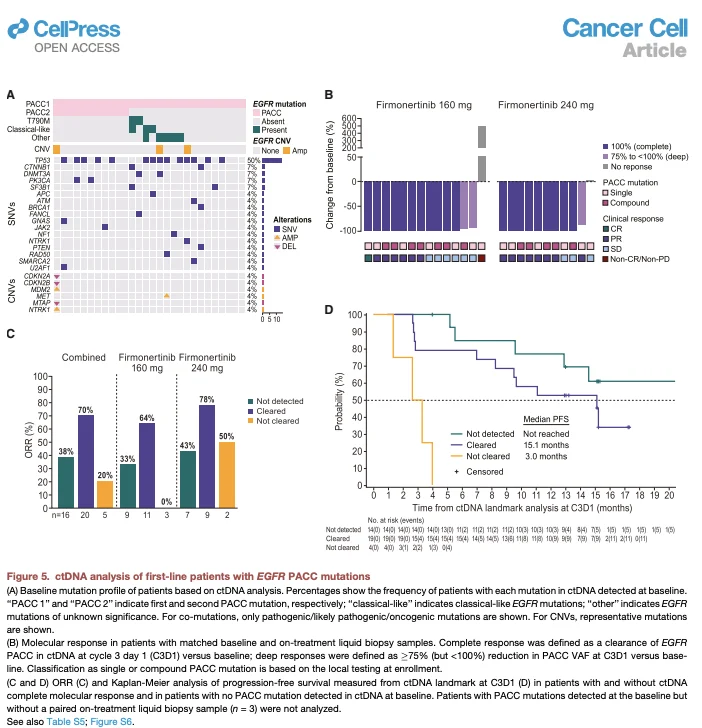
The study also incorporated longitudinal circulating tumor DNA analysis. Among first-line patients with available plasma samples, 28 had detectable EGFR PACC mutations at baseline. Twenty-five had evaluable paired plasma samples at cycle 3 day 1, approximately 6 weeks after treatment initiation.
Of these patients:
- 80% achieved complete molecular response, defined as clearance of detectable EGFR PACC ctDNA
The association with clinical outcome was striking. Patients who achieved molecular clearance had a confirmed ORR of:
- 70%
compared with:
- 20%
among patients whose PACC mutation remained detectable. Median PFS measured from the 6-week landmark was:
- 15.1 months in patients with ctDNA clearance
versus
- 3.0 months in those without clearance
These findings suggest that early molecular response could potentially provide an additional measure of treatment sensitivity. However, the ctDNA analysis involved a small number of patients and was exploratory. It cannot yet be used to modify therapy in routine practice.
Still, it provides an important direction for future studies evaluating whether early molecular response can identify patients with particularly durable benefit, or patients who may require treatment intensification.
Safety Was Generally Manageable
Across all FURTHER study patients, overall treatment-related adverse-event rates were similar between doses:
- 86% with 160 mg and 87% with 240 mg
Grade ≥3 TRAEs occurred in approximately:
- 21% and 22%, respectively
Serious treatment-related adverse events occurred in 7% and 9%. There were no grade 5 treatment-related adverse events. Within the PACC-specific cohort, any-grade TRAEs occurred in 90% of patients receiving 160 mg and 97% receiving 240 mg, while grade ≥3 events occurred in 26% and 21%. Despite the higher dose, severe toxicity did not clearly increase.
Diarrhea Was the Most Common Adverse Event
Diarrhea was the most frequent treatment-related toxicity. Within the PACC cohort, it occurred in:
- 42% with 160 mg
and
- 72% with 240 mg.
Most events were low grade. Grade ≥3 diarrhea occurred in approximately 6% and 10%, respectively. Liver-enzyme elevations were also more frequent at the higher dose, occurring in approximately 29% versus 52% of PACC patients, although severe events remained uncommon. Rash, dry skin, stomatitis and nail toxicity were also observed, largely at low grade.
ILD Was Uncommon
Interstitial lung disease or pneumonitis remains one of the most clinically important toxicities associated with EGFR TKIs. Across the entire FURTHER population, pneumonitis/ILD occurred in approximately 2% with 160 mg and 3% with 240 mg.
Grade ≥3 events occurred in approximately 2% in each group. Notably, no ILD events were reported among the PACC cohort itself in this analysis. No treatment-related cardiac failure was reported. QT prolongation was uncommon.
Dose Reductions and Discontinuations Were Limited
Within the PACC population, treatment-related adverse events led to dose reduction in:
- 19% with 160 mg
and
- 24% with 240 mg
Treatment discontinuation occurred in:
- 3% with 160 mg
and
- 0% with 240 mg.
These findings are clinically important when considered alongside the efficacy signal at 240 mg. The higher dose produced greater numerical antitumor activity without a major increase in severe treatment-related toxicity.
How Does Firmonertinib Compare With Existing TKIs?
Cross-trial comparisons require considerable caution, particularly in rare molecular subgroups with heterogeneous mutation distributions. Nevertheless, the prospective evidence provides useful context.
First-line osimertinib in the UNICORN study produced an ORR of approximately 55% and median PFS of 9.4 months across uncommon EGFR mutations. First-line afatinib in ACHILLES produced approximately 62% ORR and 10.6-month median PFS.
Firmonertinib 240 mg in FURTHER produced:
- 68% ORR
- 16.0-month median PFS
Those results are encouraging but do not establish superiority, because FURTHER was an early-phase study with a small population and no active comparator. A randomized trial is therefore essential.
ALPACCA Will Test Firmonertinib Against Osimertinib or Afatinib
The dose-selection findings from FURTHER have directly informed a phase III program. Firmonertinib 240 mg once daily has been selected for the global randomized phase III ALPACCA trial (FURMO-006; NCT07185997).
ALPACCA will compare first-line firmonertinib with investigator’s choice of osimertinib or afatinib in patients with locally advanced or metastatic NSCLC harboring EGFR PACC mutations. This trial will be particularly important because rare EGFR mutation studies often rely on single-arm or retrospective evidence.
A randomized comparison could determine whether the structural advantage demonstrated in preclinical models actually translates into superior clinical outcomes.
Important Limitations
The current results should remain firmly within the context of an early-phase study. The PACC cohort was relatively small, and subgroup analyses by individual mutation type contained very few patients. Although patients were randomized between the two firmonertinib doses, the study was not powered for a formal comparison between 160 and 240 mg.
The population also contained substantial molecular heterogeneity, including single and compound PACC alterations. Overall survival data are not yet mature enough to define long-term benefit.
Similarly, the ctDNA analysis was exploratory and involved a relatively small subset. Comparisons with osimertinib, afatinib or other EGFR TKIs are cross-trial comparisons and should not be interpreted as demonstrating superiority. The phase III ALPACCA trial will therefore be critical.
Why This Study Matters Beyond Firmonertinib
The broader significance of the study extends beyond one EGFR TKI. Historically, uncommon EGFR mutations have often been grouped together because individual variants are too rare for large clinical trials.
However, structural biology shows that different mutations alter the EGFR kinase in fundamentally different ways. A drug optimized for one structural mutation group may therefore perform better than a drug selected merely because both tumors are labeled “EGFR-mutant.”
PACC mutations offer an example of a more sophisticated approach to precision oncology, classifying mutations according to protein structure and drug sensitivity rather than exon location alone. The preclinical-to-clinical consistency in FURTHER provides support for that concept.
OncoDaily Takeaway
The phase Ib FURTHER study provides compelling early evidence that firmonertinib could become an important first-line treatment for EGFR PACC-mutated advanced NSCLC, a molecular subgroup with limited prospective treatment data.
At 240 mg once daily, firmonertinib achieved a 68% confirmed ORR, median PFS of 16.0 months, and meaningful activity across both common and uncommon PACC variants, including compound mutations. Its CNS activity is also notable, with a 47% intracranial response rate among patients with baseline brain metastases.
Perhaps equally important is the mechanistic consistency behind the clinical findings. Firmonertinib’s unique molecular structure appears to improve binding to PACC-mutated EGFR, translating from increased preclinical potency to clinically meaningful tumor responses.
The ctDNA findings add another layer: clearance of EGFR PACC mutations at six weeks was associated with substantially higher response rates and longer PFS, raising the possibility that molecular response could eventually help identify patients deriving deep benefit.
However, FURTHER remains a small phase Ib study. It cannot establish firmonertinib as superior to osimertinib or afatinib. That question now moves to ALPACCA, which will directly compare firmonertinib 240 mg with established EGFR TKIs.
If the phase III results confirm the current signal, EGFR PACC-mutated NSCLC may finally move from the broad category of “uncommon EGFR mutations” toward a structure-defined treatment strategy with its own evidence-based first-line therapy.
Source
- Le X, Wang J, Yu Y, et al. Firmonertinib in advanced non-small cell lung cancer with epidermal growth factor receptor P-loop and αC-helix compressing mutations. Cancer Cell. 2026;44. DOI: 10.1016/j.ccell.2026.09.011.