
Molecular testing is no longer only a metastatic lung cancer issue.
As targeted therapies and perioperative chemoimmunotherapy move earlier in the treatment pathway, clinicians increasingly need molecular results for patients with early-stage non-squamous non-small cell lung cancer (NSCLC). Yet in routine practice, testing can still be missed, delayed, or ordered inconsistently.
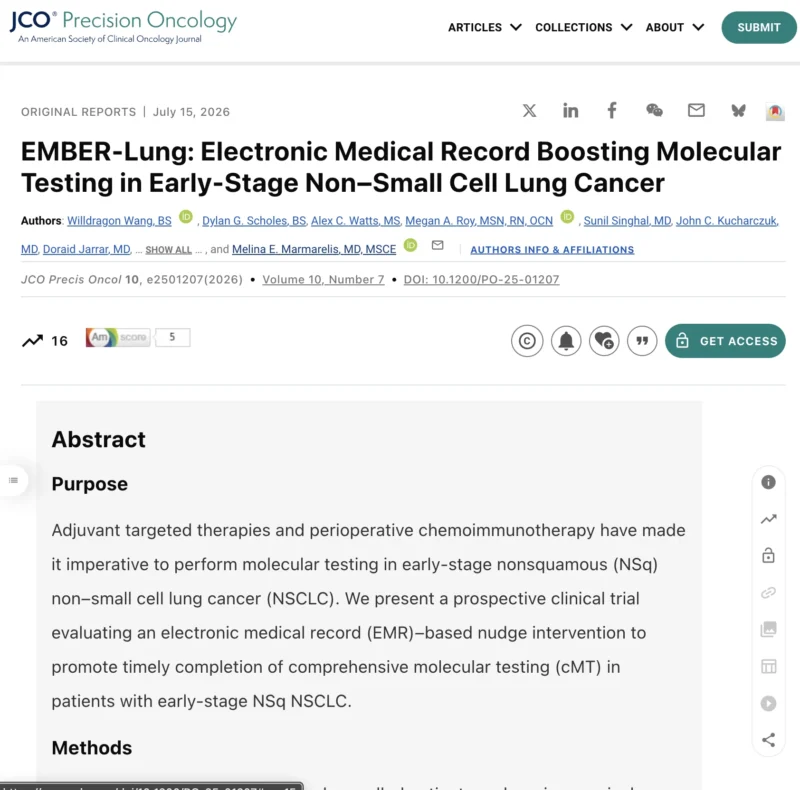
The EMBER-Lung trial, published in JCO Precision Oncology, tested a practical solution: an electronic medical record-based nudge designed to prompt comprehensive molecular testing after surgical resection.
The result was striking. Comprehensive molecular testing increased from 36.9% in the control cohort to 81.1% in the EMR-nudge cohort.
Why Early Molecular Testing Now Matters
For many years, molecular testing in NSCLC was most strongly associated with advanced disease. That is changing.
In early-stage non-squamous NSCLC, biomarker results can help guide adjuvant therapy, inform clinical trial eligibility, and prepare clinicians for treatment decisions if recurrence occurs. The growing role of adjuvant targeted therapy and perioperative immunotherapy has made timely testing more than a research question. It is now part of modern lung cancer workflow.
EMBER-Lung focused on the gap between knowing that testing matters and making sure it actually happens.
How the EMBER-Lung Intervention Worked
The trial prospectively enrolled patients undergoing surgical resection for early-stage non-squamous NSCLC.
At the first postoperative visit, the electronic medical record generated a nudge prompting the clinician to accept an order for comprehensive molecular testing when non-squamous NSCLC histology was identified.
The intervention did not stop at ordering.
When testing found an actionable alteration, a reflex alert was sent to the patient’s care team summarizing potential therapeutic options.
This made the intervention both simple and clinically connected: order the test, identify the alteration, and notify the team when results may matter.
Testing Rates More Than Doubled
The study included 460 patients: 217 in the real-world control cohort and 243 in the EMR-nudge intervention cohort.
The median age was 68.4 years, 64.3% of patients were female, and 74.1% had a smoking history. Most had stage I disease, with stage distribution reported as 75.9% stage I, 14.1% stage II, and 10.0% stage III.
The EMR nudge substantially improved comprehensive molecular testing:
- Control cohort: 36.9%
- Nudge cohort: 81.1%
- P < .00001
Importantly, the improvement was seen across stages I to III.
More Testing Meant More Actionable Findings
The intervention also increased detection of clinically relevant molecular alterations.
Classical EGFR mutations were identified in 6.5% of patients in the control cohort compared with 16.9% in the nudge cohort.
KRAS G12C mutations were detected in 5.5% of patients in the control cohort compared with 13.6% in the nudge cohort.
These findings highlight a simple but important point: precision oncology cannot reach patients if molecular testing is never completed.
Precision Oncology Is Also a Systems Problem
EMBER-Lung is not only a study about biomarker testing. It is a study about implementation.
The trial shows that clinical workflows can strongly influence whether patients receive guideline-relevant testing. A small change inside the EMR produced a large change in care delivery.
That matters because oncology is becoming more complex. New therapies depend on molecular results, but busy clinical teams need systems that make the right action easier at the right time.
The EMR nudge helped turn molecular testing from a step that could be overlooked into a default part of postoperative care.
The Next Step: Testing at Biopsy
The authors noted that future work will move this approach earlier, at the time of biopsy, to help inform neoadjuvant therapy decisions.
That may be the more important frontier.
If biomarker results are needed before surgery, postoperative testing may be too late for some patients. Earlier EMR-based interventions could help ensure that molecular profiling is available when the first treatment plan is being built.
The Bottom Line
EMBER-Lung shows that an EMR-based nudge can dramatically improve comprehensive molecular testing in early-stage non-squamous NSCLC.
Testing increased from 36.9% to 81.1%, and more patients were found to have actionable alterations including classical EGFR mutations and KRAS G12C.
The message is practical and powerful: precision oncology depends not only on better drugs and better tests, but also on better systems.
References
- Wang W, Scholes DG, Watts AC, Roy MA, Singhal S, Kucharczuk JC, Jarrar D, et al. EMBER-Lung: Electronic Medical Record Boosting Molecular Testing in Early-Stage Non–Small Cell Lung Cancer. JCO Precision Oncology. 2026;10. doi:10.1200/PO-25-01207.