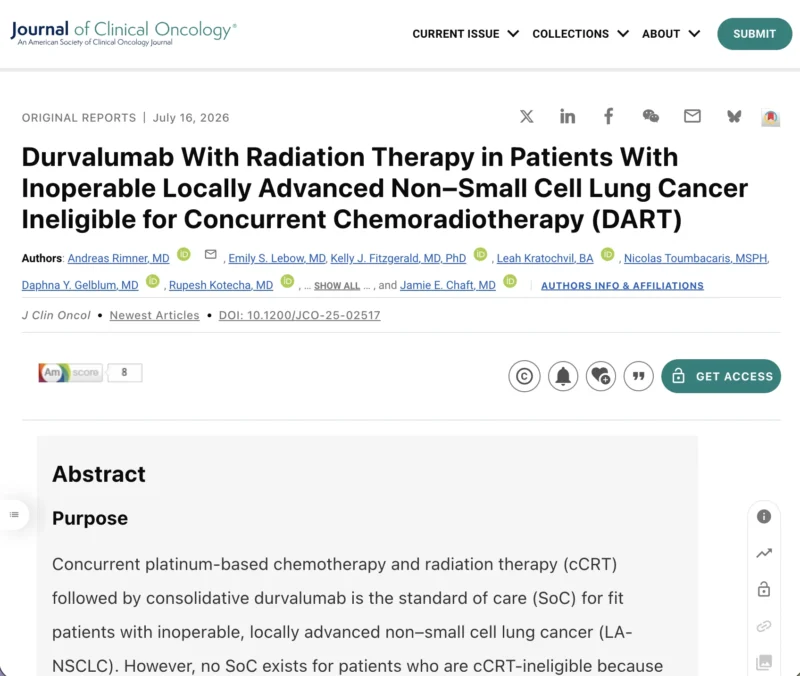
A phase II study published in the Journal of Clinical Oncology evaluated a chemotherapy-free approach for patients with inoperable locally advanced non-small cell lung cancer who were not eligible for concurrent chemoradiotherapy.
The study, known as DART, investigated durvalumab given concurrently with definitive radiation therapy and continued as consolidation treatment in patients considered unsuitable for standard concurrent platinum-based chemoradiotherapy because of age, comorbidities, or frailty.
A Difficult Population With Limited Standard Options
For fit patients with inoperable locally advanced NSCLC, the standard treatment approach is concurrent platinum-based chemotherapy and radiation therapy followed by consolidative durvalumab.
However, many patients cannot safely receive concurrent chemotherapy. These patients are often older, frailer, or have medical conditions that increase the risk of treatment-related toxicity. For this population, no universally accepted standard of care has existed, creating an important unmet need.
DART was designed to test whether immunotherapy could be safely integrated with definitive radiation therapy in this chemotherapy-ineligible setting.
How DART Was Designed
DART was a multicenter, single-arm, prospective phase II trial.
Patients received conventionally fractionated radiation therapy with durvalumab 1,500 mg every 4 weeks, given during radiation and continued as consolidation for up to 12 months.
The primary endpoint was 2-year progression-free survival. The study aimed to improve 2-year PFS from a historical benchmark of 20% with sequential chemoradiotherapy to 36%.
Additional endpoints included overall survival and cancer-specific survival.
A total of 58 patients were treated per protocol. This was an older and clinically vulnerable population, with a median age of 82 years. Most patients had ECOG performance status 1, while 14% had ECOG performance status 2. PD-L1-negative tumors were present in 28% of patients.
The Study Met Its Primary Endpoint
DART met its primary endpoint.
The 2-year progression-free survival rate was 39%, exceeding the prespecified target of 36% and comparing favorably with the historical 20% benchmark.
The 2-year overall survival rate was 54%.
These findings suggest that definitive radiation therapy combined with concurrent and consolidative durvalumab may offer disease control for selected patients who cannot receive concurrent chemoradiotherapy.
PD-L1 and Performance Status Still Matter
The study also identified clinical factors associated with outcomes.
Better ECOG performance status and PD-L1 positivity were associated with improved progression-free survival. Better ECOG performance status was associated with improved overall survival, while PD-L1 positivity was associated with better cancer-specific survival.
These findings are not surprising, but they are clinically important. In a population where frailty and comorbidity shape treatment decisions, performance status remains a key factor in assessing whether combined radiation and immunotherapy is appropriate.
Safety: Promising, but Not Risk-Free
Treatment-related grade 3 or 4 adverse events occurred in 21% of patients.
Grade 5 adverse events occurred in 7% of patients, including two cases of radiation pneumonitis and two cases of cardiac arrest.
Durvalumab was discontinued early because of adverse events in 31% of patients.
These safety findings require careful interpretation. The regimen was designed for a population unable to tolerate concurrent chemoradiotherapy, and the study suggests feasibility. However, fatal pneumonitis and treatment discontinuations highlight the need for careful patient selection, close monitoring, and multidisciplinary management.
Why This Matters for Practice
DART addresses a group often underrepresented in clinical trials: older or medically frail patients with locally advanced NSCLC who are not candidates for intensive concurrent chemoradiotherapy.
The results do not establish a new standard of care by themselves because the trial was single-arm and used historical controls. Still, the findings provide important prospective evidence that radiation plus durvalumab may be a reasonable investigational or practice-informing strategy in selected chemotherapy-ineligible patients.
The key clinical question now is how best to identify patients who are likely to benefit while minimizing the risk of severe pneumonitis, cardiac events, or early discontinuation.
The Bottom Line
DART showed that concurrent and consolidative durvalumab with definitive radiation therapy can produce encouraging outcomes in patients with inoperable locally advanced NSCLC who are not eligible for concurrent chemoradiotherapy.
The study met its primary endpoint, with a 2-year PFS of 39% and 2-year OS of 54%.
The approach is promising, but caution is essential. The trial was single-arm, the population was older and vulnerable, and serious toxicities occurred, including fatal events.
For chemotherapy-ineligible locally advanced NSCLC, DART may help define a more active treatment path beyond radiation alone or sequential approaches, but further validation is needed.
References
- Rimner A, Lebow ES, Fitzgerald KJ, Kratochvil L, Toumbacaris N, Gelblum DY, et al. Durvalumab With Radiation Therapy in Patients With Inoperable Locally Advanced Non–Small Cell Lung Cancer Ineligible for Concurrent Chemoradiotherapy (DART). Journal of Clinical Oncology. 2026. doi:10.1200/JCO-25-02517.
- ClinicalTrials.gov. Determining Whether Durvalumab in Combination With Radiation Therapy Can Delay Disease Worsening in Patients With Non-Small Cell Lung Cancer. NCT03999710.