
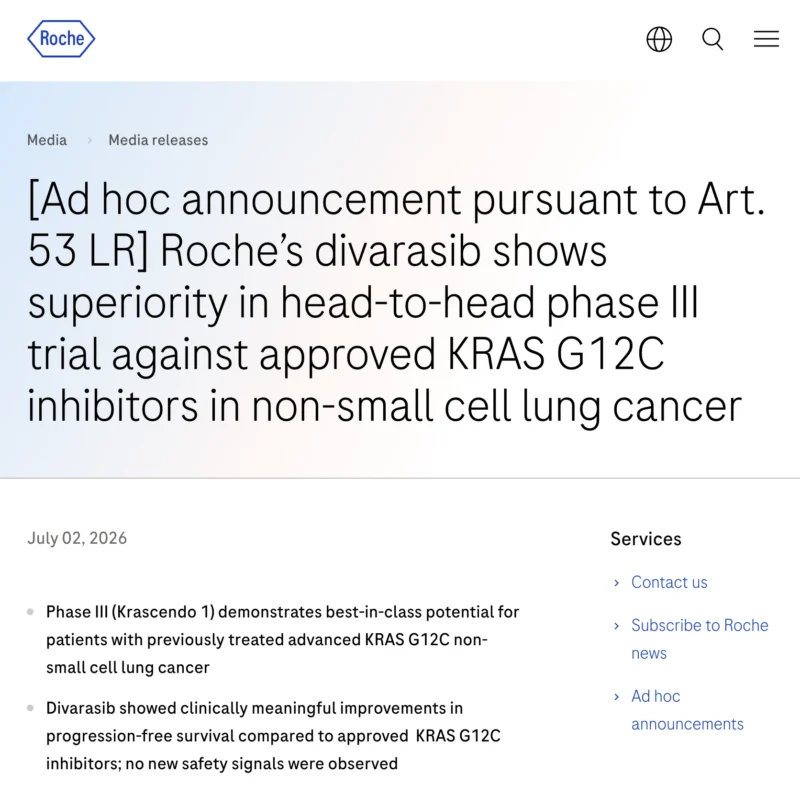
Roche has reported positive top-line results from KRASCENDO-1, a phase 3 study of divarasib in previously treated KRAS G12C-mutant advanced or metastatic non-small-cell lung cancer.
The trial compared divarasib with the approved first-generation KRAS G12C inhibitors sotorasib and adagrasib. According to Roche, divarasib produced statistically significant improvements in both progression-free survival and overall survival.
The announcement is important because it is the first reported global head-to-head phase 3 comparison of KRAS G12C inhibitors in NSCLC.
However, the company has not yet disclosed median survival outcomes, hazard ratios, response rates, subgroup analyses, or full safety data. The results have also not yet been presented at a medical meeting or published in a peer-reviewed journal.
For now, KRASCENDO-1 should be viewed as a positive top-line announcement, not as data ready to change clinical practice.
Why KRAS G12C Remains a Difficult Target
KRAS mutations are among the most frequent genomic alterations in NSCLC. KRAS G12C is a clinically important subgroup because it can be targeted with covalent inhibitors designed to bind the mutant KRAS protein in its inactive state.
Sotorasib and adagrasib established KRAS G12C as a druggable target after years in which KRAS was considered difficult to treat directly.
Yet resistance remains a major challenge.
Most patients who respond to KRAS G12C inhibitors eventually develop progression through secondary KRAS alterations, bypass signaling, histologic changes, or co-mutation-driven resistance mechanisms. Durability of response, CNS activity, toxicity management, and sequencing after resistance remain unresolved issues.
This is why a direct comparison between a next-generation agent and the currently available inhibitors matters.
What Is KRASCENDO-1?
KRASCENDO-1 is a global, randomized, open-label phase 3 trial in patients with previously treated advanced or metastatic KRAS G12C-mutant NSCLC.
The study enrolled 338 adults and compared once-daily divarasib with either once-daily sotorasib or twice-daily adagrasib.
The primary endpoint was blinded independent central review-assessed progression-free survival. Key secondary endpoints included overall survival, objective response rate, duration of response, and safety.
Roche stated that divarasib met the primary PFS endpoint and achieved statistically significant OS improvement at the interim analysis.
The company described the PFS improvement as clinically meaningful and reported no new safety findings. It stated that most treatment-related adverse events were manageable and reversible.
No numerical efficacy or safety results have yet been disclosed.
What Makes Divarasib Different?
Divarasib is an investigational oral KRAS G12C inhibitor.
Roche describes it as a next-generation agent developed for greater potency and selectivity than the first-generation KRAS G12C inhibitors. Like other covalent KRAS G12C inhibitors, it is designed to bind the mutant KRAS protein and lock it in an inactive state.
Earlier single-arm data suggested meaningful antitumor activity with divarasib in previously treated KRAS G12C-mutant NSCLC. However, single-arm studies cannot determine whether one agent performs better than another in comparable patients.
KRASCENDO-1 was designed to answer that question directly.
Why Overall Survival Is Important
Progression-free survival is a standard endpoint in targeted therapy trials. It can show whether a treatment delays disease progression compared with a control.
Overall survival is harder to demonstrate because it can be affected by subsequent therapies, crossover, patient selection, and follow-up time.
Roche’s report that KRASCENDO-1 achieved statistical significance for OS at an interim analysis is therefore notable.
Still, the clinical magnitude of that benefit remains unknown.
Without hazard ratios, median OS values, confidence intervals, follow-up duration, and subgroup results, it is not possible to determine how large the survival difference was or which patient groups may have derived the greatest benefit.
The same applies to PFS. A statistically significant result does not by itself establish the size or clinical relevance of the effect.
A Head-to-Head Trial Changes the Evidence Standard
The KRAS G12C inhibitor field has largely been shaped by separate single-arm and randomized studies conducted in different treatment settings and populations.
Cross-trial comparisons between divarasib, sotorasib, and adagrasib are difficult because the studies differ in eligibility criteria, prior therapies, brain metastasis inclusion, endpoints, imaging schedules, and follow-up.
KRASCENDO-1 is therefore important because it directly compares these treatments within one randomized phase 3 framework.
This design can provide a clearer assessment of relative efficacy and safety than indirect comparisons.
However, full interpretation will depend on the forthcoming data presentation.
Key questions include:
- What were the absolute PFS and OS outcomes?
- What was the hazard ratio for progression or death?
- How did response rate and duration of response compare?
- Were patients with stable brain metastases included, and what were their outcomes?
- How did efficacy differ by co-mutations such as STK11, KEAP1, TP53, or SMARCA4?
- What were the rates of dose interruption, dose reduction, discontinuation, hepatotoxicity, gastrointestinal toxicity, and treatment-related death?
- Did divarasib retain benefit across both comparator arms?
Divarasib Is Not Yet an Approved Treatment
Divarasib remains investigational.
Roche has stated that it plans to present the KRASCENDO-1 data at an upcoming medical meeting and submit the results to health authorities.
Until regulatory review is complete, sotorasib and adagrasib remain the available KRAS G12C-targeted options for eligible previously treated patients, subject to local approvals and labeling.
The results should not lead to switching therapy outside a clinical trial or regulatory indication.
The Larger Development Program
KRASCENDO-1 is one part of Roche’s broader divarasib program in KRAS G12C-mutant NSCLC.
KRASCENDO-2 is evaluating first-line divarasib plus pembrolizumab against pembrolizumab plus platinum-based chemotherapy in previously untreated advanced KRAS G12C-mutant nonsquamous NSCLC.
KRASCENDO-3 is evaluating adjuvant divarasib in resected stage II–IIIB KRAS G12C-mutant NSCLC after standard chemoimmunotherapy.
These studies reflect a broader strategy to move KRAS G12C inhibition beyond the later-line setting and into earlier stages of disease.
Whether divarasib can improve outcomes in first-line or adjuvant treatment remains unknown.
The Bottom Line
Roche has reported that divarasib improved both PFS and OS versus sotorasib or adagrasib in the phase 3 KRASCENDO-1 trial for previously treated KRAS G12C-mutant advanced or metastatic NSCLC.
The announcement is clinically relevant because it comes from a direct randomized comparison of KRAS G12C inhibitors.
But the data are incomplete.
No numerical efficacy results, detailed subgroup findings, or full safety outcomes have yet been released. Divarasib is not approved, and the results require presentation, peer review, and regulatory assessment before they can be translated into treatment recommendations.
References
- Roche. Roche’s divarasib shows superiority in head-to-head phase III trial against approved KRAS G12C inhibitors in non-small cell lung cancer. July 2, 2026.
- ClinicalTrials.gov. NCT06497556. A study evaluating the efficacy and safety of divarasib versus sotorasib or adagrasib in patients with previously treated KRAS G12C-positive advanced or metastatic non-small-cell lung cancer.
- Sacher AG, et al. Single-agent divarasib in patients with KRAS G12C-mutated non-small-cell lung cancer. Journal of Clinical Oncology. 2025.