
The development of deulorlatinib (TGRX-326) introduces an unusual pharmacologic strategy into thoracic oncology: rather than designing an entirely new kinase inhibitor, investigators have modified lorlatinib through deuteration, replacing selected hydrogen atoms with deuterium in an effort to alter metabolism while preserving the activity of the parent molecule.
An editorial published in the Journal of Thoracic Oncology examines whether this approach could eventually challenge lorlatinib in ALK-positive non–small cell lung cancer. The authors use the metaphor of a “pauper” challenging the “prince,” but their conclusion is appropriately cautious: deulorlatinib has generated promising efficacy and safety data, yet it remains far from displacing a first-line standard supported by exceptionally mature CROWN data (Tieu et al., 2026).
The discussion is relevant beyond one ALK inhibitor. Deuterated drugs are increasingly entering oncology, raising a broader question about whether relatively subtle chemical modifications can meaningfully improve the pharmacokinetics, tolerability, and therapeutic index of already effective anticancer agents.
What Is Deulorlatinib?
Deuterium is a stable, nonradioactive isotope of hydrogen containing one proton, one electron, and one neutron. Deulorlatinib was created by replacing three hydrogens with three deuterium atoms at the N-methyl group of lorlatinib’s pyrazole structure (Tieu et al., 2026).
The pharmacologic rationale is straightforward. Carbon–deuterium bonds can be more resistant to metabolic breakdown than corresponding carbon–hydrogen bonds. In principle, deuteration may therefore produce a more metabolically stable compound, extend drug exposure, and allow lower or less frequent dosing while maintaining antitumor activity.
For lorlatinib, this concept is particularly attractive because treatment can continue for many years. A treatment with prolonged disease control also creates prolonged exposure to chronic toxicities, making even modest improvements in long-term tolerability potentially clinically meaningful (Tieu et al., 2026).
DRAGON Provides the Registrational Phase II Dataset
The editorial focuses on results from the DRAGON phase II study, which evaluated deulorlatinib in patients with ALK-positive NSCLC whose disease had progressed after a second-generation ALK tyrosine kinase inhibitor. At the recommended phase II dose of 60 mg once daily, 163 heavily pretreated patients were enrolled, 158 of whom were evaluable. Approximately 57% had brain metastases, and 38% had previously received crizotinib (Tieu et al., 2026).
The rapid enrollment of this population was notable, with 163 patients accrued in slightly more than 11 months. A phase III study comparing deulorlatinib with crizotinib has subsequently completed accrual of 321 patients, indicating that clinical development has already moved beyond the single-arm phase II setting (Tieu et al., 2026).
Cross-Trial Comparisons With Lorlatinib Are Tempting, but Problematic
The central question raised by the editorial is whether deulorlatinib may provide comparable efficacy with a better toxicity profile than lorlatinib. However, Tieu et al. (2026) emphasize that this cannot currently be answered reliably through cross-trial comparison.
The registrational lorlatinib phase II study enrolled patients in 2015–2016, whereas DRAGON enrolled patients in 2023. During that interval, the ALK treatment landscape changed substantially. At the time of the lorlatinib trial, second-generation inhibitors such as ceritinib and alectinib were only beginning to move into earlier treatment. By the time DRAGON was conducted, multiple second-generation ALK inhibitors were established across earlier lines of therapy.
The patient populations were also structured differently. The pivotal lorlatinib study used several defined cohorts based on previous ALK treatment exposure, whereas DRAGON broadly required progression after a second-generation ALK inhibitor.
As a result, only selected subgroups can be compared with any reasonable degree of similarity.
Deulorlatinib Shows Encouraging Post–Second-Generation ALK Activity
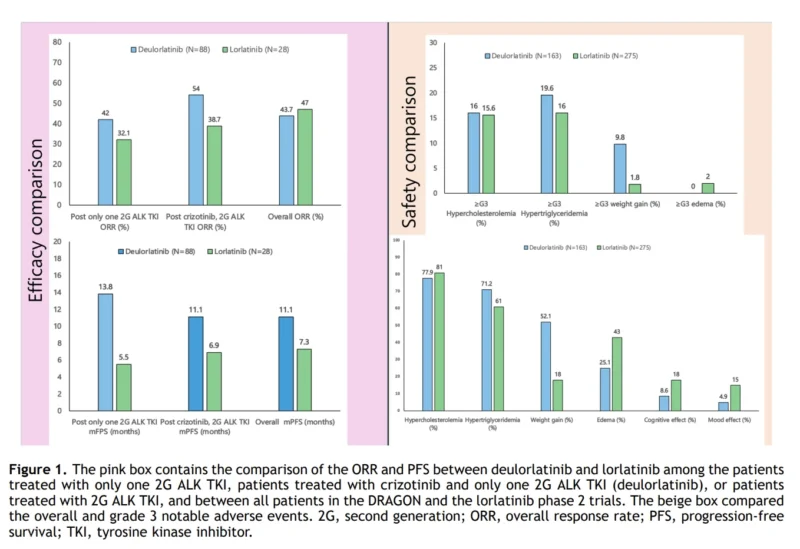
Within those limitations, the phase II data remain interesting. Among patients who had received only one previous second-generation ALK inhibitor, median PFS with deulorlatinib was reported as 13.8 months. Among patients previously treated with crizotinib followed by one second-generation ALK inhibitor, median PFS was 11.1 months.
The authors note that the apparent activity looks favorable when compared informally with historical lorlatinib experience in some post-TKI populations. However, they also point out an important inconsistency. In an earlier phase I deulorlatinib study, median PFS among 41 patients who had received one second-generation ALK inhibitor was only 5.6 months, considerably shorter than the 13.8 months subsequently reported in DRAGON (Tieu et al., 2026).
For this reason, the editorial proposes that a pooled phase I and phase II efficacy analysis would provide a more informative initial assessment than selectively comparing DRAGON with historical lorlatinib cohorts. This is a particularly important point. Attractive cross-trial numbers can generate enthusiasm, but they cannot substitute for randomized evidence when patient populations, treatment eras, and prior therapies differ substantially.
Safety May Be the More Interesting Signal
The potential advantage of deulorlatinib may ultimately be less about dramatically greater efficacy and more about therapeutic index. The editorial notes that treatment-related adverse-event comparisons appeared to favor deulorlatinib for some important grade ≥3 toxicities, particularly hypercholesterolemia and hypertriglyceridemia.
These toxicities are clinically relevant because dyslipidemia is one of the characteristic long-term adverse effects of lorlatinib. The mean relative dose intensity of deulorlatinib in DRAGON was 95.9%, with a median treatment duration of 11 months, suggesting that most patients were able to maintain planned exposure (Tieu et al., 2026).
Whether this apparent tolerability advantage persists over several years remains unknown. And that time dimension is critical. Lorlatinib is now associated with exceptionally prolonged first-line disease control, meaning that a true safety comparison requires much longer observation than the current deulorlatinib dataset provides.
Biomarkers Reinforce the Importance of Disease Biology
DRAGON also provided additional insight into factors associated with poorer outcomes in advanced ALK-positive NSCLC. The editorial highlights three adverse prognostic features: detectable circulating tumor DNA, TP53 mutations, and brain metastases.
Patients with these characteristics had shorter progression-free survival, with detectable ctDNA and TP53 mutation appearing particularly influential. Among ctDNA-positive patients, the presence of a TP53 mutation was also associated with a greater mean target tumor burden.
These observations reinforce the increasing importance of distinguishing between drug resistance caused by ALK-dependent mechanisms and broader adverse tumor biology.
ALK Mutations Remain a Setting Where Lorlatinib Is Particularly Strong
The editorial also revisits one of lorlatinib’s major strengths: its broad activity against acquired ALK resistance mutations. Among ctDNA-positive patients treated with lorlatinib, median PFS was 9.5 months when an acquired ALK mutation was detectable compared with 2.8 months when no acquired ALK mutation was identified.
This seemingly counterintuitive finding reflects lorlatinib’s potency against a broad spectrum of ALK-dependent resistance mechanisms. When progression is driven by an acquired ALK mutation, lorlatinib may still effectively suppress the pathway. When progression occurs without an identifiable ALK mutation, resistance is more likely to involve off-target mechanisms, against which simply increasing ALK inhibition may have limited benefit.
This distinction helps explain why the value of a potent next-generation ALK inhibitor may depend heavily on where it is positioned in the treatment sequence.
The First-Line Setting Changes the Comparison Completely
This is where the editorial becomes particularly important. Lorlatinib is no longer simply a salvage ALK inhibitor. Its major contemporary role is first-line therapy, where it can suppress ALK-driven disease before multiple layers of sequential resistance accumulate. The recently reported seven-year follow-up of the phase III CROWN study showed that median PFS with first-line lorlatinib remained not reached, with an estimated seven-year PFS rate of 55%. That is an extraordinary benchmark.
Based on the observed trajectory of the PFS curve, the editorial authors estimate that the 50% PFS threshold might not be reached until approximately year nine, corresponding to a mature median PFS approaching 108 months. This is an extrapolation rather than an observed endpoint and should be interpreted accordingly. For deulorlatinib to challenge lorlatinib in the first-line setting, comparable follow-up would ultimately be necessary.
That means the relevant comparison may require a decade of observation, particularly if the proposed advantage is improved long-term tolerability rather than simply short-term response.
The Phase III Comparator Raises an Important Question
The ongoing phase III strategy also deserves attention. The completed pivotal phase III trial compares deulorlatinib with crizotinib, not lorlatinib. The editorial authors argue that the more informative contemporary design would have been a direct comparison between deulorlatinib and lorlatinib, particularly because lorlatinib is now a major first-line standard.
A positive comparison against crizotinib may establish efficacy for regulatory purposes, but it will not answer the most clinically relevant question: Is deulorlatinib better tolerated than lorlatinib while preserving the extraordinary long-term disease control achieved with first-line lorlatinib?
Without that head-to-head evidence, positioning the two agents relative to each other will remain difficult.
Deuteration Is Becoming a Broader Oncology Strategy
Deulorlatinib is not an isolated example. The authors note that deuterated osimertinib has completed early-phase development and is being compared directly with osimertinib, while deuterated sorafenib has also been developed in hepatocellular carcinoma.
Deuteration is also entering antibody-drug conjugate development. The editorial highlights TQB2102, a biparatopic HER2-targeted ADC using a deuterated deruxtecan payload. Early clinical data reported relatively low rates of interstitial lung disease, although the available exposure duration was limited and those findings require longer follow-up.
The broader implication is significant. Rather than treating deuteration as a niche medicinal-chemistry technique, oncology may increasingly use isotope substitution to refine established molecules, potentially improving pharmacokinetics or toxicity without fundamentally changing the therapeutic target.
Why Deulorlatinib Is Interesting, but Not Yet a Lorlatinib Replacement
The scientific rationale for deulorlatinib is compelling. Lorlatinib already provides potent ALK inhibition and excellent CNS penetration. Deuteration attempts to preserve those desirable characteristics while potentially reducing metabolic liabilities and some chronic adverse effects.
The DRAGON results indicate that the drug has meaningful activity after second-generation ALK TKI failure and suggest a potentially attractive safety profile. But those findings cannot yet establish superiority over lorlatinib. The available data come from a different treatment setting, a different era of ALK therapy, and a single-arm phase II trial. Follow-up is also short relative to the extraordinarily mature CROWN experience.
The relevant standard is therefore unusually high. A next-generation or chemically modified ALK inhibitor does not simply need to show response after prior therapy. To displace first-line lorlatinib, it would need to demonstrate comparable or better long-term disease control, CNS protection, resistance suppression, and clinically meaningful improvement in tolerability.
The Bottom Line
Deulorlatinib represents one of the most intriguing applications of deuteration in thoracic oncology. The DRAGON phase II study demonstrates clinically meaningful activity in patients with ALK-positive NSCLC after progression on a second-generation ALK inhibitor, while early safety comparisons suggest the possibility of reduced high-grade metabolic toxicity.
However, lorlatinib remains an exceptionally difficult benchmark. At seven years, first-line CROWN data continue to show 55% progression-free survival with median PFS still not reached. The most important unanswered question is therefore not whether deulorlatinib is active. It clearly is. The question is whether deuteration can preserve the extraordinary efficacy of lorlatinib while meaningfully reducing the long-term toxicity burden that accompanies many years of therapy.
For now, as the editorial concludes, deulorlatinib still has a long way to go before it can take the CROWN.
Reference
- Tieu, V. T., Chou, E., Nagasaka, M., & Ou, S.-H. I. (2026). Will the pauper (deulorlatinib/TGRX-326) take the CROWN from the prince (lorlatinib) in an alternate ending? Deuteration is here to stay in oncology. Journal of Thoracic Oncology, 21, 103954. https://doi.org/10.1016/j.jtho.2026.103954.