
The phase III DESTINY-Lung04 trial presented at the 2026 World Conference on Lung Cancer provides the first randomized phase III evidence supporting HER2-directed therapy as an initial systemic treatment strategy for advanced HER2-mutant non–small cell lung cancer. In previously untreated patients with unresectable locally advanced or metastatic nonsquamous NSCLC harboring HER2 exon 19 or exon 20 mutations, trastuzumab deruxtecan (T-DXd) significantly prolonged progression-free survival compared with pembrolizumab plus platinum–pemetrexed chemotherapy.
The study met its primary endpoint with a median PFS of 14.3 months with T-DXd compared with 8.3 months with chemoimmunotherapy, corresponding to a hazard ratio of 0.63. T-DXd also produced a higher objective response rate and more durable responses. At the same time, the interim overall-survival analysis did not demonstrate an advantage for T-DXd, creating an important distinction between improved first-line disease control and the longer-term question of treatment sequencing.
DESTINY-Lung04 therefore represents an important advance in HER2-mutant NSCLC, but its clinical implications are more sophisticated than a simple positive-versus-negative interpretation. The trial establishes the efficacy of moving HER2-directed therapy into the first line while simultaneously highlighting how subsequent access to active therapies can complicate overall-survival interpretation in modern precision oncology.
A Phase III Test of Molecularly Directed Therapy Against Chemoimmunotherapy
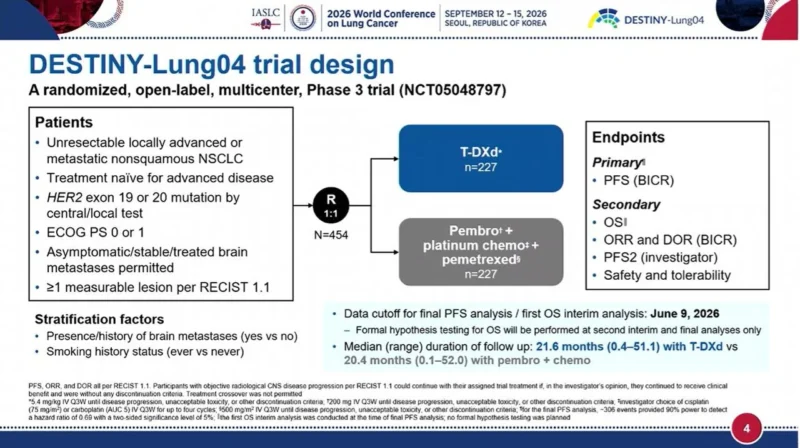
DESTINY-Lung04 was a global, randomized, open-label phase III trial enrolling 454 patients with treatment-naïve unresectable locally advanced or metastatic nonsquamous NSCLC carrying a centrally or locally identified HER2 exon 19 or exon 20 mutation.
Patients were randomized 1:1 to receive T-DXd at 5.4 mg/kg every three weeks or pembrolizumab combined with platinum chemotherapy and pemetrexed. Patients with asymptomatic, stable, or previously treated brain metastases were eligible, and randomization was stratified by smoking history and the presence or history of brain metastases.
The primary endpoint was progression-free survival assessed by blinded independent central review. Secondary endpoints included overall survival, objective response rate, duration of response, investigator-assessed PFS, and safety. At the June 9, 2026 data cutoff, median follow-up was 21.6 months in the T-DXd arm and 20.4 months in the chemoimmunotherapy arm.
The study addresses a clinically relevant question. HER2-mutant NSCLC has historically been treated with broadly active first-line regimens, while HER2-directed treatment was introduced after progression. DESTINY-Lung04 directly tests whether molecularly matched treatment should instead be used from the beginning.
T-DXd Produces a Clinically Meaningful PFS Improvement
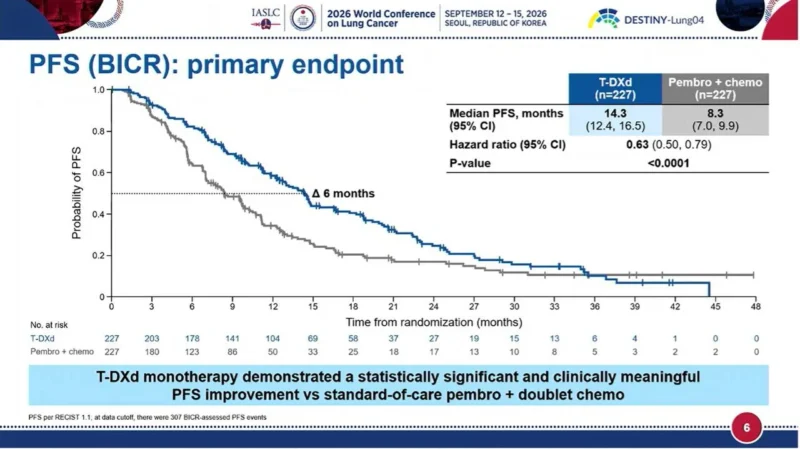
The primary endpoint clearly favored T-DXd. Median PFS was 14.3 months with T-DXd versus 8.3 months with pembrolizumab plus chemotherapy, representing an absolute difference of six months and a 37% relative reduction in the risk of progression or death.
- PFS: 14.3 vs 8.3 months
- HR 0.63; 95% CI, 0.50–0.79; P<0.0001
The Kaplan–Meier curves separated early and remained apart through much of the follow-up period, supporting a consistent treatment effect rather than a transient early response advantage.
This result is important because the comparator reflects contemporary first-line practice rather than an outdated chemotherapy-only standard. The trial therefore demonstrates that direct HER2 targeting can provide superior disease control compared with a broadly active chemoimmunotherapy strategy in a genomically selected population.
Response Depth and Durability Support the PFS Result
The response data were consistent with the primary analysis. The objective response rate reached 70.0% with T-DXd compared with 44.5% with pembrolizumab plus chemotherapy, corresponding to an odds ratio of 2.93.
Median duration of response was also longer:
- 13.4 months with T-DXd versus 9.7 months with chemoimmunotherapy.
The coherence across PFS, response rate, and response duration strengthens the evidence that HER2-mutant NSCLC represents a therapeutically distinct molecular subgroup in which HER2-directed treatment can outperform nonspecific first-line therapy. For patients with symptomatic, high-volume, or rapidly progressive disease, the higher probability of tumor response may also have immediate clinical relevance beyond the numerical PFS improvement.
Overall Survival Does Not Yet Favor T-DXd
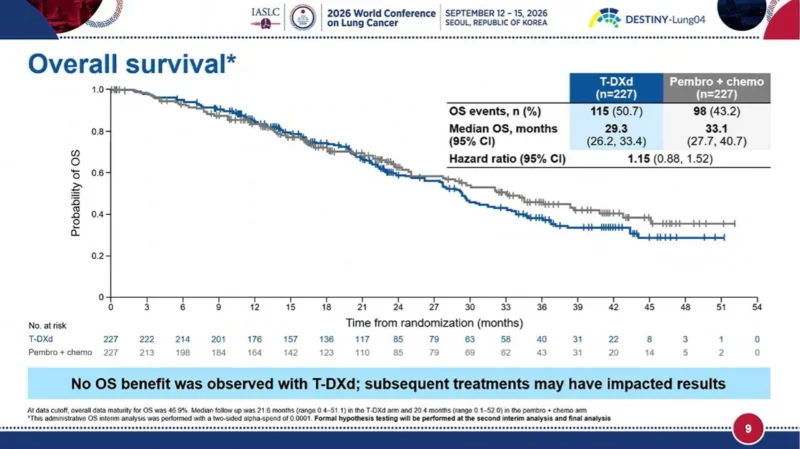
The overall-survival findings require a more cautious interpretation. At the current interim analysis, median OS was 29.3 months with T-DXd and 33.1 months with pembrolizumab plus chemotherapy, with an HR of 1.15 (95% CI, 0.88–1.52).
These data do not demonstrate an OS advantage for T-DXd. Importantly, the OS analysis remains immature, with approximately 46.9% data maturity. Formal hypothesis testing is planned at later analyses, meaning that the current result should not be interpreted as a definitive survival comparison.
Nevertheless, the absence of an OS signal despite a substantial PFS advantage is clinically meaningful and should remain central to interpretation of the trial. DESTINY-Lung04 therefore demonstrates that first-line T-DXd delays progression more effectively than chemoimmunotherapy, but it has not yet shown that using T-DXd first allows patients to live longer.
Subsequent Treatment Complicates the OS Comparison
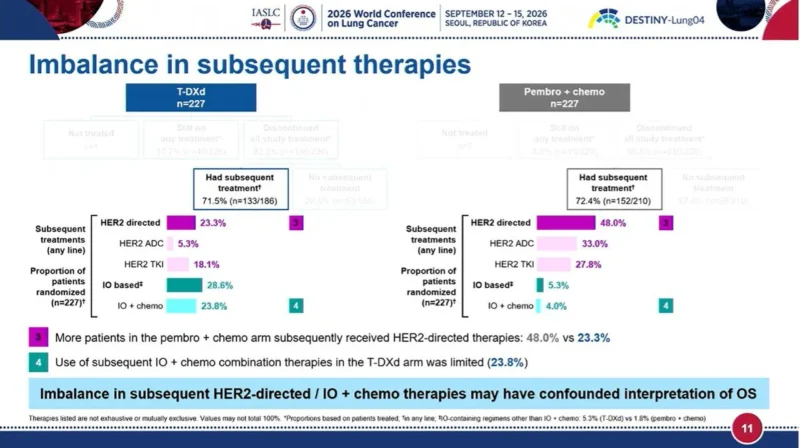
One of the most informative aspects of the WCLC presentation was the analysis of therapies received after discontinuation of randomized treatment. Subsequent treatment rates were similar overall, but the type of therapy differed considerably between groups.
Among patients initially assigned to pembrolizumab plus chemotherapy, 48.0% subsequently received HER2-directed therapy, compared with 23.3% of patients initially assigned to T-DXd.
Subsequent HER2 ADC use was particularly different:
- 33.0% after chemoimmunotherapy versus 5.3% after T-DXd
HER2 TKIs were used in 27.8% versus 18.1%, respectively. Conversely, patients who began treatment with T-DXd were more likely to receive subsequent immunotherapy-based regimens. This imbalance is highly relevant to OS because patients assigned to the control arm were not permanently deprived of HER2-directed treatment. A substantial proportion received an active HER2-targeting strategy after progression.
The randomized comparison may therefore increasingly reflect different treatment sequences rather than lifetime access versus no access to HER2-directed therapy. That distinction is becoming central to contemporary oncology trials.
Earlier Treatment and Better Sequencing Are Different Questions
DESTINY-Lung04 illustrates why first-line superiority cannot be assessed through PFS alone. The trial clearly demonstrates that giving T-DXd first delays disease progression and increases the likelihood of response. What remains uncertain is whether those advantages translate into longer survival compared with starting with chemoimmunotherapy and introducing effective HER2-directed treatment after progression.
These are distinct clinical questions. A meaningful PFS improvement may still have substantial value by prolonging disease control, delaying deterioration, reducing symptoms, and postponing subsequent treatment. However, if both treatment sequences ultimately provide access to the same highly active therapies, OS differences may become smaller.
The central issue emerging from DESTINY-Lung04 is therefore increasingly one of optimal sequencing, not simply drug activity.
HER2-Mutant NSCLC Is Now a First-Line Precision-Oncology Disease
Perhaps the most important broader implication of the trial is that HER2 mutation status must be available before first-line treatment decisions are made. HER2-mutant NSCLC has historically occupied a less clearly defined position than EGFR-, ALK-, ROS1-, or RET-driven disease. DESTINY-Lung04 now places HER2 more firmly within the model of oncogene-directed first-line treatment.
For advanced nonsquamous NSCLC, comprehensive molecular testing should therefore be completed before systemic treatment whenever clinically feasible. Beginning chemoimmunotherapy before molecular results are available may now mean initiating a nonspecific regimen in a patient who could instead receive an active HER2-directed therapy from the outset.
The implications extend beyond T-DXd. HER2-mutant disease is rapidly becoming a competitive therapeutic space that includes both ADCs and mutation-selective TKIs.
Competition Between ADCs and HER2-Selective TKIs Is Emerging
T-DXd is no longer the only HER2-directed strategy moving into first-line NSCLC. HER2-selective TKIs, including sevabertinib, are also advancing into previously untreated disease. This creates a new therapeutic question that DESTINY-Lung04 alone cannot answer. The relevant decision may soon become not whether HER2 should be targeted, but which HER2-directed modality should be used first.
Several factors may ultimately influence this choice: mutation subtype, CNS involvement, expected intracranial activity, ILD risk, treatment route, patient preference, durability of response, comorbidities, and resistance mechanisms.
Cross-trial comparisons will not reliably define the optimal sequence. Prospective studies and mature real-world experience will be needed to determine how ADCs and TKIs should be integrated.
ILD Remains the Major Safety Consideration
The efficacy of T-DXd must also be considered alongside its pulmonary toxicity profile. Adjudicated drug-related interstitial lung disease or pneumonitis occurred in 20.8% of patients receiving T-DXd compared with 2.3% receiving chemoimmunotherapy. Most events in the T-DXd arm were grade 1 or 2, accounting for 78.7% of cases, but the overall incidence remains clinically relevant.
The importance of ILD becomes even greater when T-DXd is introduced in the first-line setting, where patients may otherwise have multiple alternative treatment options and potentially prolonged survival. Careful baseline evaluation, patient education, early recognition of respiratory symptoms, prompt imaging, and rapid treatment interruption remain fundamental to safe use.
The first-line decision therefore requires consideration of both efficacy and long-term treatment burden.
CNS Outcomes Will Be Particularly Important
Patients with asymptomatic, stable, or treated brain metastases were permitted in DESTINY-Lung04, and brain-metastasis status was incorporated into stratification. That makes CNS-specific outcomes particularly relevant. HER2-mutant NSCLC has an important propensity for brain metastases, and modern targeted therapies are increasingly differentiated by their ability to provide intracranial as well as systemic disease control.
The data provided here do not include sufficiently detailed intracranial response or CNS-PFS results to draw conclusions about comparative CNS efficacy. Those analyses will be important when defining T-DXd relative to emerging HER2-directed TKIs, particularly for patients presenting with brain metastases.
The Trial Establishes Efficacy but Leaves the Treatment Sequence Open
DESTINY-Lung04 should not be reduced to either “positive because PFS improved” or “negative because OS did not.” Its significance lies in the combination of both findings.
The PFS result establishes that HER2-directed therapy can outperform standard chemoimmunotherapy when used first. The interim OS result reminds clinicians that moving an effective therapy earlier does not necessarily guarantee improved lifetime survival, particularly when patients in the control group can receive that therapy or another active HER2-directed agent later.
The trial therefore represents a transition from a simpler question of therapeutic efficacy toward a more mature precision-oncology question: When during the disease course should the most active molecular therapy be used?
The Bottom Line
DESTINY-Lung04 provides phase III evidence supporting T-DXd as a new first-line treatment option for advanced HER2-mutant NSCLC. Compared with pembrolizumab plus platinum–pemetrexed, T-DXd improved:
- Median PFS: 14.3 vs 8.3 months
- Hazard ratio: 0.63
- ORR: 70.0% vs 44.5%
- Median DOR: 13.4 vs 9.7 months
These results establish a substantial advantage in first-line disease control. At the current analysis, however:
- Median OS was 29.3 vs 33.1 months, with an HR of 1.15.
No OS benefit has yet been demonstrated, and the analysis remains immature. Interpretation is further complicated by greater subsequent use of HER2-directed treatment in the chemoimmunotherapy arm. DESTINY-Lung04 therefore changes the therapeutic framework for HER2-mutant NSCLC without resolving the full sequencing question.
The trial establishes that HER2-directed therapy can be more effective than chemoimmunotherapy at controlling disease when used first. The next question is whether earlier HER2 targeting ultimately improves lifetime outcomes compared with strategically sequencing active therapies across multiple lines. That may be the more important question as HER2-mutant NSCLC enters a new era of competing targeted options.