
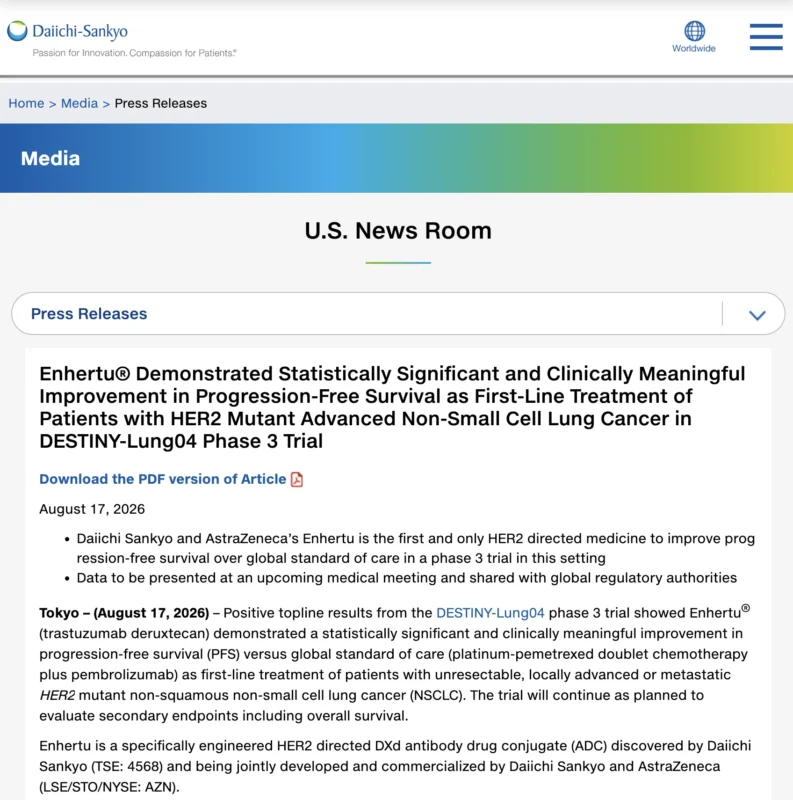
Enhertu (trastuzumab deruxtecan) has demonstrated a statistically significant and clinically meaningful improvement in progression-free survival compared with platinum-pemetrexed chemotherapy plus pembrolizumab in the first-line treatment of advanced HER2-mutant non-small cell lung cancer, according to positive topline results from the Phase 3 DESTINY-Lung04 trial.
The global randomized study enrolled 454 patients with unresectable, locally advanced or metastatic nonsquamous NSCLC harboring HER2 exon 19 or exon 20 mutations.
Patients received either Enhertu or the global standard-of-care combination of platinum-pemetrexed chemotherapy plus pembrolizumab.
The study met its primary endpoint of progression-free survival as assessed by blinded independent central review, Daiichi Sankyo and AstraZeneca announced on August 17, 2026.
The trial will continue as planned to evaluate secondary endpoints, including overall survival. Detailed efficacy and safety results are expected to be presented at an upcoming medical meeting and submitted to global regulatory authorities (Daiichi Sankyo, 2026).
What Did DESTINY-Lung04 Show?
The central topline finding is that Enhertu significantly prolonged progression-free survival compared with first-line chemoimmunotherapy in HER2-mutant advanced NSCLC.
The companies characterized the improvement as both statistically significant and clinically meaningful.
However, no numerical PFS results were disclosed in the announcement.
That means the following are not yet publicly available from DESTINY-Lung04:
- Median PFS in either treatment arm
- PFS hazard ratio and confidence interval
- Objective response rate
- Duration of response
- Overall survival
- Detailed adverse-event rates
Those results will be essential for determining the magnitude of benefit and the overall benefit-risk profile of moving trastuzumab deruxtecan into the first-line setting.
According to Daiichi Sankyo and AstraZeneca, DESTINY-Lung04 is the first Phase 3 trial to demonstrate a PFS benefit for a HER2-directed treatment against the current global standard of care in this first-line HER2-mutant NSCLC population (Daiichi Sankyo, 2026).
How Was DESTINY-Lung04 Designed?
DESTINY-Lung04 is a global, randomized, open-label Phase 3 trial.
The study enrolled 454 patients across sites in Asia, Europe and North America.
Eligible patients had unresectable, locally advanced or metastatic nonsquamous NSCLC with a HER2 exon 19 or exon 20 mutation.
Patients were randomized 1:1 to receive:
- Enhertu 5.4 mg/kg
or
- Platinum-pemetrexed doublet chemotherapy plus pembrolizumab
Randomization was stratified according to smoking history and the presence or history of brain metastases.
The primary endpoint was PFS assessed by blinded independent central review.
Secondary endpoints include overall survival, investigator-assessed PFS, objective response rate, duration of response, pharmacokinetics and safety (Daiichi Sankyo, 2026).
Why Is HER2-Mutant NSCLC a Distinct Molecular Subtype?
HER2, encoded by ERBB2, is a receptor tyrosine kinase involved in cell growth and differentiation.
HER2 mutations represent a distinct oncogenic alteration in NSCLC and occur in approximately 2% to 4% of patients, according to epidemiologic studies referenced in the DESTINY-Lung04 announcement (Mazieres et al., 2013; Li et al., 2016).
HER2-mutant NSCLC has also been associated with particular clinical characteristics.
The mutations are reported more frequently among younger patients, women and people without a smoking history, and have been associated with an increased incidence of brain metastases (Liu et al., 2018; Offin et al., 2019).
Historically, first-line metastatic treatment has generally relied on platinum-based chemotherapy combined with immunotherapy rather than a HER2-directed targeted therapy.
DESTINY-Lung04 directly tested whether targeting HER2 from the beginning of metastatic treatment could improve disease control compared with that approach.
What Is Enhertu?
Enhertu, or trastuzumab deruxtecan, is a HER2-directed antibody-drug conjugate.
It combines a HER2-targeting monoclonal antibody with multiple molecules of the topoisomerase I inhibitor payload DXd, an exatecan derivative, connected through tetrapeptide-based cleavable linkers.
The ADC is designed to bind HER2-expressing tumor cells, undergo internalization and release its cytotoxic payload inside the cancer cell.
Enhertu was discovered by Daiichi Sankyo and is jointly developed and commercialized globally with AstraZeneca, except in Japan, where Daiichi Sankyo retains exclusive rights (Daiichi Sankyo, 2026).
Why Does Moving Enhertu Into the First Line Matter?
Enhertu is already established as a treatment for previously treated HER2-mutant metastatic NSCLC.
According to the August 17 announcement, the drug is approved in more than 80 countries and regions for adults with unresectable or metastatic NSCLC whose tumors harbor activating HER2 mutations and who have received prior systemic therapy.
The US indication remains an accelerated approval based on response rate and duration of response, with continued approval potentially dependent on verification of clinical benefit in a confirmatory trial.
DESTINY-Lung04 addresses a substantially different question.
Instead of waiting until disease progresses after another systemic regimen, the trial evaluates whether HER2-directed ADC therapy should be used from the first-line metastatic setting.
The positive PFS result therefore potentially shifts trastuzumab deruxtecan from a later-line option toward an earlier treatment strategy.
Whether that change becomes clinically practice-defining will depend on the magnitude of PFS benefit, overall survival, safety and subsequent regulatory evaluation.
Why Is the Comparator Important?
DESTINY-Lung04 compared Enhertu directly against platinum-pemetrexed chemotherapy plus pembrolizumab.
This makes the result particularly relevant because the trial did not compare the ADC with placebo or a less intensive treatment.
Instead, Enhertu was evaluated against an active chemoimmunotherapy regimen used as a global first-line standard for this population (Daiichi Sankyo, 2026).
A direct comparison allows the study to address whether initiating HER2-directed therapy provides superior disease control to a treatment strategy based primarily on chemotherapy and immune checkpoint inhibition.
The topline result indicates that the study answered that question positively for its primary PFS endpoint.
The numerical results are still required to understand how much better the disease control was.
What Do We Know About Overall Survival?
Overall survival is a secondary endpoint in DESTINY-Lung04, and the trial will continue as planned.
No OS result was reported in the August 17 announcement.
That distinction matters.
A positive PFS result demonstrates that Enhertu delayed progression or death compared with the control arm, but it does not yet establish an overall survival advantage.
Longer follow-up will be required to determine whether earlier HER2-directed treatment ultimately extends survival and how subsequent therapies influence outcomes.
What Did the Trial Show About Safety?
The companies reported that the safety profile of Enhertu in DESTINY-Lung04 was generally consistent with its known safety profile, with no new safety concerns identified.
Detailed treatment-emergent adverse-event data from DESTINY-Lung04 were not released.
Therefore, it is not yet possible to compare the frequency of serious adverse events, treatment discontinuations, dose modifications or specific toxicities between Enhertu and chemoimmunotherapy.
One safety issue will be particularly important when the full results are presented: interstitial lung disease and pneumonitis.
Enhertu carries a boxed warning for ILD/pneumonitis, including severe and fatal events.
In the previously reported DESTINY-Lung02 population receiving Enhertu 5.4 mg/kg for HER2-mutant metastatic NSCLC, serious adverse reactions occurred in 40% of patients, and ILD/pneumonitis was among the events leading to treatment discontinuation (Daiichi Sankyo, 2026).
However, those historical safety results should not be assumed to represent the DESTINY-Lung04 population.
The first-line trial’s own detailed safety data remain pending.
How Could DESTINY-Lung04 Change the Treatment Sequence?
HER2-mutant NSCLC already has a defined molecular target, but HER2-directed ADC therapy has largely been positioned after previous systemic treatment.
DESTINY-Lung04 tests a different treatment architecture:
identify HER2 mutation at metastatic diagnosis → introduce HER2-directed treatment immediately.
If the full results confirm a substantial PFS benefit with an acceptable safety profile, the study could support moving Enhertu into the first-line setting.
That would also reinforce the importance of comprehensive molecular testing before initial systemic treatment, because identifying an activating HER2 mutation could directly determine first-line therapeutic strategy.
The companies have stated that the DESTINY-Lung04 results will be shared with regulatory authorities globally.
What Should We Watch for in the Full DESTINY-Lung04 Data?
The topline announcement establishes that the trial is positive, but the eventual medical meeting presentation will provide the information needed to understand its clinical importance.
The most important result will be the PFS hazard ratio, together with median PFS in the Enhertu and chemoimmunotherapy arms.
Objective response rate and duration of response will show whether the advantage reflects deeper tumor responses, longer response durability, or both.
Overall survival will determine whether the earlier reduction in progression risk ultimately translates into longer life.
Brain metastasis outcomes will also be of interest because HER2-mutant NSCLC has been associated with CNS involvement and randomization was stratified according to the presence or history of brain metastases.
Finally, detailed ILD/pneumonitis and treatment-discontinuation data will be essential for defining the benefit-risk balance of using an ADC for a potentially longer duration in the first-line setting.
The Bottom Line
DESTINY-Lung04 has met its primary endpoint, showing a statistically significant and clinically meaningful improvement in progression-free survival with Enhertu compared with platinum-pemetrexed chemotherapy plus pembrolizumab in previously untreated HER2-mutant advanced nonsquamous NSCLC.
The trial enrolled 454 patients with HER2 exon 19 or exon 20 mutations and directly compared HER2-directed ADC therapy with global standard-of-care chemoimmunotherapy.
The result potentially represents an important shift in HER2-mutant lung cancer treatment: from using Enhertu after previous systemic therapy to targeting HER2 from the first-line metastatic setting.
But the topline announcement is only the first part of the story.
No hazard ratio, median PFS, response data or overall survival results have yet been reported, and detailed DESTINY-Lung04 safety findings remain unavailable.
The upcoming full presentation will therefore determine not simply whether Enhertu worked, it already met the trial’s primary endpoint, but how large the benefit was, how durable it is, and what safety trade-offs accompany moving the ADC earlier in treatment.
References
- Daiichi Sankyo. Enhertu Demonstrated Statistically Significant and Clinically Meaningful Improvement in Progression-Free Survival as First-Line Treatment of Patients with HER2 Mutant Advanced Non-Small Cell Lung Cancer in DESTINY-Lung04 Phase 3 Trial. August 17, 2026.
- Mazieres J, et al. Journal of Clinical Oncology. 2013;31(16):1997-2003.
- Li BT, et al. Journal of Thoracic Oncology. 2016;11(3):414-419.
- Liu S, et al. Clinical Cancer Research. 2018;24(11):2594-2604.
- Offin M, et al. Cancer. 2019;125:4380-4387.