For decades, RAS was one of oncology’s most compelling but frustrating therapeutic targets.
The biology was obvious. RAS mutations are among the most common oncogenic drivers in non–small cell lung cancer, occurring in approximately 30% of patients. Yet direct pharmacologic inhibition proved extraordinarily difficult, and even after the development of KRAS G12C inhibitors, targeted treatment remained restricted to a relatively narrow molecular subgroup.
A study published in The New England Journal of Medicine on September 3, 2026, suggests that the next chapter of RAS-directed therapy may be substantially broader. Daraxonrasib (RMC-6236) is an oral, multiselective RAS(ON) inhibitor designed to target active, GTP-bound RAS across multiple mutant isoforms and variants rather than a single KRAS allele.
In the phase I–II RMC-6236-001 study, daraxonrasib produced objective responses in more than 30% of previously treated patients with advanced RAS-mutant NSCLC across the evaluated dose levels. In a clinically relevant subgroup receiving doses close to the subsequently selected phase III dose, the confirmed response rate reached 42%, median PFS was 8.3 months, and median overall survival was 16.0 months.
The results remain early and nonrandomized.
But they introduce an important concept:
RAS-directed therapy may no longer need to be restricted to one mutation such as KRAS G12C.
Why RAS Has Been Such a Difficult Target
RAS proteins cycle between inactive GDP-bound RAS(OFF) and active GTP-bound RAS(ON) states. Oncogenic mutations at residues such as G12, G13 and Q61 disrupt normal RAS inactivation, allowing persistent signaling through pathways that promote proliferation, survival and metastatic progression.
For years, RAS was considered effectively “undruggable.” The introduction of covalent KRAS G12C inhibitors changed that view, but these agents introduced another limitation: they are allele-specific and generally depend on binding to the inactive GDP-bound form of KRAS G12C.
That means their therapeutic concept does not readily extend to the many patients whose cancers contain other RAS mutations. Daraxonrasib approaches the problem differently. It is a noncovalent RAS(ON) multiselective inhibitor that forms a tri-complex with cyclophilin A and active RAS, enabling inhibition of GTP-bound RAS across KRAS, NRAS and HRAS and across multiple oncogenic variants including G12, G13 and Q61.
That distinction is central to the clinical interest surrounding the drug. The goal is not simply to develop another KRAS inhibitor. It is to broaden direct RAS targeting beyond a single allele.
The Study Focused on a Population With Limited Options
RMC-6236-001 is a multicenter, open-label phase I–II dose-escalation and dose-expansion study. The NEJM analysis focused on patients with previously treated advanced NSCLC harboring nonsynonymous KRAS, NRAS or HRAS mutations at G12, G13 or Q61.
Patients were required to have disease progression during platinum-based chemotherapy and anti–PD-1 or anti–PD-L1 therapy, or to have been unable to continue these treatments because of toxicity. Previous RAS-targeted treatment was excluded.
A total of 136 patients treated with daraxonrasib at doses of 300 mg or less were included in the principal safety and efficacy analyses.
This was a heavily treated population:
- median prior metastatic treatment lines: 2
- prior platinum chemotherapy: 99%
- prior anti–PD-1/PD-L1 therapy: 99%
- prior docetaxel-containing treatment: 20%
- brain metastases: 29%
- The most frequent RAS variants were G12V in 37% and G12D in 30%.
That mutation distribution is notable.
Unlike studies focused primarily on KRAS G12C, the majority of patients here had mutations for which established direct targeted options have historically been limited.
Antitumor Activity Was Seen Across Dose Levels
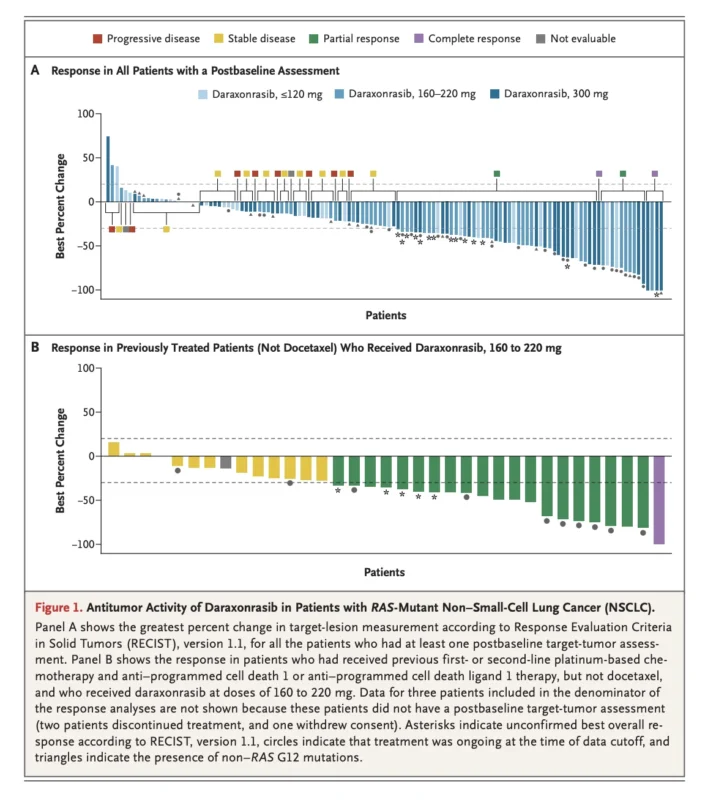
Across the full population, confirmed objective responses were observed in:
- 31% with doses ≤120 mg,
- 34% with doses of 160–220 mg,
- 37% with 300 mg.
The dose-response relationship was therefore relatively modest.
Increasing the dose to 300 mg did not produce a dramatic increase in response rate, an observation that becomes particularly important when considered alongside the toxicity profile.
The waterfall plot presented on page 8 of the paper visually reinforces the broad activity: substantial tumor shrinkage was observed across dose cohorts and across several RAS mutation categories rather than being restricted to a single allele. This is one of the most interesting aspects of the study.
Daraxonrasib appears to be functioning according to its intended biology as a multiselective RAS inhibitor, rather than behaving like another narrowly allele-specific agent.
The Most Clinically Relevant Subgroup Produced a 42% Response Rate
The investigators performed a post hoc analysis intended to approximate the population being taken forward into randomized development. This included patients who had previously received first- or second-line platinum-based chemotherapy plus PD-1/PD-L1 inhibition, but had not yet received docetaxel, and who were treated with daraxonrasib at 160–220 mg.
Among 38 patients with any eligible RAS mutation:
- ORR was 42%
- Disease control rate was 89%
- Median duration of response was 11.5 months
- Median time to response was 1.4 months
One patient achieved a complete response and 15 achieved partial responses.
Responses were observed in tumors harboring KRAS G12D, KRAS G12V, KRAS G12A, KRAS G13R and KRAS Q61H. Among the 33 patients specifically carrying RAS G12 mutations, ORR was again 42%, with a Kaplan–Meier estimate suggesting that 51% of responders remained in response at 18 months.
Although these are small exploratory cohorts, the mutation diversity of the responding population is important. It suggests that the therapeutic concept may genuinely extend beyond G12C.
The Survival Signal Is Also Encouraging
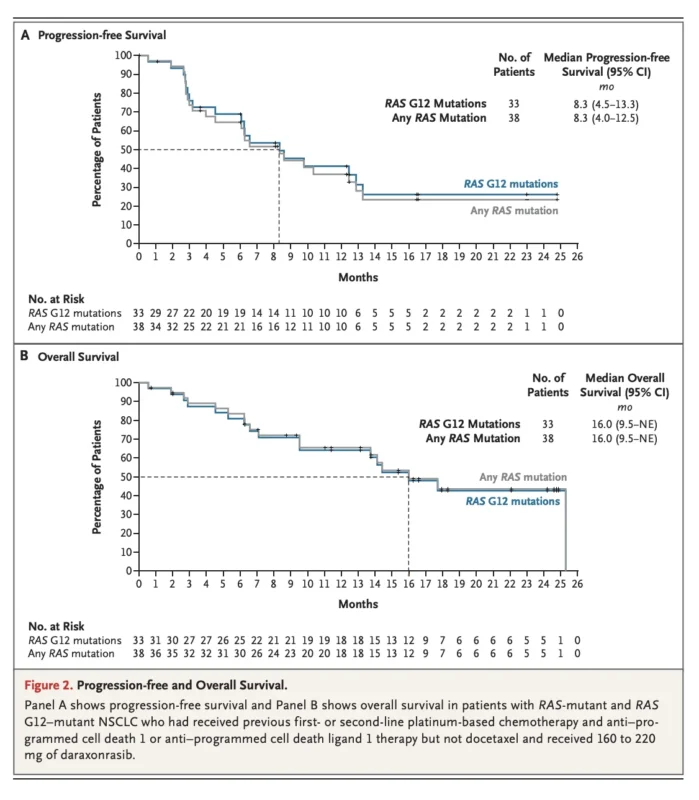
Among the 38 previously platinum/immunotherapy-treated, docetaxel-naïve patients who received 160–220 mg:
- Median PFS was 8.3 months
- 95% CI, 4.0–12.5
- Median OS was 16.0 months
- 95% CI, 9.5–not estimable
Six-month PFS was 65%, and six-month OS was 84%.
The Kaplan–Meier curves on page 10 of the publication show almost identical median PFS and OS estimates in the broader RAS-mutant cohort and the RAS G12 subgroup, supporting the possibility that benefit is not confined to one molecular subset.
The authors place those figures against historical outcomes with docetaxel, for which previously reported median PFS is approximately 3.0–4.5 months and median OS approximately 9.1–11.8 months after platinum and immune checkpoint inhibitor therapy.
That comparison is clinically provocative. But it must not be interpreted as proof that daraxonrasib is superior to docetaxel. There was no randomized comparator in this study. Cross-trial comparisons are subject to major differences in patient selection, prognostic characteristics, assessment methodology and subsequent treatment.
The randomized phase III trial will need to answer that question.
The 200-mg Dose May Be as Important as the Response Rate
One of the more instructive aspects of the study is the dose-selection story. The maximum tolerated dose was never formally reached, but the investigators found that 400 mg required frequent dose modifications and could not be administered sustainably.
Even between 160–220 mg and 300 mg, tolerability differed substantially. At 160–220 mg, treatment-related adverse events leading to dose modification occurred in 47% of patients compared with 75% at 300 mg. Treatment-related dose reductions occurred in 29% versus 53%, respectively.
Mean relative dose intensity was 88% at 160–220 mg versus 75% at 300 mg. Yet response rates were similar. That creates an important pharmacologic lesson: More drug was not necessarily better treatment. For targeted therapies that require sustained pathway suppression, excessive toxicity can paradoxically reduce effective exposure by forcing repeated interruption and dose reduction.
The investigators’ translational modeling suggested that sustained RAS pathway suppression greater than 90% was important for tumor regression. The 160–220 mg range appeared capable of maintaining adequate exposure while allowing more continuous administration.
On the basis of efficacy, pharmacokinetics, pharmacodynamics and tolerability, 200 mg once daily was selected as the phase III NSCLC dose. That dose optimization may prove crucial if daraxonrasib moves into routine practice.
Toxicity Is Meaningful and Will Require Active Management
Across all 136 patients receiving doses up to 300 mg, adverse events of any attribution occurred in 99%, and grade ≥3 events occurred in 54%. Treatment-related grade ≥3 adverse events were reported in 30%.
The most prominent treatment-related toxicities were characteristic of MAPK pathway inhibition. At 160–220 mg:
- rash: 90% overall, 8% grade ≥3
- diarrhea: 66% overall, 3% grade ≥3
- nausea: 54% overall, no grade ≥3 cases
No grade 4 or 5 treatment-related adverse events occurred in this dose cohort.
The full safety table on page 6 also demonstrates a clear dose effect. Grade ≥3 adverse events of any attribution increased from 51% at 160–220 mg to 65% at 300 mg, while dose reductions and interruptions became considerably more frequent at the higher dose.
The authors note that most treatment-related toxicities at the dose range surrounding 200 mg were grade 1–2 and could generally be managed through dose modification, topical corticosteroids, antibiotics, sun protection and antidiarrheal treatment. Prophylactic strategies are being incorporated into phase III development, particularly for rash.
The safety profile therefore appears manageable but certainly not trivial.
RAS G12C Is No Longer the Whole RAS Story
Perhaps the greatest conceptual importance of daraxonrasib comes from the mutations represented among responders. KRAS G12C inhibitors established that RAS can be pharmacologically targeted. But G12C is only one RAS alteration.
In this study, activity was observed in cancers carrying G12D, G12V, G12A, G13R, Q61H and other variants. KRAS G12D and G12V alone represented roughly two-thirds of the study population. That makes daraxonrasib particularly interesting for patients who have historically fallen into the category of:
“RAS-mutant, but without an actionable RAS mutation.”
If randomized trials confirm these findings, that category could become substantially smaller. The distinction would then shift from identifying one particular allele to identifying whether the tumor remains sufficiently dependent on active RAS signaling to respond to multiselective RAS(ON) suppression.
Co-Mutations Did Not Clearly Eliminate Activity, But Numbers Are Small
STK11, KEAP1 and TP53 alterations are clinically relevant in RAS-mutated lung cancer because they can define substantially different biological and immunologic phenotypes. Among 57 patients treated at 160–220 mg who had evaluable co-mutation data, responses were observed among patients both with and without STK11, KEAP1 and TP53 alterations.
That is reassuring but preliminary. The individual subgroups were too small to determine whether any of these alterations truly modify daraxonrasib sensitivity.
This study therefore does not establish that co-mutation status is irrelevant. Larger randomized datasets will be needed to determine whether particular genomic contexts predict deeper response, earlier resistance or different survival outcomes.
Resistance Will Still Emerge
Broad RAS inhibition does not mean resistance disappears. The investigators explicitly note that mechanisms of acquired resistance remain under investigation. Emerging observations suggest that both new on-target RAS alterations and MAPK pathway reactivation may contribute, although these findings remain preliminary.
That is biologically unsurprising. The MAPK signaling network is highly adaptable. Even when active RAS is suppressed across several isoforms, tumor cells may eventually generate alternative ways to restore downstream signaling.
Understanding these mechanisms will be critical for determining whether future strategies should combine daraxonrasib with other targeted agents rather than use it indefinitely as monotherapy.
The Study Does Not Yet Establish a New Standard
The limitations are substantial. RMC-6236-001 was a phase I–II, open-label, nonrandomized study. The primary endpoint was safety, while efficacy was a secondary or exploratory assessment.
No formal efficacy hypotheses were tested. Several clinically interesting subgroup analyses, particularly the docetaxel-naïve analysis, were performed post hoc. The individual mutation cohorts were small. KRAS G12C disease was underrepresented because patients with previous RAS-directed therapy were excluded.
And the promising comparison with historical docetaxel outcomes cannot substitute for a randomized head-to-head trial. These data should therefore be interpreted as strong evidence of antitumor activity and justification for phase III development, not as proof that daraxonrasib should currently replace standard therapy.
RASolve 301 Will Provide the Critical Test
The next step is already underway. The study supports the randomized phase III RASolve 301 trial (NCT06881784) evaluating second-line daraxonrasib against docetaxel in patients with RAS-mutant NSCLC. This is exactly the comparison needed.
The phase I–II results suggest:
- ORR around 42%
- median PFS 8.3 months
- median OS 16.0 months
in the subgroup most closely resembling the phase III population.
Historical docetaxel results look substantially less favorable. But RASolve 301 will determine whether that apparent difference survives randomization. If it does, the implications could be considerable. Rather than having a targeted therapy for one RAS allele, thoracic oncology could potentially gain a targeted strategy for a much broader family of RAS-mutated tumors.
From Allele-Specific to State-Specific RAS Targeting
The evolution of RAS therapeutics can be understood as a change in the question being asked.
The first breakthrough asked:
- Can we drug KRAS G12C?
Daraxonrasib asks something broader:
- Can we drug active RAS itself across multiple oncogenic variants?
That distinction, from allele-specific inhibition to RAS-state-specific inhibition, may ultimately be the most important aspect of this development. If successful, RAS(ON) inhibition could reshape molecular classification in NSCLC.
Instead of dividing patients into a small group with “targetable KRAS G12C” and a much larger group with “untargetable RAS,” treatment could potentially extend across G12D, G12V, G13, Q61 and other mutations. The current study does not prove that future. But it makes it considerably more plausible.
The Bottom Line
Daraxonrasib represents a different approach to one of oncology’s oldest therapeutic challenges. In previously treated advanced RAS-mutant NSCLC, the oral RAS(ON) multiselective inhibitor produced objective responses in 31%–37% of patients across the principal dose groups.
In the clinically relevant, docetaxel-naïve subgroup receiving 160–220 mg:
- ORR: 42%
- Disease control rate: 89%
- Median duration of response: 11.5 months
- Median PFS: 8.3 months
Median OS: 16.0 months
Activity was observed across several RAS mutations rather than being restricted to KRAS G12C. The 200-mg dose has now been selected for phase III development because higher exposure increased toxicity without a clear corresponding increase in efficacy.
The data remain nonrandomized, and daraxonrasib is not yet established as superior to docetaxel. That question belongs to RASolve 301. But the larger signal is already scientifically important:
The future of RAS-targeted therapy may not be one drug for every individual mutation. It may be direct inhibition of the active RAS state across mutations.
If randomized data confirm these early results, daraxonrasib could move RAS-mutant NSCLC from an allele-by-allele treatment strategy toward a substantially broader precision-oncology model.
Reference
- Arbour KC, Punekar S, Luo J, et al. Daraxonrasib for Previously Treated RAS-Mutant Non–Small-Cell Lung Cancer. N Engl J Med. 2026;395:882–893. doi:10.1056/NEJMoa2504059. Published September 3, 2026.