
Selecting immunotherapy for metastatic non-small cell lung cancer (NSCLC) still relies heavily on tissue testing. PD-L1 immunohistochemistry remains the established biomarker used to guide immune checkpoint inhibitor treatment, but obtaining tissue can be invasive, difficult to repeat, and vulnerable to sampling bias in biologically heterogeneous tumors.
A new multi-center study introduces SCENT, a deep learning model designed to infer PD-L1 expression from routine CT scan. The approach aims to function as a noninvasive “virtual biopsy,” potentially adding information beyond a single tissue sample and opening the door to longitudinal biomarker assessment during immunotherapy.
What Is SCENT?
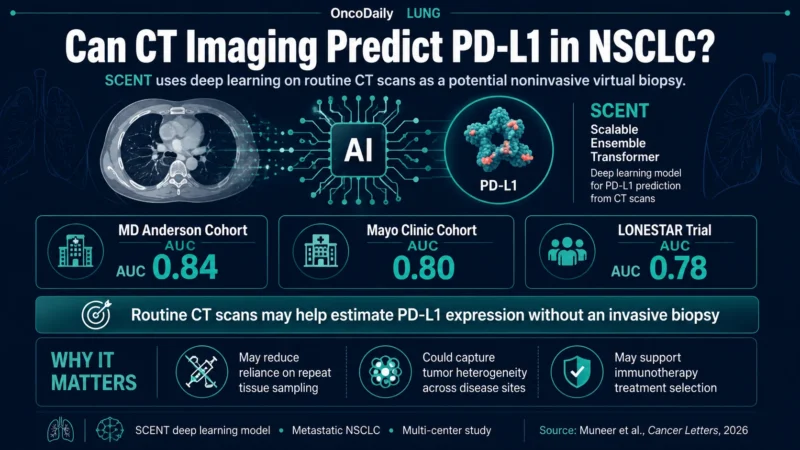
SCENT, or Scalable Ensemble Transformer, is a CT-based deep learning model trained to classify PD-L1 expression as high (≥50%) or low (<50%) in patients with metastatic NSCLC.
The investigators developed the model using diagnostic chest CT scans from patients treated with immune checkpoint inhibitors at MD Anderson Cancer Center. They then evaluated its generalizability in independent cohorts from Mayo Clinic and the randomized phase III LONESTAR trial.
The study included 1,160 patients with advanced NSCLC across the three cohorts. The primary MD Anderson cohort included 972 patients, while external validation included 72 patients from Mayo Clinic and 116 patients from the LONESTAR trial.
CT-Based PD-L1 Prediction Showed Strong Performance
Among patients with paired CT imaging and tissue PD-L1 immunohistochemistry, SCENT demonstrated strong discrimination between PD-L1 expression of at least 50% and lower expression.
In the MD Anderson cohort, SCENT achieved:
- AUC: 0.84
- Sensitivity: 85.3%
- Specificity: 83.9%
The model also retained performance in external datasets:
- AUC: 0.80 in the Mayo Clinic cohort
- AUC: 0.78 in the LONESTAR trial cohort
SCENT outperformed clinical models and conventional radiomics approaches in the study. These findings suggest that deep learning may identify imaging patterns related to tumor immune biology that are not captured through standard clinical variables or handcrafted radiomic features.
Could CT Imaging Help Predict Immunotherapy Outcomes?
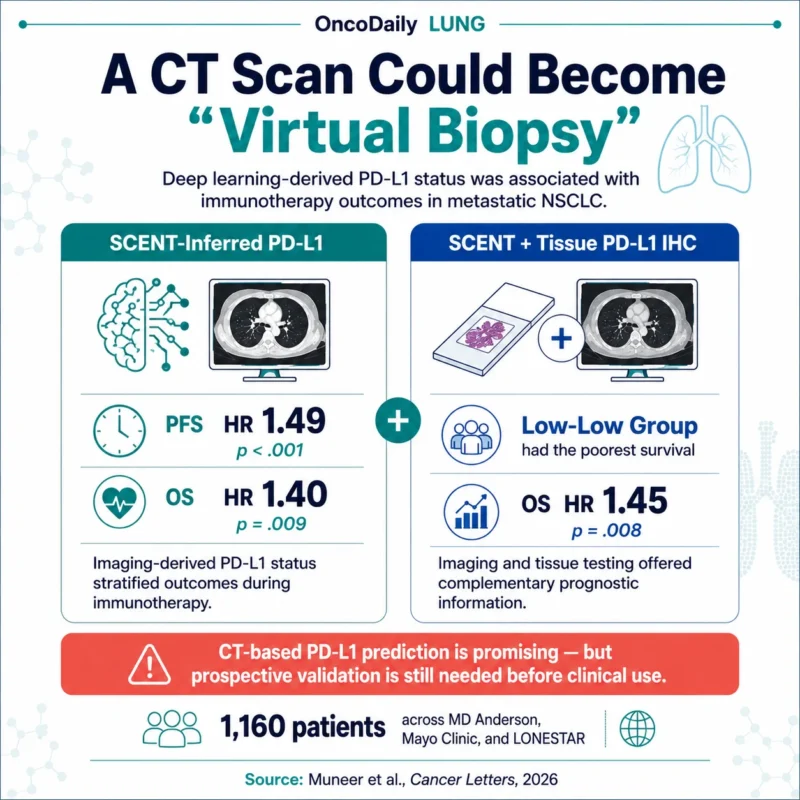
The study did not only examine whether SCENT could classify PD-L1 expression. It also assessed whether SCENT-derived PD-L1 status was associated with outcomes during immune checkpoint inhibitor treatment.
Patients classified by SCENT as having lower inferred PD-L1 expression had worse outcomes with immunotherapy:
- Progression-free survival: HR 1.49, p<0.001
- Overall survival: HR 1.40, p=0.009
The prognostic value of SCENT-derived PD-L1 status was reported to be comparable to tissue PD-L1 immunohistochemistry.
This is clinically relevant because PD-L1 testing from one biopsy specimen may not fully represent the biology of all metastatic sites. CT-based assessment could potentially provide a more global, noninvasive view of disease biology, although this concept requires prospective validation.
Combining Imaging and Tissue Testing May Add Value
One of the most interesting findings was that SCENT and tissue PD-L1 immunohistochemistry appeared to provide complementary prognostic information.
Patients classified as low PD-L1 by both SCENT and tissue IHC had the poorest overall survival. In this concordant low-low group, the overall survival hazard ratio was 1.45 (p=0.008).
This suggests that CT-derived biomarker assessment may not need to replace tissue testing. Instead, it could potentially complement conventional pathology and help refine risk stratification in patients receiving immunotherapy.
Can PD-L1 Status Be Monitored Over Time?
The LONESTAR trial included paired baseline and 3-month CT scans, allowing investigators to explore whether SCENT could track changes in inferred PD-L1 status during immunotherapy.
Serial SCENT results showed a borderline association with progression at 3 months. However, post-treatment tissue confirmation was not available, meaning the longitudinal findings should be considered hypothesis-generating.
The possibility of using serial CT scans as a dynamic virtual biopsy is appealing. Unlike tissue biopsies, CT imaging is already routinely performed during treatment monitoring. Still, prospective trials with paired imaging, tissue, and clinical outcome data will be essential before this strategy can be used in clinical decision-making.
Why This Study Matters
PD-L1 immunohistochemistry remains the current standard biomarker for immunotherapy selection in metastatic NSCLC. However, tissue testing has practical limitations, including procedure-related risks, inadequate samples, temporal changes in PD-L1 expression, and intratumoral heterogeneity.
SCENT represents a step toward a future where routine imaging may contribute more directly to treatment selection. The model showed reproducible PD-L1 classification across multiple cohorts and was associated with immunotherapy outcomes.
Importantly, this is not yet a replacement for PD-L1 tissue testing. The study was retrospective, and the longitudinal imaging findings require confirmation. The authors also emphasize the need for prospective validation before SCENT can be used to guide treatment.
The Bottom Line
This multi-center study suggests that deep learning analysis of standard CT scans can estimate PD-L1 expression and stratify immunotherapy outcomes in metastatic NSCLC.
SCENT achieved AUCs of 0.84, 0.80, and 0.78 across the MD Anderson, Mayo Clinic, and LONESTAR cohorts, respectively. Its prognostic performance was comparable to tissue PD-L1 testing and may add value when combined with immunohistochemistry.
The next challenge is proving whether this CT-based virtual biopsy can improve real-world treatment decisions, particularly when tissue is limited, biopsies are difficult to obtain, or serial monitoring is needed.