
Lung cancer screening with low-dose computed tomography has already demonstrated that detecting disease earlier can reduce mortality in high-risk populations. The more difficult implementation question is what happens after the first few screening rounds.
Should everyone continue annual CT indefinitely?
Can screening intervals be safely extended after a negative baseline examination? And if intervals become longer, will early-stage detection be maintained over time?
Long-term results from the BioMILD trial, published in Lung Cancer, provide important evidence for a more individualized approach. After a median follow-up of 9.4 years, risk-adapted LDCT screening continued to detect a high proportion of lung cancers at stage I, even when participants with negative baseline LDCT were assigned longer screening intervals (Ledda et al., 2026).
The study also delivers an equally important warning: a negative baseline CT substantially lowers near-term lung cancer risk, but it does not eliminate long-term risk. The implication is not that screening can stop after a reassuring initial scan. It is that screening intensity may potentially be tailored to baseline risk.
BioMILD Tested a Risk-Adapted Screening Strategy
The prospective BioMILD trial enrolled 4,119 current or former heavy smokers aged 50–75 years between 2013 and 2016. At baseline and at subsequent screening rounds, participants underwent LDCT and provided blood samples for a microRNA signature classifier. Screening intervals were determined according to combined LDCT and molecular risk assessment, with intervals ranging from short-term recall to three years for participants with both negative LDCT and negative microRNA results (Ledda et al., 2026).
For the current long-term analysis, however, investigators focused specifically on the prognostic value of the baseline LDCT result, dividing participants into: LDCT-negative, representing no suspicious nodules or very small/benign-appearing lesions and LDCT-positive, combining indeterminate and positive baseline findings according to nodule size and density criteria.
The primary objective was to examine how lung cancer diagnoses were distributed across four follow-up intervals:
- 0–2 years
- 3–5 years
- 6–9 years
- ≥9 years.
Secondary outcomes included cumulative lung cancer incidence, all-cause and lung cancer mortality, and screening adherence.
More Than 38,000 Person-Years of Follow-Up
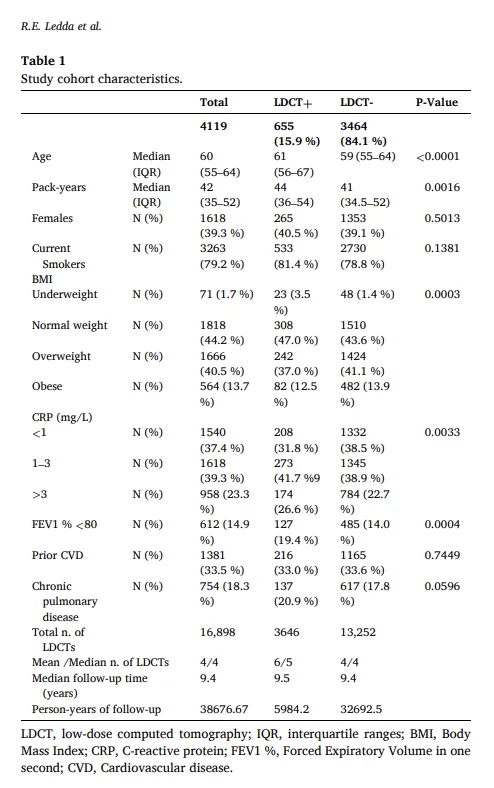
The cohort accumulated 38,676 person-years of observation over a median follow-up of 9.4 years. A total of 16,898 LDCT examinations were performed.
Of the 4,119 participants:
- 3,464 (84.1%) were LDCT-negative
- 655 (15.9%) were LDCT-positive at baseline.
Median age was 60 years, median smoking exposure was 42 pack-years, approximately 39% were women, and nearly 80% were current smokers (Ledda et al., 2026). This long observation period gives BioMILD particular value because most screening studies are strongest in their initial rounds, while real-world screening programmes must function for many years.
Baseline LDCT Strongly Predicted Long-Term Lung Cancer Risk
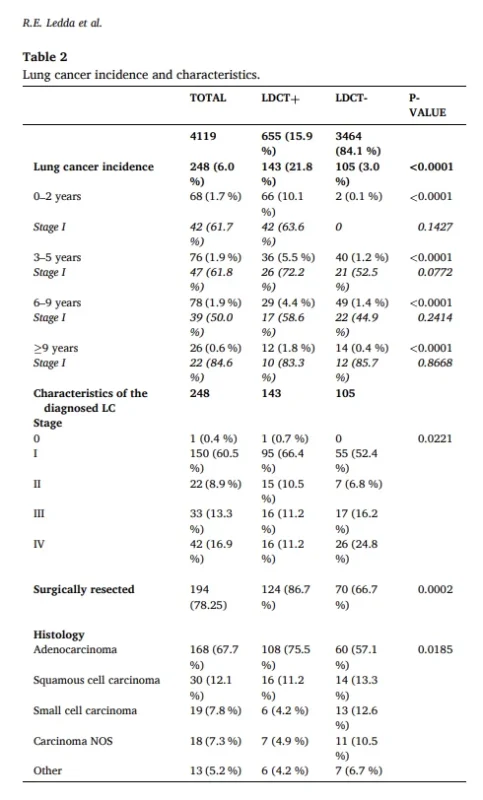
Over the study period, 248 lung cancers were diagnosed, corresponding to an overall incidence of 6.0%. But risk differed dramatically according to the baseline CT. Lung cancer incidence was:
- 21.8% in the LDCT-positive group
versus
- 3.0% in the LDCT-negative group
- P < .0001
That represents more than a seven-fold difference in cumulative lung cancer incidence. The separation persisted after adjustment for major baseline factors including age, sex, pack-years, and smoking history. The figure on page 4 makes this divergence particularly clear: the cumulative incidence curves separate early and continue to diverge across the full 10-year period, showing that information contained in the initial LDCT has long-lasting prognostic value.
Baseline imaging may therefore provide much more than a binary “screen positive” or “screen negative” classification. It can help define long-term risk.
But a Negative Baseline LDCT Did Not Mean Zero Risk
This may be the most clinically important finding in the study. Although incidence was far lower after a negative baseline scan, lung cancers continued to emerge throughout follow-up in the LDCT-negative population. Among cancers diagnosed during years 3–5, 40 occurred in the baseline LDCT-negative group.
During years 6–9, another 49 cancers arose in this initially lower-risk population. Beyond nine years, 14 additional cancers were diagnosed after an originally negative baseline examination (Ledda et al., 2026). The authors therefore argue that baseline-negative participants remain susceptible to lung cancer over time and should not simply exit screening permanently.
A negative scan lowers risk. It does not erase it.
Early-Stage Detection Was Maintained Across Nearly a Decade
The major concern with extending screening intervals is the possibility that cancers will be detected later. BioMILD provides reassuring evidence on this point. Stage I disease accounted for:
- 61.7% of cancers diagnosed at 0–2 years
- 61.8% at 3–5 years
- 50.0% at 6–9 years
- 84.6% beyond 9 years
Across the entire cohort, 60.5% of lung cancers were stage I at diagnosis. Importantly, the proportion of stage I tumors did not significantly differ between baseline LDCT-positive and LDCT-negative groups within individual screening intervals.
The stage-distribution graphic on page 5 reinforces this point: despite extended follow-up and longer intervals for lower-risk participants, early-stage disease continued to account for a substantial proportion of cancers in every time period. That finding supports the possibility that risk-adapted intervals can preserve the principal purpose of screening, detecting lung cancer while it remains potentially curable.
Extended Intervals Did Not Produce an Obvious Collapse in Screening Performance
The study’s broader implication concerns the assumption that annual CT is necessary for every eligible participant indefinitely. BioMILD does not establish that triennial screening is universally equivalent to annual screening. It was not designed as a randomized head-to-head comparison of interval strategies. However, the findings suggest that selected participants with reassuring baseline findings can undergo longer screening intervals while maintaining a high proportion of early-stage diagnoses.
This aligns with a broader movement in lung cancer screening toward risk-based intensity, where imaging findings, smoking history, age, comorbidities, and potentially biomarkers determine how frequently an individual should return. The goal is not simply fewer scans. It is better allocation of screening intensity.
Lung Cancer Mortality Also Reflected Baseline Risk
Overall all-cause mortality was 7.3%, while lung cancer mortality was 1.8%. At 10 years, the LDCT-positive group had substantially higher mortality than the LDCT-negative group. All-cause mortality was:
- 14% versus 6%
and lung cancer mortality was:
- 5% versus 1%, respectively, with highly significant differences
The mortality curves on page 4 mirror the difference in cancer incidence, showing persistent separation between the two baseline risk groups over time. The authors caution that the higher mortality in the LDCT-positive population should not be interpreted as evidence that screening performed less effectively in that group. Instead, it most likely reflects a population with intrinsically higher baseline cancer risk.
Screening Also Avoided Substantial Overtreatment
Lung cancer screening carries a competing concern: detecting indolent abnormalities that lead to unnecessary invasive procedures. BioMILD attempted to limit this through active surveillance of non-solid nodules and intervention primarily when more concerning features developed.
Across the entire study, only one lung cancer classified as stage 0 carcinoma in situ underwent surgical resection. Furthermore, only 13 patients underwent lung resection for benign histology, representing approximately 6% of all lung resections.
The authors argue that this low rate supports conservative surveillance of selected subsolid nodules rather than immediate surgery. This is an important point in screening programme design. The success of LDCT should not be measured only by how many cancers are detected. It should also be judged by how effectively unnecessary diagnostic and surgical interventions are avoided.
Adherence Remained High Initially but Declined With Time
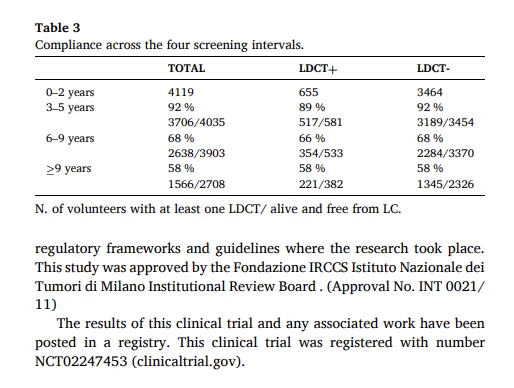
Screening is only effective if participants continue returning. BioMILD provides rare long-term data on adherence. Compliance was:
- 92% during years 3–5
- 68% during years 6–9
- 58% beyond 9 years.
Interestingly, adherence was essentially similar between baseline LDCT-positive and LDCT-negative participants (Ledda et al., 2026). The decline is not unexpected. Even tightly controlled screening trials often report excellent adherence during early rounds followed by lower participation after formal trial follow-up ends.
What is encouraging is that more than half of eligible participants were still participating after approximately a decade. The authors consider this evidence that extended risk-adapted screening can remain feasible over prolonged periods, although they acknowledge that BioMILD’s relatively modest size and single-center organization may have facilitated follow-up (Ledda et al., 2026).
The Main Question Is Not Annual Versus Triennial for Everyone
The results should not be simplified into the claim that “lung cancer screening only needs to happen every three years.” The study does not support that conclusion. BioMILD used a personalized strategy in which lower-risk participants could receive extended intervals, while those with suspicious imaging or other risk signals underwent closer surveillance.
In addition, although the original BioMILD strategy combined LDCT with a plasma microRNA classifier, the present analysis evaluated outcomes according to baseline CT alone. The microRNA component was not incorporated into the current risk comparison, limiting the ability to determine how much additional value the full combined BioMILD algorithm provided (Ledda et al., 2026).
The more defensible interpretation is therefore screening frequency may be individualized according to baseline risk rather than applied uniformly.
Why This Matters for Population Screening
Annual LDCT screening can create considerable cumulative burden when implemented across large populations. Every scan carries financial cost, logistical burden, additional imaging findings, radiation exposure, and the possibility of false-positive evaluation. Risk-adapted screening could potentially concentrate imaging resources on those with the greatest probability of developing cancer while safely reducing scan frequency for lower-risk individuals.
This could be particularly important in national screening programmes where millions of eligible individuals may need long-term surveillance. But any interval extension must preserve early-stage detection. BioMILD’s nearly decade-long experience suggests that this may be possible in selected populations.
Important Limitations
The study has several limitations that prevent it from defining a new universal screening schedule. BioMILD was a single-center prospective study, which may limit generalizability to broader national screening populations. The long-term analysis was observational, meaning it cannot directly establish that extended intervals themselves reduce mortality or are equivalent to annual screening.
The sample size was also modest compared with major population-level screening programmes. In addition, the current analysis intentionally focused on baseline LDCT and did not fully evaluate the microRNA classifier that formed part of the original BioMILD personalized screening strategy.
Changes in smoking behavior, comorbidities, and other health factors during nearly a decade of follow-up could also have influenced long-term outcomes. These caveats mean that the study should inform future risk-adapted screening research rather than immediately replace established screening guidelines.
The Bottom Line
The long-term BioMILD analysis provides an important message for the future of lung cancer screening. Among 4,119 heavy smokers followed for a median of 9.4 years:
- 248 lung cancers were diagnosed
- overall incidence was 6.0%
- LDCT-positive incidence was 21.8%
- LDCT-negative incidence was 3.0%
and stage I disease remained the predominant presentation across most screening intervals (Ledda et al., 2026). Screening adherence remained 92% at 3–5 years, 68% at 6–9 years, and 58% beyond nine years. The study therefore supports two conclusions that must be considered together.
First, baseline LDCT can meaningfully stratify long-term risk and may help identify individuals in whom screening intervals can be extended. Second, a negative baseline CT does not mean screening can stop, because lung cancers continued to develop years later in initially low-risk participants.
The future of lung cancer screening may therefore be less about choosing between annual screening and no screening. It may be about building a dynamic surveillance strategy in which screening intensity follows risk over time.
Reference
- Ledda, R. E., Sabia, F., Beck, K. S., Milanese, G., Ruggirello, M., Balbi, M., Rolli, L., Boeri, M., Sozzi, G., Sverzellati, N., Marchianò, A. V., & Pastorino, U. (2026). Long-term efficacy and adherence of a lung cancer screening strategy with extended LDCT intervals: Results from the BioMILD trial. Lung Cancer, 221, 109629. https://doi.org/10.1016/j.lungcan.2026.109629.