
The success of targeted therapy in metastatic ALK-positive non-small-cell lung cancer created an intuitive expectation: if ALK inhibition can profoundly suppress advanced disease, perhaps the same strategy should eradicate microscopic residual disease after surgery. E4512 shows why that assumption cannot be taken for granted.
In the randomized phase 3 trial published online in The Lancet Respiratory Medicine on August 25, 2026, adjuvant crizotinib did not improve disease-free survival compared with observation in patients with completely resected, early-stage ALK-positive NSCLC.
After a median follow-up of 65.7 months, median DFS was 74.6 months with crizotinib versus 106.2 months with observation, with a hazard ratio of 1.08 and P=0.80. The result is clearly negative.
But its importance extends beyond one first-generation ALK inhibitor. E4512 illustrates a broader principle that is becoming increasingly important in early-stage oncogene-driven lung cancer:
Targeting the right molecular alteration is not enough. The potency, pharmacology, CNS activity, tolerability and generation of the targeted agent may determine whether metastatic success can be translated into cure-oriented therapy.
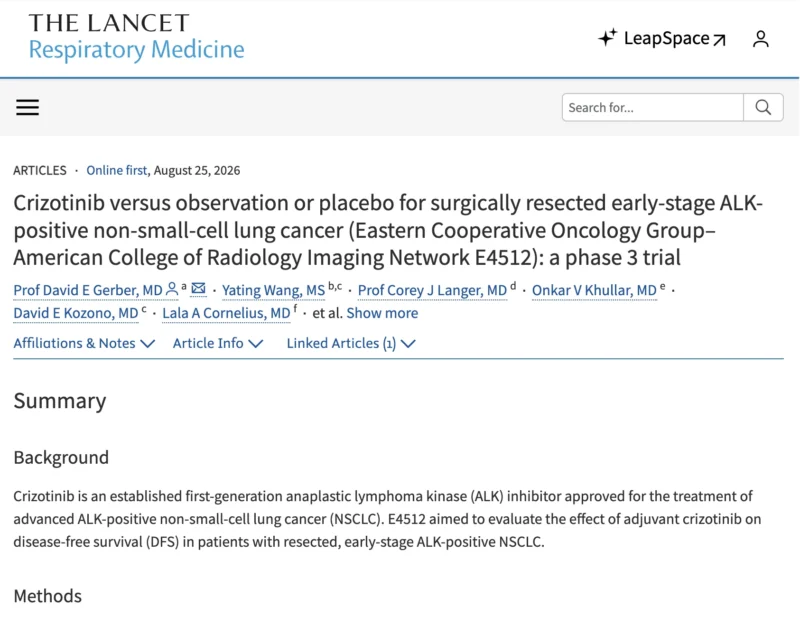
E4512 Asked a Simple but Important Question
Crizotinib established proof of principle that ALK rearrangements could be therapeutically targeted in advanced NSCLC.
E4512 tested whether that biological dependency could also be exploited after complete surgical resection.
Patients were eligible if they had resected ALK-positive NSCLC with either a tumor measuring at least 4 cm or lymph-node-positive disease, negative surgical margins, no neoadjuvant treatment and an ECOG performance status of 0–1.
Patients were randomly assigned 1:1 to crizotinib 250 mg twice daily for up to two years or observation. Adjuvant chemotherapy was permitted but was not mandatory. The primary endpoint was DFS in the centrally confirmed ALK-positive intention-to-treat population.
The trial was ambitious in scale, opening across 1,618 sites in the United States, Guam and Puerto Rico.
Yet the molecular rarity of ALK-positive resected NSCLC made accrual inherently difficult.
Between August 2014 and May 2024, 166 patients were enrolled from a planned 168, with 85 assigned to crizotinib and 81 to observation. Central testing confirmed ALK positivity in 153 patients.
Importantly, enrollment ultimately stopped not because the study had answered the question early, but because the therapeutic landscape had already moved forward: the FDA approved adjuvant alectinib during the trial.
That fact is critical to understanding E4512 today. The trial began in one era of ALK therapy and reported in another.
Crizotinib Did Not Reduce the Risk of Recurrence
The primary endpoint was unequivocally negative.
After a median follow-up of 65.7 months:
- Median DFS with crizotinib was 74.6 months
- Median DFS with observation was 106.2 months
- The hazard ratio was 1.08, with a 95% CI of 0.61–1.90 and P=0.80
There was therefore no evidence that two years of postoperative crizotinib reduced recurrence risk.
If anything, the numerical median favored observation, although the wide confidence interval and nonsignificant hazard ratio mean that this difference should not be interpreted as evidence that crizotinib actively worsened outcomes.
The appropriate conclusion is simpler adjuvant crizotinib did not demonstrate clinical benefit. The investigators state this directly and conclude that crizotinib should not be recommended as adjuvant therapy after resection of ALK-positive NSCLC.
Why Did a Highly Relevant Target Fail to Produce an Adjuvant Benefit?
This is where E4512 becomes more interesting than a simple negative trial. The biological target was not wrong. ALK remains one of the clearest oncogenic drivers in lung cancer. What changed during the life of this study was our understanding of how effectively ALK needs to be inhibited.
Crizotinib was foundational, but it is a first-generation ALK inhibitor. Subsequent agents were developed with greater potency and stronger intracranial activity.
The paper itself places E4512 within that evolution by citing modern ALK trials and, most importantly, the phase 3 study of adjuvant alectinib in resected ALK-positive NSCLC.
The implication is important. A negative trial of crizotinib should not be interpreted as evidence that ALK inhibition as a class has no role in early-stage disease.
Rather, it demonstrates that efficacy cannot automatically be extrapolated from one ALK inhibitor to another. That distinction is central in oncogene-driven lung cancer.
The Adjuvant Setting Is Biologically Less Forgiving Than Metastatic Disease
In advanced disease, treatment efficacy is measured largely through tumor shrinkage, progression-free survival and overall survival in patients with measurable cancer.
The adjuvant setting is different. After surgery, the therapeutic target is invisible. Treatment is directed against presumed micrometastatic residual disease, and the objective is not simply disease control but prevention of recurrence.
That creates a very high bar. A drug must suppress residual malignant clones long enough, and deeply enough, to alter the probability that clinically detectable disease ever returns.
A treatment capable of generating responses in metastatic disease may therefore still be inadequate as an adjuvant strategy.
E4512 is a useful reminder that activity against measurable disease and eradication of microscopic disease are related, but they are not equivalent therapeutic achievements.
CNS Control May Be Particularly Important in ALK-Positive Disease
Another plausible consideration is central nervous system activity. ALK-positive NSCLC has a clinically important propensity for brain metastases. For patients who undergo curative-intent surgery and may otherwise live for many years, prevention of CNS recurrence can become an especially important component of effective adjuvant treatment.
Crizotinib was developed before CNS penetration became one of the defining characteristics separating generations of ALK inhibitors. Modern ALK therapy has increasingly emphasized not only systemic control but also intracranial control and prevention.
E4512 does not directly establish that limited CNS activity explains its negative result. The supplied report does not provide recurrence-site analyses sufficient to make that causal claim. But the broader evolution of ALK therapy makes the issue difficult to ignore.
In early-stage disease, the optimal agent likely needs to suppress disease in all potential sanctuary sites, not merely the extracranial compartment.
Toxicity Matters More When Patients Have No Visible Disease
The safety findings also deserve attention. Among patients receiving crizotinib, 58% experienced grade 3 or higher adverse events of any attribution.
The most frequently reported included diarrhea, edema and hypertension. Serious adverse events occurred in 27%, and one death occurred, although it was not considered treatment-related. The risk-benefit calculation in the adjuvant setting is fundamentally different from that in metastatic disease.
A patient receiving postoperative therapy may have no detectable cancer after surgery. Some may already have been cured by local therapy and chemotherapy alone.
Therefore, every additional treatment must provide enough reduction in recurrence risk to justify exposing the entire population to toxicity. That makes a negative DFS result especially consequential.
Without demonstrated efficacy, even manageable toxicity becomes unnecessary toxicity.
E4512 Also Shows How Fast Precision Oncology Can Outrun a Clinical Trial
There is another important lesson in the history of the study. E4512 enrolled patients over almost a decade, from 2014 through 2024. During that period, ALK treatment changed dramatically.
Crizotinib moved from being a transformative standard in advanced disease to being surpassed by newer-generation ALK inhibitors. Eventually, the FDA approval of adjuvant alectinib led to premature closure of E4512 accrual.
This creates a recurring challenge for biomarker-selected adjuvant trials. Rare molecular subgroups require large screening networks and long enrollment periods.
But targeted-therapy development can move faster than those trials can complete. By the time a study reports, the investigational agent may already represent an older therapeutic generation.
That does not make the result irrelevant. It changes the question the result answers. E4512 no longer tells us whether ALK-targeted adjuvant therapy works. It tells us whether crizotinib should be used for that purpose. The answer is no.
Negative Trials Can Still Clarify the Standard
There is sometimes a tendency to view negative trials as less consequential than positive ones. E4512 demonstrates why that is not always true. The trial provides randomized evidence against a strategy that otherwise could have appeared biologically reasonable.
Without such data, clinicians might have been tempted to extrapolate from metastatic activity and use crizotinib in patients who lacked access to newer agents.
The phase 3 result closes that door. This is particularly relevant because precision oncology creates a strong conceptual pull toward treatment based on target presence. Yet the presence of an oncogenic driver does not make every inhibitor of that driver interchangeable.
- The drug still matters
- Generation matters
- Pharmacology matters
- CNS penetration matters
- And ultimately, randomized clinical outcome data matter
From Molecular Matching to Molecular Optimization
The larger evolution in early-stage oncogene-driven lung cancer can be summarized as a shift from molecular matching to molecular optimization.
The first generation of precision oncology asked:
- Does this tumor have ALK?
The next generation asks:
- Which ALK inhibitor provides the depth, duration and anatomic coverage required to reduce recurrence after surgery?
E4512 helps establish that these are not the same question.
This distinction extends well beyond ALK. As targeted therapies increasingly move from metastatic NSCLC into neoadjuvant and adjuvant settings, every molecularly selected strategy will need to prove that suppression of an oncogenic driver translates into a clinically meaningful reduction in recurrence.
We should not assume that the success of a drug in stage IV disease guarantees success after surgery.
The Bottom Line
E4512 provides a clear answer about adjuvant crizotinib. In patients with completely resected, early-stage ALK-positive NSCLC, two years of crizotinib did not improve disease-free survival compared with observation.
Median DFS was 74.6 months with crizotinib versus 106.2 months with observation, with HR 1.08 and P=0.80. The result supports the investigators’ conclusion that crizotinib should not be recommended as adjuvant therapy in this setting.
But E4512 should not be interpreted as a failure of the broader concept of adjuvant ALK inhibition. Instead, it demonstrates why precision oncology must extend beyond identifying the correct molecular target.
The right target still requires the right drug. And in curative-intent disease, where the objective is eradication of microscopic residual cancer rather than temporary control of measurable disease, that difference may be decisive.
Reference
- Gerber DE, Wang Y, Langer CJ, Khullar OV, Kozono DE, Cornelius LA, et al. Crizotinib versus observation or placebo for surgically resected early-stage ALK-positive non-small-cell lung cancer (Eastern Cooperative Oncology Group–American College of Radiology Imaging Network E4512): a phase 3 trial. The Lancet Respiratory Medicine. Published August 25, 2026. doi:10.1016/S2213-2600(26)00192-X.