
LIBRETTO-432 Trial was presented during ASCO 2026 by Jonathan W. Goldman, MD, as a global, multicenter, phase 3, double-blind, randomized, placebo-controlled study evaluating adjuvant selpercatinib in patients with early-stage RET fusion-positive non-small cell lung cancer. The study assessed whether selpercatinib could improve event-free survival after definitive therapy in patients with stage IB–IIIA disease.
Background
The presentation highlighted that targeted therapy is a mainstay of treatment in oncogene-driven NSCLC, where immunotherapy has demonstrated limited activity. Adjuvant targeted therapy has already improved outcomes in EGFR- and ALK-positive early-stage NSCLC, establishing new standards of care in those populations.
For RET fusion-positive NSCLC, the slides noted that selpercatinib demonstrated superior progression-free survival versus chemotherapy plus pembrolizumab in advanced or metastatic disease in the randomized phase 3 LIBRETTO-431 trial. However, no adjuvant targeted therapy is approved for early-stage RET fusion-positive NSCLC. LIBRETTO-432 was designed to investigate selpercatinib as adjuvant therapy in this patient population.
Study Design
LIBRETTO-432 enrolled 151 patients across 65 sites in 22 countries. Enrollment occurred from January 2022 to March 2025, with a database cutoff in January 2026.
Eligible patients had histologically confirmed RET fusion-positive NSCLC, stage IB, II, or IIIA, and had received definitive therapy with surgery or radiotherapy, with or without systemic adjuvant chemotherapy. Patients were required to have no evidence of disease recurrence or progression after definitive therapy.
Patients were randomized 1:1 to receive either selpercatinib or placebo. Selpercatinib was given at 160 mg orally twice daily for patients weighing ≥50 kg and 120 mg orally twice daily for those weighing <50 kg. Placebo was given orally twice daily. Treatment continued for up to 3 years, until disease recurrence, progression, or death. Optional crossover was allowed after progressive disease.
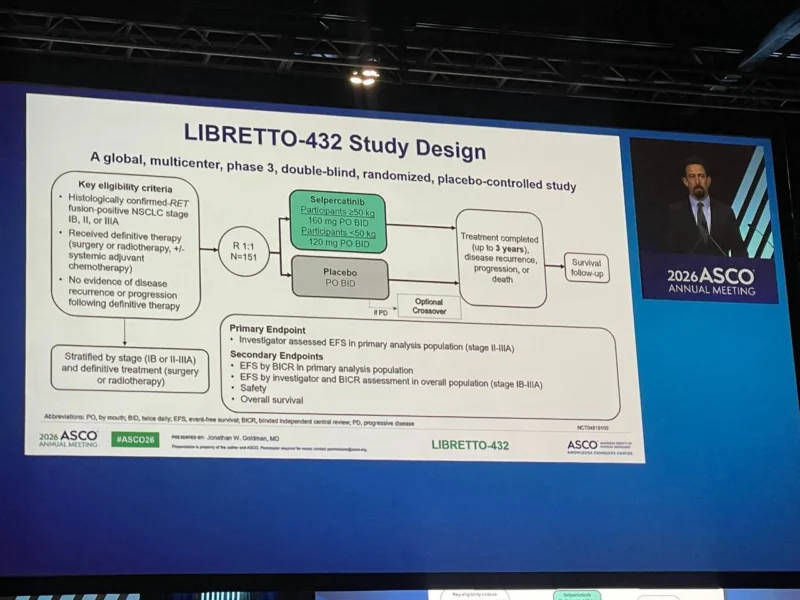
Patients were stratified by disease stage and definitive treatment, including surgery or radiotherapy.
The primary endpoint was investigator-assessed event-free survival in the primary analysis population, which included patients with stage II–IIIA disease.
Secondary endpoints included event-free survival by blinded independent central review in the primary analysis population, event-free survival by investigator and blinded independent central review in the overall stage IB–IIIA population, safety, and overall survival.
The final EFS analysis was originally planned after 67 events in the primary analysis population, assuming an EFS hazard ratio of 0.5. Before unblinding and before any EFS analysis, this assumption was re-evaluated based on ADAURA and ALINA outcomes and supported by selpercatinib activity in LIBRETTO-431. A protocol amendment revised the primary analysis to occur after at least 20 EFS events and at least 4 years of follow-up since the first patient was randomized, assuming an EFS hazard ratio of 0.24. The sample size remained unchanged at 150–170 patients.
In the overall stage IB–IIIA population, 75 patients were assigned to selpercatinib and 76 to placebo. In the primary analysis population, 54 patients received selpercatinib and 55 received placebo.
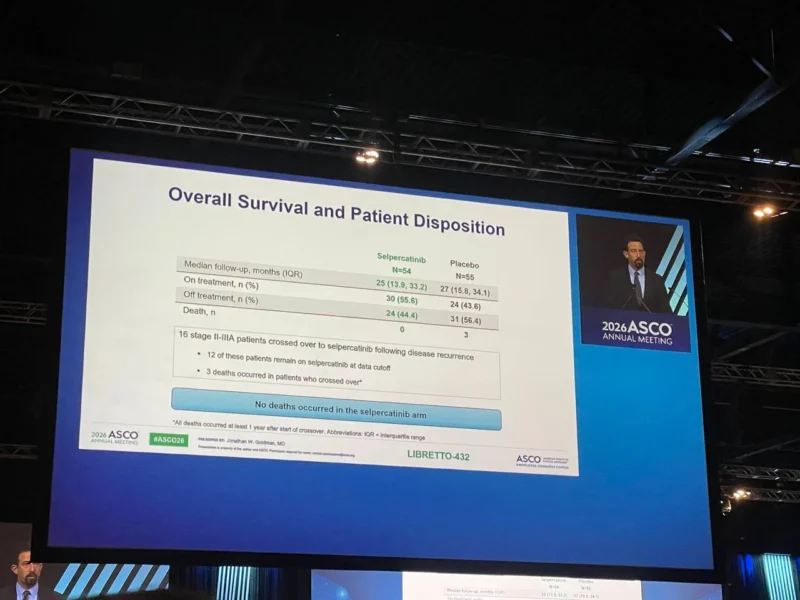
At the data cutoff in the primary analysis population, 30 patients in the selpercatinib arm remained on treatment and 24 had discontinued treatment. In the placebo arm, 24 patients remained on treatment and 31 had discontinued treatment. Disease relapse led to treatment discontinuation in 3 patients in the selpercatinib arm and 17 patients in the placebo arm.
Baseline characteristics were reported as similar and balanced between the primary and overall treatment populations. In the primary analysis population, the median age was 59.5 years in the selpercatinib arm and 61.0 years in the placebo arm.
Women represented 63.0% of the selpercatinib arm and 54.5% of the placebo arm. Most patients were never-smokers, including 68.5% and 69.1%, respectively. ECOG performance status was 0 in 55.6% of patients receiving selpercatinib and 65.5% receiving placebo.
The most common RET fusion was KIF5B::RET, reported in 61.1% of patients in the selpercatinib arm and 61.8% in the placebo arm. CCDC6::RET was reported in 25.9% and 20.0%, respectively.
Most patients had received prior systemic therapy, reported in 92.6% of the selpercatinib arm and 90.9% of the placebo arm.
Results
LIBRETTO-432 met its primary endpoint. In the stage II–IIIA primary analysis population, investigator-assessed event-free survival was significantly improved with selpercatinib compared with placebo.
There were 4 EFS events in the selpercatinib arm compared with 19 EFS events in the placebo arm. The hazard ratio was 0.172, with a 95% confidence interval of 0.058–0.509 and p=0.0003.
At 24 months, the EFS rate was 91.5% with selpercatinib and 61.1% with placebo. The slides stated that the primary endpoint was met and that selpercatinib demonstrated a statistically significant improvement in EFS.
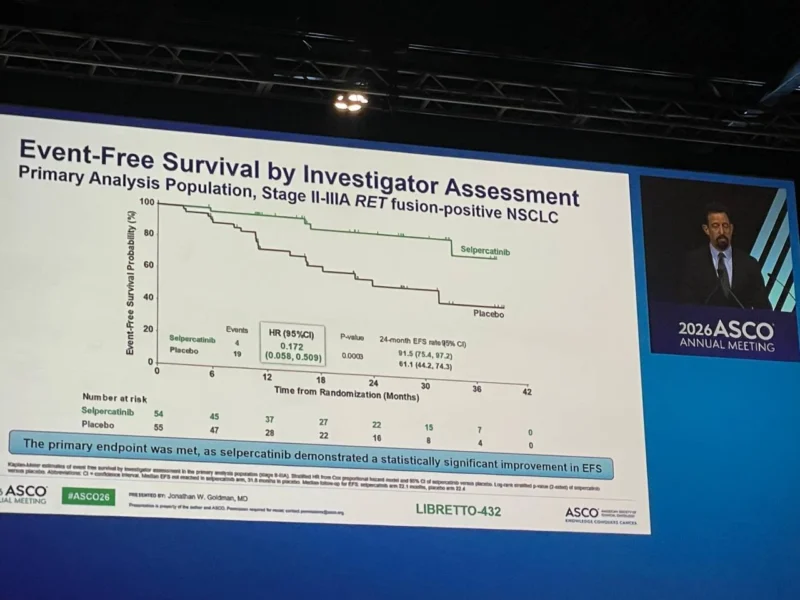
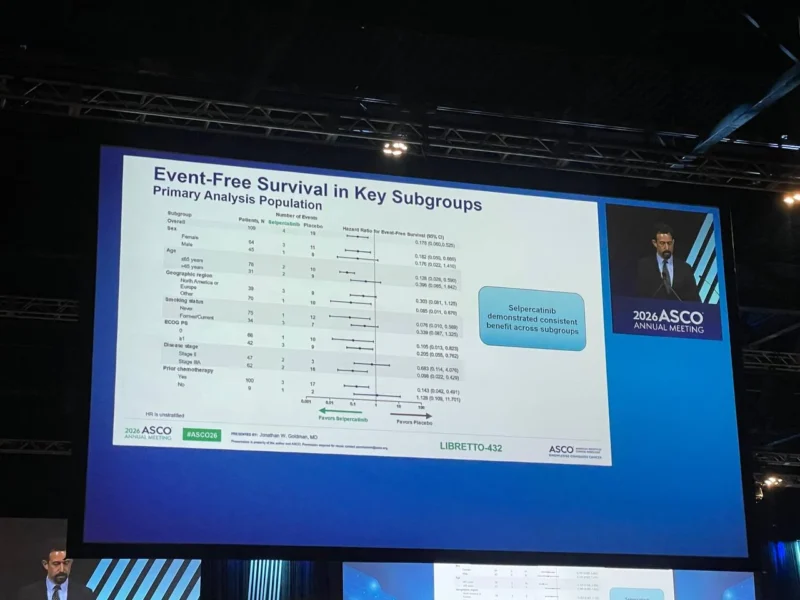
The presentation also noted that benefit was consistent in the overall study population, including patients with stage IB–IIIA disease, and that blinded independent central review showed a consistent treatment effect. Subgroup analysis also supported a consistent benefit across clinically relevant subgroups, although some subgroup sizes were small.
The presentation reported fewer sites of progression with selpercatinib. Locoregional progression occurred in 1 patient receiving selpercatinib and 10 receiving placebo. Local progression occurred in 1 versus 3 patients, and regional progression occurred in 0 versus 7 patients.
Distant progression occurred in 5 patients in the selpercatinib arm and 18 in the placebo arm. Brain progression occurred in 1 versus 3 patients. The slide noted that a patient could present with more than one site of disease recurrence.
Median follow-up was 25 months in the selpercatinib arm and 27 months in the placebo arm. No deaths occurred in the selpercatinib arm, while 3 deaths occurred in the placebo arm.
A total of 16 stage II–IIIA patients crossed over to selpercatinib following disease recurrence. Of these, 12 remained on selpercatinib at the data cutoff. The slide noted that the 3 deaths occurred in patients who crossed over, and all deaths occurred at least one year after the start of crossover.
Safety
In the overall safety population, any treatment-emergent adverse event occurred in 100% of patients receiving selpercatinib and 97.4% receiving placebo. Grade ≥3 treatment-emergent adverse events occurred in 66.7% and 23.7%, respectively.
Serious treatment-emergent adverse events occurred in 22.7% of patients receiving selpercatinib and 13.2% receiving placebo. Discontinuation of study treatment due to treatment-emergent adverse events occurred in 17.3% versus 1.3%. Discontinuation due to serious adverse events occurred in 2.7% versus 1.3%.
Dose modifications were more frequent with selpercatinib, occurring in 88.0% compared with 46.1% in the placebo arm. Dose interruptions due to treatment-emergent adverse events occurred in 77.3% versus 26.3%, and dose reductions due to treatment-emergent adverse events occurred in 54.7% versus 7.9%. No treatment-emergent adverse events leading to death occurred on study treatment in either arm.
The most common reasons for selpercatinib discontinuation were ALT increase, AST increase, and interstitial lung disease. The presentation stated that grade ≥3 treatment-emergent adverse events were manageable with dose modifications, and that discontinuations in the selpercatinib arm were mostly due to low-grade events.
Key Adverse Events
Adverse events were generally consistent with the known safety profile of selpercatinib. ALT increase occurred in 62.7% of patients receiving selpercatinib and 18.4% receiving placebo, with grade ≥3 events in 17.3% and 1.3%, respectively. AST increase occurred in 60.0% and 15.8%, with grade ≥3 events in 18.7% and 2.6%.
Diarrhea occurred in 38.7% of patients receiving selpercatinib and 17.1% receiving placebo, with grade ≥3 events in 4.0% and 0%. Dry mouth occurred in 40.0% versus 15.8%, cough in 26.7% versus 23.7%, bilirubin increase in 26.7% versus 14.5%, hypertension in 30.7% versus 10.5%, constipation in 22.7% versus 13.2%, and hyperuricemia in 20.0% versus 10.5%.
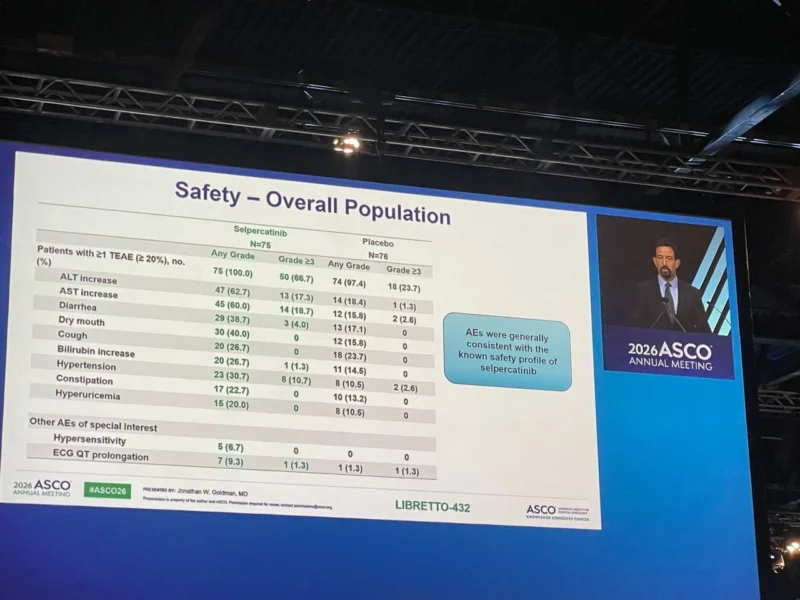
Other adverse events of special interest included hypersensitivity, reported in 6.7% of patients receiving selpercatinib and 0% receiving placebo, and ECG QT prolongation, reported in 9.3% and 1.3%, respectively.
Conclusions
LIBRETTO-432 demonstrated a statistically significant and clinically meaningful event-free survival improvement with selpercatinib compared with placebo in patients with early-stage RET fusion-positive NSCLC. In the stage II–IIIA population, the EFS hazard ratio was 0.17, with p<0.001, and consistent clinical benefit was observed across predefined subgroups and by blinded independent central review.
The safety profile was generally consistent with the known profile of selpercatinib. The presentation concluded that the results reinforce the value of comprehensive biomarker testing for actionable oncogenic drivers at diagnosis to guide therapeutic decision-making.
The conclusion slide stated that adjuvant selpercatinib should be considered a new standard of care in early-stage RET fusion-positive NSCLC.