Updated results from the single-arm phase II WUTSUP-02 trial showed pathological and radiographic responses with neoadjuvant tislelizumab plus disitamab vedotin, followed by radical nephroureterectomy and adjuvant tislelizumab, in high-risk, non-metastatic upper tract urothelial carcinoma (UTUC) with HER2 IHC 1+/2+/3+ expression.
In the intention-to-treat population, the objective response rate (ORR) was 81.0% (34/42), and the pathological complete response (pCR) rate was 26.2% (11/42). Among the 39 patients undergoing nephroureterectomy, corresponding rates were 79.5% and 28.2%.
The findings were presented at ESMO 2026 in abstract 473RO. The supplied presentation identifies Yige Bao.
Background
Recurrence and systemic progression remain concerns in high-risk UTUC despite radical nephroureterectomy. Perioperative systemic treatment aims to address disease beyond the primary tumor.
Disitamab vedotin is a HER2-directed antibody–drug conjugate carrying a monomethyl auristatin E payload. WUTSUP-02 investigated its combination with the PD-1 inhibitor tislelizumab before surgery, followed by postoperative tislelizumab.
Methods and Study Design
WUTSUP-02 (ChiCTR2300067836) was a prospective, multicenter, single-arm phase II study.
Key eligibility criteria included:
- Age 18–75 years.
- Histologically confirmed UTUC.
- Clinical stage cT2–4N0–2M0 or cTanyN1–2M0.
- HER2 expression of IHC 1+, 2+, or 3+.
- ECOG performance status 0–1 and no contraindications to surgery or systemic therapy.
Patients received four three-week cycles of disitamab vedotin 2.0 mg/kg plus tislelizumab 200 mg.
An interim assessment was performed after two cycles using contrast-enhanced CT, ureteroscopy, and urine cytology/FISH. Patients with progression were to proceed to radical nephroureterectomy.
Surgery was followed by eight cycles of adjuvant tislelizumab 200 mg every three weeks. Ipsilateral adrenalectomy and lymph node dissection were performed when indicated.
The primary endpoint was pCR. Secondary endpoints included ORR, overall survival (OS), metastasis-free survival (MFS), and treatment-related adverse events.
Patient Population
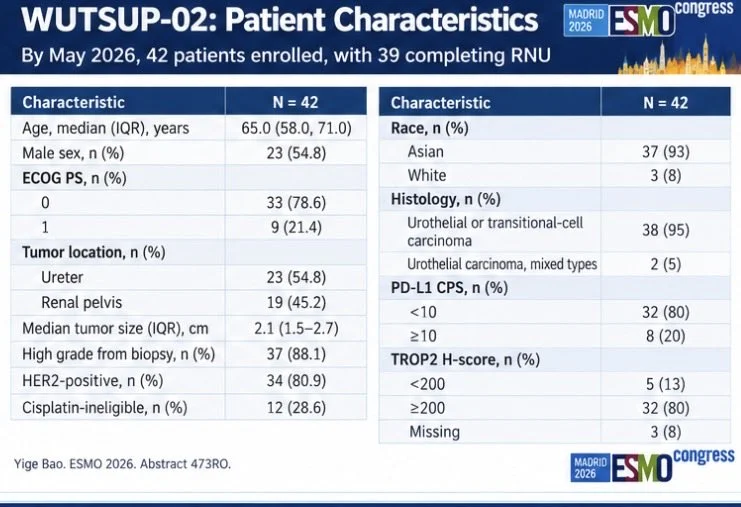
By May 2026, 42 patients had enrolled, and 39 had completed radical nephroureterectomy.
Median age was 65 years. High-grade tumors were present in 88.1%, and 28.6% of patients were cisplatin-ineligible. Tumors were located in the ureter in 54.8% and the renal pelvis in 45.2%.
Results
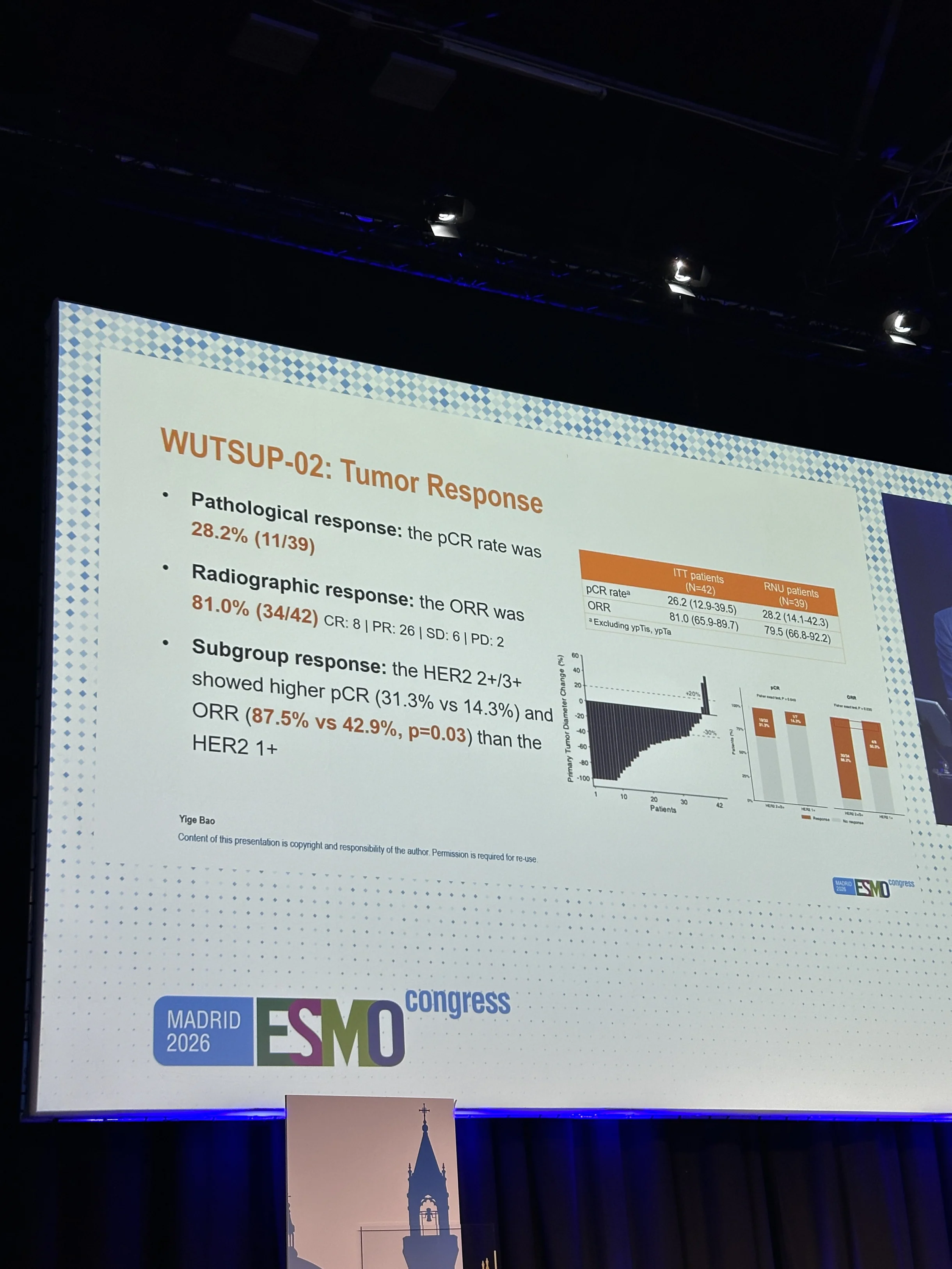
- Pathological complete response: Eleven patients achieved pCR. The rate was 26.2% in the intention-to-treat population (11/42) and 28.2% among patients undergoing nephroureterectomy (11/39).
- Radiographic response: ORR was 81.0% (34/42) in the intention-to-treat population, comprising eight complete and 26 partial responses. Six patients had stable disease and two had progressive disease. ORR among patients undergoing nephroureterectomy was 79.5%.
- HER2 subgroup findings: In the reported surgical subgroups, patients with HER2 IHC 2+/3+ tumors (n = 32) had a pCR rate of 31.3% and an ORR of 87.5%. Corresponding rates in HER2 IHC 1+ tumors (n = 7) were 14.3% and 42.9%. The presentation reported P = 0.03 for the ORR comparison.
- Survival: At a median follow-up of 24 months (IQR 16–30), estimated two-year OS was 87.1%, and two-year MFS was 83.9%.
- Overall safety: Treatment-related adverse events occurred in 90.5% of patients (38/42), including grade ≥3 events in 47.6% (20/42).
- Common toxicities: ALT/AST elevation occurred in 50.0%, hypoesthesia in 40.5%, alopecia in 40.5%, hyperglycemia in 31.0%, and pruritus in 31.0%. Grade ≥3 ALT/AST elevation, hypoesthesia, and hyperglycemia each occurred in 4.8%; grade ≥3 pruritus occurred in 2.4%.
Interpretation
WUTSUP-02 demonstrated preliminary pathological and radiographic activity with this perioperative strategy. Reporting both intention-to-treat and surgical-population results is important because three enrolled patients did not undergo nephroureterectomy.
Higher HER2 expression was associated with numerically higher response rates. However, the HER2 IHC 1+ subgroup included only seven surgical patients. These findings do not establish HER2 expression as a predictive biomarker or define an optimal treatment-selection threshold.
The survival estimates describe outcomes with the complete strategy, including surgery and adjuvant tislelizumab. Without a randomized comparator, the study cannot establish a survival advantage or determine the contribution of each treatment component.
Grade ≥3 treatment-related adverse events affected nearly half of patients and should be considered alongside the response findings.
Conclusion
Neoadjuvant tislelizumab plus disitamab vedotin, followed by surgery and adjuvant tislelizumab, showed preliminary activity in high-risk, non-metastatic UTUC with HER2 IHC 1+/2+/3+ expression.
The intention-to-treat pCR and ORR rates were 26.2% and 81.0%, respectively. Further controlled evaluation and longer follow-up are needed to establish comparative efficacy, clarify the relevance of HER2 expression, and define the regimen’s benefit–risk profile.