Talquetamab is a GPRC5D×CD3 bispecific antibody approved for relapsed/refractory multiple myeloma (R/R MM). What distinguishes it is the target: by going after GPRC5D, it offers another route for T-cell redirection, one still available to patients who have already received BCMA-directed therapy. In MonumenTAL-1, that produced ORRs of 69%-74% in T-cell-redirection-naive patients and 67% among those previously exposed.
The toxicity profile follows from where GPRC5D is expressed. It’s found across keratinized tissue, which explains the characteristic nail changes, dysgeusia, oral toxicity, and skin effects, which tend to be cumulative, building gradually in a way that’s hard to fully capture within a clinical trial’s timeframe.
That’s where real-world experience becomes especially useful, since patients treated outside trials often have poorer performance status, renal impairment, more refractory disease, and greater prior exposure to BCMA-directed therapy.
The International Myeloma Working Group (IMWG) Immunotherapy Committee set out to evaluate talquetamab across an international real-world cohort, examining efficacy alongside infections, acute immune toxicities, mucocutaneous adverse events, and treatment modifications.
Study Design and Patient Selection
This international, multicenter retrospective study included patients with R/R MM treated with talquetamab as standard of care or compassionate use at nine academic centers across the United States, United Kingdom, Greece, Spain, and Canada. The analysis was conducted within an International Myeloma Foundation Immunotherapy Database Protocol by members of the IMWG Immunotherapy Committee.
Patients were eligible after receiving at least one cycle of talquetamab. Dosing, schedule modifications, toxicity management, and antimicrobial prophylaxis followed institutional practice, and responses were assessed using IMWG criteria. The investigators also examined whether penta-refractory disease, prior BCMA therapy, absolute lymphocyte count <0.4 × 10⁹/L, or platelet count <50 × 10⁹/L were associated with survival outcomes. Patients who received talquetamab as bridging therapy before CAR T-cell therapy were excluded from the PFS and OS analyses.
A Heavily Pretreated Population Beyond MonumenTAL-1
The study included 151 patients, median age 64, with a median of six prior lines of therapy. The population was highly treatment-exposed:
- 91% were triple-refractory
- 53% penta-refractory
- 75% had received prior BCMA-directed therapy
High-risk cytogenetics were present in 42% of evaluable patients, 21% had an ECOG performance status ≥2, and 12% had creatinine clearance below 30 mL/min.
Perhaps the clearest measure of how different this population was from a registration trial: 55% would not have met MonumenTAL-1 eligibility criteria. In short, the registry tested talquetamab in a population both less fit and more refractory than the pivotal trial’s.
Talquetamab Maintained Activity in the Real World
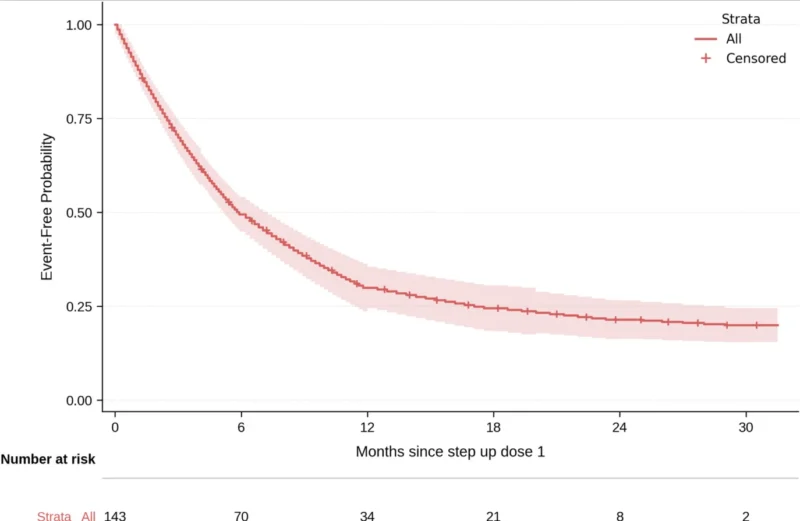
Among the 143 patients included in the efficacy analysis, ORR was 67.6%, stringent CR in 5.1%, CR in 14.7%, VGPR in 33.1%, and PR in 14.7%. With a median follow-up of 12.7 months, median PFS was 7 months. Median OS was not reached, with estimated rates of 65% at 12 months and 58% at 18 months.
Efficacy came out broadly similar to MonumenTAL-1 despite a far less-selected population. One caveat on response depth: bone marrow biopsies are performed less consistently in routine practice than in a trial, which may underreport CR in real-world datasets.
Prior BCMA therapy didn’t appear to blunt talquetamab’s activity. Median PFS among BCMA-exposed patients was 7.6 months, and prior BCMA exposure showed no significant association with PFS after adjustment. Neither did penta-refractory disease or low absolute lymphocyte count. The one prespecified factor that was independently associated with inferior PFS was a platelet count below 50 × 10⁹/L (HR 1.80).
That platelet finding is worth noting but should stay exploratory for now. What matters more immediately is the preserved activity after BCMA-directed therapy, with three-quarters of the cohort BCMA-exposed, this is one of the strongest real-world datasets supporting GPRC5D targeting post-BCMA.
CRS and ICANS Remained Largely Manageable
CRS clustered around step-up dosing and was overwhelmingly low grade:
- 26% after the first step-up dose
- 30% after the second
- 23% after the third
- 12% once patients reached full dose
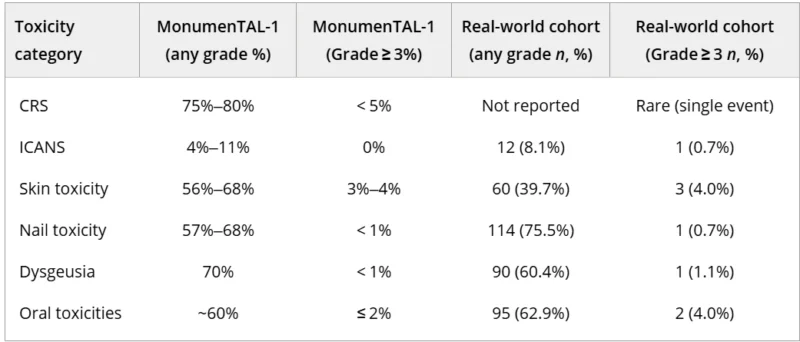
Grade ≥3 events were rare. ICANS was also uncommon, 8.1% of patients, mostly grade 1 or 2, with only one grade 3 event. It developed early, between days 1 and 9 after step-up dosing, and no recurrent ICANS was observed.
GPRC5D-Related Toxicities Were Frequent but Rarely Severe
The more persistent challenge was the characteristic on-target, off-tumor toxicity of GPRC5D inhibition:
- nail toxicity in 75.5%
- oral toxicity in 62.9%
- dysgeusia in 60.4%
- skin toxicity in 39.7%
Grade ≥3 events stayed uncommon across all four, no higher than 4% in any category.
Skin toxicity most often involved dryness, rash, pruritus, and peeling, oral events were dominated by dry mouth. Dysgeusia remained one of the most frequent treatment-related problems overall. Dose interruptions were relatively uncommon: 9.6% for skin toxicity, 6.9% for dysgeusia, 4.0% for oral toxicity.
The distinction between severity grade and patient burden matters here. Oral toxicity and dysgeusia can be low grade by conventional criteria while still affecting eating, weight, and quality of life over prolonged treatment, which is why the investigators emphasize supportive care and schedule modification.
Infections Were Common and Often Required Hospitalization
Infections occurred in 51% of patients, with 135 episodes recorded during follow-up. Upper respiratory infections were most frequent, followed by unclassified infections, lung infections, viral reactivation, bacteremia, and urinary tract infections.
The burden becomes clearer once hospitalization is factored in. Of the 77 patients who developed an infection, 37 required hospitalization, and 57 infection-related hospitalizations occurred overall, an incidence of 5 per 100 person-months, with some patients admitted repeatedly. CMV reactivation occurred in 11%, though with no cases of CMV end-organ disease. Grade 3-4 neutropenia occurred in 36% and thrombocytopenia in 32%.
Importantly, no infection-related deaths were reported. Granular data on IVIG replacement wasn’t available, which limits any assessment of how preventive strategies shaped infection risk, though the immunoglobulin replacement and prophylaxis against VZV reactivation and PJP have become standard parts of supportive care.
Dose Spacing Is Already Happening in Practice
The registry also offers a useful look at how talquetamab is being managed beyond its initial dosing schedule. Most patients started on a 2-week interval. Where intervals were later modified, patients most commonly moved to every-4-week dosing, with favorable response the most frequently cited reason, followed by treatment-related toxicity.
At last follow-up, 21.2% remained on talquetamab. Progressive disease was the most common reason for discontinuation, while only 6.6% stopped because of toxicity. Dose spacing may therefore become an important part of long-term talquetamab management, particularly for good responders. This analysis can’t establish an optimal schedule or prove that less frequent dosing preserves efficacy, but it does show how clinicians are already adapting treatment in routine practice.
How Does the IMWG Experience Compare With Other Real-World Data?
The findings aren’t isolated. Two other published real-world cohorts, one from Frenking and colleagues, another from Hadidi and colleagues, also included heavily pretreated populations with a median of six prior lines of therapy. Prior BCMA exposure ranged from 51% to 75%, ORRs from 64% to 73%, and median PFS from 6.7 to 10 months. Median OS had not been reached in any of the three cohorts.
The IMWG analysis stands out for its particularly high proportion of BCMA-exposed patients and longer follow-up than the other series. The consistency across independent cohorts strengthens the case that talquetamab’s activity isn’t restricted to patients who resemble the MonumenTAL-1 population.
What Does the IMWG Real-World Analysis Add?
The central finding is that talquetamab remained active in a population substantially more treatment-exposed and less selected than typical registration-trial enrollees.
The study also clarifies what matters once talquetamab moves into routine practice. Acute toxicity, CRS and ICANS, was largely low grade and concentrated around step-up dosing. Longer-term management was shaped more by infections and the distinctive oral, taste, nail, and skin effects of GPRC5D targeting. These rarely led to discontinuation, but their frequency makes supportive care and dosing strategy increasingly important.
The analysis is limited by its retrospective design, lack of centralized response assessment, nonstandardized toxicity grading, incomplete characterization of prior BCMA exposure, and missing data on IVIG, vaccination, weight loss, and ataxia.
You can also read about