
The randomized phase III STARBOARD trial met its primary objective response rate (ORR) endpoint and key secondary progression-free survival (PFS) endpoint with encorafenib, binimetinib, and pembrolizumab compared with placebo plus pembrolizumab in previously untreated BRAF V600E/K-mutant advanced melanoma.
Median PFS was 33.0 months with the triplet versus 3.4 months with control. Overall survival (OS) remained immature, and the efficacy gains were accompanied by more frequent grade 3/4 treatment-emergent adverse events and treatment discontinuations.
Dirk Schadendorf presented the findings at ESMO 2026 (abstract 2071O).
Background
Combining BRAF and MEK inhibition with PD-1 blockade aims to improve disease control in BRAF V600-mutant melanoma.
Following a safety lead-in that supported further evaluation of the combination, the randomized phase III portion of STARBOARD investigated whether adding encorafenib and binimetinib to pembrolizumab improved outcomes compared with pembrolizumab plus placebo.
Methods and Study Design
STARBOARD (NCT04657991) was a randomized, double-blind, placebo-controlled phase III trial. The randomized phase III population included 220 patients with unresectable locally advanced or metastatic cutaneous melanoma harboring a BRAF V600E/K mutation.
Eligible patients had measurable disease according to RECIST 1.1, ECOG performance status 0–1, and no prior systemic treatment for unresectable locally advanced or metastatic disease.
Patients were randomized 1:1 to:
- Triplet arm (n = 110): Encorafenib 450 mg once daily, binimetinib 45 mg twice daily, and pembrolizumab 200 mg every three weeks.
- Control arm (n = 110): Matching placebos plus pembrolizumab 200 mg every three weeks.
Randomization was stratified by prior systemic adjuvant therapy and disease stage.
The primary endpoint was ORR assessed by blinded independent central review (BICR). BICR-assessed PFS was the key secondary endpoint. Other secondary endpoints included OS, investigator-assessed efficacy, duration of response, time to response, quality of life, and safety.
The study design was amended because of recruitment difficulties, reducing the planned sample size and revising the primary and key secondary endpoints. ORR and PFS testing used a one-sided significance level of 0.05.
Results
The data cutoff was January 12, 2026.
- Objective response: Confirmed ORR was 70.0% with encorafenib, binimetinib, and pembrolizumab versus 32.7% with placebo plus pembrolizumab. The trial met its primary ORR endpoint.
- Progression-free survival: Median PFS was 33.0 months (95% CI 20.0–not estimable) with the triplet versus 3.4 months (95% CI 2.2–8.3) with control. The stratified HR was 0.33 (90% CI 0.24–0.46; one-sided P <0.0001), corresponding to a 67% reduction in the hazard of progression or death.
- Landmark PFS: Estimated 12-month PFS was 70.7% with the triplet versus 34.3% with control. At 24 months, the corresponding estimates were 54.8% versus 26.4%.
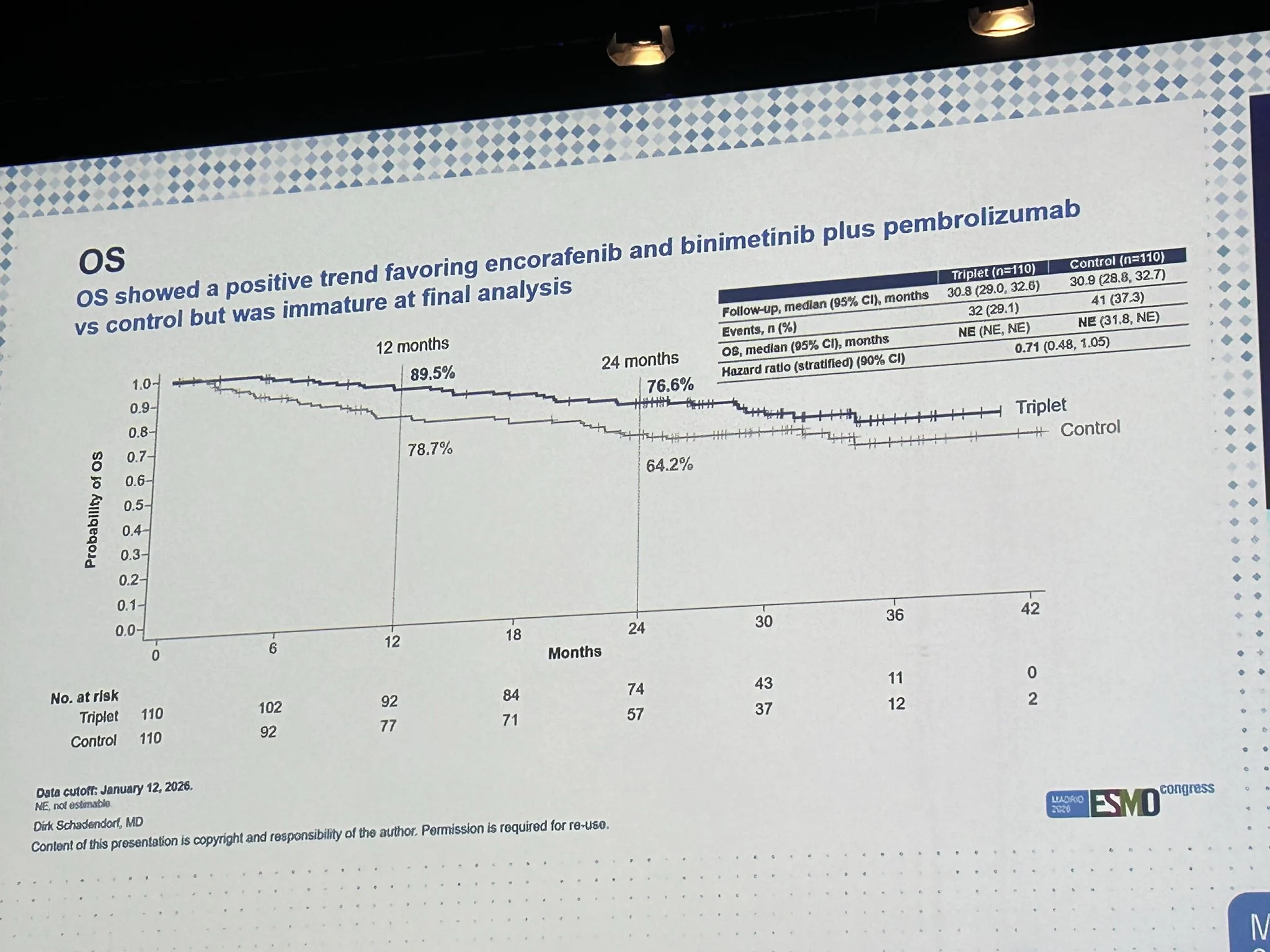
- Overall survival: Median OS was not estimable in either arm. The stratified OS HR was 0.71 (90% CI 0.48–1.05). Estimated 12-month OS was 89.5% versus 78.7%, and 24-month OS was 76.6% versus 64.2%. OS remained immature, and these findings do not establish a survival benefit.
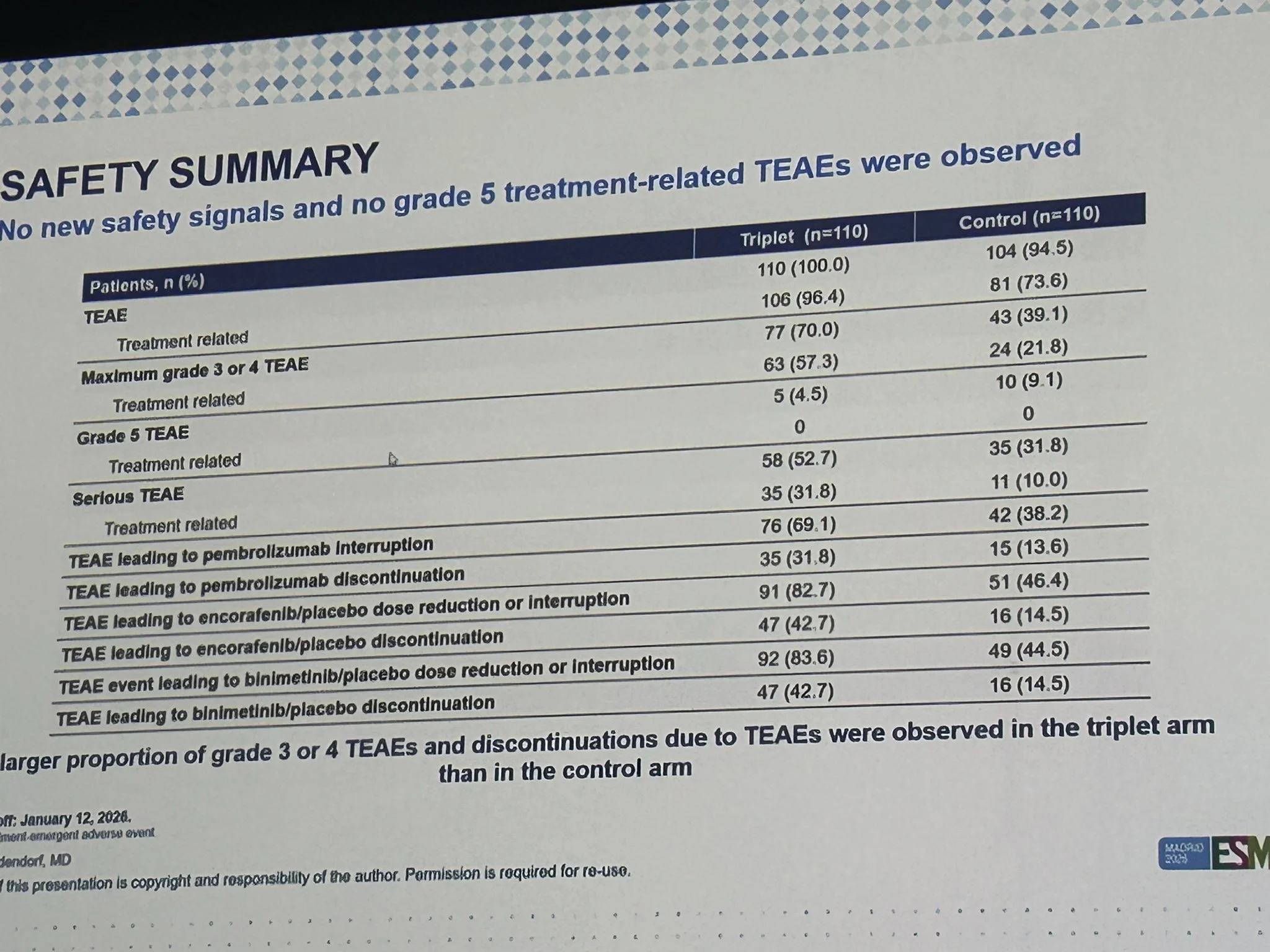
- Grade 3/4 adverse events: Grade 3/4 treatment-emergent adverse events (TEAEs) occurred in 70.0% of patients receiving the triplet versus 39.1% receiving control. Treatment-related grade 3/4 TEAEs occurred in 57.3% versus 21.8%.
- Serious adverse events: Serious TEAEs occurred in 52.7% versus 31.8%; treatment-related serious TEAEs occurred in 31.8% versus 10.0%.
- Treatment discontinuation: TEAEs led to pembrolizumab discontinuation in 31.8% of patients receiving the triplet versus 13.6% receiving control. Encorafenib and binimetinib were each discontinued because of TEAEs in 42.7% of triplet-treated patients, compared with 14.5% for each corresponding placebo in the control arm.
- Fatal adverse events: Grade 5 TEAEs occurred in 4.5% versus 9.1%, but none were considered treatment-related. No new safety signals were reported.
Interpretation
STARBOARD demonstrated statistically significant improvements in response and PFS when encorafenib and binimetinib were added to pembrolizumab. However, the triplet also increased severe toxicity and treatment discontinuations.
The comparison was against pembrolizumab plus placebo. The study therefore does not establish superiority over dual checkpoint inhibition or over strategies that sequence immunotherapy and BRAF/MEK-targeted therapy.
OS findings remain immature and require further follow-up.
Conclusion
STARBOARD met its primary ORR and key secondary PFS endpoints with encorafenib, binimetinib, and pembrolizumab in previously untreated BRAF V600E/K-mutant advanced melanoma.
The improvements in tumor response and disease control were accompanied by more frequent grade 3/4 adverse events and treatment discontinuations. An OS benefit has not been established, and the trial does not determine how the triplet compares with dual checkpoint inhibition or alternative treatment sequences.

neoHIP Trial: Biomarker-Guided Immunotherapy in HER2-Positive Breast Cancer